We avenge in the absence of our Leaders & House doing their jobs. We do not want tax-payer handouts but equitable access. MP in question violated rights & all levels exhausted. Our rights aren't up for debate or whim. We won them decades ago.
#Canadian is a #Canadian period.
#Oliverscampaign
Thank you
@CareChoicesLtd
Into Perspective: How can providers implement the Oliver McGowan Code of Practice beyond training delivery?
https://t.co/JPyGirsB5E
One of the most exhausting parts of autistic communication is being forced to defend yourself against an intention you never had.
You say something literal.
Someone assigns a hidden meaning to it.
You clarify that you didn’t mean that.
And somehow the conversation continues as?
You’re telling the wrong person, here in MAiD purgatory, that exclusion from assisted death amounts to enslavement. I’m challenging a gate that makes disability-related eligibility a condition of access, and you’re answering as though equality protections are an obligation to serve my will.
But calling yourself enslaved doesn’t make you anyone else’s master. Your autonomy matters. It doesn’t entitle you to a policy that disproportionately harms other people, including disabled people like me. Even widening access wouldn’t excuse discriminatory effects.
I would uphold your rights alongside mine, even when that conflicts with my own preferences. Where does your argument uphold mine? 🖖
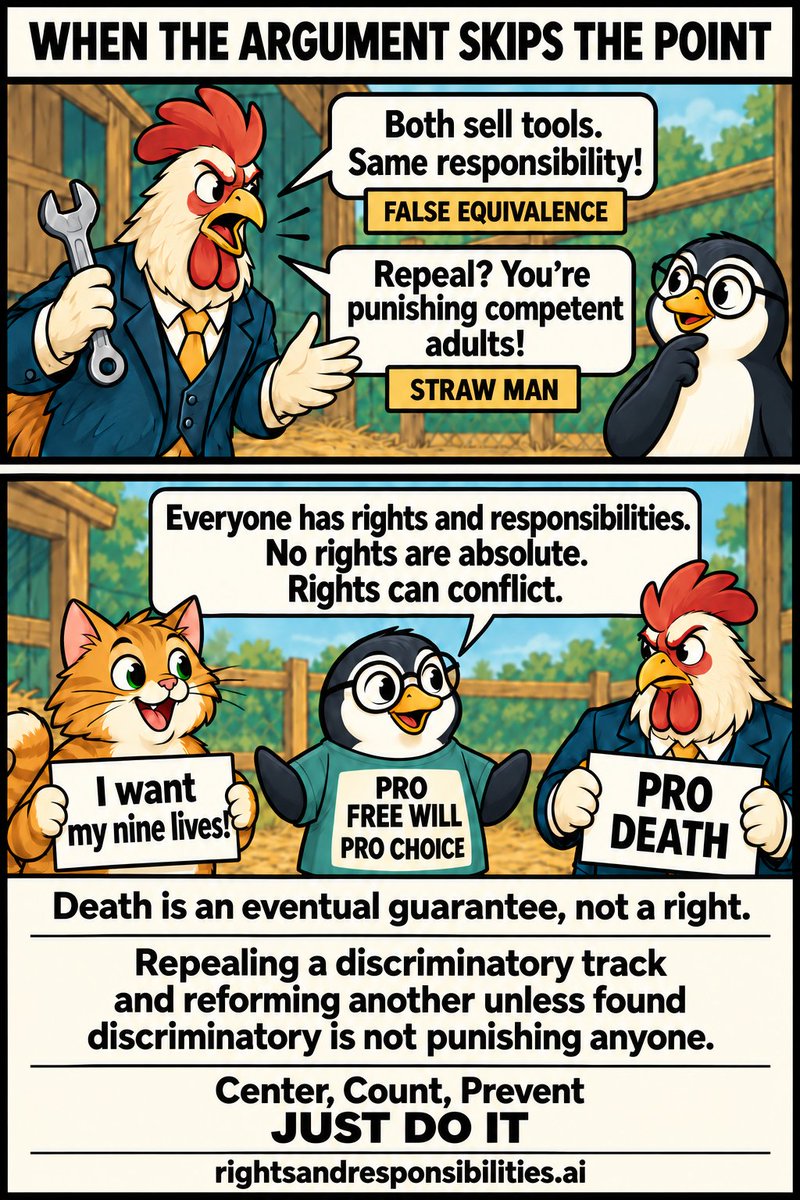
Two debate fallacies, responding to both arguments:
A false equivalence treats two things as equal while ignoring differences that matter.
“Both sell tools, so both have the same responsibility” ignores purpose, knowledge and duties.
A straw man distorts someone’s argument to make it easier to attack.
“You’re punishing competent adults” misrepresents many disabled people's position: repeal Track 2; reform Track 1 to uphold free will and equitable choice, or repeal it if that cannot be achieved. Those are distinct proposals, not a blanket argument against personal choice.
Calling someone competent does not establish the reliability of the assessment or freedom from coercion, discrimination, and deprivation. Disabled people who want to live and challenge the policy can be equally competent.
Both people’s rights count. Rights can conflict. Individual choice does not make a discriminatory framework equitable.
🐧 Center, Count, Prevent. JUST DO IT. https://t.co/r5yf2VtEw1
How are you defining "assistance", though? Because "assistance" can often just mean providing access to a method. Meaning that the hardware shop that sells a rope or a sharp knife that is later used for suicide is just as guilty of assisting a suicide as a business which provides access to a more reliable and humane method. The reason that ropes and knives aren't banned, but more highly reliable methods are banned, is because the state is using coercion and the introduction of avoidable risk to suppress the suicide rate, because they know that positive attempts to resolve the issues driving people towards suicide will not be enough to achieve the desired goal. The negative liberty right to be allowed to die is inseparable from the legal right for vendors to supply the method. You pretend to be campaigning against coercion, but in fact, you simply want coercion to be exercised towards your desired end of forcing people to live. If the benefits system isn't providing a comfortable enough lifestyle for disabled people, then there's nothing I can do to change that, so it would be an injustice to make my rights over my own body conditional upon something that I have no power to fix. If a disabled person (who is an individual whose welfare matters, not a mere political pawn) is inclined to choose MAiD/suicide partly or wholly because of the lack of support, but is stopped from doing so, then the very reasons driving them towards contemplation of suicide are the same reasons being used to force them to continue languishing in that suffering.
Your person is imaginary, and so is the perfectly successful assessment you've stipulated. Calling that a hypothetical doesn't turn it into evidence.
I challenged the reliability of assessment. That is not the same as claiming that every assessment must fail. "You can't prove none" does not establish reliability, demonstrate your person exists, or rebut the evidence I've shared.
More importantly, universal assessment failure is not the test for disability discrimination. An equality challenge examines whether the law creates or contributes to a distinction based on a protected ground and reinforces disadvantage. It does not require every disabled person to experience the same harm. One ideal case cannot settle that question.
For real disabled people like me, this is not an abstract exercise. You're defending a particular pathway to death tied to disability-related eligibility. Yet the competence, consent and autonomy you invoke would not, by themselves, make a nondisabled person eligible. Why does invoking "choice" justify that distinction or its harmful effects?
The UN disability-rights committee explicitly called for Track 2's repeal. I support equitable choice and safeguarded reform. You have not shown that protecting autonomy requires preserving this particular gate or others autonomy and choices.
You asked. I answered: I would uphold human-rights protections even when they conflict with someone's preference, including my own. Your imaginary exception does not dispose of those protections.
Which evidence in the articles I shared do you dispute? Calling it "noise" and adding "at least you tried" does not answer it. 🖖
So you've established that I/this page would uphold human-rights protections even when they conflict with someone's preference, including my own. Yes.
No surprise. Some Autistic people become deeply distressed by inequity and choose what they consider just even when it does not benefit them, or comes at a personal cost. Researchers have even framed autistic participants' refusal to profit from a harmful cause as moral "inflexibility." Apparently, refusing to benefit from harm is something to explain away.
I'd like to think it's virtue or righteousness, but apparently it got me a diagnosis. lol but know not a choice. Anyone following this page won't be shocked. What do you think got me damned to MAiD purgatory?
The thing is, you aren't merely dismissing my preferences. You're dismissing the equality protections and disproportionate harms I'm asking you to address. A law doesn't escape constitutional scrutiny because one person competently consents.
If this is about autonomy, how are you accounting for the autonomy of other disabled people harmed by the gate? One person's consent cannot waive their rights. Your hypothetical doesn't resolve that conflict.
Not a single person in my proposed framework has anything taken away inequitably. You're defending a gate that turns membership in a protected class into grounds for authorizing death. Competence, informed consent and autonomy don't open that gate by themselves. So explain why protected disability status should. That's the equality question your hypothetical leaves unanswered. That's some serious kumquat peddling.
What you haven't established is that preserving Track 2 satisfies those human-rights protections. The UN Committee on the Rights of Persons with Disabilities explicitly called for its repeal. We have article after article explaining and establishing the objections. Calling that explanation "noise" doesn't justify overriding other disabled people's rights, even if you are disabled.
It takes me hours to organize traditional communication, so I use writing and memes to communicate. It's kindness to share and was encourage to do both. Calling it noise doesn't make it less. Different doesn't mean less.
Go build an equitable gate. Track 2 is futile as an equitable solution. I tried to warn you, like too few of us tried to warn years ago but apparently others have faith-based, subjective death benefits to get to and it costs lives and autonomy ineqitably. 🖖
The person in your hypothetical is imaginary by definition. You’ve stipulated competence, informed consent, no coercion, and meaningful alternatives, but there’s no scientific way to prove that all those conditions are reliably established in practice. Even if they could be proved which they can’t the policy would still discriminate disproportionately and violate international law. So your hypothetical assumes the very thing at issue.
I’ve answered your question and shared four articles explaining why I don’t consider Track 2 an equitable right. Read or listen to them, or don’t. I’m not spending hours repeating what I’ve already written but here if you want to discuss it.🖖
https://t.co/LWKunsiUG8
Yeah, do you need an easy-to-read version? This page made some too and made articles shared. The links are below, and if you’re on a desktop, the page can read them to you.
I’m trying to be kind and provide information because you seem either misinformed or in need of some support. Maybe both. But there’s no reliable way to assess someone’s competence or suicidal ideation just from Track 2 eligibility. If they aren’t disabled, they don’t qualify for Track 2; they’re directed to suicide prevention until they are.
Your “person” is imaginary and ableist. I’ve already explained that this takes away no one’s equitable choice, and that MAiD isn’t even a conflicting right.🖖
@Crazycdn2@existentialgoof@macaghalla@Pepperfire You would think a competent adult would recognize their own argument when it’s being answered, eh?
🎧 Isn’t It Ironic? A little Alanis Morissette moment. 🐧🙃🖖
https://t.co/hZorgQdt75
https://t.co/32ielEGaIv
Why? I agree with reforming the failures in Track 1, but also with repeal if the evidence and conflicts between rights establish a legal obligation to do so.
Track 2 is a discriminatory gate. Repealing it today would not deny anyone an equitable choice. If it would, I would not advocate for it.🖖
You say there is no straw man, then make my objection conditional on supporting your entire position on suicide prevention. That replaces my argument with a test of allegiance to yours.
Your false dilemma is “access to the assistance I demand, or slavery.” You still need to establish why regulating someone else’s participation amounts to ownership of your body. Calling it slavery does not establish that.
And yes, disabled people fought for expansion. Their agency matters. So does ours. Participation by members of an affected group does not establish that a policy treats that group equitably.
My position remains: repeal Track 2; reform Track 1 for free will and equitable choice, or repeal it if that cannot be achieved.🖖
Two debate fallacies, responding to both arguments:
A false equivalence treats two things as equal while ignoring differences that matter.
“Both sell tools, so both have the same responsibility” ignores purpose, knowledge and duties.
A straw man distorts someone’s argument to make it easier to attack.
“You’re punishing competent adults” misrepresents many disabled people's position: repeal Track 2; reform Track 1 to uphold free will and equitable choice, or repeal it if that cannot be achieved. Those are distinct proposals, not a blanket argument against personal choice.
Calling someone competent does not establish the reliability of the assessment or freedom from coercion, discrimination, and deprivation. Disabled people who want to live and challenge the policy can be equally competent.
Both people’s rights count. Rights can conflict. Individual choice does not make a discriminatory framework equitable.
🐧 Center, Count, Prevent. JUST DO IT.
https://t.co/r5yf2Vt6Gt
Why is restricting access to assisted death immediately framed as overriding a competent adult, while restricting the means to live is treated as background circumstances?
You still need to distinguish a person’s capacity to decide, the conditions in which they decide, and the reliability of the process authorizing someone else to end their life. Competence alone does not establish that a choice is free from coercion or discrimination.
Nor can you assume that the burden of delaying or refusing assistance in dying necessarily outweighs the irreversible harm of facilitating a death that was not freely chosen. That is part of what proportionality must examine, not a conclusion the word “competent” establishes.
Whose choices count? The person who wants to die and the person who wants to live, equitably. 🖖
Again, nothing exists in a vacuum. You have described assisted dying as “leave people alone,” but it involves other people, professional authority, resources and a legal framework.
Invoking negative liberty does not establish a positive right to assistance. Freedom from interference and an entitlement to have others facilitate, provide or fund your choice are different claims. You cannot establish the second simply by asserting the first.
Let’s be precise. Canada’s MAiD framework provides conditional Criminal Code exemptions from culpable homicide and assisting suicide offences. Charter rights are engaged, but those exemptions do not make every eligibility rule, expansion or implementation immune from challenge.
Who qualifies, who assesses, who provides, who pays, and who bears the consequences are public policy questions. “Private” provision would still require regulation and enforcement. Calling it personal choice does not make its effects on other people disappear.
Your accusation assumes what you need to establish: that protecting disabled people’s rights necessarily unjustifiably infringes someone else’s liberty. Calling a restriction “forcing people to live” does not demonstrate that the particular restriction is disproportionate or that removing it would respect everyone’s rights.
Rights can conflict. Invoking autonomy does not settle that conflict in your favour. The question is how to respect the rights involved equitably, and whether restrictions are justified and proportionate. Carter itself recognized the need to consider both people making autonomous requests and people who could be endangered by a permissive regime.
Many Disabled people demanding equity are not demanding ownership of anyone else’s body. We are asking whether this framework respects our rights equally, including our autonomy, safety and access to the support we need to live. Disabled people who want assisted dying count. Disabled people endangered by its implementation count too. Neither group gets to erase the other.
Healthcare professionals have rights of conscience too. Your autonomy does not automatically establish an entitlement to compel a particular person to provide assisted dying. Public funding also involves decisions about shared resources and access to care. Asking who bears those costs and consequences is scrutiny, not an attack on your freedom.
And I did not say that deciding for yourself is paternalistic. I said that advocating for a paternalistic policy does not necessarily mean advocating for the people whose choices it inequitably overrides. You have shifted from defending a policy to defending personal choice as though they were identical.
Paternalism substitutes someone else’s judgment for a person’s own, supposedly for their benefit. Calling a policy “choice” does not establish that it avoids that problem, protects against coercion, or makes meaningful alternatives available. Equally, a safeguard is not automatically justified simply because someone calls it protection. Both require scrutiny.
Whose autonomy counts? Everyone’s, equitably. 🖖
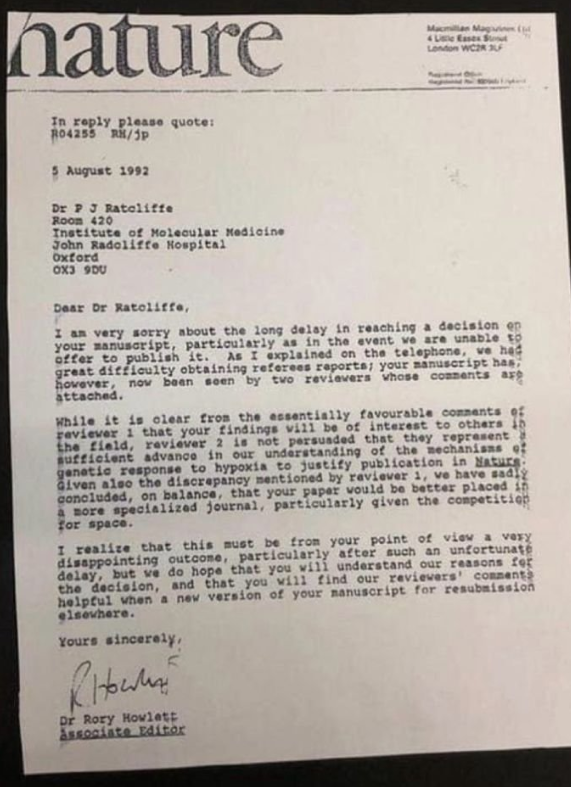
In 1992 Peter Ratcliffe received this rejection from Nature.
Almost 30 years later he won the Nobel Prize for the same discovery.
Don't lose faith in the things you believe in.
https://t.co/LWKunsjsvG
Aww, I thought what Pepper and this page had was special. Pepper was the first or second person to try to challenge or gatekeep this page almost a decade ago. I think she used to read tarot cards too. Still couldn’t tell who was lying?
Again, Goof, you can advocate for what is, at best, a paternalistic policy. That does not mean you are advocating for the people whose choices it inequitably overrides.
Plenty of evidence has been cited. You’re welcome. 🖖
https://t.co/jw94PMWJWM
Sol 3229+ New World Order
@MarkJCarney PM
@PierrePoilievre Opposition
@DonDavies Interim
@JustinTrudeau Former PM
@UNOSAPG@UN@UNHumanRights@UNDESASocial@UN_SPExperts@POTUS@Pontifex@RobJetten@AlboMP@SebLecornu@UNRWA@sanchezcastejon@SDG2030@UNESCAP@antonioguterres@andyburnham@Oikoumene@wef@DalaiLama@globalflutter@lesliechurch@MarcMillerVM
Series: ⏲️ 2030- SDG Special Edition month Year: 2026
Artifact: Art Captures the Now
Interactive article · 2026
An inquiry into art, artificial intelligence, and the meanings carried through the tools people use. Bringing Pope Leo XIV’s distinction between human art and machine output into conversation with disability access, artistic authorship, algorithms, and environmental responsibility, the work asks what rights and responsibilities we share as technology reshapes how people create and communicate.
The article includes an interactive word composition, working definitions of art and medium, and an invitation to build safeguards across differing worldviews.
Medium: Web-based interactive article
Themes: Art, access, authorship, technology, rights and responsibilities
We ❤️🔥 You ❤️🔥 #COSP19 #PocoAPoco #Hodie #AyDios Human Rights Receipt: UN reporting indicates that ~98% of disability-related SDG indicators are off track; “inclusion” without outcomes becomes paper compliance. 2030 Clock: 3 years, 3 months. Count • Center • Prevent G$nocid3. Statement: Treating documented abuse and systemic neglect as “religious objection,” then downgrading freedom of conscience/religion to protect a not-medically-necessary intentional ending of life invoked through disability status as a protected characteristic, isn’t neutrality. It is intersectional discrimination. #Autism #Neurotwitter #FOAMed #Meded #Neurodiversity #DisabilityRights #HumanRights #CRPD #NotToday #InjuryEquity #EndT422 #GlobalGoals #Interfaith #PeopleOfFaith #WorldReligions #Humanist #Christian #Muslim #Jewish #Hindu #Buddhist #Sikh #IndigenousSpirituality Not Your Footnote 📷