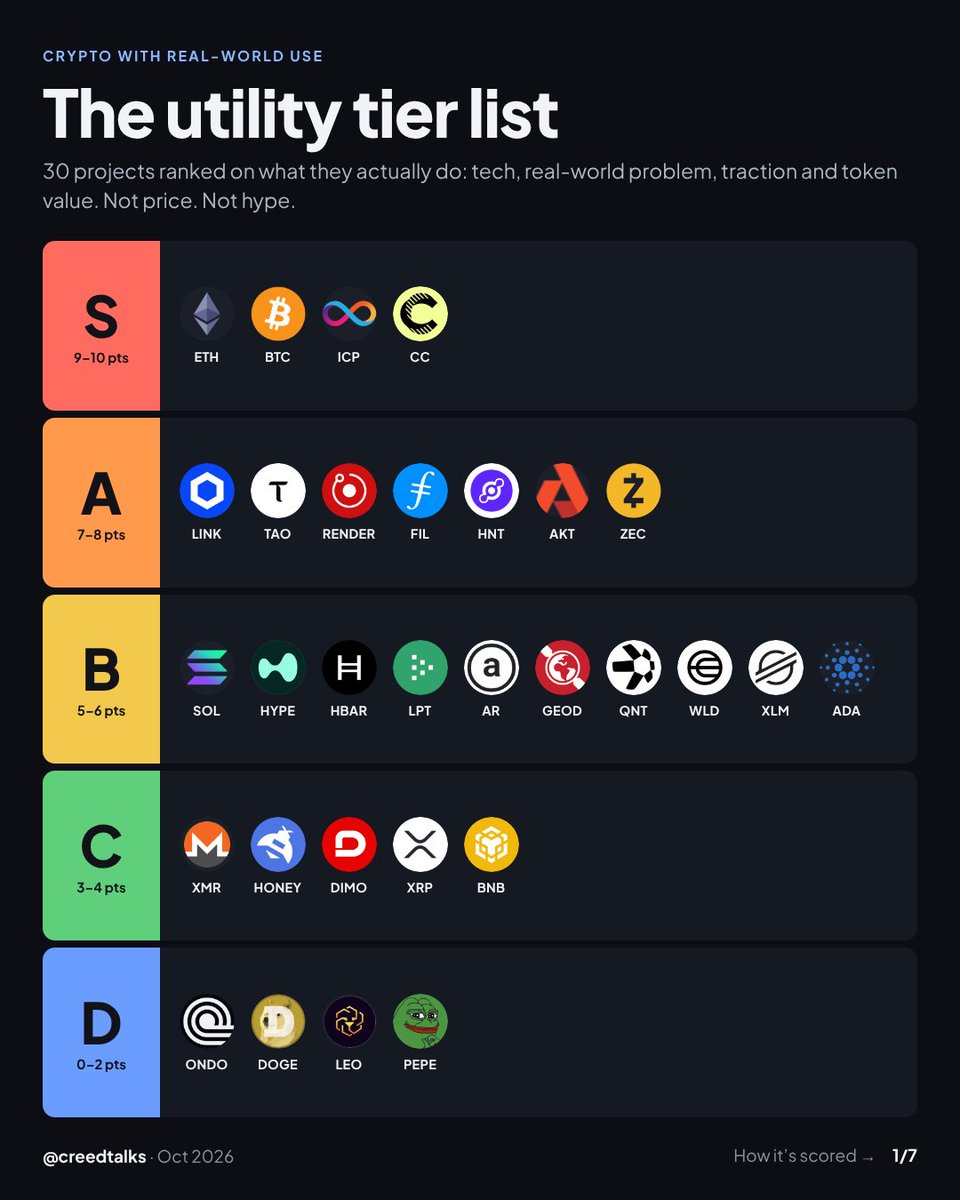
The utility tier list.
30 crypto projects ranked on what they actually do. Not price, not hype.
My highest-conviction coin didn't take #1.
How it's scored and the full breakdown.
internet-computer:native ethereum:native bitcoin:native
Coupons are cool but is there an enterprise sales team actually taking this to market globally?
Who’s the buyer CTOs / CISO’s?
Events and podcasts are cool but large enterprises don’t adopt without someone on the phone or in their inbox making it clear how this solves their challenges.
@PierreSamaties
Next week, I'm releasing an episode many of you have been waiting for.
I visited the headquarters of @dfinity in Zürich, and recorded an 80-minute podcast with the founder of $ICP, @dominic_w.
A thoughtful, interesting conversation where we talked about the challenges humanity currently faces as AI rises.
I've learned a lot from the episode, and I'm really keen to hear what you all think.
Releasing on Thursday!
@ICP100X Cloud engine adoption will need to come from an enterprise sales team closing deals and getting it in mindshare of CISOs and CTOs… A Gartner magic quadrant would help too
@dominic_w@PierreSamaties
I guess that leaves only the Internet Computer in the "world computer" game then, building on hardcore technical work since 2014 ;) Cloud engines this week ✌🏼..
No guarantees it’s different this time.
But here’s what actually changed:
DFINITY stopped waiting for a killer app. For years the bet was build the protocol and someone will ship WEB3 Facebook,Booking,Spotify etc.. on it. That didn't happen.
The pivot is to enterprises, institutions and governments with configurable cloud engines. That strategy is a different game as companies need secure infra, lower software costs, and less dependence on centralized providers.
Why they'd care: AI driven attacks are already up 50%+ YoY and every security forecast says regular autonomous attacks are a WHEN not IF.
$ICP is the only major network where the entire app, frontend, backend and data, not just tokens, runs replicated under consensus. Mathematically verifiable results for the whole application.
A single cloud can't give you that, no matter how good its enclaves are.
Cloud Engines accessible through hyperscalers make adoption even easier as enterprises dont need to understand crypto, manage tokens change how they purchase IT services and deal with crypto accounting nighmare. They use existing cloud accounts and procurement processes.
The industry's own bet is that most software will be AI-written within next 18 months.
@dfinity answer is Open SaaS, CRM, HR, accounting, files etc. as free, opensource onchain apps. No licensing fees, full functionality out of the box, AI built in, modifiable to each company needs.
The pitch isn't "move your business to blockchain."
It's "replace expensive software licenses and vulnerable infra with secure, customizable software that you control."
All that said, meaningful adoption isn't guaranteed.
If you want to be on safer side, don't invest until you see sustained 8–10x higher cycle burn with consistent higher highs. Thats roughly where burn fully covers whats minted for node providers.
Fun fact: ICP node providers are paid in fixed fiat (XDR) terms, so a 10x price jump also means 10x lower node provider ICP rewards.
⚠️All other blokchains a ticker price 10x means 10x security bill.
That design is truly unique to ICP and make all the difference between a network with a business model that can actually sustain itself and one running on a slogan.
Imagine if your AWS hosting costs were tied to Amazon stock price. Today, you pay $100K a year for hosting, but if Amazon stock doubles, so does your bill.
This is why so much of the blockchain industry is one big circle jerk. Infra/Serivce providers get funded through token emissions, then use buybacks to prop up token prices, only to dump their holdings later.
Your typical blockchain ticker is little more than a meme. There's no sound business model behind it, just marketing narratives and speculation disconnected from any underlying economic value.
For what it’s worth, most of my crypto money came from investing on those tickers, that's the game. I'm no investment maximalist and I'd never tell anyone to go all in on a single asset, ICP included.
Full disclosure, a big chunk of my crypto profits sits in ICP as a long term investment. I still gamble on other tickers and I don't expect most of them to exist in a few years.
To conclude: I'm not telling you to invest. I'm telling what changed and which number to watch.
Verify the claims, read the tokenomics, and let the burn rate decide for you. #InternetComputer economics are different by design and that's checkable, not a matter of opinion.
https://t.co/RakNLem5AW
No one is denying that base:0x00f3c42833c3170159af4e92dbb451fb3f708917 has been anything but a good investment so far. Loyal holders have suffered the most, while traders were making money on price swings between $2.50-$20.
It's easy to point fingers and blame @DFINITY, but it's not like they weren't trying. They went through multiple approaches that simply didn't take off.
And let's be fair, most of those projects were trying to compete with massive Web2 platforms that already have hundreds of millions of users. That's anything but easy.
Now, with Cloud Engines and the shift toward enterprises, institutions, and governments, I think we're finally looking at a much better approach.
ICP doesn't need to build the next Facebook, Airbnb, Bookingcom. It needs to solve problems that companies are already spending billions trying to solve.
Think about it. How many companies would love to have infra where they don't have to worry about servers, firewalls, backups, cloud configurations, or trusting a bunch of third parties?
Where applications run on tamper resistant infra without all the usual complexity?
That's a completely different market from trying to convince millions of people to leave the apps they already use.
And with consumer apps, building the product is less then 20% of the battle. The other 80% is getting people to actually use it, which takes enormous amounts of marketing money.
You can build something technically better than Facebook and still end up with nobody using it.
With enterprises, you don't need millions of users. You need companies running real workloads and paying for the infra. A few large customers bring more actual usage than hundreds of dapps that nobody uses.
That's why I believe enterprise adoption could be what finally changes things for base:0x00f3c42833c3170159af4e92dbb451fb3f708917.
Even if we completely ignore the potential adoption through UNDP and governments, the enterprise market alone is massive.
Of course, none of this means success is guaranteed. @dfinity still needs to deliver and bring in paying customers. But at least now the focus is on selling something #InternetComputer is actually built to do well, instead of hoping someone builds the next big social network.
I think you are missing the point of what $ICP is actually solving.
Let's look at some major hacks:
Bybit: Had exactly what you prescribe:
an air-gapped multisig cold wallet with hardware signers.
Still lost $1.5B. The compromised laptop wasn't even Bybit's. A Safe Wallet dev was hacked, attackers obtained AWS credentials and replaced the JavaScript in Safe AWS S3 bucket. The signers approved what the screen showed them. The screen lied. The malicious JavaScript was removed two minutes later.
Binance: DevOps laptop -> service container -> the signing system signed whatever it was told. No private key was leaked.
Bangladesh Bank: Custom malware inside SWIFT Alliance Access, manipulating the Oracle DB to conceal fraudulent transfers.
Capital One: A misconfigured WAF on AWS.
See the pattern?
The pattern isn't "humans". It's one human reaching one mutable server that sits between the signer and the chain. #InternetComputer removes that server.
An attacker compromises a mutable component of the infra and changes what the system does. That infra is the attack surface, not the person signing.
That's the attack surface $ICP is designed to eliminate:
✅Frontends served directly from canisters, with responses certified by the subnet and verifiable by the client. No S3 bucket where attackers can silently replace JavaScript.
✅No traditional service containers, SSH access or admin controlled databases. Canister state changes are executed through subnet consensus.
✅No single administrator holding the upgrade keys on a laptop. Canisters can be governed by a DAO, with upgrades requiring a vote.
✅No complete signing key sitting in one place. Threshold crypto distributes key shares across nodes, while properly implemented consent messages let users verify what they're signing.
✅ No API keys or cloud credentials. Canister calls are authenticated by the protocol, nothing for a compromised laptop to hand over.
✅ Verifiable deployed code. Wasm hash is onchain, reproducible builds let anyone check it matches source.
✅ Public controllers. Anyone can see who can upgrade a canister, one key, DAO, or nobody.
✅ Withdrawal policy enforced by consensus. Limits and approvals live in the canister, not in a backend someone can reach.
✅ Upgrades go through a visible voting window. A malicious change is a public proposal, not a silent push.
✅ Certified data reads. Balances and transaction lists are verifiable as coming from the subnet, not a tampered node.
✅ No runtime supply chain. Dependencies compile into the WASM, nothing fetched at execution time.
✅ No passwords or seed phrases to phish. Internet Identity uses passkeys, with a separate principal per app.
✅ No key server. vetKeys derive encryption keys onchain via threshold crypto.
Your three "someone still has to" points: code bugs, key custody and user signing and those are real risks, and they apply everywhere. ICP has never claimed otherwise.
What $ICP solves is that the infra layer exploited in hacks like Bybit, Binance, Bangladesh Bank etc.. can be fundamentally redesigned to eliminate entire classes of attack.
#InternetComputer isn't trying to make traditional infra more secure. It's eliminating entire attack surfaces by making that infra unnecessary.
That's why I'm genuinely optimistic about ICP future.
The tech addresses real problems, and its potential extends far beyond what we've seen in crypto.
I like the direction @dominic_w is taking on X lately, focusing on practical problems and what $ICP can do to solve them.
Another major bottle neck. If adoption depends on people making a crypto account, buying bitcoin, transferring to icp just to do useful work it’s never going to happen.
Direct integration with Claude and a credit card to bring it live.
Hope the marketing team has
@claudeai 3/3 Try it
Open Claude Code, describe your idea, and add:
"Use https://t.co/k7oTmfpSqO to build this and deploy it to the Internet Computer."
Pay for your hosting easily with a credit card via Stripe, or with ICP.
Claude has backdoored one of the main blockers to #ICP adoption: the complexity of needing a developer.
Caffeine was cool but another step in the chain that’s ultimately a bottleneck.
Direct integration with leading AI tools that people already use every day is an impressive step and signals @dfinity breaking down barriers to entry.
Love to see it.
AI made writing software easy. Where it runs is now the differentiating factor for your business.
With @claudeai, your app goes live on infrastructure that can't be tampered with, stays online, and stays under your control. A safe place for agents to build and run software, and AIware.
Here's how:
🧵
@dominic_w@PierreSamaties A genuine question after Binance, not a dig.
According to Binance, no keys leaked.
A compromised engineer's laptop let the attacker get Binance's own systems to sign withdrawals, and most of $6.3bn left across ten chains in about 20 minutes. The keys held. What failed was that nothing in the path could say no.
Could an ICP canister act as a co-signer on exchange hot wallets?
It would enforce outflow caps, delays on large withdrawals, allowlists, and a refusal to sign the EIP-7702 delegations used on ETH. It wouldn't stop the breach itself, but a $6bn night would become whatever the cap allows.
https://t.co/7oARyHokxl
Binance is handling this well.
Deep reserves on the book to cover customer funds as the priority love to see it.
Won’t get that coverage on a ledger hack.
Binance has begun recovering affected assets for users and continues to work with law enforcement, issuers, blockchain intelligence firms and industry partners to trace, freeze and recover additional funds.
The company has already publicly committed to cover losses through company funds in the prior announcement.
Binance has already reserved over $6.34B of company funds to cover this incident. $5B of these funds are already held in the exact token assets that were impacted. We are completing the purchase of the remaining amount by buying token assets through market channels and OTC channels. We are doing this to match the format of the remaining token assets and address any asset shortfalls. This step can take longer because some tokens may have low liquidity and OTC settlement also takes time. We will share more progress as soon as we can.
These figures do not include frozen or protected assets, which remain subject to ongoing recovery and verification. Currently, $3bn has been frozen, with thanks to our industry partners. We are working with partners and law enforcement to recover the frozen assets.We will continue to use company resources to cover confirmed shortfall and will provide further verified updates as recovery efforts progress. Ultimately, all user funds will be verified publicly through our Proof of Reserves.
We will weather this storm. Thank you for the support.