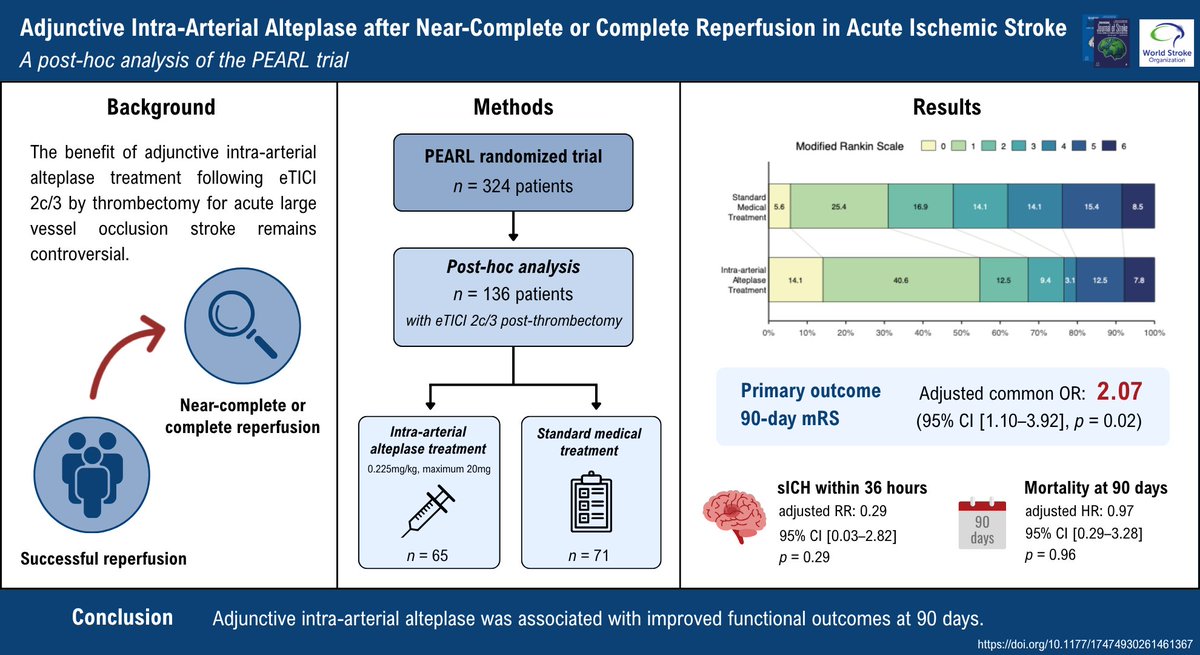
📊🦪Post hoc analysis of the PEARL trial
💉Patients with near-complete/complete reperfusion after mechanical thrombectomy who received adjunctive intra-arterial alteplase had better 90-day functional outcomes
☝️Further research needed
Read more here⬇️
https://t.co/wBNfD19XaS
The findings in this study provide the first evidence of higher-than-expected skin phosphorylated alpha synuclein deposits in a large cohort of patients with essential tremor. Learn more: https://t.co/IJedIXFgXS
Parkinson’s Prognosis: What really happens over time? A new population-based meta-analysis reveals the trajectory. Prognosis means the expected course and outcomes of a disease over time. Macleod and colleagues describe in a new paper in Movement Disorders how Parkinson’s disease unfolds using pooled data from six European population-based cohorts followed for up to 12 years.
Key Points:
- Parkinson’s outcomes such as postural instability and loss of independence occurred earlier and more frequently than previously reported w/ ~70% affected by 10 years.
- Dementia developed in about half of individuals by 10 years, and over half had died by 12 years, highlighting a more aggressive natural history in real-world populations.
- Older age, worse motor severity, and early cognitive changes were the strongest predictors of worse outcomes across all domains.
My take:
This study is important because it moves us away from overly optimistic clinic-based data and toward what truly happens across entire populations. It reinforces that Parkinson’s is not just a movement disorder, it is a whole-brain and whole-body condition that evolves over time. These findings should push us to identify risk earlier, personalize care plans, and intervene more aggressively where possible.
Here are 5 points that resonated w/ me:
1- Prognosis in Parkinson’s disease may be worse than many of us were taught, especially when we look at real-world populations.
2- Age at diagnosis remains one of the most powerful predictors of how the disease will unfold.
3- Cognitive symptoms early in the disease are not subtle, they are signals that should shape care planning.
4- Genetics such as GBA and APOE variants are beginning to inform risk and may guide future personalized therapies.
5- The future of Parkinson’s care will depend on combining clinical features, biology and timing to better predict and change outcomes.
https://t.co/j1plRl2l2H #parkinson @ParkinsonDotOrg
Smiling tremor: a rare twist in essential tremor or possibly task specific tremor. I recently learned about a man whose cheeks would tremble every time he smiled. This paper just dropped in Movement Disorders Clinical Practice by Chen and colleagues on the topic. This unusual phenomenon called smiling tremor may expand how we think about essential tremor, or at the very least it should humble us that we have not 'seen it all.' This is our 19th year teaching neurology residents from all over the country and it is an honor to be on this campus again today and to walk among this distinguished faculty and rising super-stars.
Key Points:
- Smiling tremor is extremely rare w/ only about eight reported cases since 1987.
- This case involved a man whose facial tremor appeared only when smiling or laughing, alongside mild essential tremor in his hands.
- Alcohol improved both the facial and hand tremors suggesting a link to essential tremor rather than dystonia or parkinsonian tremor.
My Take: There is some healthy debate among movement specialists whether this is a task specific tremor, essential tremor, a form of dystonia or something else. Regardless of the debate, it is humbling to observe this phenomenon and it is challenging to treat. 1- Essential tremor usually affects the hands, however it can sometimes involve unexpected areas like the face. 2- Smiling tremor is task specific, meaning it happens only during a particular activity such as smiling. 3- Alcohol can temporarily reduce tremors, however it is not a reliable and certainly not a safe long term treatment. 4- Tremor subtypes may overlap and this case suggests that essential tremor may include more task specific forms. 5- If you notice unusual tremors such as shaking that appears when you smile speak w/ a health care provider for proper evaluation.
https://t.co/DxCB5JYlH0 @MDCP_Journal@FixelInstitute@ParkinsonDotOrg@essentialtremor@VanderbiltU
While freezing of gait (FOG) is the most widely recognized manifestation within the freezing spectrum, other forms, such as freezing of the upper limb and freezing of speech, are increasingly acknowledged.
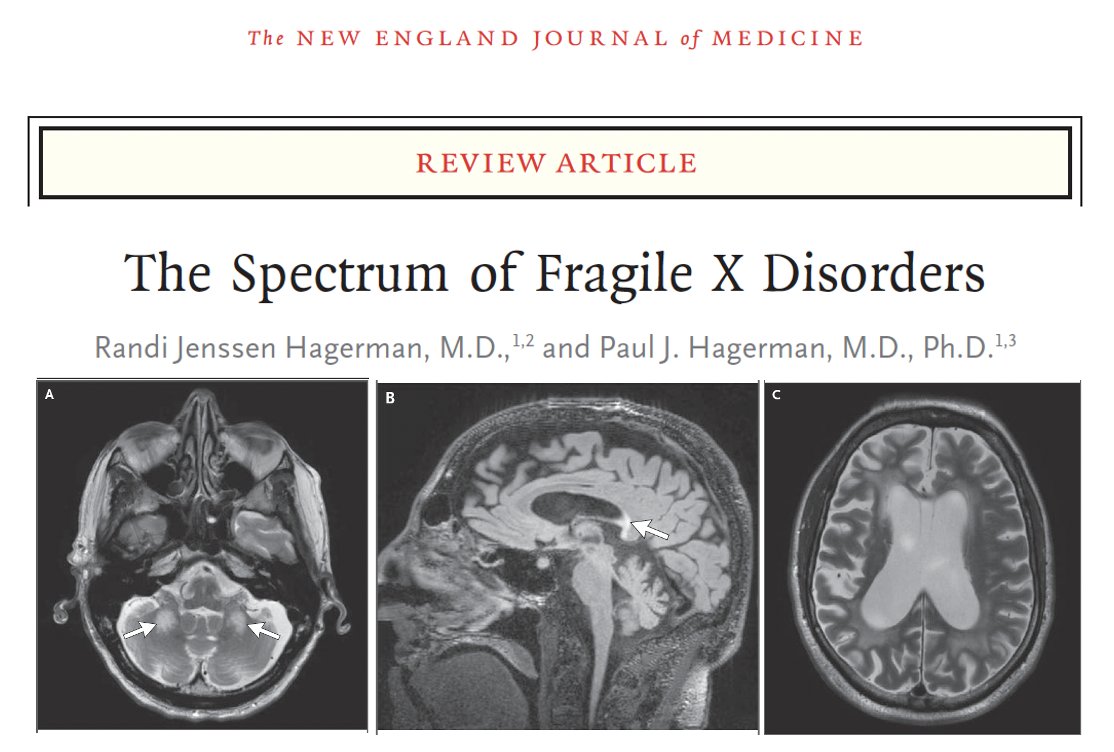
Fragile X isn’t just for kids. How about the adult-onset tremor we frequently blow off? Spoiler alert: Fragile X isn’t one disease, it’s a spectrum. One of its most underrecognized manifestations is a neurological disorder that looks like Parkinson’s or essential tremor, but it’s not. It’s FXTAS or Fragile X–associated Tremor/Ataxia Syndrome and the new NEJM review calls on neurologists to catch it earlier, especially in older adults.
Key Points:
- FXTAS affects men and women with the fragile X premutation which is a CGG repeat expansion in the FMR1 gene.
- It can present in older adults with intention tremor, gait ataxia, neuropathy, parkinsonism and cognitive decline.
- MRI clues like white matter changes in the middle cerebellar peduncles can tip the clinician to the diagnosis.
My take: If you see a presentation that isn’t quite essential tremor and has a flavor of Parkinson’s always check for FXTAS. Here are the 5 points that resonated w/ me about the NEJM review. 1- If your dad or grandfather has tremor and balance issues plus a family history of autism or family members w/ early menopause, it could be FXTAS. 2- This condition is genetic, progressive and frequently misdiagnosed as Parkinson’s or just aging. 3- Women aren’t immune as 8–16% of female carriers develop symptoms too. 4- Genetic testing is simple as the FMR1 premutation can confirm the diagnosis and guide treatment as well as family planning. 5- Medications can help symptoms like the tremor. Consider propranolol, primidone or even levodopa and in some cases FUS or DBS. Let’s rethink the tremor differential as fragile X might be hiding in plain sight.
https://t.co/RQVBgFQFsC @FixelInstitute@NEJM@ParkinsonDotOrg@fragilexuk@fragilexsyndrom@FragileXAus #tremor #Parkinsons
Study findings indicate patients with Creutzfeldt-Jakob disease often present with multiple clinical symptoms and many alternative diagnoses are considered, which may prolong the diagnostic journey and increase health care utilization and expenditures: https://t.co/KLSdig0jmp
How cool is it to appreciate that Alice in Wonderland Syndrome maps to a common brain network linking body and size perception? Friedrich, @foxmdphd and colleagues really ‘nail’ this syndrome down in their new imaging paper which appeared in the Annals of Neurology @TheNewANA1.
Key Points:
- ‘In Lewis Carroll's 1865 classic novel, “Alice's Adventures in Wonderland”, the protagonist experiences a surreal world with curiously warped rules of size and space.’
-The distortions affect the perception of her own body or those of the Wonderland's inhabitants.
- Similar distortions have been reported in folks w/ neurological disorders.
- One cool case was a migraine sufferer who reported ‘my neck stretches and my head goes to the ceiling.’
- In this imaging study, AIWS-related perceptual distortions mapped to ‘one common brain network, encompassing regions critical for body representation and size-scale processing.’
My take: This is really beautiful work which helps us to correlate clinical symptoms into a brain network underpinning one of the most interesting and mysterious disorders in neurology. Now, when I watch the Tom Petty video ‘Don’t come around here no more,’ I will have a new appreciation of the brain regions involved in the Alice in Wonderland experience. https://t.co/PZodCge9OY #aliceinwonderland #TomPetty #neuroradiology
Vocal flutter- a unique speech feature in some individuals with MSA-P? Listen in to the acoustic recordings here to learn how to spot it! @michelajmir@kailashbhatia@mmerello https://t.co/dJbzrckrOS
@Cex_responde Hola, escribo por el envío N. 6383000621116953, enviado el día 22-02 con CP de destino 08770, el paquete no se ha entregado y no logro localizarlo, me urge q la entrega se realice hasta el día de hoy 28-02 y no logro contactarme de ninguna manera!! 😓
A person with Parkinson's disease can't walk because of severe freezing but put him on a bike and he is fine. Great case by Snijders and @basbloem Love the explanation: 'This striking kinesia paradoxica may be explained by the bicycle's rotating pedals, which may act as an external pacing cue. Alternatively, the motor-control mechanisms involved in gait as compared with other activities engaging the legs, such as cycling, could be affected differentially in Parkinson's disease. Cycling may offer a useful approach for exercise training in patients with Parkinson's who are “grounded” by severe freezing of gait.' https://t.co/fq5oe2oodu https://t.co/fq3jiDgUBC
🇸🇬Fin de semana increíble. Lo hemos gestionado a la perfección, controlando el ritmo toda la carrera. El equipo merece esta victoria por el enorme trabajo que han hecho tanto aquí como en Maranello. Se le dedico a ellos y a los Tifosi! A por Suzuka!
👉https://t.co/MMIvXDGO3Z