The US is issuing $3.15T in debt just to get through the last 8 months of 2023
Annual US interest expense up ~$400B in the last 18 months, ~$300B in the next 18 months. ($700B)
Context: US Defense budget ($800B)
Soft landing? Or premature celebration?
https://t.co/NspAT3iXNk
One of the core value props of owning bitcoin is the sovereignty it can provide holders over their wealth. But as @BespokeGroupCO founder @mcclintock_m explores in the latest episode of The Last Trade, simply accumulating bitcoin does not guarantee an individual’s sovereignty.
True sovereignty stems from diligently planning for the future and establishing appropriate structures & processes to ensure your wealth will be preserved for generations to come.
Catch the full episode here 👇
https://t.co/3EUyHHGutb
Other platform links 👇
YouTube: https://t.co/ULAAKhq0ZA
Spotify: https://t.co/K04QebVGuo
Apple podcasts: https://t.co/xEVkpnViiO
We are in the midst of a remarkable shift in the mainstream narrative surrounding bitcoin, and specifically bitcoin mining. What was once lambasted as a “currency for criminals” and a wasteful process that was “boiling the oceans,” is increasingly being heralded as perhaps the most “ESG-friendly" investment opportunity that exists today.
The latest piece of evidence in support of this ongoing narrative shift is a research report from “Big Four” audit firm, KPMG, titled “Bitcoin’s role in the ESG imperative.”
https://t.co/04QVbqLBzX
In the report, the authors succinctly summarize many of the arguments bitcoiners have been making for years - in short, Bitcoin has immensely positive implications for the environment and society at large. Before diving into KPMG’s report, it’s worth highlighting some of the prescient work that preceded and likely inspired KPMG’s research:
@C_Bendiksen in March 2021:
https://t.co/2gOJy8GNmt
@galaxyhq in May 2021:
https://t.co/Y893s5IwLj
@LynAldenContact in August 2021:
https://t.co/ytvo5DNUn7
@edstromandrew in February 2022:
https://t.co/KuFH16uoxb
Unsurprisingly, KPMG presents very similar logic throughout their report, describing how bitcoin – contrary to the prevailing narrative – is inherently aligned with each pillar of “ESG”:
Environmental: Bitcoin mining enables the location-agnostic monetization of energy for the first time in human history, allowing us to harness otherwise stranded energy and incentivize the build-out of renewable sources of generation. Moreover, strategically-located miners can help reduce methane emissions or participate in demand response programs to help stabilize grids, as bitcoin mining represents a uniquely flexible industrial load.
Social: Bitcoin's pseudonymous nature has historically raised concerns of illicit activity, yet a 2022 report revealed that illegal use of crypto accounted for merely 0.24% of total transactions. Separately, bitcoin streamlines cross-border remittances, reducing fees and increasing speed. During Ukraine's conflict with Russia, bitcoin helped raise nearly $70 million in short order. In Africa, Bitcoin miners co-locate in microgrids, improving electricity access and affordability. Broadly speaking, bitcoin is an open, permissionless system that promotes financial inclusion in areas lacking banking services, illustrated by Afghan women being paid in bitcoin, facilitating escape from oppressive regimes.
Governance: Bitcoin's key feature is its decentralization, achieved via a vast network running the same software. Transaction data is immutable and verifiable across nodes, ensuring the system's integrity. This process parallels the TCP/IP protocol facilitating global communication. Any changes to Bitcoin’s system rules - including the 21 million coin limit, difficulty adjustment, block size, etc. - would require a different version of Bitcoin, causing a "fork" from the main network.
Considering the reputation of a firm like KPMG, it appears as though we’ve reached a tipping point in terms of market participants waking up to the realities of bitcoin and its implications for our world. This ongoing narrative shift is also a function of certain powerful catalysts such as:
(1) BlackRock and other legacy financial behemoths pivoting from attacking bitcoin from an ESG perspective to embracing the asset and building products to serve increasing client demand
(2) Favorable regulations at the state level (like Texas & Wyoming) that aim to protect the rights of individuals to own, transact in, and mine bitcoin
(3) Growing adoption of bitcoin mining within the oil/gas and renewable energy industries, as they recognize the financial incentives that improve their existing business models
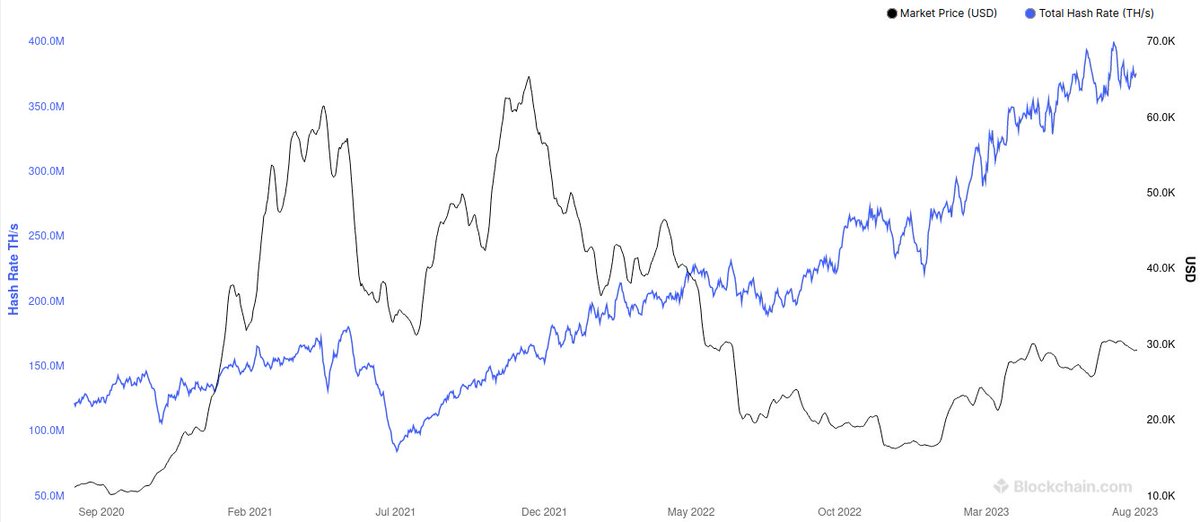
Interestingly, to those paying close attention to the mining industry in recent years (@MartyBent @TheStandardBTC @CathedraBitcoin), this narrative shift may have been more readily apparent. Demand for bitcoin mining – spurred on by the aforementioned economic incentives associated with mining – is directionally reflected by the network’s hash rate, which has been steadily growing since mid-2021, despite the downturn in bitcoin’s price.
Regardless of whether you subscribe to the virtues of the “ESG” framework, the facts on the ground are becoming harder and harder to ignore – bitcoin mining is clearly a net positive for the environment, bitcoin the asset promotes economic freedom and inclusion for the entirety of society, and bitcoin the protocol represents a paradigm-shift in governance structure, as all peers on the network are equal and no trust is required. Bitcoin is as “ESG” as “ESG” gets.
Brilliant summary and articulation of the lessons learnt from the early journeys. People still are their quest to find the next #Bitcoin and this is so on point!🎯
So Listen up, this was already tried by many.
THERE IS NO SECOND BEST !
#Bitcoin ONLY
“What do you want to own? You want to own something that in a decade a person richer than you and smarter than you will want to buy from you.” -@saylor on #Bitcoin
Full interview: https://t.co/WcN2glOub5
The more time will pass the more we will see people like @jameslavish@boomer_btc@Croesus_BTC@FossGregfoss.
Very smart and hardworking people who have great knowledge of economics, big experience in the investment manager world, and a career + success prior joining the Bitcoin community.
Meanwhile, the more time will pass, the less intense/important will be the message of cypherpunks and cryptoanarchist in the Bitcoin world
If you only have time to watch one bitcoin podcast & hope to create generational wealth, @saylor ‘s discussion will have to wait🤔🧠🎯
@OnrampBitcoin@MartyBent@Croesus_BTC@MTanguma 💯
E011: Multigenerational Security for Bitcoin with Matt McClintock https://t.co/apiZHUTmMb
New episode of The Last Trade, out now! @BespokeGroupCO founder @mcclintock_m joins hosts @MartyBent@Croesus_BTC@MTanguma to explore the intricacies of securing bitcoin for future generations and the asset’s emergent role in portfolio construction.
Get the full episode here 👇
https://t.co/3EUyHHGutb
Other platform links 👇
YouTube: https://t.co/ULAAKhq0ZA
Spotify: https://t.co/K04QebVGuo
Apple podcasts: https://t.co/0vOhRubLfD
One of the questions I am asked the most about #Bitcoin is how much capital needs to flow in/out in order to create a $1 change in Market Cap?
There is no perfect answer, but I think I now have a pretty decent answer. Let's dive into the data 🧵
The Realized Cap
This metric is the on-chain equivalent to the market capo, valuing each coin at the price when it last transacted.
This model really represents the value SAVED in #Bitcoin, since it is keeping track of the price it was acquired at. Sure there are nuances, but it is a pretty damn close estimation in my experience.
If the Realized Cap is a model capturing capital inflows and outflows, then we can compare how big of a takes place in the Realized Cap to affect the Market Cap.
The Capital-to-Valuation Change Ratio
Here I compare 90-day percent change of of both valuation models, and then take a ratio of them (absolute value).
After applying a 90-day median, we get the grey area trace which I call the Capital-to-Valuation Change Ratio. This shows how many $ needed to enter or exit the Realized Cap to create a $1 change in the Market cap. I also have a 4yr Median through the guts of it for the long term view.
Key Insights
What emerges are some pretty valuable insights to my eye which help contextualise things:
- Bull markets end when you need more than $0.80 to $1.00 injected to keep the Market Cap going --> unsustainable levels.
- In the early years up to 2016, we needed around $0.45 per $1 change. This reflects market immaturity, but also the insane returns which investors were able to lock in off just a few hundred $ invested. Early investors actively sold their $BTC, and mining sell-side on a per coin basis was still significant. Very few actually HODLed the whole way from 2013 to 2017.
- In modern times, we seem to need just $0.25 in capital flows to spark an equivalent move in the valuation. HODLers are more in tune with #Bitcoin than ever before due to education, and the liquid circulating supply continues to decline. This is despite there being an ATH in circulating supply.
So to summarise, there is no perfect model for capital in vs valuation out, but my instinct is that this isn't the worst estimation approach. It keeps it simple, and aligns with gut feel and smell tests, which I find are usually good indicators.
Any thoughts of feedback welcomed!
Chart link below, and report coming soon.
https://t.co/qh47RiFb19
digital scarcity. absolute and immutable
what an incredible, mind-blowing, and humanity-changing discovery. absolutely bonkers 🤯🤯🤯
#bitcoin#studybitcoin
Everyone learns the hard way. I certainly did. When we first take interest in cryptocurrencies, we naturally explore what’s out there. Everything sounds exciting, some of it even compelling.
So we diversify, thinking that’s the prudent thing to do. But, invariably, the more you proactively learn or the longer you stay in the market, the stronger your understanding grows that there’s only one asset here worth holding: Bitcoin.
If you are new to cryptocurrencies, a lot of pain and heartache can be spared if you lean in to understanding why.
Here are the three key reasons why Bitcoin is the only cryptoasset worth holding:
• Digital scarcity is a one-time phenomenon
• Money is the mother of all network effects & tends to one
• The Crypto Catch-22 precludes any genuine competition to Bitcoin
Considering these topics could be the difference between cementing a Bitcoin fortune or squandering the massive opportunity before you. Let’s dig in…
Digital scarcity is a one-time phenomenon
You can’t store value on the internet. The internet is just information - expressed as 0s and 1s - translated by your computer into words and images. The problem with information is that it can be copied & pasted. That’s the defining attribute of information — it is dematerialized, which grants it the incredible dual characteristics of speed-of-light transmission & infinite replicability.
But this replicability doesn’t work for value.
For value to exist natively on the internet, there needed to be a finite system within the unbounded internet expanse, one whose architecture tamed informational replicability in order to create a system of digital scarcity.
And that was the breakthrough invention of Bitcoin.
The reason you can’t copy and paste Bitcoin is that a Bitcoin is not a jpeg made up of 0s and 1s. Instead, when you own a Bitcoin, what you really own is the consensus view of every computer on the Bitcoin network that you have authority over 1/21M of the Bitcoin supply.
In that sense, you don’t own anything tangible; you own an inalienable property right. And ultimately, that is the essence of value — unilateral control over something finite.
This system of value consensus comes with a minor problem. Although it is impossible to copy value within the confines of this walled-garden system, it is still possible to copy & paste the entire system.
And of course, information that can be copied… can be replicated infinitely. There is minimal marginal cost to spinning up a brand-new copy of the original system. And that’s what we’ve seen in digital assets.
Bitcoin is the original instance of a system of digital scarcity. Every other cryptocurrency is a copy of this system of digital scarcity, dressed up with various bells and whistles to make it seem different, new, and better.
When I first made this graphic in 2021 to highlight the endlessly replicable nature of cryptocurrencies, there were ~7,000 total cryptocurrencies. Now, there are ~30,000. 4x more in just 2 years.
In that sense, if someone purchased a fixed % of a new cryptocurrency in 2021 that featured no supply dilution over time… their % ownership of the total supply in the “copy of digital scarcity” market has still been diluted 4x. That’s 75% debasement in just 2 years.
Granted, this assumes that all crypto projects are equally valuable. Now let’s consider the realities of value…
Money is the mother of all network effects and tends to one
Network effects apply whenever the value of a system increases as the number of users increases. (Telephones, the internet, Facebook, etc.) Metcalfe's Law describes the value of a network as proportional to users^2.
Money is the mother of all network effects — we gain wealth by choosing to value the form of money that others value, and we lose wealth if we choose wrong. (Beanie babies, tulips, NFTs.) Because of this pressure, money tends to one.
That is why gold emerged as the singular worldwide monetary standard after 70,000+ years of free market experimentation with various commodities as money. It was the hardest commodity to make more of and therefore the most reliable store-of-value for hard-earned wealth.
The result of this is that humans store ~40x more wealth in gold (~$12T total value) than the #2 store-of-value commodity, silver (~$300B total value).
This is called a Schelling Point, a game theoretic focal point. When humans store wealth, they intrinsically select a store-of-value that they anticipate others will value in the future.
With that in mind, let’s update our graphic above to show the relative valuation of existing cryptocurrencies, represented by the size of each circle.
Consider what would happen if you showed the graphic above to 100 people and asked them to pick which circle was most valuable. Better yet, which circle they thought the other 99 people would pick. That’s the Schelling Point, whether or not market participants have realized it yet.
The Crypto Catch-22
Aside from Bitcoin’s strengths as the singular digital scarcity & dominant network effect, it’s worth reflecting on the weakness of Bitcoin’s competition.
While the marketing for any particular cryptocurrency will highlight its feature set and flashy specs, these all amount to bells and whistles. What matters is a simple question: which asset do people choose to hold as a store-of-value? Bitcoin has a big lead.
As such, every altcoin created since Bitcoin has been playing catchup. And yet, what is required in order to catch up precludes any altcoin from being a genuine competitor to Bitcoin.
In the celebrated satirical war novel, Catch-22, the protagonist wrestles with an air-tight paradox of military policy: if a soldier has gone crazy, he doesn’t have to go on missions; but, a crazy soldier has to request to be excused, and this request demonstrates that he is not crazy.
Well, every upstart project in the crypto landscape faces their own impossible paradox as they attempt to catch up to Bitcoin – the Crypto Catch-22:
• You can’t catch Bitcoin without a leadership team and a marketing budget
• With a leadership team and marketing budget, you are a company masquerading as a decentralized protocol
The end result of this is quite clear: almost every one of the 30,000 crypto projects trying to get a foothold in the market is, to use SEC Chairman Gary Gensler’s pet term, a DINO project (“decentralized in name only”). They have leadership teams working to guide the project with the objective of delivering an investment return for holders of their crypto token. By the unambiguous definition of the Howey Test, this means they are companies offering unlicensed securities.
This violates securities law, and in all of these cases… there’s a centralized leadership team that the SEC can hold responsible.
And indeed, we have now entered the era of enforcement. Just this week, the SEC sued the exquisitely obnoxious founder of HEX for 3 counts of securities fraud & told Coinbase’s CEO that “every [crypto] asset other than Bitcoin is a security.”
To summarize:
• Bitcoin is the invention of digital scarcity & every cryptocurrency since is a replica copy of that system
• Money is the mother of all network effects & Bitcoin has already won
• All challengers to Bitcoin are ultimately companies promoting unlicensed securities offerings & the SEC is coming after them
Now, with your hard-earned money at stake, pick which circle others will value most. But don’t take too long, because 99% of the world is currently making the same decision.
Here's the original post, sent out earlier this week via Once-in-a-Species.
If you enjoyed this post, get on the free email list to receive next week's post, delivered to your inbox!
https://t.co/3FHAYquMor
@Croesus_BTC does a wonderful job of articulating why bitcoin not altcoins. So much wisdom shared in this tweet and so much pain to be avoided if the wisdom here is implemented…hats off to you sir!


![Croesus_BTC's tweet photo. Everyone learns the hard way. I certainly did. When we first take interest in cryptocurrencies, we naturally explore what’s out there. Everything sounds exciting, some of it even compelling.
So we diversify, thinking that’s the prudent thing to do. But, invariably, the more you proactively learn or the longer you stay in the market, the stronger your understanding grows that there’s only one asset here worth holding: Bitcoin.
If you are new to cryptocurrencies, a lot of pain and heartache can be spared if you lean in to understanding why.
Here are the three key reasons why Bitcoin is the only cryptoasset worth holding:
• Digital scarcity is a one-time phenomenon
• Money is the mother of all network effects & tends to one
• The Crypto Catch-22 precludes any genuine competition to Bitcoin
Considering these topics could be the difference between cementing a Bitcoin fortune or squandering the massive opportunity before you. Let’s dig in…
Digital scarcity is a one-time phenomenon
You can’t store value on the internet. The internet is just information - expressed as 0s and 1s - translated by your computer into words and images. The problem with information is that it can be copied & pasted. That’s the defining attribute of information — it is dematerialized, which grants it the incredible dual characteristics of speed-of-light transmission & infinite replicability.
But this replicability doesn’t work for value.
For value to exist natively on the internet, there needed to be a finite system within the unbounded internet expanse, one whose architecture tamed informational replicability in order to create a system of digital scarcity.
And that was the breakthrough invention of Bitcoin.
The reason you can’t copy and paste Bitcoin is that a Bitcoin is not a jpeg made up of 0s and 1s. Instead, when you own a Bitcoin, what you really own is the consensus view of every computer on the Bitcoin network that you have authority over 1/21M of the Bitcoin supply.
In that sense, you don’t own anything tangible; you own an inalienable property right. And ultimately, that is the essence of value — unilateral control over something finite.
This system of value consensus comes with a minor problem. Although it is impossible to copy value within the confines of this walled-garden system, it is still possible to copy & paste the entire system.
And of course, information that can be copied… can be replicated infinitely. There is minimal marginal cost to spinning up a brand-new copy of the original system. And that’s what we’ve seen in digital assets.
Bitcoin is the original instance of a system of digital scarcity. Every other cryptocurrency is a copy of this system of digital scarcity, dressed up with various bells and whistles to make it seem different, new, and better.
When I first made this graphic in 2021 to highlight the endlessly replicable nature of cryptocurrencies, there were ~7,000 total cryptocurrencies. Now, there are ~30,000. 4x more in just 2 years.
In that sense, if someone purchased a fixed % of a new cryptocurrency in 2021 that featured no supply dilution over time… their % ownership of the total supply in the “copy of digital scarcity” market has still been diluted 4x. That’s 75% debasement in just 2 years.
Granted, this assumes that all crypto projects are equally valuable. Now let’s consider the realities of value…
Money is the mother of all network effects and tends to one
Network effects apply whenever the value of a system increases as the number of users increases. (Telephones, the internet, Facebook, etc.) Metcalfe's Law describes the value of a network as proportional to users^2.
Money is the mother of all network effects — we gain wealth by choosing to value the form of money that others value, and we lose wealth if we choose wrong. (Beanie babies, tulips, NFTs.) Because of this pressure, money tends to one.
That is why gold emerged as the singular worldwide monetary standard after 70,000+ years of free market experimentation with various commodities as money. It was the hardest commodity to make more of and therefore the most reliable store-of-value for hard-earned wealth.
The result of this is that humans store ~40x more wealth in gold (~$12T total value) than the #2 store-of-value commodity, silver (~$300B total value).
This is called a Schelling Point, a game theoretic focal point. When humans store wealth, they intrinsically select a store-of-value that they anticipate others will value in the future.
With that in mind, let’s update our graphic above to show the relative valuation of existing cryptocurrencies, represented by the size of each circle.
Consider what would happen if you showed the graphic above to 100 people and asked them to pick which circle was most valuable. Better yet, which circle they thought the other 99 people would pick. That’s the Schelling Point, whether or not market participants have realized it yet.
The Crypto Catch-22
Aside from Bitcoin’s strengths as the singular digital scarcity & dominant network effect, it’s worth reflecting on the weakness of Bitcoin’s competition.
While the marketing for any particular cryptocurrency will highlight its feature set and flashy specs, these all amount to bells and whistles. What matters is a simple question: which asset do people choose to hold as a store-of-value? Bitcoin has a big lead.
As such, every altcoin created since Bitcoin has been playing catchup. And yet, what is required in order to catch up precludes any altcoin from being a genuine competitor to Bitcoin.
In the celebrated satirical war novel, Catch-22, the protagonist wrestles with an air-tight paradox of military policy: if a soldier has gone crazy, he doesn’t have to go on missions; but, a crazy soldier has to request to be excused, and this request demonstrates that he is not crazy.
Well, every upstart project in the crypto landscape faces their own impossible paradox as they attempt to catch up to Bitcoin – the Crypto Catch-22:
• You can’t catch Bitcoin without a leadership team and a marketing budget
• With a leadership team and marketing budget, you are a company masquerading as a decentralized protocol
The end result of this is quite clear: almost every one of the 30,000 crypto projects trying to get a foothold in the market is, to use SEC Chairman Gary Gensler’s pet term, a DINO project (“decentralized in name only”). They have leadership teams working to guide the project with the objective of delivering an investment return for holders of their crypto token. By the unambiguous definition of the Howey Test, this means they are companies offering unlicensed securities.
This violates securities law, and in all of these cases… there’s a centralized leadership team that the SEC can hold responsible.
And indeed, we have now entered the era of enforcement. Just this week, the SEC sued the exquisitely obnoxious founder of HEX for 3 counts of securities fraud & told Coinbase’s CEO that “every [crypto] asset other than Bitcoin is a security.”
To summarize:
• Bitcoin is the invention of digital scarcity & every cryptocurrency since is a replica copy of that system
• Money is the mother of all network effects & Bitcoin has already won
• All challengers to Bitcoin are ultimately companies promoting unlicensed securities offerings & the SEC is coming after them
Now, with your hard-earned money at stake, pick which circle others will value most. But don’t take too long, because 99% of the world is currently making the same decision.](https://pbs.twimg.com/media/F2ni628asAAVOZt.jpg)
![Croesus_BTC's tweet photo. Everyone learns the hard way. I certainly did. When we first take interest in cryptocurrencies, we naturally explore what’s out there. Everything sounds exciting, some of it even compelling.
So we diversify, thinking that’s the prudent thing to do. But, invariably, the more you proactively learn or the longer you stay in the market, the stronger your understanding grows that there’s only one asset here worth holding: Bitcoin.
If you are new to cryptocurrencies, a lot of pain and heartache can be spared if you lean in to understanding why.
Here are the three key reasons why Bitcoin is the only cryptoasset worth holding:
• Digital scarcity is a one-time phenomenon
• Money is the mother of all network effects & tends to one
• The Crypto Catch-22 precludes any genuine competition to Bitcoin
Considering these topics could be the difference between cementing a Bitcoin fortune or squandering the massive opportunity before you. Let’s dig in…
Digital scarcity is a one-time phenomenon
You can’t store value on the internet. The internet is just information - expressed as 0s and 1s - translated by your computer into words and images. The problem with information is that it can be copied & pasted. That’s the defining attribute of information — it is dematerialized, which grants it the incredible dual characteristics of speed-of-light transmission & infinite replicability.
But this replicability doesn’t work for value.
For value to exist natively on the internet, there needed to be a finite system within the unbounded internet expanse, one whose architecture tamed informational replicability in order to create a system of digital scarcity.
And that was the breakthrough invention of Bitcoin.
The reason you can’t copy and paste Bitcoin is that a Bitcoin is not a jpeg made up of 0s and 1s. Instead, when you own a Bitcoin, what you really own is the consensus view of every computer on the Bitcoin network that you have authority over 1/21M of the Bitcoin supply.
In that sense, you don’t own anything tangible; you own an inalienable property right. And ultimately, that is the essence of value — unilateral control over something finite.
This system of value consensus comes with a minor problem. Although it is impossible to copy value within the confines of this walled-garden system, it is still possible to copy & paste the entire system.
And of course, information that can be copied… can be replicated infinitely. There is minimal marginal cost to spinning up a brand-new copy of the original system. And that’s what we’ve seen in digital assets.
Bitcoin is the original instance of a system of digital scarcity. Every other cryptocurrency is a copy of this system of digital scarcity, dressed up with various bells and whistles to make it seem different, new, and better.
When I first made this graphic in 2021 to highlight the endlessly replicable nature of cryptocurrencies, there were ~7,000 total cryptocurrencies. Now, there are ~30,000. 4x more in just 2 years.
In that sense, if someone purchased a fixed % of a new cryptocurrency in 2021 that featured no supply dilution over time… their % ownership of the total supply in the “copy of digital scarcity” market has still been diluted 4x. That’s 75% debasement in just 2 years.
Granted, this assumes that all crypto projects are equally valuable. Now let’s consider the realities of value…
Money is the mother of all network effects and tends to one
Network effects apply whenever the value of a system increases as the number of users increases. (Telephones, the internet, Facebook, etc.) Metcalfe's Law describes the value of a network as proportional to users^2.
Money is the mother of all network effects — we gain wealth by choosing to value the form of money that others value, and we lose wealth if we choose wrong. (Beanie babies, tulips, NFTs.) Because of this pressure, money tends to one.
That is why gold emerged as the singular worldwide monetary standard after 70,000+ years of free market experimentation with various commodities as money. It was the hardest commodity to make more of and therefore the most reliable store-of-value for hard-earned wealth.
The result of this is that humans store ~40x more wealth in gold (~$12T total value) than the #2 store-of-value commodity, silver (~$300B total value).
This is called a Schelling Point, a game theoretic focal point. When humans store wealth, they intrinsically select a store-of-value that they anticipate others will value in the future.
With that in mind, let’s update our graphic above to show the relative valuation of existing cryptocurrencies, represented by the size of each circle.
Consider what would happen if you showed the graphic above to 100 people and asked them to pick which circle was most valuable. Better yet, which circle they thought the other 99 people would pick. That’s the Schelling Point, whether or not market participants have realized it yet.
The Crypto Catch-22
Aside from Bitcoin’s strengths as the singular digital scarcity & dominant network effect, it’s worth reflecting on the weakness of Bitcoin’s competition.
While the marketing for any particular cryptocurrency will highlight its feature set and flashy specs, these all amount to bells and whistles. What matters is a simple question: which asset do people choose to hold as a store-of-value? Bitcoin has a big lead.
As such, every altcoin created since Bitcoin has been playing catchup. And yet, what is required in order to catch up precludes any altcoin from being a genuine competitor to Bitcoin.
In the celebrated satirical war novel, Catch-22, the protagonist wrestles with an air-tight paradox of military policy: if a soldier has gone crazy, he doesn’t have to go on missions; but, a crazy soldier has to request to be excused, and this request demonstrates that he is not crazy.
Well, every upstart project in the crypto landscape faces their own impossible paradox as they attempt to catch up to Bitcoin – the Crypto Catch-22:
• You can’t catch Bitcoin without a leadership team and a marketing budget
• With a leadership team and marketing budget, you are a company masquerading as a decentralized protocol
The end result of this is quite clear: almost every one of the 30,000 crypto projects trying to get a foothold in the market is, to use SEC Chairman Gary Gensler’s pet term, a DINO project (“decentralized in name only”). They have leadership teams working to guide the project with the objective of delivering an investment return for holders of their crypto token. By the unambiguous definition of the Howey Test, this means they are companies offering unlicensed securities.
This violates securities law, and in all of these cases… there’s a centralized leadership team that the SEC can hold responsible.
And indeed, we have now entered the era of enforcement. Just this week, the SEC sued the exquisitely obnoxious founder of HEX for 3 counts of securities fraud & told Coinbase’s CEO that “every [crypto] asset other than Bitcoin is a security.”
To summarize:
• Bitcoin is the invention of digital scarcity & every cryptocurrency since is a replica copy of that system
• Money is the mother of all network effects & Bitcoin has already won
• All challengers to Bitcoin are ultimately companies promoting unlicensed securities offerings & the SEC is coming after them
Now, with your hard-earned money at stake, pick which circle others will value most. But don’t take too long, because 99% of the world is currently making the same decision.](https://pbs.twimg.com/media/F2ni6YObEAA7DYU.jpg)
![Croesus_BTC's tweet photo. Everyone learns the hard way. I certainly did. When we first take interest in cryptocurrencies, we naturally explore what’s out there. Everything sounds exciting, some of it even compelling.
So we diversify, thinking that’s the prudent thing to do. But, invariably, the more you proactively learn or the longer you stay in the market, the stronger your understanding grows that there’s only one asset here worth holding: Bitcoin.
If you are new to cryptocurrencies, a lot of pain and heartache can be spared if you lean in to understanding why.
Here are the three key reasons why Bitcoin is the only cryptoasset worth holding:
• Digital scarcity is a one-time phenomenon
• Money is the mother of all network effects & tends to one
• The Crypto Catch-22 precludes any genuine competition to Bitcoin
Considering these topics could be the difference between cementing a Bitcoin fortune or squandering the massive opportunity before you. Let’s dig in…
Digital scarcity is a one-time phenomenon
You can’t store value on the internet. The internet is just information - expressed as 0s and 1s - translated by your computer into words and images. The problem with information is that it can be copied & pasted. That’s the defining attribute of information — it is dematerialized, which grants it the incredible dual characteristics of speed-of-light transmission & infinite replicability.
But this replicability doesn’t work for value.
For value to exist natively on the internet, there needed to be a finite system within the unbounded internet expanse, one whose architecture tamed informational replicability in order to create a system of digital scarcity.
And that was the breakthrough invention of Bitcoin.
The reason you can’t copy and paste Bitcoin is that a Bitcoin is not a jpeg made up of 0s and 1s. Instead, when you own a Bitcoin, what you really own is the consensus view of every computer on the Bitcoin network that you have authority over 1/21M of the Bitcoin supply.
In that sense, you don’t own anything tangible; you own an inalienable property right. And ultimately, that is the essence of value — unilateral control over something finite.
This system of value consensus comes with a minor problem. Although it is impossible to copy value within the confines of this walled-garden system, it is still possible to copy & paste the entire system.
And of course, information that can be copied… can be replicated infinitely. There is minimal marginal cost to spinning up a brand-new copy of the original system. And that’s what we’ve seen in digital assets.
Bitcoin is the original instance of a system of digital scarcity. Every other cryptocurrency is a copy of this system of digital scarcity, dressed up with various bells and whistles to make it seem different, new, and better.
When I first made this graphic in 2021 to highlight the endlessly replicable nature of cryptocurrencies, there were ~7,000 total cryptocurrencies. Now, there are ~30,000. 4x more in just 2 years.
In that sense, if someone purchased a fixed % of a new cryptocurrency in 2021 that featured no supply dilution over time… their % ownership of the total supply in the “copy of digital scarcity” market has still been diluted 4x. That’s 75% debasement in just 2 years.
Granted, this assumes that all crypto projects are equally valuable. Now let’s consider the realities of value…
Money is the mother of all network effects and tends to one
Network effects apply whenever the value of a system increases as the number of users increases. (Telephones, the internet, Facebook, etc.) Metcalfe's Law describes the value of a network as proportional to users^2.
Money is the mother of all network effects — we gain wealth by choosing to value the form of money that others value, and we lose wealth if we choose wrong. (Beanie babies, tulips, NFTs.) Because of this pressure, money tends to one.
That is why gold emerged as the singular worldwide monetary standard after 70,000+ years of free market experimentation with various commodities as money. It was the hardest commodity to make more of and therefore the most reliable store-of-value for hard-earned wealth.
The result of this is that humans store ~40x more wealth in gold (~$12T total value) than the #2 store-of-value commodity, silver (~$300B total value).
This is called a Schelling Point, a game theoretic focal point. When humans store wealth, they intrinsically select a store-of-value that they anticipate others will value in the future.
With that in mind, let’s update our graphic above to show the relative valuation of existing cryptocurrencies, represented by the size of each circle.
Consider what would happen if you showed the graphic above to 100 people and asked them to pick which circle was most valuable. Better yet, which circle they thought the other 99 people would pick. That’s the Schelling Point, whether or not market participants have realized it yet.
The Crypto Catch-22
Aside from Bitcoin’s strengths as the singular digital scarcity & dominant network effect, it’s worth reflecting on the weakness of Bitcoin’s competition.
While the marketing for any particular cryptocurrency will highlight its feature set and flashy specs, these all amount to bells and whistles. What matters is a simple question: which asset do people choose to hold as a store-of-value? Bitcoin has a big lead.
As such, every altcoin created since Bitcoin has been playing catchup. And yet, what is required in order to catch up precludes any altcoin from being a genuine competitor to Bitcoin.
In the celebrated satirical war novel, Catch-22, the protagonist wrestles with an air-tight paradox of military policy: if a soldier has gone crazy, he doesn’t have to go on missions; but, a crazy soldier has to request to be excused, and this request demonstrates that he is not crazy.
Well, every upstart project in the crypto landscape faces their own impossible paradox as they attempt to catch up to Bitcoin – the Crypto Catch-22:
• You can’t catch Bitcoin without a leadership team and a marketing budget
• With a leadership team and marketing budget, you are a company masquerading as a decentralized protocol
The end result of this is quite clear: almost every one of the 30,000 crypto projects trying to get a foothold in the market is, to use SEC Chairman Gary Gensler’s pet term, a DINO project (“decentralized in name only”). They have leadership teams working to guide the project with the objective of delivering an investment return for holders of their crypto token. By the unambiguous definition of the Howey Test, this means they are companies offering unlicensed securities.
This violates securities law, and in all of these cases… there’s a centralized leadership team that the SEC can hold responsible.
And indeed, we have now entered the era of enforcement. Just this week, the SEC sued the exquisitely obnoxious founder of HEX for 3 counts of securities fraud & told Coinbase’s CEO that “every [crypto] asset other than Bitcoin is a security.”
To summarize:
• Bitcoin is the invention of digital scarcity & every cryptocurrency since is a replica copy of that system
• Money is the mother of all network effects & Bitcoin has already won
• All challengers to Bitcoin are ultimately companies promoting unlicensed securities offerings & the SEC is coming after them
Now, with your hard-earned money at stake, pick which circle others will value most. But don’t take too long, because 99% of the world is currently making the same decision.](https://pbs.twimg.com/media/F2ni5xAb0AAGs3l.jpg)



![Croesus_BTC's tweet photo. Everyone learns the hard way. I certainly did. When we first take interest in cryptocurrencies, we naturally explore what’s out there. Everything sounds exciting, some of it even compelling.
So we diversify, thinking that’s the prudent thing to do. But, invariably, the more you proactively learn or the longer you stay in the market, the stronger your understanding grows that there’s only one asset here worth holding: Bitcoin.
If you are new to cryptocurrencies, a lot of pain and heartache can be spared if you lean in to understanding why.
Here are the three key reasons why Bitcoin is the only cryptoasset worth holding:
• Digital scarcity is a one-time phenomenon
• Money is the mother of all network effects & tends to one
• The Crypto Catch-22 precludes any genuine competition to Bitcoin
Considering these topics could be the difference between cementing a Bitcoin fortune or squandering the massive opportunity before you. Let’s dig in…
Digital scarcity is a one-time phenomenon
You can’t store value on the internet. The internet is just information - expressed as 0s and 1s - translated by your computer into words and images. The problem with information is that it can be copied & pasted. That’s the defining attribute of information — it is dematerialized, which grants it the incredible dual characteristics of speed-of-light transmission & infinite replicability.
But this replicability doesn’t work for value.
For value to exist natively on the internet, there needed to be a finite system within the unbounded internet expanse, one whose architecture tamed informational replicability in order to create a system of digital scarcity.
And that was the breakthrough invention of Bitcoin.
The reason you can’t copy and paste Bitcoin is that a Bitcoin is not a jpeg made up of 0s and 1s. Instead, when you own a Bitcoin, what you really own is the consensus view of every computer on the Bitcoin network that you have authority over 1/21M of the Bitcoin supply.
In that sense, you don’t own anything tangible; you own an inalienable property right. And ultimately, that is the essence of value — unilateral control over something finite.
This system of value consensus comes with a minor problem. Although it is impossible to copy value within the confines of this walled-garden system, it is still possible to copy & paste the entire system.
And of course, information that can be copied… can be replicated infinitely. There is minimal marginal cost to spinning up a brand-new copy of the original system. And that’s what we’ve seen in digital assets.
Bitcoin is the original instance of a system of digital scarcity. Every other cryptocurrency is a copy of this system of digital scarcity, dressed up with various bells and whistles to make it seem different, new, and better.
When I first made this graphic in 2021 to highlight the endlessly replicable nature of cryptocurrencies, there were ~7,000 total cryptocurrencies. Now, there are ~30,000. 4x more in just 2 years.
In that sense, if someone purchased a fixed % of a new cryptocurrency in 2021 that featured no supply dilution over time… their % ownership of the total supply in the “copy of digital scarcity” market has still been diluted 4x. That’s 75% debasement in just 2 years.
Granted, this assumes that all crypto projects are equally valuable. Now let’s consider the realities of value…
Money is the mother of all network effects and tends to one
Network effects apply whenever the value of a system increases as the number of users increases. (Telephones, the internet, Facebook, etc.) Metcalfe's Law describes the value of a network as proportional to users^2.
Money is the mother of all network effects — we gain wealth by choosing to value the form of money that others value, and we lose wealth if we choose wrong. (Beanie babies, tulips, NFTs.) Because of this pressure, money tends to one.
That is why gold emerged as the singular worldwide monetary standard after 70,000+ years of free market experimentation with various commodities as money. It was the hardest commodity to make more of and therefore the most reliable store-of-value for hard-earned wealth.
The result of this is that humans store ~40x more wealth in gold (~$12T total value) than the #2 store-of-value commodity, silver (~$300B total value).
This is called a Schelling Point, a game theoretic focal point. When humans store wealth, they intrinsically select a store-of-value that they anticipate others will value in the future.
With that in mind, let’s update our graphic above to show the relative valuation of existing cryptocurrencies, represented by the size of each circle.
Consider what would happen if you showed the graphic above to 100 people and asked them to pick which circle was most valuable. Better yet, which circle they thought the other 99 people would pick. That’s the Schelling Point, whether or not market participants have realized it yet.
The Crypto Catch-22
Aside from Bitcoin’s strengths as the singular digital scarcity & dominant network effect, it’s worth reflecting on the weakness of Bitcoin’s competition.
While the marketing for any particular cryptocurrency will highlight its feature set and flashy specs, these all amount to bells and whistles. What matters is a simple question: which asset do people choose to hold as a store-of-value? Bitcoin has a big lead.
As such, every altcoin created since Bitcoin has been playing catchup. And yet, what is required in order to catch up precludes any altcoin from being a genuine competitor to Bitcoin.
In the celebrated satirical war novel, Catch-22, the protagonist wrestles with an air-tight paradox of military policy: if a soldier has gone crazy, he doesn’t have to go on missions; but, a crazy soldier has to request to be excused, and this request demonstrates that he is not crazy.
Well, every upstart project in the crypto landscape faces their own impossible paradox as they attempt to catch up to Bitcoin – the Crypto Catch-22:
• You can’t catch Bitcoin without a leadership team and a marketing budget
• With a leadership team and marketing budget, you are a company masquerading as a decentralized protocol
The end result of this is quite clear: almost every one of the 30,000 crypto projects trying to get a foothold in the market is, to use SEC Chairman Gary Gensler’s pet term, a DINO project (“decentralized in name only”). They have leadership teams working to guide the project with the objective of delivering an investment return for holders of their crypto token. By the unambiguous definition of the Howey Test, this means they are companies offering unlicensed securities.
This violates securities law, and in all of these cases… there’s a centralized leadership team that the SEC can hold responsible.
And indeed, we have now entered the era of enforcement. Just this week, the SEC sued the exquisitely obnoxious founder of HEX for 3 counts of securities fraud & told Coinbase’s CEO that “every [crypto] asset other than Bitcoin is a security.”
To summarize:
• Bitcoin is the invention of digital scarcity & every cryptocurrency since is a replica copy of that system
• Money is the mother of all network effects & Bitcoin has already won
• All challengers to Bitcoin are ultimately companies promoting unlicensed securities offerings & the SEC is coming after them
Now, with your hard-earned money at stake, pick which circle others will value most. But don’t take too long, because 99% of the world is currently making the same decision.](https://pbs.twimg.com/media/F2njIpEaIAAgj0f.jpg)


