There's speed. And then there's the speed of a @crosbylegal client.
Take @p0 Parallel Web Systems. The web was not built for agents, so Parallel invented an entirely new way to navigate the internet.
Not only are they ambitious in their mission, but they're relentless about their speed. They've scaled up in under a year, working with some of the world's most important companies.
I'm so excited to finally share the story of our work together 🚀
Related: we’re hiring a human writer @crosbylegal
LLMs can produce a lot of average writing.
We sell to a lot of not-average people. Founders of fast-scaling AI startups. General counsels at Fortune 500 companies. Chief Revenue Officers at trusted financial services firms.
We’re hiring a 99th percentile writer who can reach our 99th percentile customers.
To celebrate the launch of https://t.co/zLuwpQBoCs, we're hosting an event with NYC's top AI minds on July 1. @jsarihan will chat with @paraga. We're saving a few spots for "that cracked person we met online." If that might be you or someone you know, plz DM me!
Building RedlineBench with @micro1_ai was fascinating.
We asked a bunch of senior lawyers to negotiate against each other. At first they did similar things, but then things got weird. As the deals dragged on, each lawyer went rogue, relying on instinct to get things closed.
How can you possibly grade a model against that!? This is where @aliansarinik's team came in -- design an eval framework, review structures, pipeline design.
As always, loved discussing this with @TBPN@jordihays & @johncoogan
"It's not the same as a math problem where you can just verify it."
@johncoogan@jordihays & @ryanjdaniels break down benchmarks for non-verifiable domains and RedlineBench on @TBPN
Law is an interesting use case for subjective AI, due to judgment and other players playing significant roles in the best outcomes. Most of this judgment is built on the collective experiences of the law firms' partners and employees.
Crosby is working to codify this intelligence and announced Crosby Intelligence today - a dedicated org to expand what their AI-powered law firm is capable of. Looking forward to seeing how the frontier models continue performing on their new RedlineBench benchmark, and the convos in their new series with leading scholars and practitioners.
We're excited to announce the @crosbylegal Intelligence Fellowship: $50K in grants and $25K in Codex credits supported by @OpenAI
Legal is AI's next trillion dollar frontier. The hardest problems won't be solved by just one team.
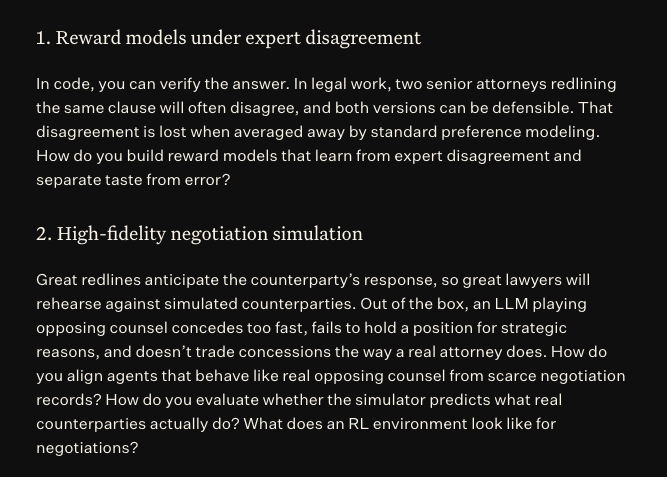
We've shared some ideas that fascinate us and we're excited to see what you come up with:
introducing Crosby Intelligence!
while AI agents are new, human negotiation has been the backbone of society for thousands of years. the Crosby Intelligence branding is a simulation of the Gale-Shapley stable matching algorithm, instantiated with random preferences and solved in O(n^2) steps every time. the study of how humans reach agreement is one that has deeply meaningful and rich with history.
Crosby is excited to be pushing its next frontier.
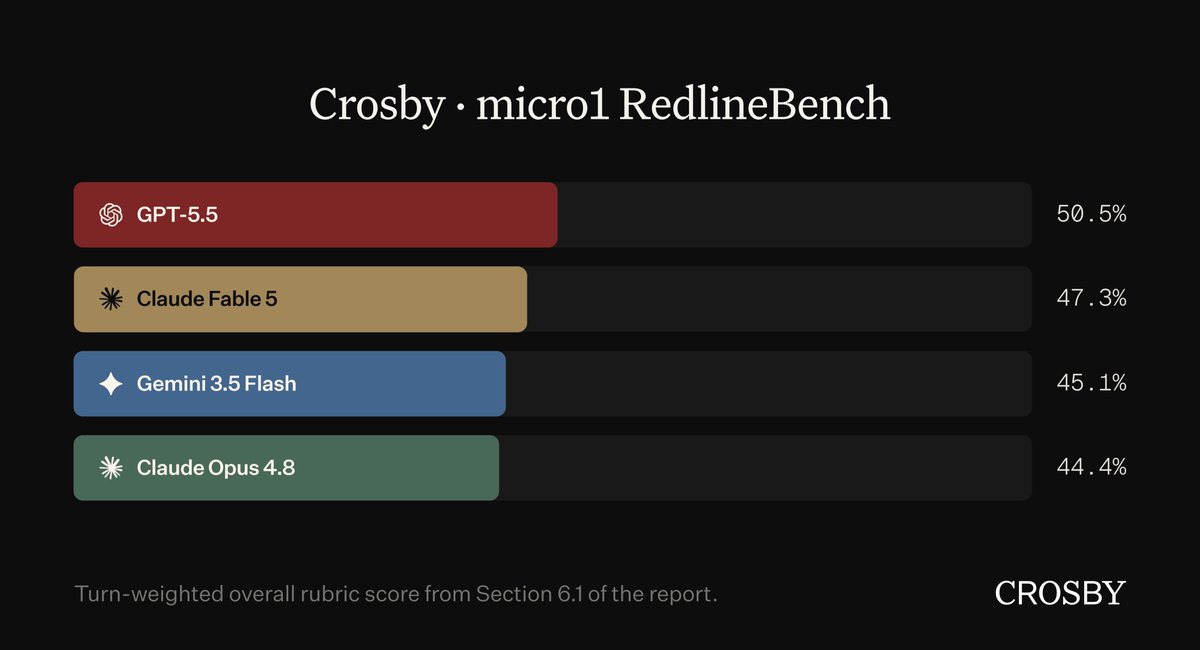
Contract negotiations are like poker games. The right answer depends on knowing your opponent, as much as knowing the law/rules. How good are frontier models at closing deals?
With @micro1_ai we benchmarked frontier models on multiple contract negotiations, across several turns. Rather than individual edits, we assessed the full sequence of judgment calls a lawyer makes across a deal lifecycle.
The headline: no model is close, and there are no standout winners yet.
We’re announcing 3 things as part of the Crosby Intelligence launch today:
1/ RedlineBench with @micro1_ai – publishing the first benchmark measuring how frontier models handle multiple steps of a complex, real world contract negotiation*, hosted on @huggingface
2/ The Crosby Intelligence Research Fellowship – funding two fellows pursuing frontier research with support from @OpenAI: $25K + $12.5K Codex credits each
3/ Hosting the most interesting conversations in applied AI at our Soho office, featuring @paraga, @rahulgs, @PeterHndrsn, @NeelGuha, and more
*built externally with no client data
Read more about all three at https://t.co/WuoSfT4g2E
🎯 we've hired dozens of brilliant attorneys at @crosbylegal, embracing the pain of cold-starting a world-class law firm. It's very hard. Selling agents would be so much easier. But we're *long humans.* Our agents make our lawyers even more valuable.
Neofirms will be defined by business models that charge for outcomes instead of hours. In order to win, they must measure the efficiency of labor + token spend, rather than competing to maximize token spend.
At Crosby, we use the Ramp AI spend dashboard to understand how we're spending tokens on customer outcomes, where efficiency = customer outcomes delivered / [token cost + legal cost].
The billable hour is optimized for the opposite, where more hours means more revenue. For us, every token and every hour of legal time comes out of our margin, so the pressure is always to deliver more with less. For the first time, the firm and the client actually want the same thing.
The firms that win won't be playing at the Token Casino. The firms that win will be the ones delivering the best outcomes at the lowest all in cost -- and measuring it closely enough to keep improving.
On building in NY v SF from the Big 🍎 Bigger AI panel with:
@bernhardsson@shensi@ryanjdaniels
3 great reasons to build in NY:
- Closer to enterprise customers
- Venture firms are expanding here
- Forces you to build distribution
SF still wins on one thing:
- Density (the best founders, engineers, researchers and investors are all bumping into each other every day)
Life hack.. build in NYC, visit SF often