From verified cacao to tokenized trade finance
A physical commodity does not become a financial instrument because it is placed on-chain. It becomes financeable when provenance, documentation, issuer onboarding, compliance, and investor verification operate in a controlled workflow.
Our recent cacao pilot with @blockticity , Seedcore, and @XDCNetwork mapped that process:
• Blockticity issued farm-level authenticity certificates for licensed cacao farms.
• Seedcore sourced and consolidated the cacao, linking export documents to farm records.
• Brickken onboarded Seedcore, completed compliance, and supported the tokenized receivable deployment on XDC.
The result is not just a token.
It is a trade finance workflow where the financial instrument references authenticated records from the underlying supply chain.
That is the institutional relevance of tokenization: verification replaces assumption.
Institutional interest in tokenized assets is growing across capital markets.
Next week, our CEO, @edwin_mata , will be in Monaco for @waibsummit 2026, joining two days of conversations with institutional allocators, issuers, and ecosystem partners.
On June 9, he will join the panel:
"RWAs: Is There Real Market Demand?", for a conversation focused on where institutional appetite is real, where the market is being tested, and where interest is converting into on-chain activity.
📅 June 9-10
📍 One, Monte-Carlo
🎤 Panel: June 9, 1 PM UTC
If you're attending WAIB Summit, reach out to connect.
Two days of high-signal conversations with allocators, founders, and institutional partners across the room.
Our CEO, @edwin_mata , and our Head of Partnerships, @albondd , leave Paris with new connections, a stronger network, and a number of potential deals on the table.
Proof of Talk continues to stand out as one of the few events where the conversation moves past narrative and into substance.
For Brickken, this is the audience that matters, and several of the discussions opened in Paris are already advancing toward next steps.
Thank you to @proofoftalk for the platform, the curation, and the quality of the room. A pleasure to be there.
Community AMA with Edwin | New Date
The Community AMA with our CEO, @edwin_mata , has been rescheduled due to a last-minute change of plans.
📅 June 15
🕓 2:00 PM UTC
📍 X | YouTube | Telegram
The new date gives the community a wider window to submit questions ahead of the session, and gives Edwin more space to walk through the answers in detail.
Agenda is unchanged. See you there.
We have surpassed $5M in TVL on @base
$42M+ is now deployed across all supported chains.
Real assets.
Real issuers.
Real capital formation.
They represent tokenized financial instruments issued through Brickken's infrastructure.
Private credit. Tokenized funds. Real estate. Revenue-sharing structures. Corporate financing.
Capital formation is on-chain.
Verified on @DefiLlama : https://t.co/eF3PSZsqXL
We are deploying tokenization infrastructure on @taikoxyz
The collaboration connects our institutional RWA infrastructure with Taiko’s Ethereum-equivalent Layer 2 ecosystem.
👉🏼 Read the full announcement: https://t.co/iWivAiZ1YT
Community AMA | 1 day left
Q2 was about execution. The next phase is about deployment.
Tomorrow, @edwin_mata will walk through Q2 progress, what is shipping next, and how tokenization infrastructure moves from exploration to deployment.
The market is no longer asking whether tokenization works.
It is asking which infrastructure can support regulated issuance, lifecycle management, and institutional distribution.
👉🏼 Set your reminder: https://t.co/czKWu6V6dR
ERC-7943 has reached Final status, giving the market a universal standard for real-world assets and a stable interface for compliant tokenization.
Tokenized financial instruments need more than issuance rails.
They need common compliance interfaces that institutions, custodians, and infrastructure providers can implement without creating another closed system.
On June 9, Brickken’s CTO, @felipedonofrio , will be joined by The CEO & Co-founder of @DigiSharesDK , @clausskaaning , for a technical and strategic session on what this means for institutions building tokenized financial products.
The discussion will cover:
• Why a common RWA standard was needed to move beyond fragmented implementations
• How pluggable compliance supports regulatory control while preserving interoperability
• What infrastructure providers, custodians, and issuers can do to implement ERC-7943 today
📅 June 9
⏰ 3pm UTC
📍 X / LinkedIn / YouTube
For financial institutions, the significance is practical: compliance logic, transfer controls, enforcement actions, and asset restrictions need to work across infrastructure layers, not remain locked inside proprietary systems.
That is the role of standards.
The endgame for tokenization is that fewer people need to say “tokenization”
That is how infrastructure matures.
Executives are not buying terminology.
They are buying faster settlement, clearer ownership records, better compliance execution, improved reporting, and more efficient capital movement.
The technology matters because it changes the operating model.
But the market will not scale if every issuer has to redesign how a bond, fund share, equity instrument, or private credit product works from scratch.
A mature market needs standards, templates, and infrastructure that can pass the same internal review more than once.
When the infrastructure becomes repeatable, the language becomes less important.
That is when tokenization stops being an innovation project and becomes part of how financial instruments are operated.
Tokenized real-world assets are entering the agentic economy
That requires infrastructure built for both financial instruments and autonomous on-chain execution.
We are deploying Brickken’s tokenization infrastructure on @taikoxyz , bringing our issuance, compliance, distribution, lifecycle management, and agent identity capabilities into Taiko’s Ethereum-equivalent Layer 2 ecosystem.
The collaboration also extends our agent-ready tokenization stack, including RAMS (Regulated Agent Mandate Standard) [ERC-8226], the compliance delegation standard for AI agents operating on regulated on-chain assets into an execution environment built for autonomous on-chain activity.
This matters because RWAs and autonomous agents are starting to converge.
Agentic workflows are adding another layer.
Autonomous participants need identity, permissions, and rule-based execution when interacting with tokenized assets.
Taiko provides the Ethereum-equivalent execution layer.
We provide the tokenization and agent-identity infrastructure required for compliant issuance, distribution, and lifecycle management.
The next phase of RWA deployment will not be defined only by bringing assets on-chain.
It will be defined by how those assets are operated, controlled, and executed inside programmable environments.
The RWA Week Awards 2026 nominations are open
This year, the community decides which companies are recognized for advancing real-world asset tokenization.
Our work has focused on issuer infrastructure, compliance execution, lifecycle management, and scalable tokenized financial instruments across real-world asset markets.
If Brickken’s contribution has supported you as a client, partner, investor, builder, or industry participant, we would appreciate your nomination.
The category is yours to choose.
Nominations close July 31.
Winners will be announced live at the @rwaweek Awards Ceremony in Singapore on October 9.
👉🏼 Nominate us here: https://t.co/pYeL43Wzgv
Regulated assets need infrastructure that DeFi was not originally built to support.
Dario Lo Buglio (@xaler2 ), our co-founder and Head of Blockchain, was featured by @Cointelegraph discussing ERC-7943, the uRWA token standard he co-authored, which has now reached the final stage of the @ethereum Improvement Proposal process.
The interview addresses a core issue for institutional tokenization: regulated assets require identity frameworks, transfer controls, compliance logic, and interoperability across custodians, exchanges, wallets, and institutional platforms.
ERC-7943 was designed as a flexible framework for tokenized real-world assets, helping assets move across different compliance systems without forcing every institution into isolated infrastructure.
Tokenized RWAs have grown from roughly $6.4B at the start of 2025 to about $34B today.
The standards underpinning that growth matter.
Read the full Cointelegraph feature here:
https://t.co/HfcJ9GnzCo
Tokenization is moving beyond issuance
The harder question now is distribution: how tokenized financial instruments move across regulated venues, investor networks, institutional platforms, and permissionless liquidity environments without losing compliance, investor eligibility, or operational control.
Join 21X and Brickken for a live webinar on what RWA distribution infrastructure looks like in practice.
📅 June 11
⏰ 12:00 PM UTC
🎙 Speaker: Philip Filhol, Senior Business Development Manager at 21X
🗣 Host: Rodrigo Palacios, Head of Sales and Business Development at Brickken
The session is designed for issuers, financial institutions, asset managers, infrastructure providers, and market participants building or operating tokenized financial products.
• Permissioned vs permissionless tokenized market structures.
• Transfer restrictions, investor onboarding, and compliance layers.
• Secondary market infrastructure for tokenized instruments.
• Interoperability across tokenization ecosystems.
• Institutional adoption blockers and operational constraints.
Proof of Talk starts tomorrow at the Louvre in Paris.
Our CEO, @edwin_mata , and Head of Partnerships, @albondd , will be on-site as banks, asset managers, regulators, and digital finance leaders gather around the next phase of tokenization.
The question is no longer whether tokenized assets belong in capital markets.
It is what infrastructure is required to issue, manage, and connect tokenized financial instruments at institutional standard.
That is where Brickken operates.
If you're attending @proofoftalk , reach out to meet the team.
RWA tokenization is accelerating past the speculative phase and setting concrete milestones
Here is where the market stands today:
• On-chain value has hit a new all-time high ranging from $31B to $37.5B
• Institutional giants like @BlackRock are expanding their footprint with new tokenized fund filings
• Base-case projections anticipate a massive $1.6T market by the year 2030
The financial infrastructure of the next decade is being deployed right now.
Community AMA with Edwin | June Edition
As Q2 comes to a close, Brickken continues to execute across product, infrastructure, and ecosystem development.
Brickken’s CEO, @edwin_mata , will host a live community AMA to provide a clear update on what is happening across Brickken today, where the team is directing its focus next, and how current priorities connect to the broader roadmap.
The session will cover recent progress, upcoming areas of execution, and the role of tokenization infrastructure as financial institutions, issuers, and ecosystem partners move from exploration to deployment.
📆 June 4
⏰ 3:00 PM UTC
📍 X | YouTube | Telegram
See you there!
Forget the theory. We surveyed active issuers to uncover the operational realities of RWA tokenization in 2026.
The consensus is clear: tokenization is an active vehicle for capital formation, but scaling it comes with distinct friction points.
A look at the data:
• 69.2% of surveyed issuers are already live.
• 53.8% are leveraging tokenization primarily for fundraising.
• 84.6% cite regulatory drag as their primary bottleneck, drastically outpacing technology struggles (13%).
Technology is no longer the hurdle.
Regulation and investor onboarding are.
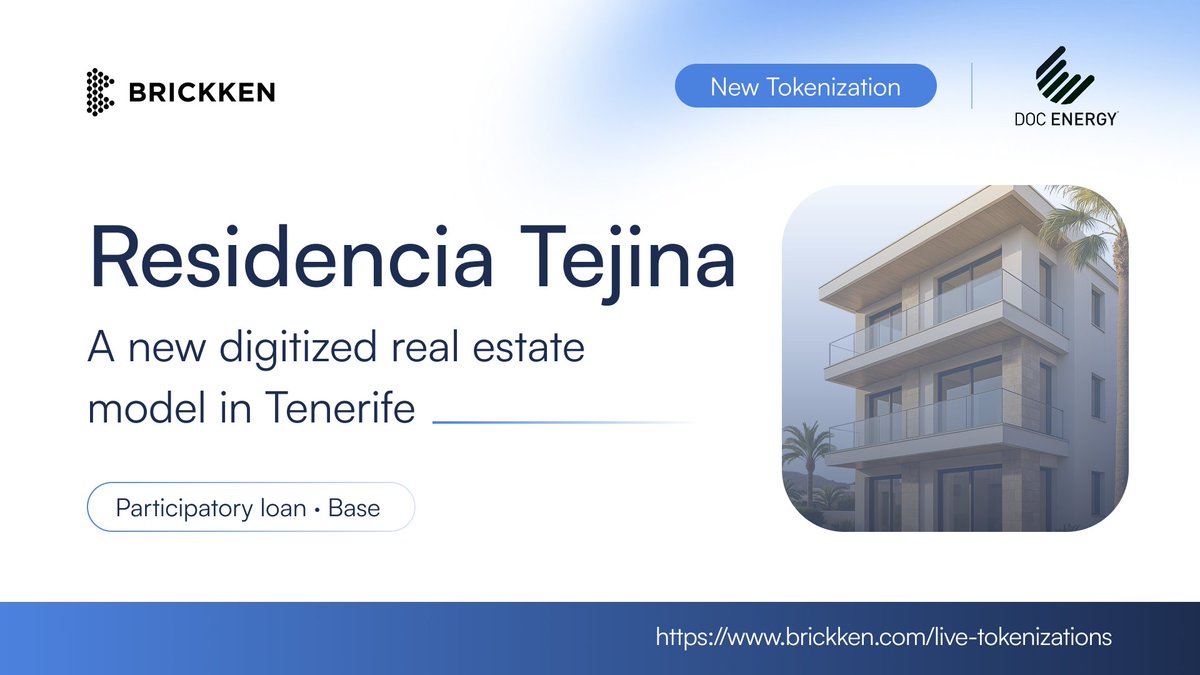
Residencia Tejina has successfully closed its €200,000 round
Developed by Doc Energy Skill, the project introduces a tokenized real estate model focused on the transformation of an underperforming hospitality asset in Tenerife.
The structure connects real estate execution with digital asset infrastructure:
• Acquisition and renovation of an existing hospitality property.
• Energy efficiency upgrades and operational repositioning.
• Tokenized representation of investor economic rights.
• Transparent reporting and distribution workflows.
• Lifecycle management through Brickken’s infrastructure.
Residencia Tejina is designed around a clear real estate value creation model: improve the technical performance, operational efficiency, and market positioning of the asset before entering the rental phase and eventual exit.
Project details:
• Website: https://t.co/R0bqKfdMaM
• Asset type: Participatory loan - Real estate
• Blockchain: @base
The project shows how tokenization infrastructure can support private real estate structures without replacing the underlying legal and operational model.
The asset remains real.
The rights are digitally represented.
The lifecycle is managed through infrastructure driving efficiency and lowers operational costs.
Tokenization is not a fundraising event.
It is capital management infrastructure.
Too many tokenization projects still start and end with issuance: structure the asset, create the token, distribute it, and move on.
Institutions do not operate that way.
A fund, note, bond, real estate-backed structure, or private credit instrument has a lifecycle.
It needs investor records, compliance logic, reporting, distributions, transfer controls, and post-issuance administration that continue after the asset is launched.
That is where tokenization either becomes useful or breaks down.
Companies do not buy ERP software to launch accounting once.
They buy it to run accounting every day.
Tokenization should be treated the same way: not as a project plan, but as an operating layer for financial instruments.
Digital assets are moving past narratives and into infrastructure.
@edwin_mata, CEO, will join INSIDE WEB3 Podcast on May 29 for a cross-border dialogue on digital assets, payments, and market infrastructure.
The conversation brings together leaders from Brickken, EMCD, and Mangrove to discuss where digital asset use cases are creating practical impact across regions and markets.
📅 May 29
⏰ 3 PM UTC
📍 X Spaces
Set a reminder and join the conversation.








![Brickken's tweet photo. Tokenized real-world assets are entering the agentic economy
That requires infrastructure built for both financial instruments and autonomous on-chain execution.
We are deploying Brickken’s tokenization infrastructure on @taikoxyz , bringing our issuance, compliance, distribution, lifecycle management, and agent identity capabilities into Taiko’s Ethereum-equivalent Layer 2 ecosystem.
The collaboration also extends our agent-ready tokenization stack, including RAMS (Regulated Agent Mandate Standard) [ERC-8226], the compliance delegation standard for AI agents operating on regulated on-chain assets into an execution environment built for autonomous on-chain activity.
This matters because RWAs and autonomous agents are starting to converge.
Agentic workflows are adding another layer.
Autonomous participants need identity, permissions, and rule-based execution when interacting with tokenized assets.
Taiko provides the Ethereum-equivalent execution layer.
We provide the tokenization and agent-identity infrastructure required for compliant issuance, distribution, and lifecycle management.
The next phase of RWA deployment will not be defined only by bringing assets on-chain.
It will be defined by how those assets are operated, controlled, and executed inside programmable environments.](https://pbs.twimg.com/media/HJzUk1-XMAAwvVo.jpg)