The crux of the issue with all the gaslighting from the DAT & DiGiTaL CrEdIt salesmen is that they themselves have been aggressively gaslit.
One of the most shocking responses to any critique of these instruments is “he clearly hasn’t listened to the recent earnings calls!”
With $MSTR trading at or below 1.22x ATM guidance and $STRC ATM turned off below par, how are they going to raise cash without selling more BTC?
6 months of cash reserves before they have to start making serious decisions around turning off dividends or breaking guidance.
GN
Likely going to see $STRC not trade at par by the ex-dividend date for the first time in a while.
They:
1) Removed the USD reserve to buy back 0-coupon bonds (wild decision).
2) Didn't raise the STRC dividend rate today.
@WazzCrypto@crypto_condom This one is great bc it’s not trading far enough below NAV to liquidate. They bought his own companies with stock and horribly managed debt. Really is one of the worst companies I have ever seen.
Now would be an ideal time to turn off growth mode
@tradexyz has a dominant marketshare, the best liquidity, the most markets, and outstanding trust from traders
HL is currently generating $300k a day in fees from HIP-3, split 50/50 with deployers
Turn off growth mode and that’s $1.5m a day and $550,000,000 annually for the AF without additional growth
The day growth mode is turned off, HL annual fees increase by over 50% - FIFTY PERCENT
That will make the AQAv2 repricing look like foreplay
Also keep in mind, tradexyz/unit is essentially a secondary assistance fund and a portion of their half a billion dollars a year will likely flow into $HYPE
Everyone is arguing about $USDH dying. They're missing the point entirely. What happened today is the single most important business move in Hyperliquid's history.
Let me explain. Revenue, liquidity, politics, lobby, and what it means for the USDH vote debate.
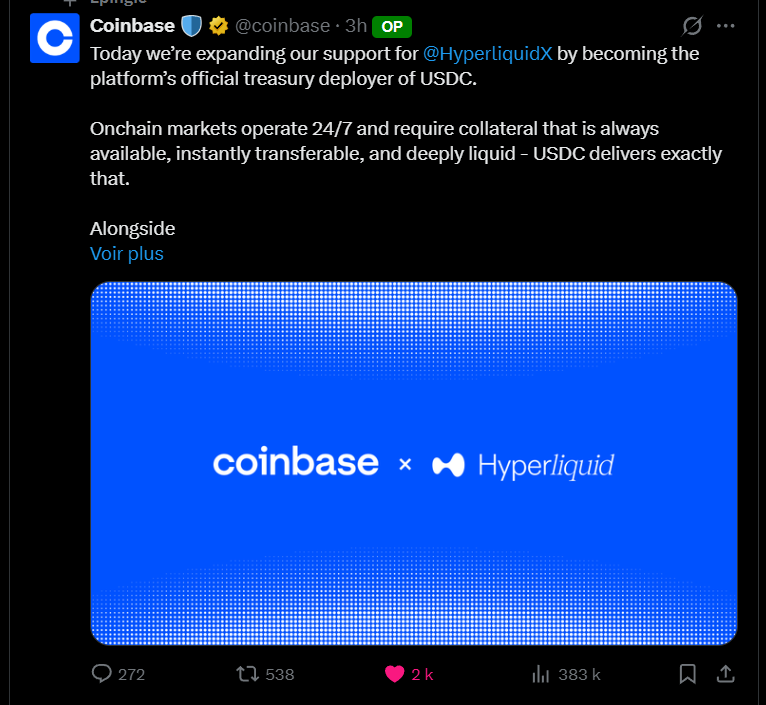
Coinbase is now the official treasury deployer of $USDC on Hyperliquid under AQAv2. Circle handles the technical side (CCTP, cross-chain infra). Both are staking hyperliquid:native. Native Markets agreed to sell the USDH brand assets to Coinbase.
$USDH is sunsetting. But the mechanics it pioneered are not. They just got applied to a $4.7B asset instead of a $100M one.
Let's break down why this is a win on every single front.
LIQUIDITY
The biggest complaint from traders and builders for months: fragmentation. $USDH had the alignment but not the liquidity. $USDC had the liquidity but not the alignment. You had to choose.
That choice is gone. One stablecoin. One orderbook per pair. No split liquidity. No confusion for HIP-3 deployers picking a quote asset. No friction for new users bridging in.
$4.7B in USDC on Hyperliquid, 2x year over year. That is the base generating yield now, not $100M.
REVENUE
Under AQAv2, the treasury deployer shares 90% of the reserve yield revenue with the protocol. Run the numbers on the current $USDC supply:
$4.7B at 3.8% interest rate, 90% shared with the Assistance Fund = $160M+ per year flowing directly into HYPE buybacks. That is $440K per day. Every day.
For context, USDH at peak supply was generating a fraction of this on $100M. The AQA model worked. It just needed to be applied at the right scale.
POLITICS AND LOBBYING
This is the angle most people are sleeping on. Coinbase is the largest publicly traded crypto company in the US. They spent over $100M on crypto lobbying and political action in the last cycle. They are the single most powerful voice for crypto regulation in Washington.
The CLARITY Act markup is happening today. Coinbase has been one of its strongest advocates. Having them financially aligned with Hyperliquid, staking HYPE, operating as treasury deployer, is not just a liquidity play. It is a regulatory shield.
Every conversation about "is Hyperliquid a US regulatory risk" just got a lot harder to make when Coinbase is literally staked into the network.
Circle staking 500K HYPE and moving toward becoming a validator. Jeremy Allaire posting "Hyperliquid." That is institutional endorsement at the highest level.
THE USDH QUESTION
"Was USDH a failure?" "Was the vote theater?" "Did Native Markets just flip an asset?"
No. USDH was a weapon. It was a credible threat that proved a protocol can demand yield sharing from stablecoin issuers. Before USDH, Hyperliquid had $5B+ in USDC generating $150-200M/year for Circle and Coinbase. The protocol saw none of it.
USDH launched. The AQA model proved that yield can be redirected onchain, transparently, back to the protocol. It only reached $100M in supply but that was never the point. The point was forcing incumbents to the table.
Basit said it best: the entire lifecycle of USDH from launch to sunset should be studied. Coinbase didn't come to Hyperliquid out of goodwill. They came because USDH proved they would lose the venue if they didn't align.
"But Paxos offered better economics during the vote." Maybe on paper. But 95-100% of a stablecoin that might have also struggled to reach $100M in supply is still less revenue than 90% of $4.7B. The vote was never about picking the best yield split on a small asset. It was about creating the leverage to capture yield on the dominant one.
WHAT THIS MEANS FOR BUILDERS
USDC becomes the canonical quote asset for HIP-4 outcome markets. No more guessing which stablecoin to build around. Hyper Foundation is issuing grants to HIP-3 and HIP-1 deployers who integrated USDH to cover migration costs. Feeless conversions from USDH to USDC during the transition.
For HIP-3 deployers running equity perps, commodity perps, outcome markets: one liquidity pool, one collateral asset, deeper books.
SECOND ORDER EFFECTS
Coinbase operating perps through Hyperliquid via builder codes? Not confirmed, but now structurally possible. Their existing perp product is weak. Hyperliquid's infrastructure is the best in crypto. The incentive alignment is there.
Tether now has a clear path to compete. AQAv2 is an open spec. Any stablecoin issuer can stake 500K HYPE and share yield to become an aligned quote asset. Competition is good.
AQAv2 becomes a blueprint for every other chain. Hyperliquid just proved that a protocol can force the largest stablecoin issuers in crypto to share revenue at the protocol level. No one has done this before.
Hyperliquid.
Drift’s recovery token raises debt-like questions.
Arca Research Associate Alex Woodard guest authors this week’s That’s Our Two Satoshis, covering:
• Recovery tokens as claims on a dedicated pool
• Asset recovery assumptions across frozen and remaining funds
• Exchange reopening scenarios and revenue-sharing assumptions
• Unresolved capital-stack questions
@Crypto_Alex17 examines the distressed debt instrument!
The proposal to let GNO holders redeem their pro-rata share of the Gnosis DAO treasury is now live. If you hold GNO, vote in favor.
https://t.co/XAyHjQsX5m
Here is why it exists: Gnosis Ltd, the operating company led by Gnosis' original cofounders and funded by the DAO treasury, is structurally misaligned with the tokenholders paying for it and is starting to act with hostility against them.
Holders expect financially rational decisions and value accrual. What they have received is careless spending, no path nor consideration for profitability, and a management team that hides behind product pivots to mask the absence of product-market fit and stay away from having to make hard decisions.
Ten months ago, Gnosis Ltd received $30M in DAO funding under GIP-128. Across the two quarters they disclosed revenue, the total was under $300k. They stopped disclosing it in Q1. Per the latest report, headcount sits at 132. They stopped reporting that too in Q1 (simply because it’s gross). This is not a company built to return value to GNO holders. It is a charity operation funding the founders' vanity projects and a pure cash sink.
Pro-rata treasury value per GNO is currently ~$171, roughly 30% above market. That figure excludes the enterprise value of Gnosis Chain and Gnosis Pay, and marks the venture portfolio at the operator's own number, which is almost certainly conservative.
The obvious question: why not buybacks? They are part of the treasury manager's mandate. They were on the table. Actually, buybacks have been stop-start to accommodate a dual mandate of value accrual to Ltd at the expense of purely focusing on returning to NAV. But this is also when Gnosis Ltd made their move. The treasury manager was ordered to reclassify 250k Ltd-held GNO as circulating supply, with no Snapshot vote, no GIP, no announcement. That single change would cut NAV per GNO by ~16.5% overnight.
The implication is that Ltd holds those tokens as a separate beneficial owner with a claim on the treasury. That contradicts the purpose-driven entity structure under which Ltd was restructured in 2025. Those tokens are held on behalf of the DAO. They are not Ltd's to claim against.
This proposal exists because the buyback path was poisoned at the source. Redemption gives every holder a way out at real NAV, on terms the operator cannot manipulate.