@Dan_Jeffries1 I always thought, simplifying, that being evil is stupid and being good is intelligent. I get evil is advantageous when your life depends on it and probably that's why we are, too much evolutionary pressure in the past, but nowadays makes no sense, it's short-sighted.
🧵 The greatest wealth transfer in history isn't happening through new tech or fancy investments. It's hidden in plain sight: the gap between natural deflation and forced inflation. Let's explore why this matters for your future. 👇
I hate CSAM too, let's remove it together!
So, how will it work? Let's start with the requirements!
First, we need a way to identify all the methods people can use to put data in bitcoin. (Do we also care about bad links to CSAM or only the pics themselves?)
Second, we need to monitor all data placed onto bitcoin to determine whether it is CSAM. I will leave that job to you, i aint looking at that shit!
Third, we need a method of removing and reporting all CSAM. This will require hardforking out any that got in before we could remove it from the mempool. It will also require some integration with authorities.
Finally, we will need to regulate miners because they are the ones actually putting in the evil transactions, and the only way to stop them is to censor them too.
Once we have the power to censor txns from the mempool, from miners, and from the blockchain, and we integrate with the government, and find someone to monitor all data and photos on Bitcoin ... we can be rid of this vile use case!
Censorship is freedom!
Who is with me?
(This is satire)
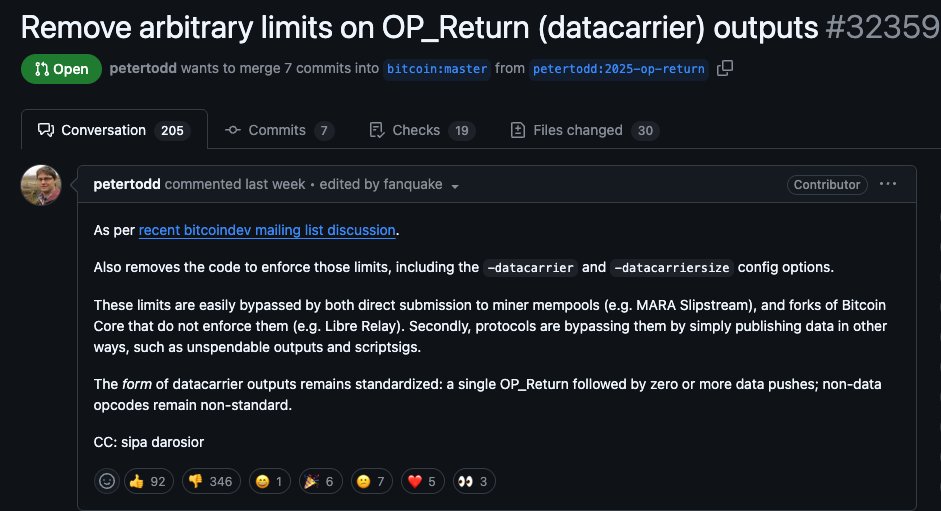
A quiet change in Bitcoin Core just blew open a years-long battle.
Most people missed it.
But it could reshape what Bitcoin is.
Some are calling it a slippery slope to Ethereum.
Others call it an essential upgrade.
This thread breaks it down🧵
@ArlosBitcoin It's not that rare. The odds of the next word being the same as the previous are 1/2048. Do it 19 times and you have 19/2048 for any two consecutive words. And the chances of any two words being the same in the list of 20 words are remarkably higher.
Proponents of open are fundamentally realists.
We know that some bad things will happen no matter what you do in life. And we know the problems that come from openness vastly outweigh the downsides of openness. By a massive margin.
Enemies of openness all share similar traits. It doesn't matter if they're against democracy, open weights AI, open source software, or free speech.
At their core, enemies of open are pessimists.
They believe people are inherently corrupt and evil at their core and can't be trusted.
They believe the small number of risks outweigh all the benefits.
They are short-sighted and fixed on big, flashy risks that are often totally imaginary but that they’ve convinced themselves are real.
That leads them to try to design rigidly controlled systems where they're in charge of deciding who gets to do what and when. More than anything, they believe that preventing harms is vastly more important than any benefits that an idea or technology might bring if it was more widely disseminated.
These are the folks who would have been against the printing press, because knowledge is "dangerous."
They're also fundamentally elitists. They believe they have special knowledge about how the world works that nobody else has except their chosen in-group and that they're the only ones who can be trusted to do the right things in the world.
They mistake their model of reality for actual reality itself.
In other words, they're delusional.
And dangerous.
You won't find a single fan of openness in the entire history of dictatorships or in systems of mass violence like communism and fascism. They favor rigid control and a bloody reality today for an imagined glorious future. If only they could eliminate these people who don't agree and these ways of thinking they could have true paradise.
Rigid control has never made a paradise for anyone.
Only openness has.
Go ahead and grab Linux for whatever project you dream up. Grab one of the 10s of millions of other open source projects for everything from running a website, to training an AI model, to running a blog, or to power a Ham radio. You don't have to ask anyone's permission or pass a loyalty test or prove that you align to the people in power's view of the world. It's free and ready to use right now.
You get to use the same software as mega-corporations with 10s of billions of dollars in revenue. You get to use the same software as super powerful governments around the world. So do charities, small businesses just getting started, universities, grade schools, hobbyists, tinkerers and more.
Open source is a powerful idea that's shaped the modern world but it's largely invisible because it just works and most people don't have to think about it. It's just there, running everything, with quiet calm and stability. That's made it hard to defend and that's a tragedy because open source gives everyone a level playing field.
With that kind of reach and usefulness I never saw it as even remotely possible that someone would see open source as a bad thing or something that must be stopped ever again.
But I was wrong. Here we are again. The battle is not over. It's starting anew.
The people who want to destroy open source AI come from a loosely knit collection of gamers, breakers and legal moat makers. Mustaf Suleyman wants to make high end open source AI work illegal. He and a few other AI voices want to make sure that you can never compete with their companies through regulatory capture like licensing model makers. The Ineffective Altruism movement (powered by such luminaries Sam Bankman-Fried and his massive crypto fraud) has linked up with AI Doomsday cultists and they want to stop open source AI by forcing companies to keep AI locked up behind closed doors instead of releasing the weights and the datasets and the papers that define how it works.
They must be stopped.
They must be stopped because they are misguided, magical thinkers, whose ideas don't work, have never worked and will never work. We can't run a society based on the broken ideas that have a 100% failure rate over time. We can't run it based on wishful thinking and delusional thinking.
Real life is about understanding that good and bad people exist and you can't prevent all harm before it happens. We punish the bad people and we let the rest of us go to work and live life.
Real, adult understanding of life is that life is a risk. There are no guarantees. Openness means sometimes bad things will happen but open is almost always preferable to closed except when it comes to personal privacy and weapons of mass destruction.
We don't make healthy societies with childish black and white thinking.
When we grow into adults we put away childish things.
And we embrace open.
8/
@SeedSigner Another attack vector could be this:
Even if you give it a new seed, the compromised HW could display the addresses or provide the zpub of a seed the manufacturer controls. You would only realize if you check your seed with another wallet software. @Molson_Hart
@SeedSigner But that's very inconvenient (and risky) for the average user to do. What I'd recommend is always adding a complex passphrase to the given seed.
A blockchain is only valuable in the context of money. Bitcoin and its blockchain are interdependent (one is not valuable without the other) and economies converge on one form of money, therefore only one blockchain is valuable: bitcoin's. Bitcoin, Not Blockchain. Read more!