You have noticed it. ChatGPT feels dumber than it used to. Your prompts that worked six months ago produce worse results now. The writing sounds flatter. The ideas sound safer. The internet itself feels like it is shrinking. Every article reads the same. Every email sounds the same. Every answer sounds like it was written by the same voice.
You thought it was you. It is not you.
Researchers at Oxford and Cambridge published a paper in Nature proving what is happening. They call it Model Collapse.
Here is the mechanism in one sentence. AI trained on AI-generated data gets dumber every generation until it forgets what real human data looked like.
The internet is filling with AI-generated content. Blog posts. Articles. Reviews. Comments. Social media. AI companies scrape the internet to train the next generation of models. Which means the next generation of AI is being trained on the output of the current generation.
Each cycle loses information. Not randomly. It loses the rarest, most unusual, most creative parts first. The researchers call these the "tails of the distribution." The weird ideas. The unexpected perspectives. The things that made the internet feel human. Those disappear first.
What remains is the average. The safe. The expected. The bland.
Then the next generation trains on that. And loses more. And the next generation trains on that. And loses more. The researchers proved this is not a slow decline. Major degradation happens within just a few iterations. Even when some of the original human data is preserved.
They tested it on large language models. On image generators. On statistical models. The pattern was the same every time. The output converges toward a narrow, flattened version of reality that looks nothing like the original data.
The lead researcher put it plainly. "Large language models are like fire. A useful tool. But one that pollutes the environment."
The pollution is invisible. You cannot see which sentence on the internet was written by a human and which was written by AI. Neither can the AI that is about to train on it. And once the tails are gone, they do not come back. The damage is irreversible.
This is not a prediction anymore. It is a diagnosis.
The internet you grew up on was built by humans writing things no algorithm would have written. Strange, personal, imperfect, alive. That internet is being diluted. One generation of AI at a time. And the models trained on what remains are learning a smaller and smaller version of the world.
Model Collapse is not a technical problem. It is a cultural one. The thing that made the internet worth reading is the thing that disappears first.
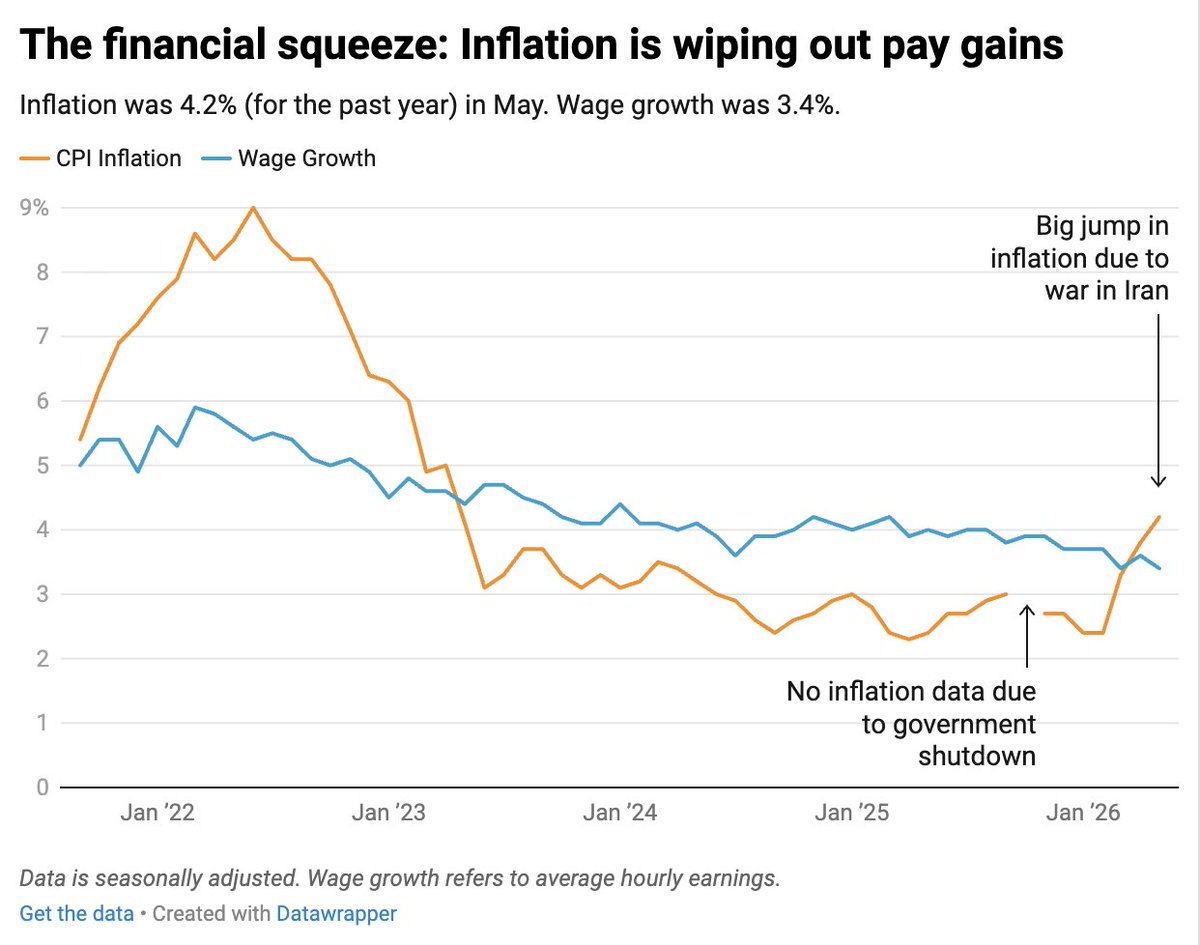
Inflation is so high that it's erasing all wage gains.
Inflation: 4.2% in May for the past year
Wage growth: 3.4% in May for the past year.
Americans are getting squeezed financially. This isn't just "bad vibes" about the economy. There is real pain, especially for middle-class and lower-income households. It's tough because so many basic items are seeing sizable price increases: gas, electricity, food, medical care.
🚨 Glenn Greenwald just broke it down…
A sitting US President, who ran on ending wars, is being openly defied by a foreign Prime Minister. Not behind closed doors. In public. Repeatedly.
Trump is a Zionist. His family is tied to Israel. He is owned. But he wants this war over. The midterms are coming. His base is fracturing. His promises, and legacy, are rotting in public.
Trump has repeatedly begged Netanyahu to stop.
Netanyahu didn’t just tell him to STFU.
He went straight to Congress, who AIPAC has bribed with $28M this election cycle alone, and passed Section 224, LEGALLY FUSING the US and Israeli military structures.
Democracy BYPASSED In broad daylight.
This is what @ggreenwald has spent years warning people about.
The most powerful man on earth can’t end a war his own voters want ended, because the lobby doesn’t just own the President.
It owns the building he works in.
Palantir's Alex Karp: “It’s not just the man and woman on the street that is unhappy with the frontier labs, it’s in private, every single enterprise we deal with...Many customers believe these companies don’t understand their businesses and only care about “tokenmaxxing,” or burning through AI tokens to signal productivity...It is not that large language models aren’t crucial for the world. It’s just the implementation is where the value is, certainly in the next seven years.”
In my December report on "GenAI & Productivity" (https://t.co/kEx5Z4BJH7), I warned about much the same concern as Karp is warning about today—that uncertainty about the hyperscaler business model was a path to overextension risk. To quote the report:
"At a Dealbook Summit, Anthropic’s Amodei encapsulated the core challenge facing everyone from hyperscalers to investors to corporate executives across industries: 'I think there is a real dilemma deriving from uncertainty about how the economic value [of genAI] is going to grow…And whenever there’s uncertainty, there’s a risk of overextension. I believe some players are not managing that risk well.'
Amodei’s comments were a lightly veiled reference to his primary private-market competitor, OpenAI, and there’s compelling evidence to support his concern. The company is committed to spending $1.4t on data centers over the next decade—money dedicated based on speculative estimations of the compute power needed to meet demand two to three years from now. Yet, the company’s strategic vision remains turbulent. As The WSJ reported in the wake of Sam Altman’s “code red” declaration after the release of Gemini 3:
'When Altman made the dramatic call for a “code red” last week to beat back a rising threat from Google, he put a notable priority at the top of his list of fixes. The world’s most valuable startup should pause its side projects for eight weeks and focus on improving ChatGPT, its popular chatbot that kicked off the AI boom. In so doing, Altman was making a major strategic course correction and taking sides in a broader philosophical divide inside the company—between its pursuit of popularity among everyday consumers and its quest for research greatness.'
To be clear, we’re not intending to pick on OpenAI. Every hyperscaler faces the same challenges that OpenAI faces. Again, to quote Amodei: 'Data centers have a long lag time, a year or two, so I have to decide now how much compute I need to buy to serve the models in 2027.' Hyperscalers are making seismic spending commitments today without a full understanding of demand tomorrow or the revenue that demand will generate."
Learn more about Sage Road Research: https://t.co/iHoD3YqgFQ. Interested in subscribing? Message me.
CNBC link: https://t.co/NGTDqVJO3q
“If someone does something bad to you once, they’ll do it again and again.”
Robert Greene dropped this truth: People rarely do something harmful “just once.” That apology (“that wasn’t me”) is almost never true, it’s part of a pattern. The same goes for our own compulsive behaviors. To break them, you have to catch the thinking loop early and repeat the mantra: let go, let go, let go.
This is one of those simple but brutal lessons that saves you so much pain once you actually internalize it.
Spotting patterns, in others and in yourself, is one of the highest-leverage skills you can develop.
What’s a pattern you’ve finally started to recognize in yourself or someone else?
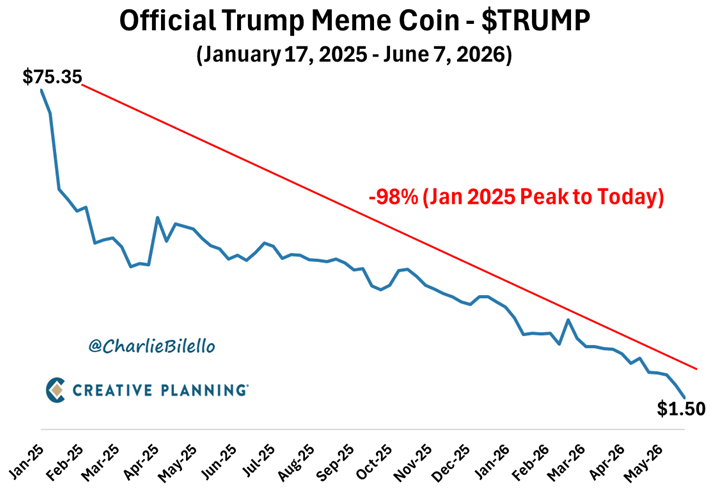
The Official Trump Meme Coin has now lost 98% of its value.
Elected officials should not be issuing, promoting, and profiting from speculative financial assets.
This should be illegal.
Demis Hassabis just handed the future of civilization to the philosophers.
Not more engineers. Not more compute. Not more code.
A direct call to arms for the humanities.
Hassabis: “It’s very urgent that we really think about the second-order consequences. Many of you in the humanities subjects, it’s now your time in my opinion.”
The CEO of Google DeepMind. The man further down the road of artificial intelligence than almost anyone alive.
And he’s saying the next chapter doesn’t belong to him.
He laid out the exact sequence of what comes next.
First, get the technology right.
Then, rewrite the economics.
Then, face the philosophical questions about the human condition.
That third layer is where everything changes.
Because we’ve spent all of recorded history defining ourselves by what we can do. Think. Build. Solve. Create.
Intelligence was the currency. The differentiator. The thing that separated us from everything else on this planet.
And we’re about to make it abundant.
When the thing you built your entire identity around becomes something a machine does better, faster, and for free…
You don’t have a technology problem.
You have a mirror.
And the mirror is asking one question.
What are you without the doing?
Most people look at that question and see obsolescence.
Hassabis sees elevation.
Hassabis: “I’m very optimistic that we’re gonna get this right. I’m a big believer in human ingenuity, especially when the pressure’s on.”
This is not a warning about the end of the world.
It’s an invitation to build a better one.
For a century, society pushed the humanities to the margins. We prioritized the mechanics of survival over the philosophy of living.
That era is over.
When artificial intelligence automates the mechanics of survival, philosophy ceases to be a theoretical luxury.
It becomes the most critical applied science on Earth.
Algorithms cannot calculate what constitutes a virtuous life. Code cannot assign meaning.
The technologists are about to hand us infinite leverage. But infinite leverage without human direction is just chaos.
Hassabis: “Humanity has always figured it out when the chips are down. And they are now.”
The chips are down.
But that’s exactly where this species does its best work.
We spent ten thousand years building a machine that could lift the burden of basic survival.
We succeeded.
Now we finally get to figure out what it actually means to be alive.
Howard Marks has been writing investment memos for 30 years that Warren Buffett says he reads first thing every time.
In 36 minutes he explains why every bull market ends the same way - and where he thinks we are right now.
36-min. Oaktree. TBPN.
Bookmark & watch - the clearest market cycle read you'll find in 2026
Single Crystal CVD Diamond
Have no doubt, you are at the dawn of an industrial revolution. There is a string of breakthroughs happening throughout upstream industries that all compound.
Diamond manufacturing is now able to produce CPU size single crystals wafers.
Currently these are marketed as heat spreaders because they have thermal conductivity of 2,200 W/mK which means they move heat incredibly effectively.
However, that somewhat misses the wood for the trees…
Diamond has physical and electrical properties that exceed traditional silicon, making it uniquely suited for high demand applications.
Thermal Conductivity: Heat is the enemy of electronics. Diamond conducts heat better than almost any other known material, about 5 times better than copper and over 10 times better than silicon.
A diamond chip can act as its own heat sink.
Ultra Wide Bandgap: Diamond can handle massive amounts of voltage and operate at incredibly high temperatures without electrical breakdown.
This makes it perfect for high power applications like electric vehicle inverters, power grids, and aerospace technologies.
High Frequencies: Electrons move very quickly through diamond, allowing chips to operate at much higher frequencies, which is ideal for advanced telecommunications and radar.
Radiation Hardness: Diamond is incredibly resilient to radiation, making diamond based chips ideal for satellites, space exploration, and nuclear facilities.
To make a material act as a semiconductor, you have to "dope" it. To do this you inject impurities into the crystal lattice to create a positive (p-type) or negative (n-type) charge.
Diamond's atomic structure is so tightly packed that forcing other elements into it is hard. While p-type doping (with boron) has been figured out, reliable n-type doping (with phosphorus) remains a massive hurdle.
Theoretical ceilings
Band gap
Silicon wafer = 1.1 eV
Diamond CVD wafer = 5.5eV
Clock speed
Silicon wafer = 5-6 GHz clock wall
Diamond CVD wafer = 1-2 THz clock wall
Max Running Temp
Silicon wafer = 150°C
Diamond CVD wafer = 1,000°C
Whilst we etch silicon with photolithography and Extreme UV light, this doesn’t really work with chemically inert diamond.
Diamond CVD is currently etched with oxygen plasma etching, but this lacks the precision of EUV.
However, we can etch diamond to extreme precision with electron projection lithography. EPL was invented in the 90s by Bell Labs, IBM and Nikkon but abandoned as it was harder than EUV.
Electrons repel each other so the beams blurrs too readily.
What if we built a femto electron beam?
What if we built it to extreme such that it was a ‘single electron’ pulse?
What if we build a microscopic "bed of nails" containing millions of nanoscale tungsten or silicon tips (photocathodes). You shine a massive, highly complex femtosecond laser system across the entire array.
Every time the laser pulses, millions of tiny tips each fire a single, perfectly straight electron at the exact same time.
Turns out, research teams at likes of MIT and Stanford are currently experimenting with exactly this, laser driven nanotip electron emitters.
Pair that tool with Diamond CVD substrate tech and we approach the material limits of both semiconductors and nanotechnology.
Would require asynchronous logic to escape fatal clock skew and operate at full capability.
But I think I will live to see it.
@SaraEisen@netanyahu you could've asked him about the dozens of testimonies of IDF targeting civilians... and children... but you didn't.... shame on cnbc, war crime apologists https://t.co/3sqY1fPdae
That particular moment when a British surgeon was giving his testimony to the UK Parliament.
He describes how IDF drones arrive right after airstrikes in Gaza, targeting and shooting the injured, including children,right on the spot.....
Documenting the headwinds I now see for AI.
It won't seem like it, but I love AI and am long-term positive. But when "math doesn't math" I take note.
1. The core thesis for foundation model lab investment has been high upfront investment made worthwhile by significant long-term profits.
2. These are capital intensive businesses and the compute commitments are very high relative to revenue and require strong growth over long time periods. The "leverage" (commitments versus revenue) is extremely high.
3. The fundamentals are not as positive as they previously were:
• Input costs are higher (commodities, chips, power)
• Interest rates are higher
• Competition is more intense
• Scaling Laws are now problematic: exponential costs/power cannot continue
4. Forecasting compute spend is challenging and high risk due to (a) revenue uncertainty and (b) algorithm uncertainty
5. Revenue growth appears to be slowing. The technology is valuable, but ROI is proving to be more expensive and take longer than anticipated.
6. The future is likely "different models for different use cases" with the lower end of the market being highly competitive.
7. Core use cases such as agentic software engineering are likely to need approaches beyond next-token prediction. They are Σ₂ᴾ complexity problems requiring multi-objective optimization and likely a combination of Transformers and other methods.
8. Current forecasts in memory makers are built largely on quadratic attention. That will not persist: we are already seeing work from DeepSeek, Minimax and Nvidia that can cut RAM needs by 80% or more.
9. This means semiconductor valuations are substantially overinflated and will go through the traditional glut versus shortage cycle.
10. For foundation model providers: lower costs with competitive differentiation is good. However, lower costs with a lack of differentiation would mean lower revenues. This makes it harder to (a) service commitments and (b) pay back investors.
11. Leverage is substantially higher than in previous cycles, evidenced by leveraged ETFs, call option activity and margin loans. Korea is particularly susceptible.
12. 0DTE options create a profile that has stronger parallels to portfolio insurance and 1987 than any other point I can remember.
13. The combination of exponential increases in call activity coupled with the ties of semiconductors to structured products means there is a non-trivial systemic risk to the financial system.
14. Implied earnings growth rates are inconsistent with other periods in history.
15. Macroeconomically we cannot and should not fund exponential cost increases. History has shown us repeatedly that there are better ways (see Quick Sort and Simplex).
16. Significant supply is hitting the market via IPOs.
––
Taken together: costs and competition are increasing while revenue growth is likely slowing. Valuations are fragile and prone to technology disruptions that are already here. Systemic financial market risk is extremely high.


![trevornoren's tweet photo. Palantir's Alex Karp: “It’s not just the man and woman on the street that is unhappy with the frontier labs, it’s in private, every single enterprise we deal with...Many customers believe these companies don’t understand their businesses and only care about “tokenmaxxing,” or burning through AI tokens to signal productivity...It is not that large language models aren’t crucial for the world. It’s just the implementation is where the value is, certainly in the next seven years.”
In my December report on "GenAI & Productivity" (https://t.co/kEx5Z4BJH7), I warned about much the same concern as Karp is warning about today—that uncertainty about the hyperscaler business model was a path to overextension risk. To quote the report:
"At a Dealbook Summit, Anthropic’s Amodei encapsulated the core challenge facing everyone from hyperscalers to investors to corporate executives across industries: 'I think there is a real dilemma deriving from uncertainty about how the economic value [of genAI] is going to grow…And whenever there’s uncertainty, there’s a risk of overextension. I believe some players are not managing that risk well.'
Amodei’s comments were a lightly veiled reference to his primary private-market competitor, OpenAI, and there’s compelling evidence to support his concern. The company is committed to spending $1.4t on data centers over the next decade—money dedicated based on speculative estimations of the compute power needed to meet demand two to three years from now. Yet, the company’s strategic vision remains turbulent. As The WSJ reported in the wake of Sam Altman’s “code red” declaration after the release of Gemini 3:
'When Altman made the dramatic call for a “code red” last week to beat back a rising threat from Google, he put a notable priority at the top of his list of fixes. The world’s most valuable startup should pause its side projects for eight weeks and focus on improving ChatGPT, its popular chatbot that kicked off the AI boom. In so doing, Altman was making a major strategic course correction and taking sides in a broader philosophical divide inside the company—between its pursuit of popularity among everyday consumers and its quest for research greatness.'
To be clear, we’re not intending to pick on OpenAI. Every hyperscaler faces the same challenges that OpenAI faces. Again, to quote Amodei: 'Data centers have a long lag time, a year or two, so I have to decide now how much compute I need to buy to serve the models in 2027.' Hyperscalers are making seismic spending commitments today without a full understanding of demand tomorrow or the revenue that demand will generate."
Learn more about Sage Road Research: https://t.co/iHoD3YqgFQ. Interested in subscribing? Message me.
CNBC link: https://t.co/NGTDqVJO3q](https://pbs.twimg.com/media/HKdss6PaEAACWsW.jpg)