ESTE TIPO USÓ CLAUDE PARA CONSTRUIR UN SISTEMA DE TRADING AUTOMATIZADO QUE GANÓ 847 $ DE LA NOCHE A LA MAÑANA
Todo empezó con un solo artículo sobre bots de Polymarket.
Claude lo leyó, seleccionó 7 repositorios de GitHub, los conectó en un pipeline funcional y desplegó el sistema de principio a fin.
A partir de ahí, todo funcionó de forma autónoma.
El sistema escaneó más de 412.000 operaciones, rastreó wallets de ballenas, detectó actividad de insiders y tomó decisiones en tiempo real.
Según él, cada pocos segundos analizaba datos, decidía si comprar, vender o pasar, y ejecutaba las operaciones automáticamente.
47 operaciones después, el sistema terminó la noche con 847 $ de ganancia, sin ninguna intervención manual.
LOCURA
Episode 4: Interesting Patterns and Best Practices in Event-Driven Architecture
In the journey of mastering Event-Driven Architecture (EDA), understanding the design patterns and best practices that enhance its functionality is crucial. This episode delves into two influential design patterns Event Sourcing and Command Query Responsibility Segregation (CQRS) as well as the Saga pattern, choreography in microservices, and the necessity of event versioning. These concepts are instrumental in addressing complex scenarios within EDA and ensuring the architecture's long-term viability and flexibility.
Event Sourcing and CQRS
Event Sourcing is a pattern where changes to the application state are captured as a sequence of events. Instead of storing just the current state of data in a domain, Event Sourcing stores a history of all changes as events. This approach allows applications to reconstruct past states by replaying the events, offering immense benefits for auditing, debugging, and complex state rebuilding.
Command Query Responsibility Segregation (CQRS) is a pattern that separates the models for reading and writing data. This separation allows for more optimized data structures, improved performance, and scalability. CQRS is often used in conjunction with Event Sourcing, where the write model generates events that are used to update the read model, ensuring that the system can handle high loads of data operations efficiently.
Saga Pattern and Choreography
The Saga pattern is a strategy for managing long-running, distributed business processes. It involves breaking down the process into multiple local transactions, each publishing events upon completion. These events trigger the next local transaction in the process, allowing for complex workflows to be managed across distributed systems.
Choreography is a method of coordination between microservices in an EDA, where services communicate directly through events without requiring a central orchestrator. Each service knows what to do upon receiving specific events, leading to a system that is more decentralized and flexible. Choreography can simplify the design of distributed systems by reducing dependencies and allowing services to evolve independently.
Event Versioning
As systems evolve, the structure of events can change, leading to potential compatibility issues. Event Versioning is a critical practice for managing these changes. It involves defining a strategy for evolving event schemas over time, ensuring that new and old versions of events can be processed seamlessly. Techniques such as adding version numbers to events, using backward-compatible changes, or providing transformation logic to handle different versions are commonly employed. Event versioning is essential for maintaining the integrity and flexibility of an event-driven system as it evolves.
This are just a hint of the whole palette of interesting patterns related to EDAs. I hope this post will spark some curiosity 🙂
Bookmark and like this post if you found it useful and don't forget to repost to share the knowledge.
Follow me, If you are interested in more Software and system architecture topics. As well as Team mechanics and real life IT stories.
Event-driven architecture (EDA) is exciting until you deal with event versioning.
The solution is a pattern, an Adapter, but with a twist. (Like 90% of the problems in Software Development)
The Problem
Your schema changed with some breaking changes.
You have to update your Producer and 3 of your consumers.
You may think you can have coordinated deployments. Good luck; you will be stuck in 27 meetings, and something will go wrong.
A Solution
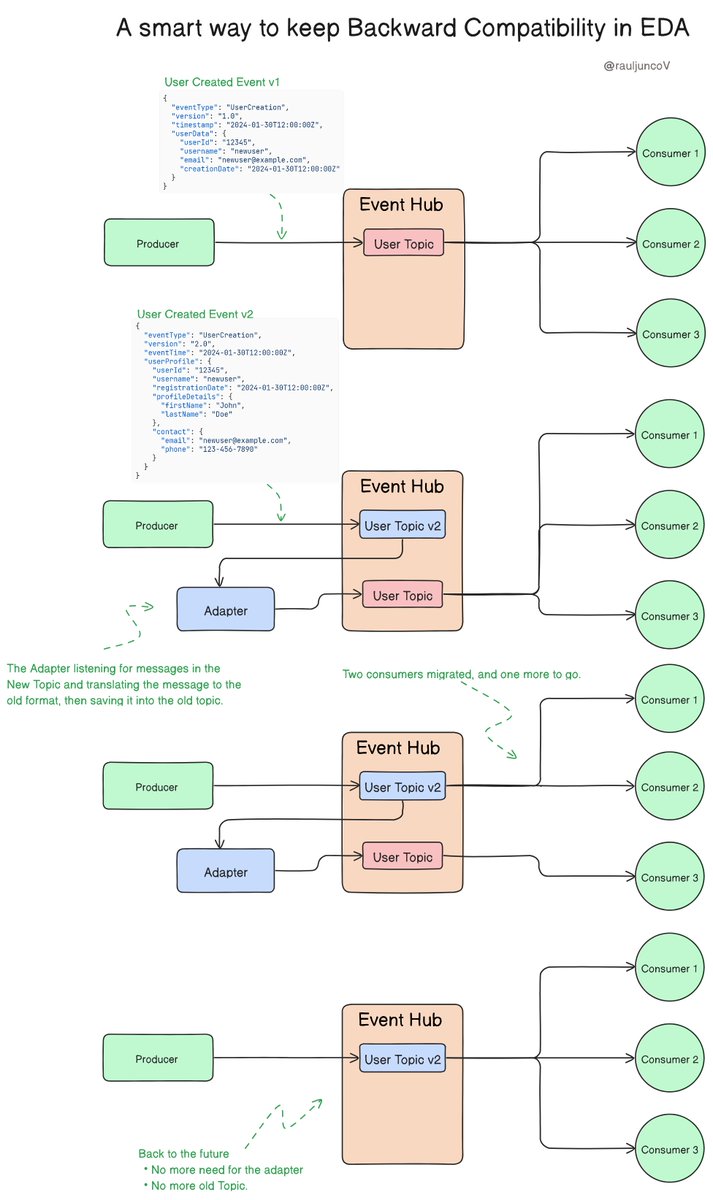
Create a new Topic; use this topic to publish the new schema versions.
Update the Producer to generate the new schema and point it to the new topic.
Create an Adapter listening for messages in the New Topic and translating the message to the old format, then saving it into the old topic.
Start migrating the consumers and pointing them to the New Topic.
Once you finish the migration, you can decommission the Adapter and get rid of the old topic.
Benefits
The Adapter ensures backward compatibility, allowing existing consumers to continue functioning.
This allows for a gradual migration of consumers to the new event schema.
There is no big coordinated deployment with downtimes and no endless meetings.
Testing will be more focused and controlled, as each consumer's transition can be tested independently.
Say no to more meetings and start releasing the smart way! 😉
Flutter is the default choice for future Ubuntu apps.
@kenvandine, Engineering Manager, is here to tell you about some of Canonical's contributions to Flutter at #FlutterEngage.
Watch 👉 https://t.co/kc1tFBlMJh
#LoopBack4 now offers support for going from a model definition to REST API with no custom repository or controller classes.
https://t.co/AUDElHohk6
#LoopBack#REST#API