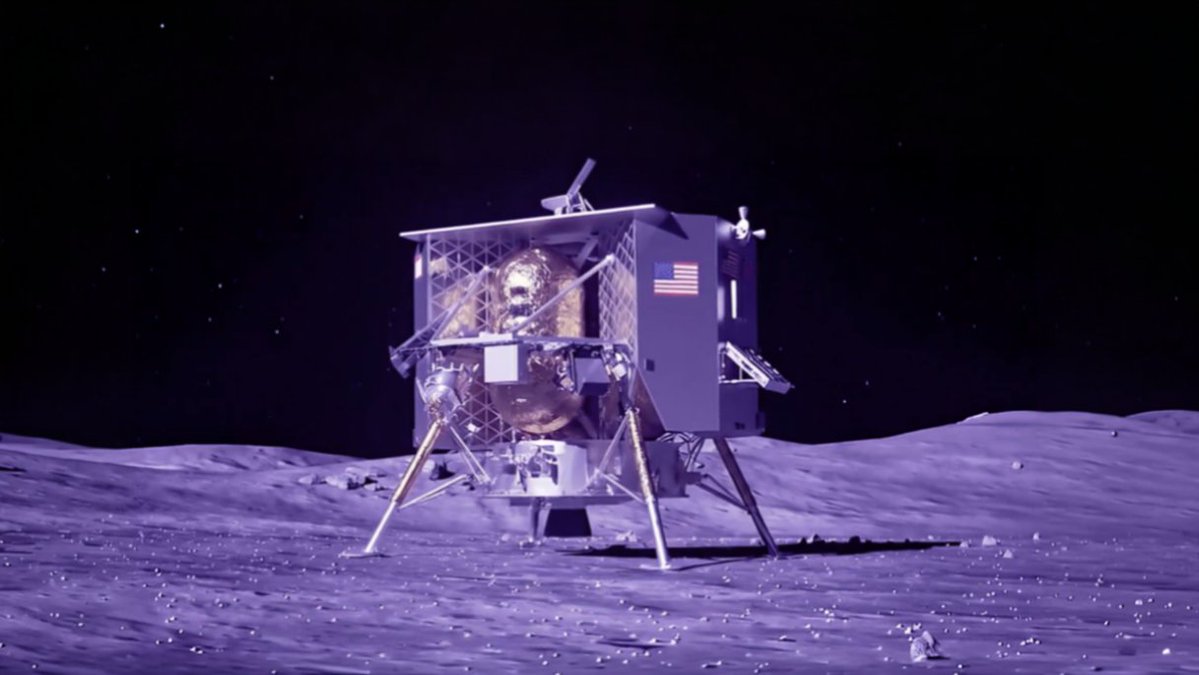
Griffin-1 is scheduled to land on the lunar surface before the end of the year, joining a 60-year history of American Moon exploration. But the Moon remains a largely unexplored frontier and there’s so much left to learn. With three lunar landings planned within the next three years, Voyager is enabling what comes next.
$VOYG #AcceleratingtheAdvantage #MissionReady
JUST IN FROM THE ALL-IN SUMMIT: NASA Administrator Jared Isaacman just laid out his vision for America’s next phase in space.
Among his most notable remarks:
• NASA expects “dozens of landers” and “dozens of rovers” to head to the Moon over the next four years, alongside major robotics and lunar resource experiments.
• Isaacman said the lunar south pole has only a limited number of viable landing areas near permanently shadowed craters containing water ice, creating what he described as a race for a small number of strategic “parking spots.”
• He warned China is targeting the same region, intends to build a lunar base with Russia and “will get to the Moon.” Isaacman said China is now an “incredible rival” and that “the Chinese are extremely good in space right now.”
• Isaacman called SpaceX NASA’s “most important launch partner” and said the U.S. would be “seriously challenged in the high ground of space” without its capabilities.
• On Mars, he argued the hardest problem is not getting astronauts there, but getting them home - and said NASA should develop nuclear-powered transfer vehicles that reduce the need to manufacture return propellant on Mars.
• He said NASA’s SR-1 Freedom nuclear mission will be followed by “SR-2, SR-3, SR-4,” with technology ultimately aimed at destinations including Enceladus, Europa and Titan.
In summary, the message from @NASAAdmin was clear: the next space race will be won by whoever can secure the Moon’s most valuable terrain, build permanent infrastructure there and use it as the springboard to Mars and beyond.
Biomanufacturing in space is moving from concept to capability.
Ambrosia Space Manufacturing Corporation has reserved volume aboard Starlab to validate and integrate its biomanufacturing system during Starlab’s first year of commercial operations. The system is designed to support production of biopharmaceuticals while laying the groundwork for other biological technologies that could support life and operations in space.
This is more than a technology demonstration. By validating biomanufacturing hardware in orbit and working toward integration with Starlab’s onboard systems, Ambrosia Space is taking a step toward the scalable production capabilities needed for a sustained human presence beyond Earth.
What could microgravity research make possible?
Starlab Space and Center for Space and Aviation Switzerland and Liechtenstein (CSA) have opened an international Call for Proposals for investigations aboard the International Space Station, giving researchers an opportunity to generate data and insights that can advance scientific, technical, process and business cases toward future applications and commercialization.
Up to four proposals will be selected, with awardees receiving support for payload integration, launch, on orbit operations, crew time and return of experimental samples.
Research areas include microorganisms, mammalian cells and tissues, protein crystal growth, fluid dynamics and mixing, biomaterials and plant research.
Step 1 of the proposal process opens TODAY. Learn more and review eligibility requirements: https://t.co/ZINscwbUuI
🌕 Opportunity: New Solicitation for Lunar Technologies!
NASA has issued a new solicitation to work with partners in advancing critical lunar surface technologies in the key areas including vertical solar arrays, ISRU oxygen production, radioisotope generators, in‑space manufacturing, and advanced nanomaterials — capabilities that are essential to establishing an enduring @NASAMoonBase at the lunar South Pole.
📅 Responses are due October 8, 2026. 🔗 https://t.co/gFVQyZMXtX
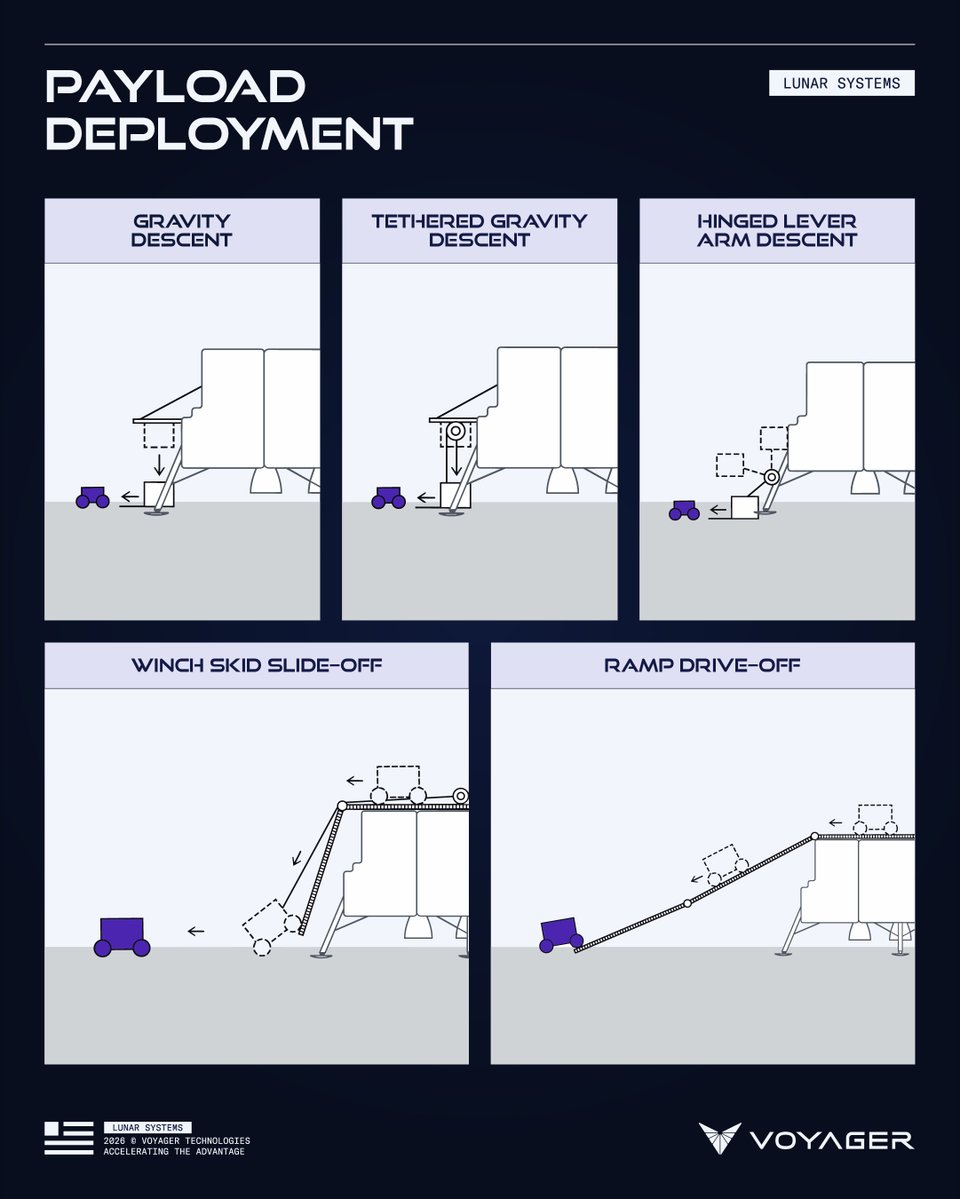
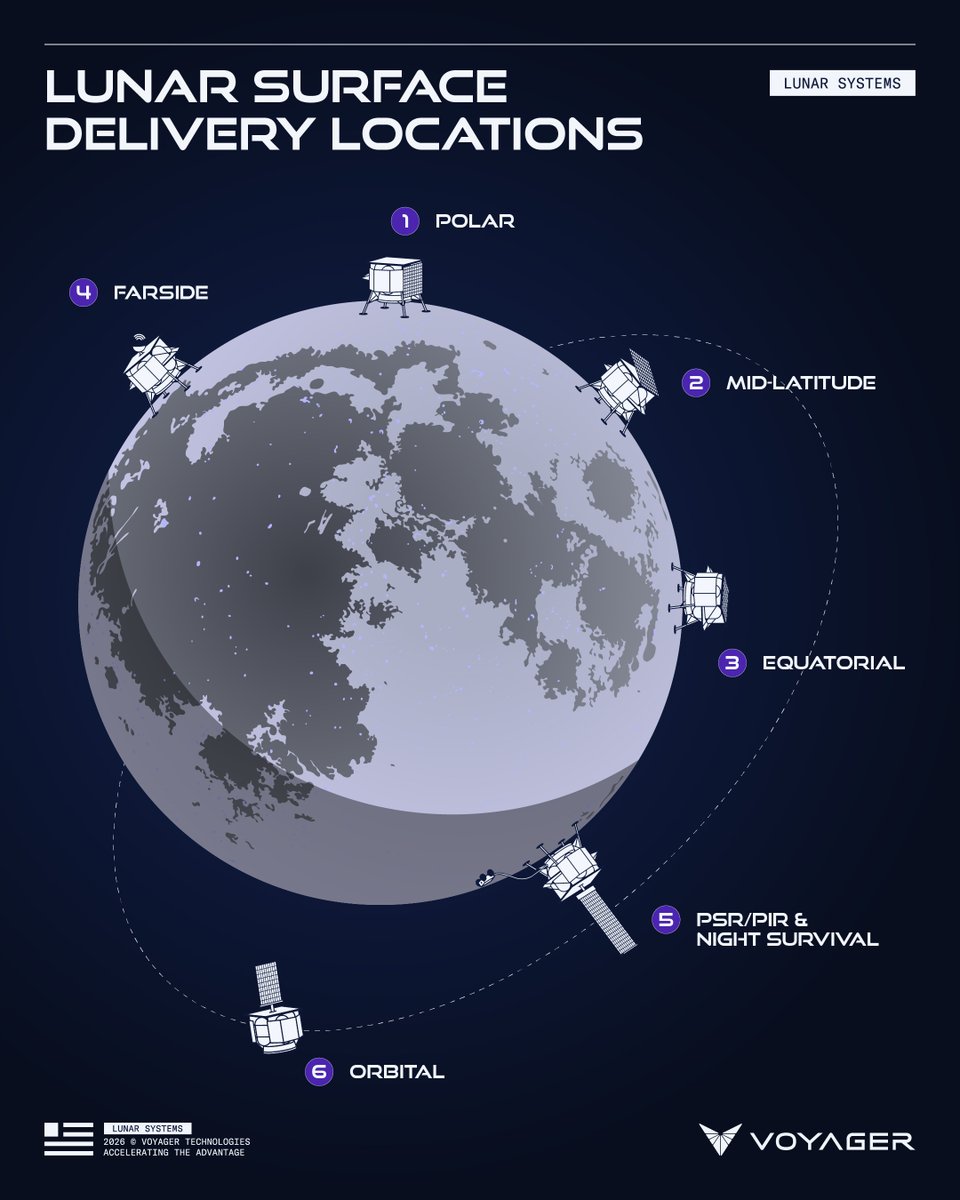
Our Peregrine and Griffin landers offer up to five payload deployment options and six different configurations to land on the lunar poles, equator and near or far sides. We configure to best match your mission needs, not the other way around.
$VOYG #AcceleratingtheAdvantage #MissionReady
Griffin-1 in late 2026. Peregrine-2 and -3 by the end of 2028. Voyager will go to the Moon three times in the next three years, but this is only the beginning. Read more about our upcoming lunar missions: https://t.co/ADYU0cfL5Y
$VOYG #AcceleratingtheAdvantage#MissionReady
Our small-class Peregrine lander, under @NASA contract for two lunar landing missions, has a max capacity of 50 kg, 1.0 W/kg of power and 192 hours of payload operation. The lander provides power, communications and thermal support throughout missions to enable scientific investigations and technology demonstrations.
$VOYG #AcceleratingtheAdvantage #MissionReady
Griffin-1 is getting a serious shakeout @NASAJPL. 🚀 Vibration testing puts the spacecraft through the forces it will experience during launch, helping our team make sure it’s ready for the journey to the Moon.
$VOYG #AcceleratingtheAdvantage#MissionReady#Griffin1
Space may be quiet, but getting there is not. 🔊🚀Voyager has completed acoustic testing for Griffin-1, confirming its hardware can withstand the intense sound environment of launch. Next up: vibration testing.🌙 Another critical step toward flight.
$VOYG #AcceleratingtheAdvantage #MissionReady #Griffin1
Orbital data centers were not top of mind in 2024, let alone the software layer. Our CTO Paul Tilghman on why that's the harder problem — in space, your software has to know where it is. Listen to his interview with @Via_Satellite@OnOrbitPodcast here: https://t.co/c0UjUn1Etg
$VOYG #AcceleratingtheAdvantage #MissionReady