Our 2024 CSHL conference on human brain development and stem cell models is in full swing, with over 300 participants!
This year’s event features exciting new discoveries and dynamic discussions, driven largely by the energy & insights of trainees.
A privilege to organize this meeting with Guo-Li Ming @UPenn_SongMing!
#Assembloids #Organoids #Brain
#CSHL2024Brain
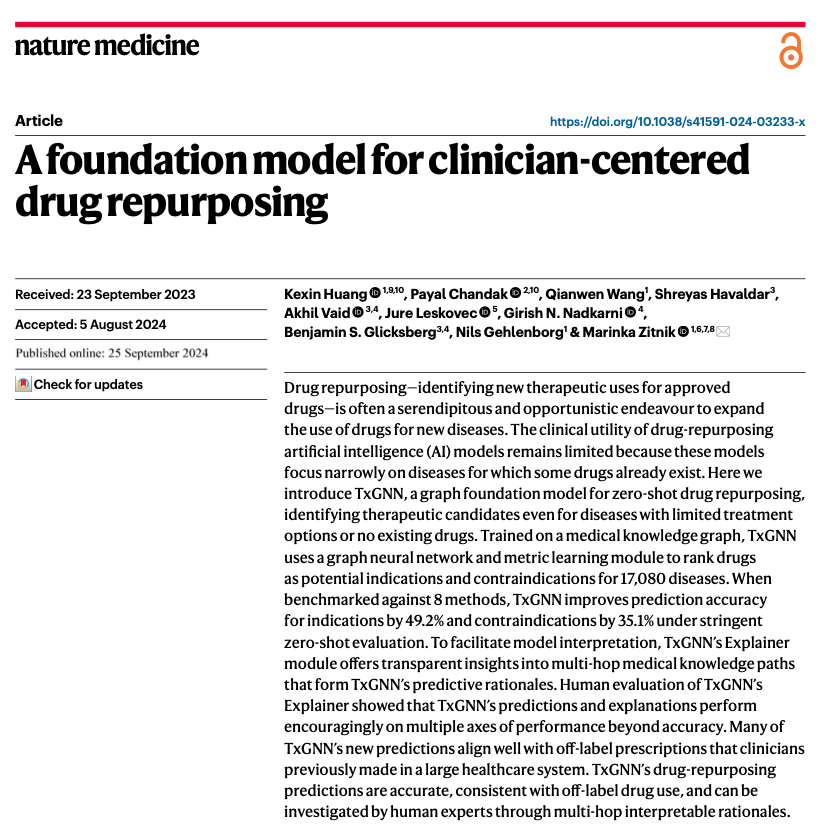
Excited to share TxGNN, a model that identifies potential therapies from existing medicines for thousands of diseases. Trained across 17,080 diseases, TxGNN predicts drug candidates for conditions with limited or no treatment options, including rare diseases
@NatureMedicine paper: https://t.co/TZcKGqjSba
Globally, there are over 7,000 rare and undiagnosed diseases, yet only 5 to 7 percent have treatments, leaving the majority untreated or undertreated. Even for more common diseases, new drugs could offer alternatives with fewer side effects or replace drugs that are ineffective for certain patients
TxGNN generates new insights on its own in the form of multi-hop interpretable rationales, applies them to diseases it was not trained for, and offers explanations for its predictions
Human evaluation showed that TxGNN's predictions perform well across multiple axes of performance
Many of TxGNN's predictions align with off-label prescriptions used in a large healthcare system
Many thanks to a fantastic research team @KexinHuang5@payal_chandak@WangQianwenToo@_toolazyto_@AkhilVaidMD@jure@girish_nadkarni@BenGlicksberg@HarvardDBMI@harvardmed@KempnerInst@harvard_data@broadinstitute@cziscience@harvardmed News and Gazette: https://t.co/xpr28o3n0n Thanks @EkaterinaPeshev
I am thrilled to share that I have joined @StJudeResearch as a faculty member. The Alsina lab is now open and studies the molecular and cellular mechanisms of brain development in health and disease, with focus on RNA and cytoskeleton regulation.
Sexual violence among primates, tides on Jupiter's moon Europa and cyber security: 201 postdoctoral researchers will benefit from Postdoc.Mobility fellowships to support their research abroad or their return to Switzerland.
https://t.co/JR236wXV8h
Sexual violence among primates, tides on Jupiter's moon Europa and cyber security: 201 postdoctoral researchers will benefit from Postdoc.Mobility fellowships to support their research abroad or their return to Switzerland.
https://t.co/JR236wXV8h
https://t.co/16MKBFz9fh
Check out our newest manuscript on #BioRxiv, where we provide an optimized method to visualize lipid droplets in wildtype mouse brain tissue! A special congrats goes to the shared first authors @PhDPetrelli and @Alicia__Rey!
It is an honour to announce that our 1st Charles Weissmann Lecture Laureate will be: Prof. Dr. Hans Clevers! He will give his lecture on 5 July at 15:30 in the Aula Magna of the University of Zurich (see flyer attached). Everyone is welcome to attend!!
Happy!!! The 1st piece of my work at @ArlottaLab out today @Nature!!! A huge team effort co-lead with @BolanosAnton ! So grateful to all our collaborators!!!!https://t.co/Nq4DxFB5FO
📢Thrilled! My 1st piece of work of my postdoc at @Arlottalab is out @Nature! This has been a huge co-lead effort with @IreneFaravelli👩🔬👩🔬🤩
Link: https://t.co/9HmNVh0SQZ
Tweetorial 👇🧵
Excited to share new work from our lab and @versp1 led by @MelissaACadena1! We're always thinking of ways to improve and customize organoid culture and differentiation. So we turned to 3D bioprinting to build tunable scaffolds for cortical organoids. https://t.co/RB4x2sEkoW
Latin America & the Caribbean are home to >8% of the world’s population, yet Hispanic people + people of LatAm ancestry comprise only 1.3% of all genomics data.
Read how #SingleCell researchers are building relationships to diversify the Human Cell Atlas https://t.co/rVHNZzd0on
Also, super cool to participate in the ongoing "The People Behind the Papers" series in @developmentjournal. Check it out here! https://t.co/dPzUswASpr
Happy to share our latest work on microglia! We developed a comprehensive transcriptional atlas of microglia throughout cortical development and demonstrated that these cells are essential for cortical changes induced by in utero inflammation. Congratulations to all co-authors and collaborators @ostremlab, @NuriaIturza, @jeff_stogsdill, @FaitsTyler, @kwanho_k, @jzlevin !!! https://t.co/MJkiX0BBtL
How do we first come to know the world around us? My #neuroscience colleagues @UZH_en found that young mice exploring the world with touch build upon early impressions formed by smell, using neural pathways that exist only briefly in #development. https://t.co/mAi1VXwrEh