The core economic pitch for Trump's mass deportations was "fewer immigrants means more jobs for Americans"
Unsurprisingly, that's just not happening
Prime-age employment rates for native-born Americans fell to the lowest levels in more than four years in data released today
A civilian medevac plane crashed in New Mexico after a U.S. military GPS-jamming exercise disrupted navigation across hundreds of miles, killing all four people on board.
Everyone should read this: https://t.co/RjS6heKs8K
BASH: I want you to use your bully pulpit to tells parents who have not vaccinated their kids that they should vaccine their kids for measles. Will you do that? Look into the camera
RFK Jr: I'll say it right now. Parents should get their children vaccinated for measles.
Saudi Arabia's message to Washington is becoming increasingly clear. It echoes the warning delivered by Defense Minister Prince Khalid bin Salman during his visit to Washington last week: if the United States launches major strikes against Iran's energy infrastructure, Saudi Arabia and the Gulf states will likely bear the immediate consequences.
Tehran has already signaled what it would target across the Gulf if President Trump follows through on his threats. From Riyadh's perspective, the timing could hardly be worse. With tensions rising again with the Houthis, the last thing Saudi Arabia wants is a broader regional confrontation with Iran.
This also highlights a broader strategic reality. The war has strengthened Iran's deterrence vis-à-vis the Gulf states. For Gulf leaders, preserving regional stability has become a higher priority than pursuing a decisive confrontation with Tehran.
At the same time, the core dispute remains unresolved. There is still no agreement over the future of the Strait of Hormuz, and Iran shows no indication that it is willing to compromise on what it views as its role there. As long as that issue remains unsettled, there is no obvious diplomatic off-ramp.
So far, Iran's strategy of increasing pressure on the Gulf state, treating them as the weakest link in Washington's regional coalitio, appears to be producing results.
The focus is shifting back to quiet diplomacy between Oman and Iran, as both sides explore whether a compromise over the Strait of Hormuz is still possible. But regardless of what emerges from those talks, the key decision will once again rest with Washington.
If an agreement is reached, will the Trump administration be prepared to accept it? If not, will it ultimately decide that military escalation is the only remaining option?
President Trump's hesitation also suggests that the administration itself is far from convinced that a broader military campaign would weaken Iran or compel it to concede. That uncertainty helps explain why, despite repeated threats, diplomacy continues to be the preferred path.
Ultimately, Washington still appears to view a negotiated outcome as preferable to a conflict whose costs and consequences remain highly unpredictable.
#iran
Allowing Starlink enabled strikes over Russia, or part of it, is one of the few ways available to hunt and displace Russian Iskander-M launchers. Also RM-48U. Presently, Ukraine is just not getting the interceptors it needs to keep up with Russian ballistic missile strikes.
Introducing Rook by @Hop_Aero (YC S26): an autonomous hypersonic cargo rocket that delivers 550 lbs up to 450 miles in ~15 minutes.
It launches from a standard 40-foot shipping container and lands on unprepared surfaces—no runways or fixed infrastructure required.
Petraeus: The death zone in Ukraine extends 35 kilometers on either side of the front lines — defined by drone battery life. Tanks can't survive. Armored vehicles can't survive. Nothing can.
Neither side even drives vehicles anymore. Russians keep trying and keep proving it.
Petraeus: No trenches — drones fly through. Soldiers in survivability positions hundreds of meters apart, not mutually supporting. Resupplied by ground robots.
Commanders can't visit the front line. Soldiers stay 60+ days. In urban areas, some couldn't be extracted for months.
Petraeus: Russian advances mean individual soldiers running forward trying to dig in. Drone units pick them up immediately, cycle surveillance drones, then FPV attack drones arrive.
You see them hitting around the soldier in the woods until one connects. It doesn't end well.
Petraeus: Ukraine is about to isolate Crimea. Gasoline so short they won't sell it to civilians. Tourists who came for beaches are trying to get home any way they can.
Kerch Bridge rail no longer works. Ferries knocked out. Land bridges destroyed. Pontoon bridges now targeted.
Petraeus: Ukraine took down Russia's air defenses steadily. Russia pulls them to Moscow — vulnerabilities open everywhere else. Moscow refinery hit three nights running, out at least six months.
They're going after fuel storage, refineries, gas lines from Siberia to the west.
Petraeus: Real prospect now that Putin might need a cessation of hostilities himself. Oil sanctions reimposed, national welfare fund running out of money.
Crimea isolated, front lines cut off, economy crushed — all of this could force Putin to recognize he should end this war.
Source: text of Tymofiy Milovanov
Ukraine's ongoing destruction of Russia's Wildberries logistics empire is beginning to look like a backdoor method to implode the Russian banking system.
Oligarch Deripaska says Wildberries owes so many billions that its bankruptcy will "destroy the banking system".
This is one of the most important pieces I've read on the future of warfare because it captures something too many policymakers still haven't internalized: the character of war has fundamentally changed.
The decisive advantage is no longer who has the most tanks, artillery, or troops. It's who can see first, decide first, adapt first, and replace losses fastest. A drone that costs a few hundred dollars can destroy equipment worth millions. Soldiers spend months dispersed in isolated positions because concentrating combat power has become a liability, not an advantage.
I've been hammering this issue because it has implications far beyond Ukraine. It changes how we build our military, how we buy technology, how we train our force, and how we rebuild the defense industrial base. If our acquisition system can't keep pace with the speed of innovation, we're preparing for a battlefield that no longer exists.
Outstanding work by @Reuters.
https://t.co/XNyGuV18r3
Ukraine is about to start shooting down Russian drones with lasers.
Not in some distant future. In two to three months.
The weapon already exists. It already works. It has already shot down FPV drones — and it is now being tested against Shaheds.
"This is not some future thing. It already knows how to shoot down FPVs today. And it is already working on Shaheds. This is a matter of the next 2–3 months — we will have systems that hit aerial attack weapons even better than machine guns."
That was Brigadier General Andrii Lebedenko, Deputy Commander-in-Chief of the Armed Forces of Ukraine, at a briefing.
Here is why it matters.
Right now, a Ukrainian mobile fire group shoots down a $20,000 Shahed with machine gun rounds — and hopes the barrel holds and the ammunition lasts. Russia launches 100–500 of them a night.
A laser has no ammunition. It has electricity. Point, hold, done. The economics of that flip the entire drone war.
And lasers are only half of it.
Ukraine is also developing pulse weapons — designed for the problem that keeps air defence planners awake:
"Mass drone use in swarms or group raids means we need brilliant solutions where you press a button and those swarms either fail their mission or are completely destroyed. We have these projects too. Some are partner projects, some are ours — and I think we will demonstrate this soon."
Russia's entire strategy for exhausting Ukraine's air defence is volume. Fire enough cheap drones, and eventually the interceptors run out.
Ukraine's answer is to make the interceptor cost approximately nothing.
Press a button. Kill the swarm.
Two to three months.
Source: Deputy Commander-in-Chief of the Armed Forces of Ukraine / ArmyInform, July 23, 2026
#Ukraine #UAF #AirDefence #DroneWarfare #ModernWarfare #DefenceTech
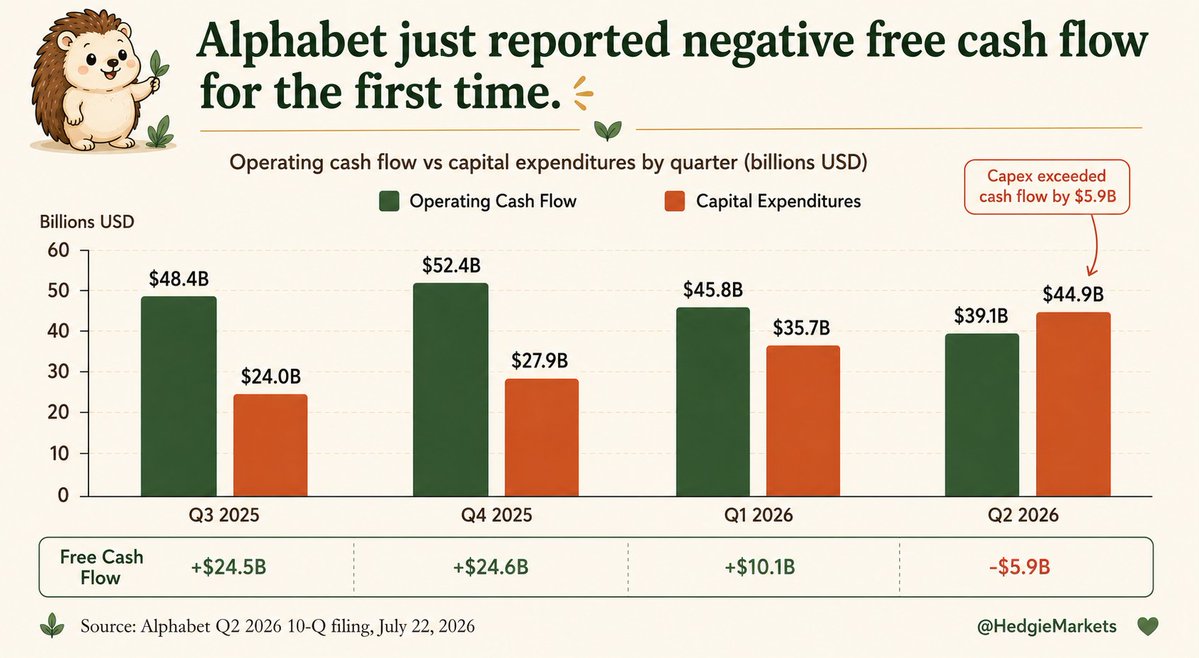
🦔Alphabet beat on every headline number tonight. Revenue up 24%. Cloud up 82%. EPS of $9.11. But $6.26 of that EPS came from paper gains on Alphabet's Anthropic stake, not from operations. Strip that out and operating EPS is about $2.85. Free cash flow went negative for the first time in Alphabet's history. Long-term debt more than doubled in six months. Stock buybacks dropped to zero.
My Take
Cloud grew 82% and I'll give them credit for that. But the company spent $44.9 billion in capex during a quarter where cloud brought in $24.8 billion. Alphabet raised $49.6 billion in equity and $20.3 billion in bonds in Q2 alone, roughly $70 billion in outside capital in a single quarter to fund AI infrastructure that the business itself can no longer cover from cash flow. A year ago Alphabet was buying back $13 billion in stock per quarter. Now it's issuing stock instead of repurchasing it. That shift is a bigger deal than the revenue beat.
The $9.11 EPS will be the headline on every financial site tomorrow and most people won't dig deeper. Alphabet booked $77 billion in unrealized gains because its Anthropic stake went up on paper ahead of the IPO. Nobody paid Alphabet $77 billion. If Anthropic's IPO prices lower or gets delayed, those gains reverse. The actual operating business just crossed into negative free cash flow for the first time while doubling its debt. I think this earnings report will age differently than the headline says.
Hedgie🤗
Talked to someone today who found that a single $30/hr employee who focused on leveraging AI and becoming an expert in her field began outproducing an entire team of 15+ people.
They laid off most of the team, 5x’d her pay, and gave her an unlimited token budget.
Trial lawyers are lobbying against self-driving cars because they're too safe. They need people to be killed and injured so that they have material for lawsuits.
This is absurd. Every piece of voter data Trump mentions here, as well as which elections each voter voted in, is readily available in Kentucky for a small fee.