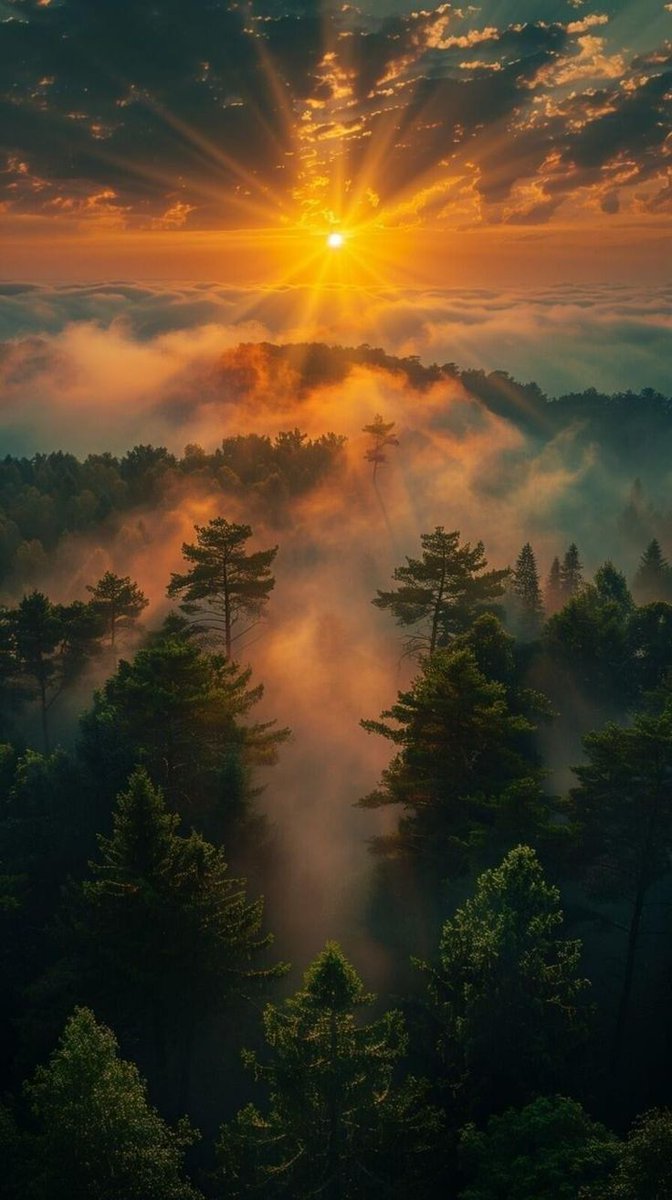
To everyone who has subscribed to this account, thank you. Your support is greatly appreciated. If you enjoy this account and would like to support it, consider subscribing as well.
📽️: Antonio Sáez
Fast radio bursts (FRBs) - enigmatic, millisecond-long flashes of radio emission from the distant universe - were first discovered in 2007.
Their origins are difficult to pinpoint, but Webb found the host galaxy to the most distant FRB seen to date.
https://t.co/nd2NQqrRdX
Within this star-forming nebula (captured by Webb) are the smallest brown dwarfs ever detected. Neither planet nor star, these objects are formed like stars, raising questions about the star formation process. https://t.co/s58sxdx1dl
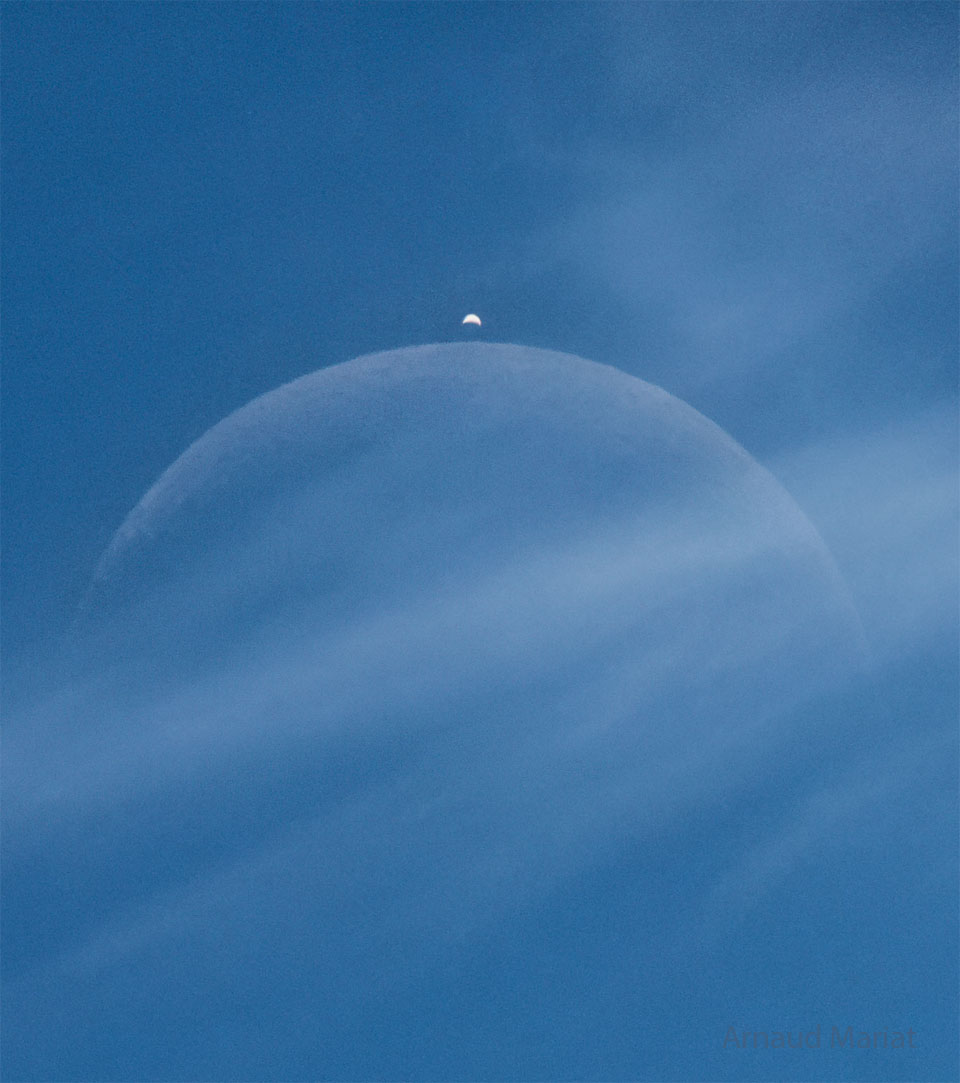
There was something behind the clouds. Upon close inspection, it was the Moon, which was hard to see yesterday around noon above the small village of Cessy, France. But soon, it was not only the Moon. As expected, a bright dot suddenly appeared from behind the Moon -- the planet Venus far in the distance. Captured in the single featured exposure, both appeared to show a crescent phase. The Moon's crescent was quite slight -- with only about 10 percent of its face illuminated by the Sun. In contrast, Venus's crescent was more full -- showing about 25 percent illumination. Venus appeared brighter because it is nearer the Sun and because its clouds are more reflective than the dark lunar surface. An occultation of Venus by the Moon is visible to only about 10 percent of the Earth, but in yesterday's event even most of that was experiencing daytime.
Image Credit & Copyright: Arnaud Mariat
We’re teaming up with the @NFL to bring the excitement of America’s space program directly to fans! Catch our Inspiration Tour at four games this fall, including NASA aircraft flyovers before kickoff: https://t.co/7HxjTOXc1P
The flying chipmunk! 🐿️
#OTD in 1987, this De Havilland-Canada DHC-1A Chipmunk "Pennzoil Special" was delivered to the Museum. Veteran aerobatic and movie pilot Art Scholl flew it in airshows around the country in the 1970s and early 1980s. #AirSpacePhoto
Is this a fossilized turtle on Mars?
No.
Although resembling a large Earth tortoise, this is a layered rock outcrop on Mars that is estimated to span about 15 meters, making it much larger than turtles on Earth.
NASA’s robotic Curiosity rover came across this unusual mound, dubbed Miraflores, last month during its 4922nd Martian day exploring Mars.
The small butte may survive because it was somehow more resistant to erosion than surrounding rock.
More recent wind has now covered its top with orange Martian sand. Below the top shell, many layers of stratified rock are visible, possibly indicating a long history of intermittent wind-blown sand being deposited and then hardened by ground water.
Similar wind-eroded layered landforms, such as yardangs in the Qaidam Desert of China, exist here on Earth. Curiosity and its companion rover Perseverance continue to investigate the ancient history of Mars as well as searching for signs of primeval life.
Image Credit: NASA/JPL-Caltech/MSSS; Processing & License: Thomas Thomopoulos
Is there an angry Sith using force lightning in the Tatacoa Desert?
This is not science fiction, but a red sprite with multiple streamers! Ordinary lightning occurs when thundercloud particles collide, lose their electrons, and build up negative charge at the cloud bottom.
The cloud’s negative charge repels negative charge deeper into the Earth, leaving Earth’s surface positively charged. The opposite charges attract, reaching towards each other and superheating the air into a white strike of plasma.
Red sprites are millisecond events triggered by positive cloud-to-ground lightning. They extend up into the mesosphere where the air is too thin for thunder. Their red glow comes from heated molecular nitrogen.
There are several potential causes for red sprites, including that the preceding positive lightning exposes the negatively charged cloud core to the positively charged upper atmosphere, allowing those charges to connect. NASA’s Juno has observed sprites on Jupiter, indicating that sprites occur on other planets!
Image Credit & Copyright: Mario Vargas
Text: Keighley Rockcliffe (NASA GSFC, UMBC CSST, CRESST II)
Sam Neill, the versatile actor whose career of more than 50 years was highlighted by his appearances in the “Jurassic Park” and “Jurassic World” franchises, died on Monday in Sydney, Australia. He was 78.
In April, Neill revealed that he was cancer free after being diagnosed in 2022 with stage 3 angioimmunoblastic T-cell lymphoma, a form of blood cancer.
"Sam was surrounded by family and passed with the dignity that has characterized his whole life,” his family said in a statement. “The loss was sudden and unexpected but blessed by the fact that Sam remained cancer free." https://t.co/Dt5AmNXBgM
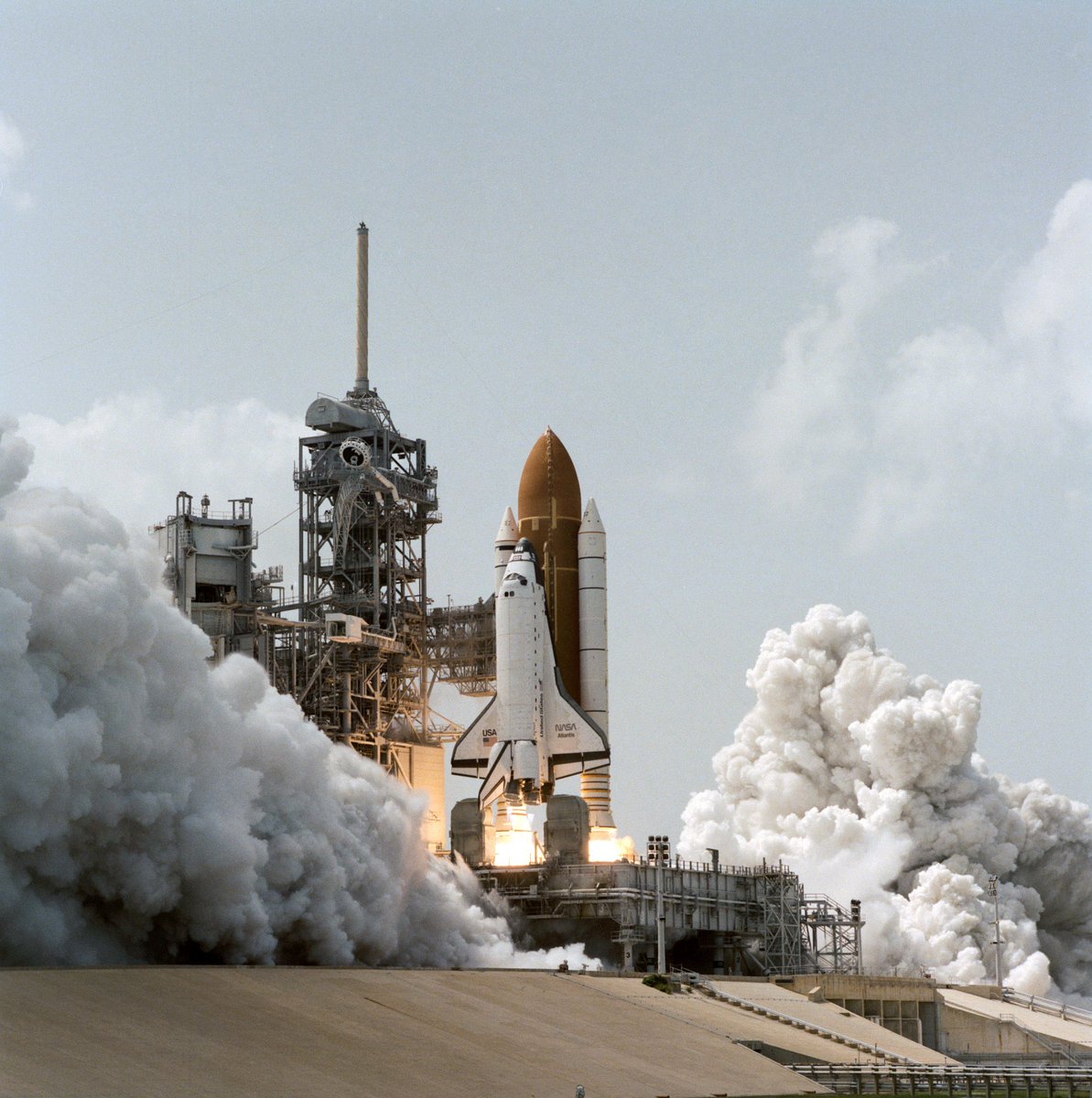
On this week in history in 1995, Space Shuttle Atlantis launched on the United States' 100th human spaceflight. STS-71 was the first mission to complete space shuttle-Mir docking.
#OTD in 1985, Space Shuttle Discovery launched on its fifth mission—STS-51G—to deploy three communications satellites, including Mexico's Morelos-1 satellite, pictured here.
This Vought OS2U Kingfisher served aboard the USS Indiana and was used to rescue two U.S. airmen shot down over Guam during World War II. It is our featured Guam artifact for our "50 for 50" project: https://t.co/ZWRGRJNQ2n
The upper galaxy might be more photogenic, but the lower galaxy is more unusual. The galaxy up top is NGC 3660, a spiral galaxy similar to our own Milky Way galaxy in that it has several bright blue spiral arms and a central bar of stars, dust, and gas. Captured by chance in the featured deep and colorful image, surprisingly, is SN 2026cff, a supernova found just to the right of the central bar. Farther in the distance is the bottom galaxy, known informally as Burçin’s galaxy, but formally cataloged as LEDA 1000714. The center of this galaxy appears to be an old elliptical galaxy, but it is strangely surrounded by not one but two rings of stars. What created Burçin's galaxy is a mystery and remains a continuing topic of research, but it likely involves the accretion of one or more smaller galaxies.
Image Credit & Copyright: Adam Block, El Sauce Obs.
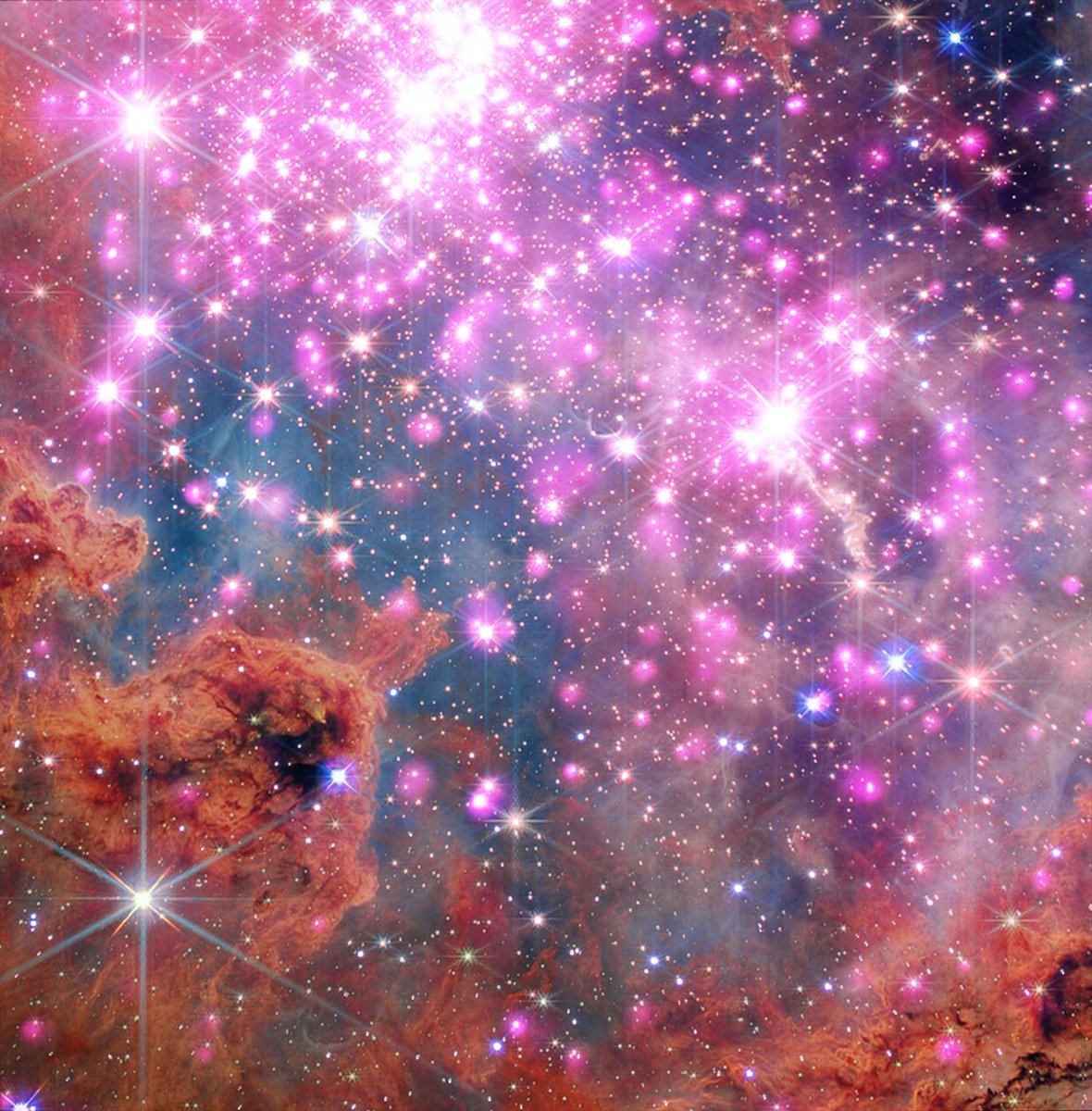
Westerlund 2 is a young cluster of thousands of stars located about 20,000 light-years from Earth. This close-up image, roughly 12 light-years across, combines observations from NASA's Chandra X-ray Observatory & @NASAWebb.✨
Don’t let anyone dull your shine 💫
The heart of galaxy M77 nearly outshines the galaxy itself in this mid-infrared Webb image. Gas rapidly orbits the central black hole, heating up, and radiating light. https://t.co/LDOGmXEytb
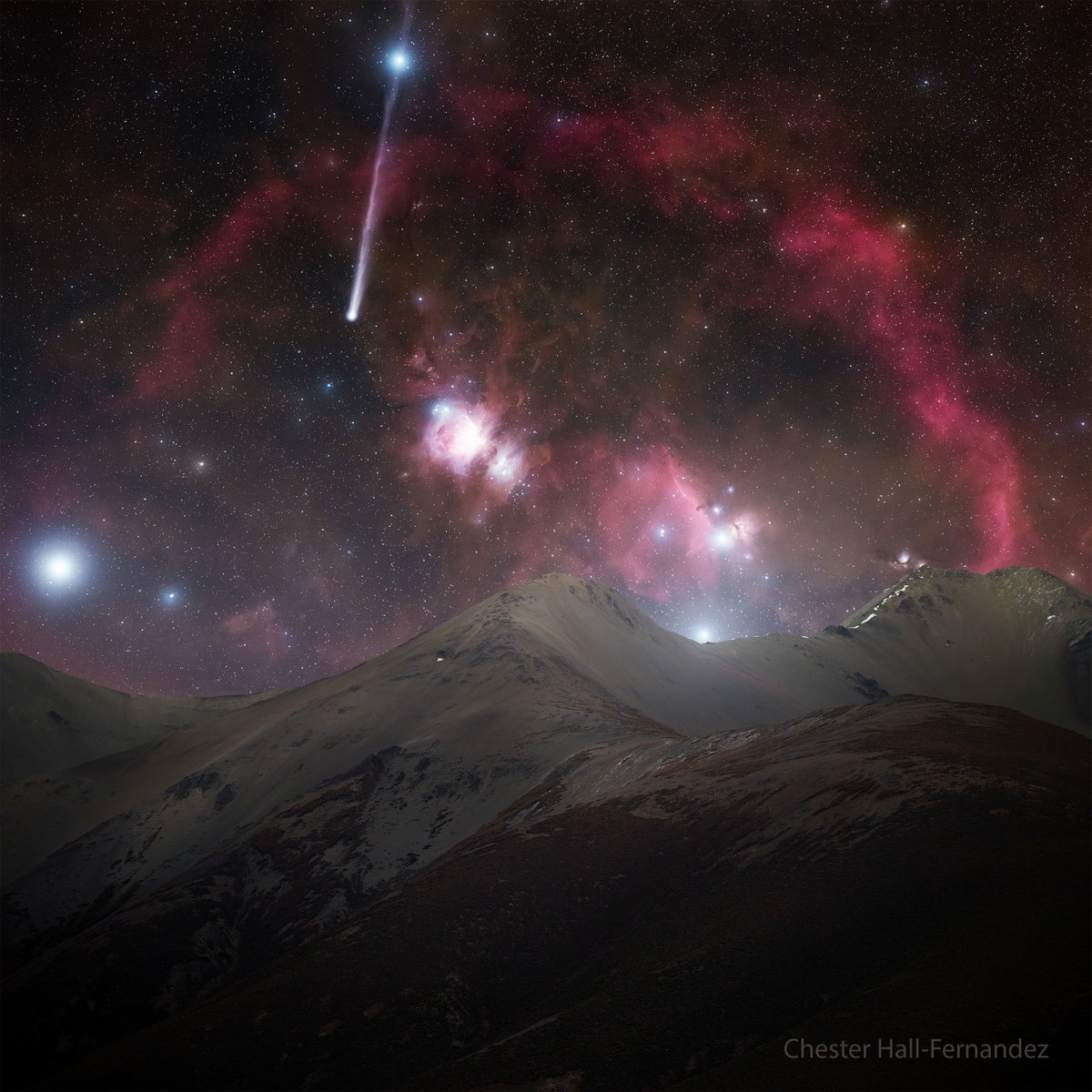
Comet R3 PanSTARRS might be best remembered as an Orion comet. A key reason is because Comet C/2025 R3 (PanSTARRS) was near its most spectacular -- in terms of tail visibility -- when passing in front of the iconic constellation.
Although rare, other bright comets, too, have ventured across Orion, including Lovejoy in 2015, Hale-Bopp in 1997, and the Great Comet of 1264.
Best visible in long duration exposures, the featured image was captured last week from the Craigieburn Mountain Range in New Zealand. Visible in the deep background image are the Orion Nebula, Barnard's Loop, and through R3's tail, the bright star Saiph, the sixth brightest star in the constellation of Orion.
Comet R3 PanSTARRS continues to fade as it moves further south, passing into the constellation of the Unicorn (Monoceros) in the next few days.
Image Credit & Copyright: Chester Hall-Fernandez
65 years ago today, Mercury capsule #14 was launched on its second uncrewed launch escape system test at Wallops Island. The launch escape system functioned as planned even though the trajectory was too low and the aerodynamic pressures were higher than planned.