@NoBiscotti I'm proud to say I didn't vote for this Trump ass-licker who likes tying firecrackers to cats. I VOTED FOR IVÁN CEPEDA 🫰🏻 This is EMBARRASING.
https://t.co/xMscONzUiw
This piece is clearly post-liberal and right-populist rather than conventionally Republican in the way outlets like Fox News often frame issues.
3. The article also suggests that participation in DEI organizations or anti-racism initiatives became a pipeline toward fellowships, residency distinctions, scholarships, and awards. If that occurred in a purely performative or opportunistic way, then yes, that is deeply—
—not only current medical students — White and Asian physicians, as well as men, still remain heavily represented within the field. That broader context matters and is often left out of these discussions.
2. The author argues that White and Asian individuals are becoming underrepresented in certain academic or training spaces. To some extent, there is data that can support parts of that argument. However, if we examine who overwhelmingly practices medicine overall—
—not simply institutional pressure or performative quotas. Otherwise, we are not addressing the root problem; we are only applying temporary fixes to deeper social inequalities that remain unresolved.
1. The one area where I partially agree is the idea that there can be forms of forced inclusion. I am a far-left Democrat and strongly support DEI initiatives, but I believe inclusion should ultimately come from education, ethical development, and structural cultural change—
Its central critique targets DEI and affirmative-action approaches within human sciences and medicine, generally arguing in favor of meritocracy and standards-based admissions, hiring, and inclusion.
My thoughts are more nuanced:
Repetition rewires the brain.
Repetition rewires the brain.
Repetition rewires the brain.
Repetition rewires the brain.
Repetition rewires the brain.
Repetition rewires the brain.
Repetition rewires the brain.
Love! From a psychological perspective, music offers a powerful metaphor for cognition: temporally structured, predictive, embodied, and socially coordinated. Thinking of the brain as an orchestra rather than a computer captures the dynamical nature of neurocognitive processes.
Music helps to understand the mind and the brain. Throughout the history of science, metaphors have shaped how we understand complex phenomena. The brain-as-computer metaphor has guided decades of theories and research. We propose music as a scientific metaphor for understanding the mind and brain via triplicate interfaces (listener, performer, composer) and a compound set of predictions. Multiple domains of music can be mapped onto different neural, cognitive and intersubjective processes such as network coordination, prediction, emotion and meaning. Neurocognition is not static but a dynamic, embodied, and time-sensitive system, much like a self-organized orchestra in which multiple processes interact simultaneously. Drawing on synergetics, predictive processing, and embodied cognition, we outline musical principles illuminating cognitive and action integration across time, offering new conceptual frameworks and testable predictions for future research. I enjoyed writing this piece with these stellar authors: @Kaiameye, @acolverson1, Christopher Bailey, @brucemillerucsf, @dafneduron90, Nicholas Johnson, Olga Castaner, @PierLuigiSacco, Eoin Cotter and Lucia Melloni. Science, like music, advances through new ways of listening to complex systems: https://t.co/W3pJRyXJOH
Psychotherapy is the most leftwing profession, statistically, and regularly produces people with a revolutionary bias toward the world.
Weirdly, the second doesn't actually follow from the first. Therapists are generally leftwing because they're structural thinkers, but they're great about keeping their politics out of session. The reason people come out of therapy in a countercultural mindset is because therapy is fundamentally anti-duty, anti-"should." There's a naive belief in the goodness of human beings, that we have a natural draw toward wholeness with our environments that our feelings automatically point us toward.
This was very inspiring and understandable in the 1970s but totally fucking bonkers in the hyperreal 2020s. Corporations have spent 50 years engineering the average person's environment into a wall-to-wall hyperaddiction machine. If you "just do what feels good" you will enjoy yourself right into a malnourishing, ideologically warped, forever-alone, neon-lit gooncave. You will be correct about relationships, about dependency, about how your family should treat you, about how the world should make you feel. Your environment will perfectly suit your needs, free of anything that reminds you of your dependence on the sacrifice of normal, decent people who accept reasonable limitations on their behavior as the price of civilization.
Everything will feel good and nothing will mean anything. You will have finally achieved happiness, and it will be the worst thing that ever happened to you.
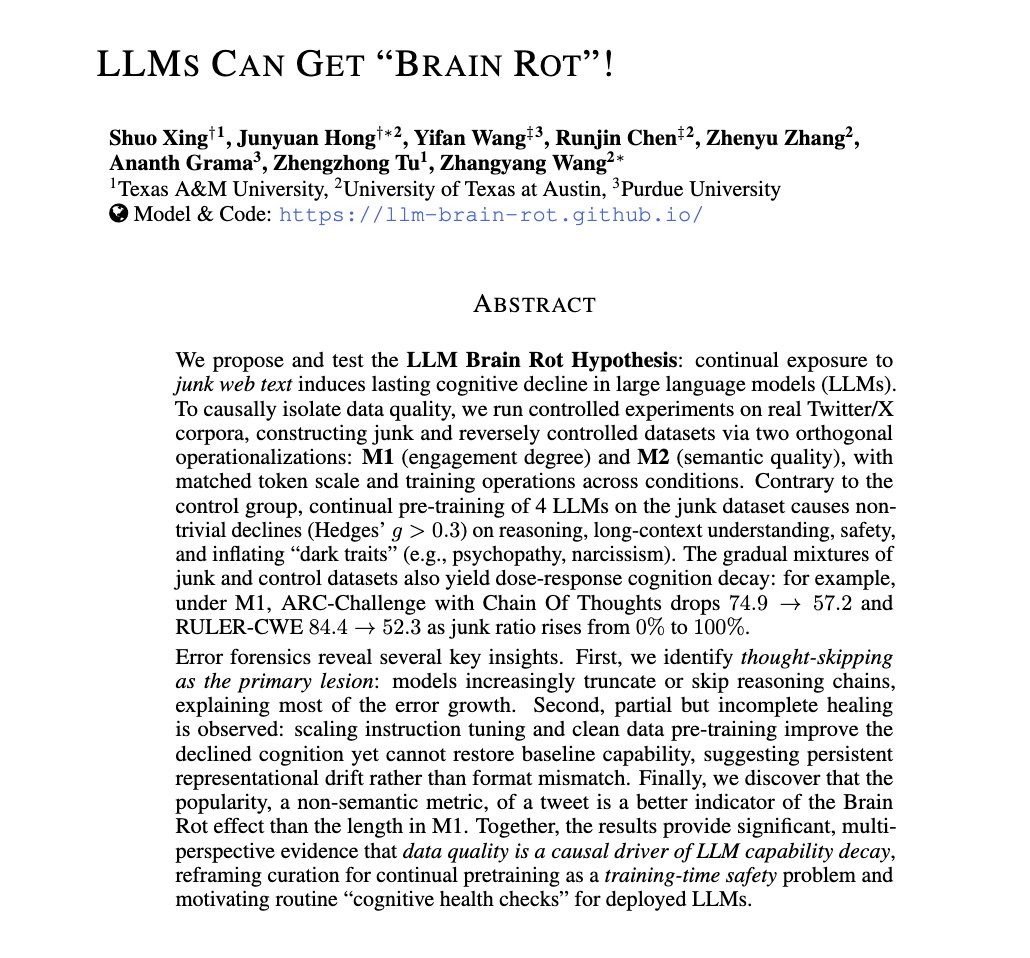
This might be the most disturbing AI paper of 2025 ☠️
Scientists just proved that large language models can literally rot their own brains the same way humans get brain rot from scrolling junk content online.
They fed models months of viral Twitter data short, high-engagement posts and watched their cognition collapse:
- Reasoning fell by 23%
- Long-context memory dropped 30%
- Personality tests showed spikes in narcissism & psychopathy
And get this even after retraining on clean, high-quality data, the damage didn’t fully heal.
The representational “rot” persisted.
It’s not just bad data → bad output.
It’s bad data → permanent cognitive drift.
The AI equivalent of doomscrolling is real. And it’s already happening.
Full study: llm-brain-rot. github. io
@g0thgoblin Short girl legs. It's normal. Men are disgusting. Also, I've seen this picture countless times and I NEVER looked at her ankles. I kept looking at the quads!
We might know more about ourselves than anyone else, but sometimes we need an external perspective to shed a light on the things we don’t want to admit.
Full conversation with Prof Cheng Lesong of @PKU1898 here: https://t.co/a9ImfZmDsD