The Dutch government wants to tax holding #Bitcoin, #Crypto, Physical Gold and Silver, with 36% unrealized capital gains, while they're going to tax holding those assets through an ETF or any other service provider with 36% realized capital gains.
That's wrong.
That's theft.
That's the opposite of what it should be.
That's why I'm supporting @NVC_crypto with their paper on why these taxes should be the same.
Holding #Bitcoin in self-custody should be supported, not taxed.
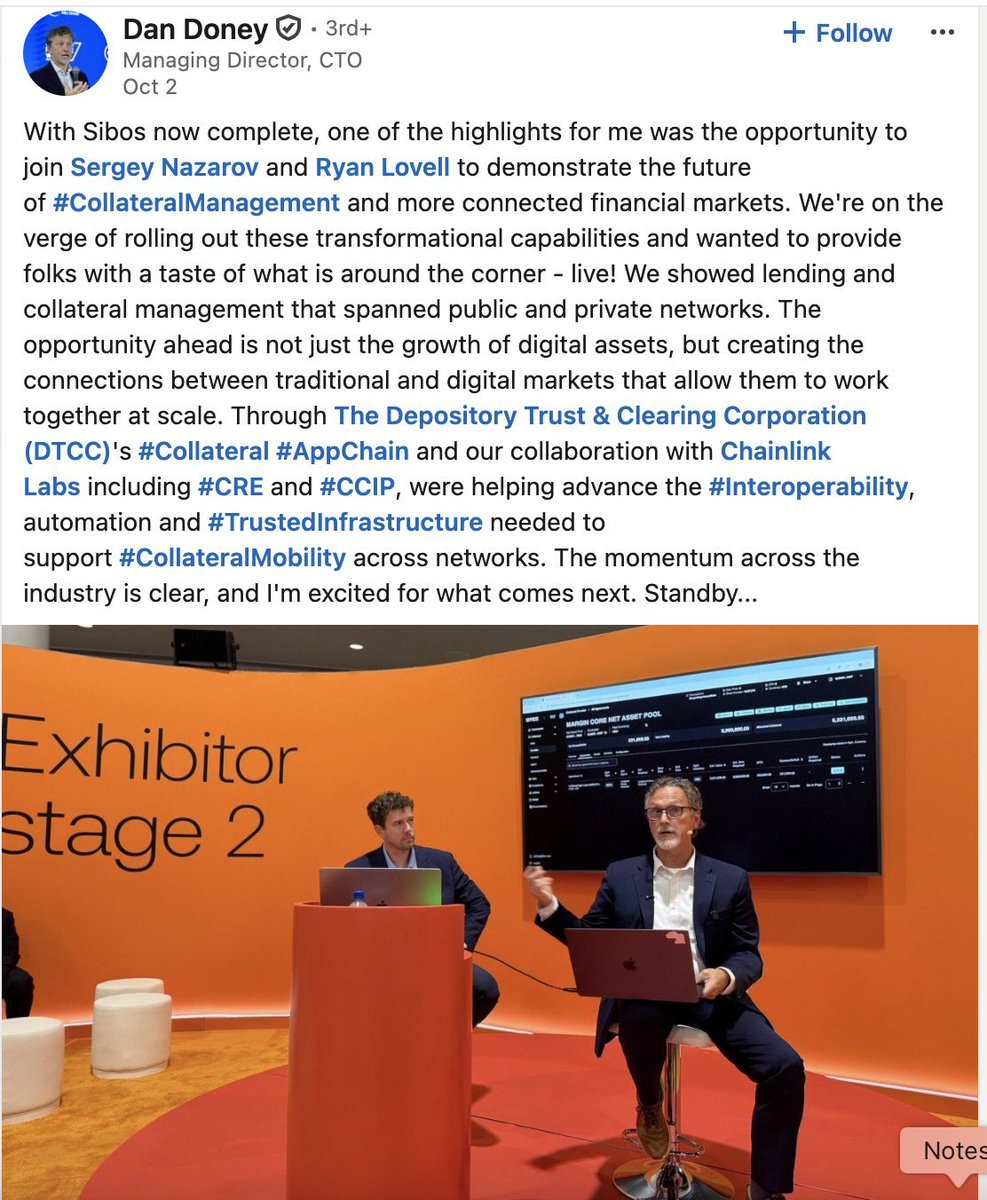
Just the CTO of DTCC, the central clearing house for U.S. securities, which processes quadrillions in value annually, talking glowingly about #Chainlink.
Sergey Nazarov with @RobbieKlages of @therollupco at @Sibos 2026:
"Tokenized equity is about better yield on the equity, 24/7, 365 movement of the equity, better balance sheet management."
"The more chains there are, and the more things you need to connect to the contract then to the chain, the more important Chainlink is."
"Chainlink will continue to evolve and become whatever is needed for advanced smart contracts."
Watch the full conversation:
Disappointed by the European Central Bank’s (ECB) and European Banking Authority’s (EBA) responses to the MiCA consultation.
They are not only advocating for a prohibition on paying yield on stablecoins, but also for restrictions on CASPs providing access to DeFi, including protocols offering yield on non-MiCA-authorized stablecoins, without providing a clear framework for how access to DeFi should work in practice.
They also suggest that CASPs offering access to DeFi should restrict it to certain groups of users through so-called “suitability tests,” alongside a potential certification regime for DeFi lending protocols.
It is unclear how these requirements would work in practice. If regulators determine which protocols are deemed suitable for European users, the result risks looking very different from the open DeFi that exists today.
Instead, we could end up with more walled gardens that undermine the liquidity and network effects of open financial networks, ultimately limiting Europeans’ ability to access new ways to grow and preserve wealth.
These proposals are presented as measures to “protect consumers.” But excessive restrictions can instead create more friction for innovation and slow the development of open, transparent, and auditable financial infrastructure that can benefit consumers.
The reality is that onchain finance, including stablecoins, DeFi, and tokenized securities, has the potential to reshape financial infrastructure by reducing friction, increasing transparency, and expanding access to financial opportunities.
European consumers and businesses stand to benefit significantly from this transformation, particularly if the companies building this infrastructure can continue to build and compete from within Europe.
Meanwhile, U.S. regulators, including the SEC and CFTC, have increasingly taken a more pragmatic approach toward enabling onchain financial innovation.
European regulators should put users and their interests at the center of the framework. Banks and other incumbents should be able to adapt their businesses to serve users in an increasingly onchain economy, rather than relying on artificial restrictions that risk increasing costs and reducing access for Europeans as the rest of the world moves onchain.
DeFi will win.
The launch of CCIP 2.0 is something we've been working on with the world's top financial institutions for a while, we have now implemented their feedback on what is needed for institutional grade bridging of data and the movement of the digital assets themselves across both public and private chains.
The response from the capital markets community here at Sibos has been very positive, and it is clear that the additional compliance, risk management, configurability and network participation capabilities of CCIP 2.0 are something that institutions find attractive and useful.
I think the digital asset industry will end up at a new level of risk management for their data all of their tokenized value; where digital assets that are not bridged via a secure method and/or are relying on data that can be manipulated, will be viewed as much more risky. If the digital assets that bridge via providers which are not secure by default and/or keep repeatedly losing bridging keys, then they will receive worse asset risk scores which necessarily leads to worse terms for their usage as collateral, their inclusion on a balance sheet, and various other use cases. In some cases we are already seeing that having unreliable bridging or easy to manipualte data for valuation is leading to some digital assets to not be accepted for collateral or other users cases at all.
We are now working closely with top FMIs, the leading banks, top asset managers, top GSIs and various capital markets technology providers to enable digital assets to operate in a derisked way, to unlock the liquidity found in public chains and to efficiently connect the next generation of digital assets to the benefits of DeFi.
https://t.co/rYzhSWCcPY
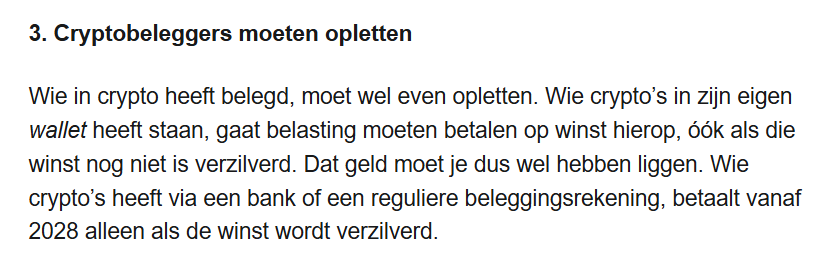
Let op: Het lijkt erop dat de wijziging voor crypto en bitcoin nóg minder gunstig uitpakt dan het onderstaande bericht suggereert.
Als vermogenswinstbelasting alleen gaat gelden voor financiële instrumenten, kan rechtstreeks aangehouden bitcoin onder de vermogensaanwasbelasting blijven vallen.
Of je die bitcoin op een Ledger bewaart of bij een exchange, verandert op zichzelf niets aan het type bezit.
Een crypto of bitcoin ET/ETH zou dan mogelijk wél onder vermogenswinstbelasting vallen.
De precieze uitwerking moet dit nog bevestigen, maar het onderscheid zou dus liggen in bij definitie van het beleggingsproduct, niet bij de bewaarplek.
Dus vanaf 2028 betalen we alsnog papieren winst op crypto in je wallet?
Eén van de meest risicovolle, volatiele assets voor een belegger?
En daarover 36% op papieren winst? Een asset die 80% in een jaar kan dalen?
Ze zijn helemaal gek geworden.
https://t.co/0tI5Wdimlp
TODAY: Chainlink announced it is working to enable financial institutions to connect to @swiftcommunity’s blockchain ledger through the Chainlink platform.
Swift moves the equivalent of the world's GDP roughly every three days ⬇️
Onchain recordkeeping is becoming regulated financial infrastructure.
The CFTC just clarified that registrants can use blockchain technology to satisfy recordkeeping requirements and hold customer funds in tokenized forms of permitted investments.
This is exactly the kind of institutional infrastructure Chainlink has been building.
NEW: @PaxosLabs, has launched PAXGy, a gold-backed token built on $1.8B+ PAX Gold (PAXG) issued by @Paxos that accrues in gold terms.
PAXGy is powered by CCIP as its exclusive cross-chain infra & Chainlink Price Feeds for reliable onchain pricing to enable adoption across DeFi.
NEW: Bottomline, a top-three Swift service provider moving $16+ trillion in payments annually, has launched Global Pay Connect, a new onchain payment connectivity platform for 600+ banks powered by Chainlink.
@bottomlinepay and Chainlink are now giving financial institutions a direct path onchain at scale.
Chainlink extends Bottomline’s platform to blockchain networks through secure interoperability & orchestration infrastructure:
→ CCIP connects Bottomline's payments infrastructure to blockchain networks through a single, network-agnostic integration model.
→ CRE coordinates end-to-end payment workflows across onchain & offchain systems.
The result is that institutions can reach onchain payment rails through the Swift network & payment messaging standards they already use, without replatforming or building a bespoke integration for every network.
The infrastructure powering global payments is connecting to the onchain economy through Chainlink.
🚨 New CLG Podcast is live 🚨
Two years since our last episode, @Crypto___Oracle and I discuss how institutional adoption is reshaping crypto and who will benefit as tokenization scales
This one was long overdue
Link in the next tweet 👇
$LINK This Partnership is absolutely massive and I don't think people understand the numbers here.
Bottomline moves $16+ TRILLION in payments every single year.
• 600+ banks use Bottomline.
• They are a Top 3 Swift service provider.
• And Chainlink is now being integrated to connect that existing payment infrastructure to public AND private blockchains.
Just look at the numbers.
• 0.1% of $16T = $16 BILLION
• 1% = $160 BILLION
• 5% = $800 BILLION
• 10% = $1.6 TRILLION
• 25% = $4 TRILLION
Look at the SIZE of the infrastructure Chainlink is getting plugged into.
And the 600+ banks part is wild brah
• This isn't Chainlink trying to individually convince 600 banks to integrate blockchain infrastructure.
• Bottomline already has the banking relationships.
• Bottomline already has the payment infrastructure.
• Bottomline already moves $16T+ annually.
• Banks can continue using familiar ISO 20022 messaging while accessing public and private blockchain rails.
• Chainlink provides the interoperability and orchestration infrastructure connecting these different systems.
Think about how ridiculous that distribution is.
• $16,000,000,000,000 in annual payments.
• 600+ existing bank customers.
• Public chains.
• Private chains.
• Existing banking systems.
• ISO 20022.
• CCIP connecting networks.
• CRE coordinating the workflows.
And this is literally ONE Chainlink partnership.
One.
Now add everything else Chainlink is involved in across tokenized assets, stablecoins, funds, securities, cross-chain settlement and institutional finance.
This is why I keep saying people are massively underestimating how big Chainlink can become.
$16 TRILLION annually from ONE partner's existing payment ecosystem.
The scale is fucking absurd. Biggest asymmetric Opportunity in the history of capital markets.
Yachts and mansions will be bought. Parties will be thrown.
NEW: Top-three Swift service provider, Bottomline, has entered a strategic partnership with Chainlink to unlock cross-chain, cross-border payments for its 600+ bank customers.
Bottomline moves more than $16 trillion in payments annually across its platforms.
Through the partnership, Chainlink is providing the secure interop and orchestration layer connecting Bottomline’s existing payment infrastructure to public and private blockchains.
TradFi is moving onchain at a rapidly accelerating pace, and CCIP is enabling tokenized value to move securely across chains, with the Chainlink Runtime Environment (CRE) coordinating payment workflows end-to-end.
The result is that Bottomline’s banks can continue using familiar ISO 20022 messaging to access onchain payment rails through a single, network-agnostic connection.
NEW: @Lighter_xyz, a top perp DEX with $1.7 trillion total volume, has expanded its adoption of Chainlink to strengthen data oracle security.
This strategic expansion covers 100+ markets, on top of the 25+ already powered by Chainlink, scaling support for U.S. and APAC equities, major crypto assets, foreign exchange pairs, and commodities.
The integration covers both the Lighter L2 deployment on @Ethereum, as well as the deployment on @RobinhoodCrypto Chain, which shares the same underlying oracle infrastructure.
JUST IN: @Coinbase selects Chainlink as the official oracle infra powering its new Tokenized Stocks on @base.
Chainlink is now enabling millions of Base users to lend, borrow, and trade the largest publicly traded U.S. stocks onchain.