💡 Translational Impact: MaGE provides a non-invasive, scalable tool for patient stratification and pharmacodynamic monitoring in upcoming senolytic clinical trials.
I'm proud to present Methylation-associated Gene Expression predictors of senescence, a new pre print Co-led between myself, Sam Crofts & Christos Mavromattis. Thank you also to Tamir Chandra and Nathan LeBrasseur for supervising. https://t.co/g3JbKOrvxb
Tweetorial below:
10/10 💡 Why it matters:
MaGE provides a scalable, interpretable blood biomarker to stratify high-risk patients and measure pharmacodynamic response in senolytic & senotherapeutic clinical trials.
Your DNA doesn’t dictate your destiny but it offers a pretty good forecast. An epigenetic clock named after the Grim Reaper is still the best at predicting death. In a massive study of 19,000 people in Scotland, the GrimAge clock was the best predictor of who would die over the next 10 years.
For the experts: GrimAge v2 predicts 10 yr all-cause mortality (HR per SD epigenetic age acceleration = 1.54, P = 7×10⁻⁶²).
Christos Mavrommatis, Riccardo Marioni 2025 An unbiased comparison of 14 epigenetic clocks in relation to 10-year onset of 174 disease outcomes in 18,859 individuals.
doi: https://t.co/Q28KmtdWyy
https://t.co/XUE4wutMMl
Cutting NIH funds hurts all Americans.
Why? Three main reasons:
#1: These funds support a huge industry in all 50 states. For every $1 of NIH funding generated, there is a short-term return of ~$2.46 in economic activity1. The $4B in cuts will take away $10B from the economy.
Global Healthspan-Lifespan Gaps Among 183 World Health Organization Member States
👉"These findings suggest that the healthspan-lifespan gap is a universal threat to healthy longevity."
https://t.co/tnev7P2PNM
Great to see this work published, excellent explanation of what epigenetic clocks might be truly measuring and the limitations of penalized linear models. Well done @BiologyAgeing
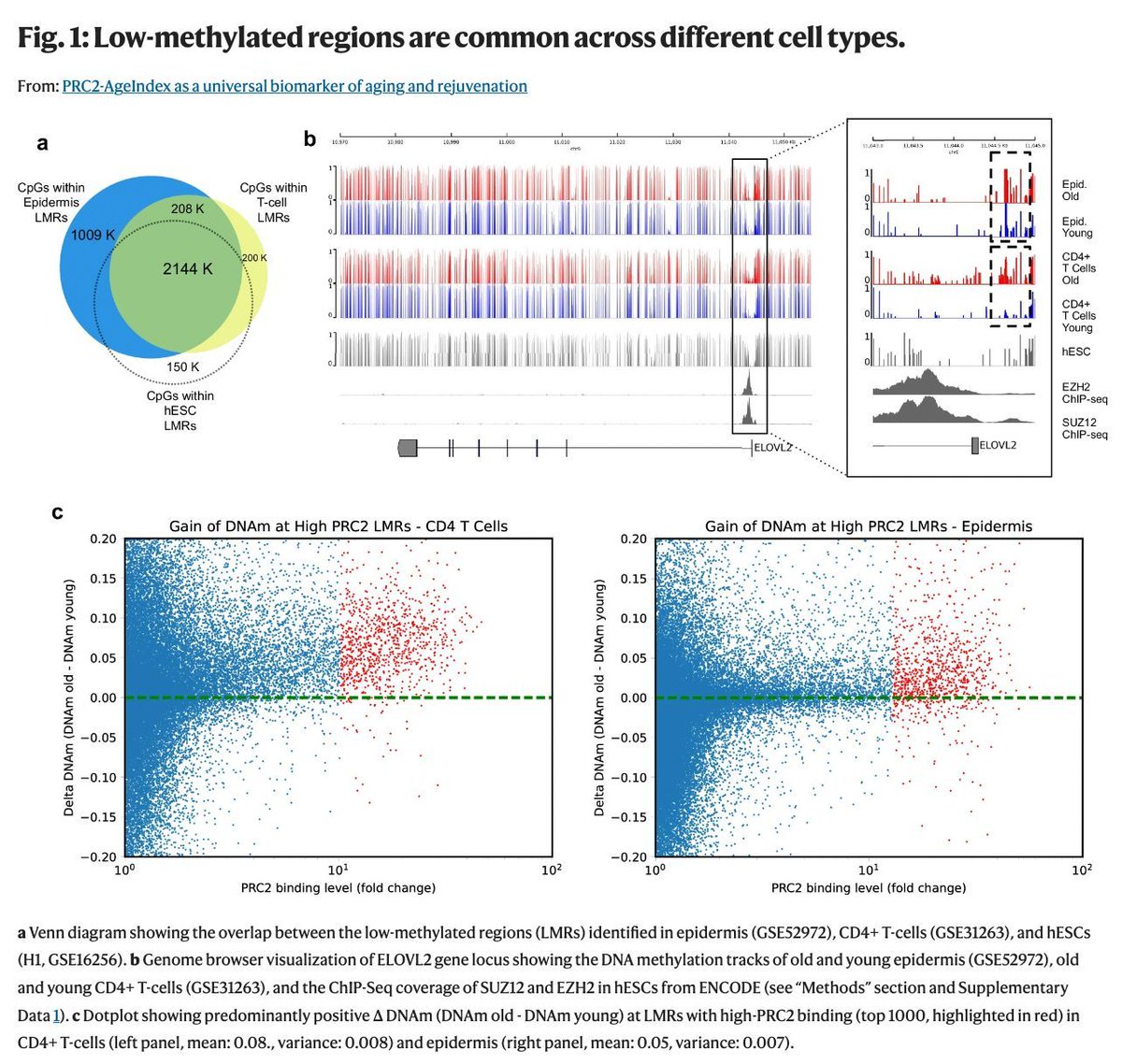
⚗️ Drs. @mahdi_moqri, Andrea Cipriano, & @DanielJSimpson4 spearheaded this study showing that low-methylated regions which PRC2 highly binds in #ESCs gain methylation with age in all examined somatic mitotic cells. @SebastianoLab@StanfordMed
https://t.co/quclYCQyzn
🧵 1/6 In our most recent collaborative work led by @SebastianoLab, Consortium members have identified the PRC2-AgeIndex as a universal biomarker of aging and rejuvenation. This study focused on DNAm changes, particularly those enriched in PRC2 targets across mammalian tissues.