It’s a bit of a long post👀
I wrote this letter on artificial intelligence and authorship nearly three years ago, when AI had not yet reached its current level.
Today, my position is even clearer: we will get nowhere by rejecting AI. Just as computers, the internet, and statistical software became integral to scientific work, AI will become a natural part of academia. Those who ignore it will fall significantly behind those who use it effectively and may eventually face an existential professional challenge.
But for me, one principle is non-negotiable: transparency.
Some journals ask authors to declare that a manuscript was not written using AI. But does ticking a box really solve the ethical problem? If a journal effectively prohibits AI use, authors who use it will simply be more likely to conceal it. A system intended to protect transparency may therefore end up encouraging secrecy.
We need to stop playing Pollyanna and confront the realities of scientific practice. AI use should be openly disclosed. New reporting categories should be developed according to the nature and extent of its contribution, and, where necessary, the principles of authorship responsibility and publication ethics should be redefined.
The real ethical problem is not using AI. It is using AI and hiding it.
Over the past three years, I have also had to confront a rather uncomfortable reality: in some areas, AI can think faster than I can, perform more comprehensive analyses, and write better manuscripts. As a result, I have found myself writing less. To be honest, this has brought a certain existential anxiety about the meaning of academic work.
The issue is no longer simply that AI makes academics more efficient. It is beginning to perform some of the intellectual functions traditionally associated with academics—sometimes better than we do. In such an environment, it is unrealistic to expect researchers to continue producing with the same motivation, under the same publication pressures and performance metrics.
Academia in the AI era cannot be governed merely through prohibitions and disclosure checkboxes. We need new systems of evaluation and incentive that motivate academics to formulate original questions, think critically, challenge assumptions, and take intellectual risks.
The answer is not to resist AI. It is to redefine the human role in academia.
https://t.co/Fl1qThkHSh
⚡️NEW STUDY: after a remarkable 13-year median follow-up, the randomized EORTC 22033 trial found no difference in overall survival between RT and TMZ after surgery for high-risk WHO grade 2 gliomas. Even more striking, health-related QoL and global cognitive functioning were similar during the first 3 years of follow-up, challenging the long-held assumption that RT necessarily results in worse neurocognitive outcomes.
Study schema:
🧠 478 patients with high-risk WHO grade 2 glioma
Randomized to:
☢️ RT: 50.4 Gy in 28 fractions
or
💊 Dose-dense TMZ: 12 cycles
Median follow-up: 13.1 years
Primary outcome:
➡️ No significant difference in PFS or OS
Previously reported secondary outcomes:
➡️ No significant difference in health-related QoL or global cognitive funcitoning (Reijneveld et al, Lancet Oncol 2015)
⁉️Why no survival difference?
Cross-over was extensive.
At progression:
➡️ ~72% of patients initially treated with RT later received TMZ
➡️ ~68% of patients initially treated with TMZ later received RT.
‼️By the end of follow-up, the majority of patients had received both treatments, only in a different sequence.
Another key observation:
▶️For decades, age ≥40 years has been considered a major adverse prognostic factor.
▶️ After reclassifying tumors according to the 2021 WHO molecular classification, this association disappeared. In fact, older patients fared significantly better.
☝️My take:
1⃣Combined chemoRT remains the standard for high-risk LGG
2⃣If a patient declines, or is not a candidate for one modality, either RT alone (6 weeks) or TMZ alone (12 months) could be a reasonable initial option, with the other reserved for progression.
3⃣ Finally, this study provides yet another piece of evidence that the often overstated perception that RT inevitably causes substantial long-term neurocognitive deterioration or worse QoL deserves to be reconsidered, particularly when modern focal RT is delivered to a moderate dose (50.4 Gy).
Nice to see a cost analysis of CHALLENGE, but worth mentioning that new oncology drugs or local tx aren't expected to be cost-saving to become SOC in US.
Yet exercise appears to require higher threshold for economic justification (even w RCT showing OS benefit & low toxicity).
dMMR/MSI-H rectal cancers treated with TNT: International real-world study
👉 dMMR/MSI-H: 3.5% of patients with LARC
👉 No difference in pCR, CR, 3-year EFS, and 5-year OS versus pMMR/MSS tumors
👉dMMR/MSI-H did not hold prognostic value
@OncoAlert
https://t.co/fdPT51LlYH
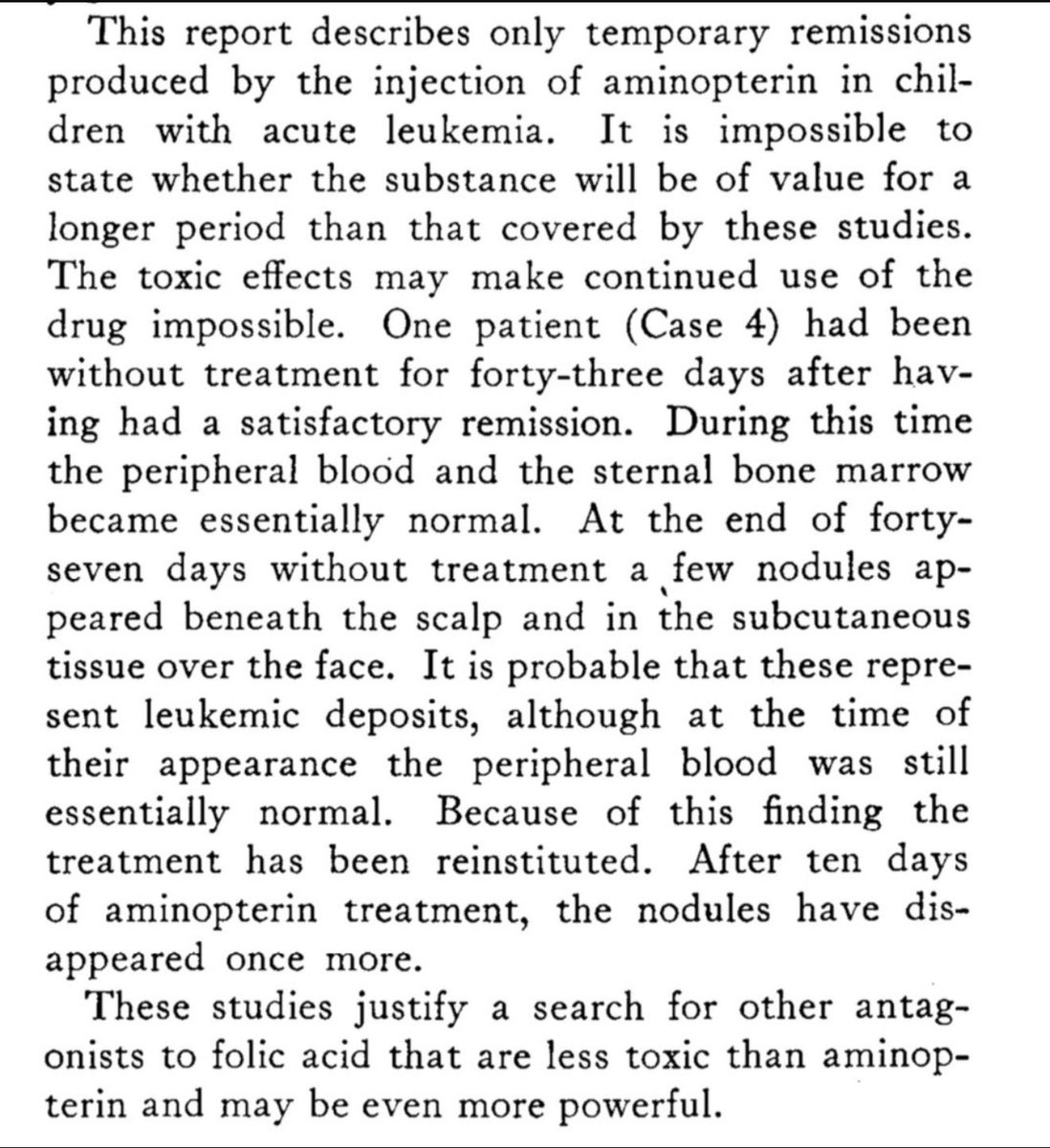
In 1948, Sidney Farber and colleagues published his work in @NEJM that helped open the door to modern chemotherapy.
Seeing that history from the same institution — especially after a remarkable #ASCO26 with major plenary contributions and @NEJM papers from @DanaFarber — is humbling.
A powerful reminder that progress in oncology is built across generations: by patients, scientists, clinicians, and teams who keep asking what might be possible.
Position statement on ADCs in solid tumors
The recent pivotal studies & key ongoing studies on ADCs are summarized in Table 1 & 2.
🔗https://t.co/Zp6DWW9Cb8
@ESMO_Open@OncoAlert
🧬🎯Precision oncology has a geography 🌏🌍🌎problem!
Tumor-agnostic therapy is moving cancer care beyond the organ of origin. Yet testing, reimbursement, trials, and workforce gaps still block access...
Congratulations to @JiaJennyLiu and colleagues on this important review. A timely roadmap for turning tumor-agnostic innovation into equitable global access.
@ASCO@JCO_ASCO@herbloong@BenWestphalen@curijoey@VivekSubbiah@OncoAlert@OpenMedicineHQ@jrgralow@ASCOPres
Nice review & interesting trial concept: total neoadjuvant tx +/- GLP1 agonist for rectal ca pts w BMI > 30.
Obesity associated w increased RT side effects & metabolic dysfunction overall can worsen outcomes.
GLP-1 for metabolic optimization during tx worth testing. @OncoAlert
Wonderful study in @Cancer_Cell from @skopetz@IamLinghua et al @UTMDAnderson:
Spatial multi-omics landscape of #ColorectalCancer macro- and micrometastases
https://t.co/dSiZ7ZH5oD
Deconstructing the clonal evolution of micromets & TME differences between micro- & macromets.
Our latest research on ctDNA Status and ACT in Resected Colorectal Liver Metastases is now out in JAMA Oncology!
🔗https://t.co/RuRq2gkmSb
🔗doi:10.1001/jamaoncol.2026.2191
@JAMAOnc@OncoAlert






![mtmdphd's tweet photo. Implementing #PrecisionMedicine Programs and #ClinicalTrials in the Community-Based Oncology: Practice: Barriers and Best Practices [May 23, 2018] @JLErsek @lorablk @mtmdphd @DrEdKim #ASCO18 Educational Book https://t.co/UJqfs6bPXf https://t.co/8s5GphMUFX](https://pbs.twimg.com/media/HN_1LtsWYAEpvPm.jpg)