@jim_rutt @brodeur The model I have (M3 16", 36g) happily runs all the local LLMs I've thrown at it, deepseek r0 and gemma most recently. I DJ'd the EFF party a few weeks ago with fancy "unmixing AI" software while talking to deepseek about designing a new cryptography algorithm, no glitches.
@MillerLabMIT For clarity, it 's just another signal processing landmark in the historical review. But it's the rare work on IT using systematic stimuli and proposing a frequency code rather than grandmother cell or high level feature specific cell.
@MillerLabMIT I'd like to have seen a cite of the late 80s/90s Richmond and Optican papers on Temporal Encoding of Two Dimensional Patterns (multiplex filter hypothesis). Aperiodic activity in IT - they were influential for me doing nonliear wave interaction image processing.
@t_andy_keller@mozesjacobs You might be interested in work I did in engineering at UT Austin 1995-2001 which bears some similarities, but in a nonlinear dynamics framework. Pretty sure I cited that sound of a drum paper.
https://t.co/gH5pjdzZHz
Traveling waves are known to exist throughout the brain in a variety of forms — there are many hypotheses, but their exact computational role is debated.
Together with @wellingmax we built an RNN which exhibits traveling waves to see what it could do. Here’s what we think:
1/7
Follow up on promises! 📢
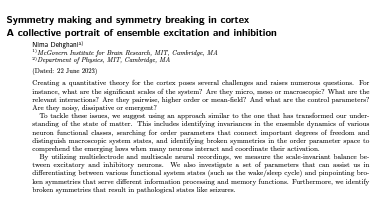
"Symmetry making and symmetry breaking in cortex A collective portrait of ensemble excitation and inhibition"
https://t.co/BuKMsVG1lD
(this is paper 1 from "symmetry breaking/spatiotemporal series" series)
see 🧵👇1/n
1/11 Super excited to share our latest preprint! 📢
We estimate a putative marker of whole-cortex excitation/inhibition (E/I) ratio that indexes cortical maturation in youth! Leveraging a large-scale biophysically plausible model, we can estimate E/I ratio in-vivo! 🧵
More than once I've finger wagged at youngsters failing to do their research on precedents. I just found some work from '86 that I ought to have cited.
https://t.co/wcTxYVlqlT
@neurograce The late Gerhard Werner, O.G. single unit physiologist with Mountcastle, wrote a few critical reviews. I think this was the last.
https://t.co/SzijSTTw6r
@realpotofgreed Glad I read that preprint a few weeks ago by Bongard and Levin on polycomputing, so that I can feel good about saying all of the above on the same hardware.
https://t.co/0XhjmQ6ekg
@IntuitMachine@OpenAI Possibly relevant, see esp. the part about the institutional review committee. DH says there's never been any conflict between their take and the parent.
https://t.co/5uT61C7AxU
For me it was natural to think about low frequencies modulating neural field parameters like nonlinearity (bifurcation) parameters, coupling constants in laterally coupled neural fields. Mostly I see people talk about inhibition, gain modulation - circuit ideas.
Any other people in theoretical or computational neuroscience come in with a background in sythesizers, especially modular synthesis? Did it affect the way you think about things?
Just curious.