@TyroChemist@Astro_Wright It’s convention to draw aldehydes that way in most contexts. I don’t know the reason why, but I’d guess it’s to emphasize the difference between other carbonyl compounds, especially ketones, which are ostensibly “the same”, but not nearly as electrophilic.
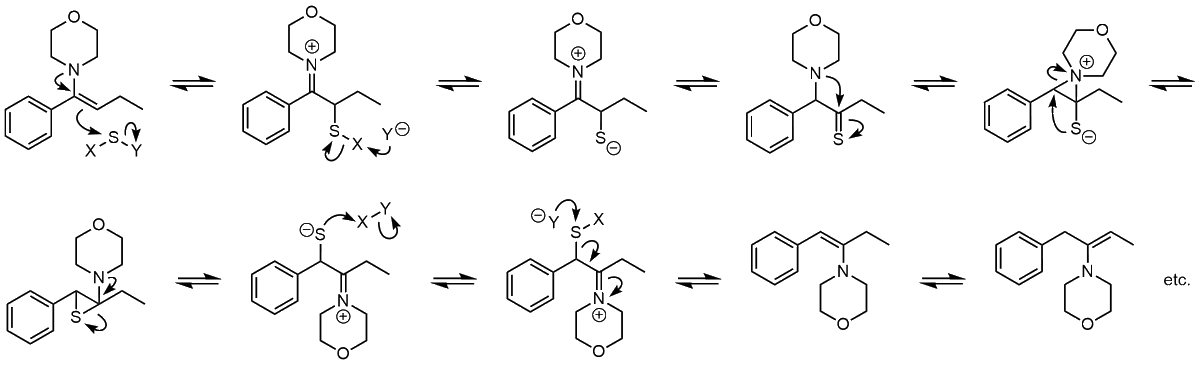
@geordifrere@KCGOrtiz@ndchiappini If you assume that all of the steps of the mechanism are reversible, then, as you implied, all you need to do is find a way to get the morpholine and the sulfur to switch places. Here's my guess. X = SR or H, Y = SR or morpholinium, Y- = RS- or morpholine.
@StatedClearly@bradyajohnston@proteinimaging @DrJayTweets Also, if the compound has a crystal structure, you might find a 3D model on the CDCC database: https://t.co/1poz9WmWUU
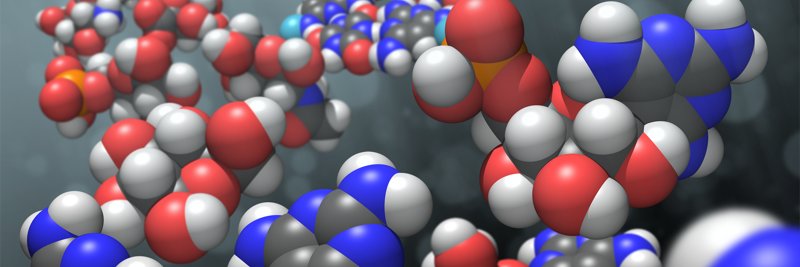
Adenosine, for example, can be found there.
@StatedClearly@ChemBarkPaul@Evolutionistrue Or, maybe he meant that researchers who have devoted their lives to advancing their own hypotheses on the origin of life are unwilling to be frank about how improbable their “prebiotically plausible” chemical systems really are.
@StatedClearly@ChemBarkPaul@Evolutionistrue I don’t know the context this was stated in, but if I’m giving him the benefit of the doubt, maybe he meant that admitting our ignorance on the topic elicits unwelcome “God of the gaps” type arguments, or worse, makes funding harder to obtain.
Check our our recent @NatureComms paper on formation of proto-peptides from simple mixtures containing amino acids and mercaptoacids under a wide variety of conditions! https://t.co/4cNz22oqQK
@StatedClearly@Sara_Imari I think is a good analogy. I also think that, while we will eventually fully understand the general principles, there are historical details to the origin of life on Earth that we may never know with certainty.