The economic right of center is always saying “If you want less of something, then tax it”
Maybe after the millionaires tax next we can figure out a tax on corporate lobbyists, political action committees and federalist society members?
“Billionaire, former Starbucks CEO, and man who sold the Seattle SuperSonics to Oklahoma City Howard Schultz announced this week he’s moved to Miami, proving that the state of Washington’s new Millionaire Tax is already working.”
Ouch.
With a few anomalous exceptions privatizing public monopolies generally means wealth accumulation for shareholders and austerity for ratepayers, consumers, workers. No thanks.
I trust your opinion on this entirely. But here’s another radical idea. Seattle City Light should be privatized, and report into shareholders and customers and regulatory bodies, not the Mayor’s office. There are far too many other priorities for the executive and legislative branches of Seattle.
Democrats have a neoliberalism problem and a billionaire sycophancy problem. Unions aren’t perfect. But after $80T of upwards income transfer to the 1% over 5 decades, blaming them for govt failure is like blaming the bank janitor after the CEO loots the vault.
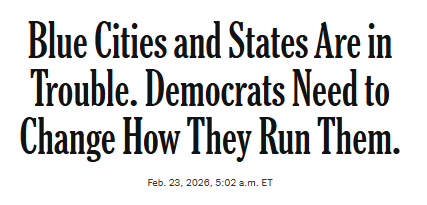
Democrats have a public-sector union problem. It’s not a popular thing to say, but continuing to ignore it won’t serve us well.
My latest, together with the excellent @robertmgordon, at @nytimes (link in thread below):
Advocates allege fraud in WA's public comment system, saying duplicate and fake sign-in inflated opposition to a proposal to enact a income tax on income over $1 million. https://t.co/3Ap70LVffN
@TanDunMusic What an amazing piece and performance of the Water Concerto tonight with the @seattlesymphony at @benaroyahall . Who was the percussion soloist? She was somehow not listed in the program guide for the audience?
Looking forward to the second half of the program.
In 2013, progressive SEIU union leader @DavidMRolf, one of the most innovative and strategic thinkers in organized labor, sparked the $15 min wage movement that spread across big blue cities by running and winning - by 77 votes - a then quite radical ballot measure in Seatac, a small working class Seattle suburb (home to thousands of low paid airport workers), to raise their min wage to $15.
Now, 12 years later, urban working class voters are voting increasingly Republican and only 6 percent of private sector workers are in a union. And Rolf is in a surprising (to us, anyway!) dialogue with a rising right-of-center movement led by conservative economists like @oren_cass that seeks to push the Republican Party to adopt economic policies that boost blue collar workers.
So on the latest episode of Blue City Blues (@bluecitypodcast) @hyded and I sat down for revealing conversation with Rolf to ask him whether present-day union leaders are culturally and politically out of step with their own members, why the Democratic Party is losing the working class, and whether the Republican Party is really likely to embrace pro-worker economic policies.
We weren't disappointed - David has a lot of candid and insightful things to say on all of these fronts!
One of the world’s richest men wants his newspaper to strictly push policies that favour the rich.
That’s the upshot of Jeff Bezos’s announcement today of a new regime at the Washington Post.
My latest.
https://t.co/XAsJleKMGL
CEO @timoreilly: “As labor organizer @DavidMRolf said to me, “God did not make being an auto worker a good job!” Those middle class jobs that we look back at with such nostalgia were the result of a fierce competition between companies and labor as to who would set the rules of the game. The invisible hand became very visible indeed by way of bitter strikes, and then transcended the market into the political process with the National Labor Relations Act of 1935 (the Wagner Act), the Labor Management Relations Act of 1947 (Taft-Hartley), and state “right to work laws.” Read more: https://t.co/nIppfmIHLJ
NEW: Cherry Street Coffee House owner complained to City Council that paying minimum wage may force him to close stores. Outraged, the workers shut down one of his stores anyway. Business may have power in City Hall, but workers still run the workplace.
https://t.co/ZXVL8OhjXN
Now the industry wants to make a sub-minimum wage permanent for their employees, relying on their customers to make up the difference. Red states like Florida have voted for $15. Alaska and Montana don’t allow tip penalties. Weakening our min wage law is political suicide.
A deal is a deal. The Seattle min wage law, negotiated by a 24-person city commission, recommended by a 21-2 vote, passed unanimously the @SeattleCouncil, signed by the Mayor, allowed small local restaurants a TEN YEAR phase-in period.