Cyanobacteria as dye factories? Engineered Synechocystis sp. PCC6803 uses light to convert indole into indigo dye with an 86% yield via flavin monooxygenase. A new sustainable production process and efficient dye recovery. Promising biotech leap! https://t.co/ZWFH1ocPt5
Every synthetic biologist, every biochemist, when they dream, will sometimes hear a voice calling
A whisper on the wind, as impossible as infinity, as sweet as the ambrosia of the very Gods
"Engineer RuBisCo"
And this paper takes us one step closer
https://t.co/xS0ns6UGlY
Out now in @NAR_Open! A #ribozyme can self-integrate into and hydrolyze ss- & dsDNA, offering a new avenue for the development of protein-free genome editing tools, and hinting at the possibility of a pre-translation origin of group II introns (G2Is).🧵1/7
https://t.co/iOKReHLuul
Preprint alert 🚨 Cautions in the use of @nanopore sequencing to map DNA modifications: officially reported “accuracy” ≠ reliable mapping in real applications.
We performed a critical assessment of nanopore sequencing (across different versions of models) for the detection of multiple forms of DNA modifications: while it is reliable for high-abundance modifications, including 5mC at CpG sites in human cells and 5hmC in human brain cells, it makes very high % false positive calls for low-abundance modifications, such as 5mC at CpH sites, 5hmC and 6mA in most human cell types [1].
Want to know why? Please read further (long):
In 2022, we reported in @ScienceMagazine that 6mA is much less abundant in human cells than previously reported (mostly false positives) [2]. In 2023, we wrote a perspective in @NatureRevGenet to help navigate the common pitfalls for false positive in the mapping of DNA and RNA modifications [3].
With these two papers, we thought the importance of recognizing false positive calls has been adequately described. Unfortunately, this was not the case. New official models report nanopore seq can achieve >97.5% raw read accuracy in the detection of 5mC, 5hmC and 6mA, across all sequence contexts. New methods are to be released for mapping DNA damages, etc. Unfortunately, we do not think these “accuracies” are reliable in practical applications. To help biologists and methods developers, @kong_yimeng (first author of the 2022 & 2023 papers, now a PI) and I felt the need to do this study to critically assess nanopore seq for the detection of multiple forms of DNA mods. Thanks to team and collaborators: @KohliLab@ChristianLoo_@XuesongRutgers.
Why did we pick nanopore in this critical assessment? First of all, we have no bias among different sequencing platforms. In fact, we regularly use nanopore seq in our lab for several projects. However, we think there is a broad misunderstanding and over expectation that nanopore sequencing can map many forms of DNA modifications in any genome. A fundamental limitation is that the training and test data used in existing machine learning models do not consider the physiological levels of DNA modifications.
Common pitfalls:
1. High accuracies in training and test data don't guarantee reliability in real applications. It depends on the abundance of DNA modifications (6mA is abundant in bacteria, but rare in human).
2. Reliability in one sequence context or genomic region doesn't ensure reliability in others. It depends on the abundance of DNA modifications at a specific sequence context or genomic region (5mC is abundant at CpG sites but not at CpH sites; 5mC is abundant on the nuclear genome but not on mtDNA).
3. Reliability in one cell type doesn't guarantee success in others. It depends on the abundance of DNA modifications in a specific cell type (5hmC is abundant in brain tissues but rare in blood).
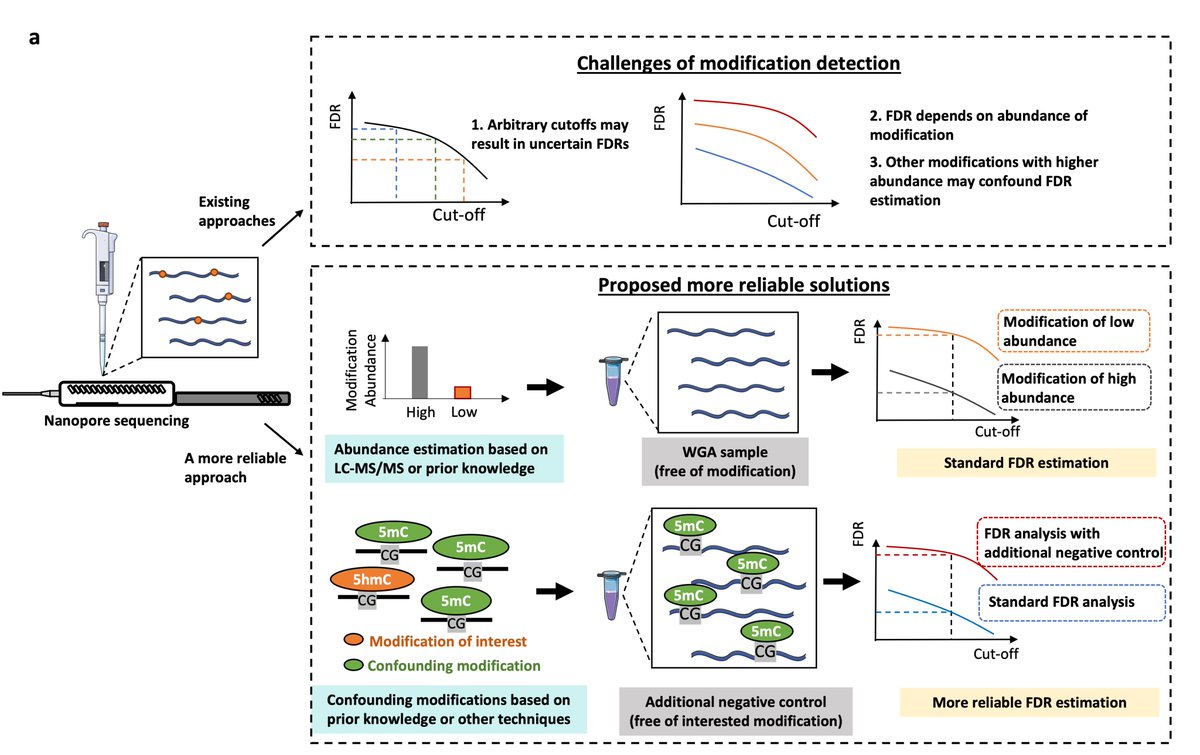
Why do each of these pitfalls involve the critical consideration of the abundance of DNA modification? This is because every genomic technology has a certain level of background noise in detecting DNA modifications. It will detect a certain level of DNA modification even when no modification was present in a negative control sample! Therefore, the method is only reliable if the physiological levels of DNA modification are sufficiently higher than background noise.
How to navigate the pitfalls?
To assist biologists and methods developers, we describe a framework for rigorous evaluation that highlights the use of false discovery rates (FDRs) along with rationally designed negative controls capturing both general background and confounding modifications. What is “confounding modification”? It turns out that modification-free negative controls are not enough. For example, the abundant 5mCpG in most human cell types can lead to increased levels of false positive 5hmC calls, much higher than the actual 5hmC levels in most human cell types (Fig. 1 attached) ……
(1) This study highlights the urgent need to incorporate this framework in future methods development and biological studies. Using this framework, you can quantitatively evaluate the reliability of DNA modifications detected in your samples.
(2) This study advocates prioritizing nanopore sequencing for mapping abundant, not rare, modifications in biomedical applications. Specifically, 5mCpG can be largely reliably mapped across mammalian cell types; 5hmCpG mapping by existing methods should be limited to tissues with high 5hmC abundance (e.g. brain tissues). In addition, our assessment does not support the use of nanopore sequencing to map endogenous* 6mA or various DNA damages in mammalian genomes due to their low abundance.
(3) This framework is also applicable to RNA modifications. Although this work is focused on DNA modifications, the principles we outline—rigorous false positive recognition, use of negative controls, and FDR evaluation—are equally applicable to RNA modifications.
[1] New preprint: https://t.co/yQ8oDydWU9
[2] Critical assessment of DNA adenine methylation in eukaryotes using quantitative deconvolution https://t.co/Fgk5A1G6qf
[3] Navigating the pitfalls of mapping DNA and RNA modifications https://t.co/ddg3BGJlnY
[*] Please note the detection of exogeneous DNA modifications is different from mapping natural endogenous DNA modifications, because abundant exogeneous DNA modifications are added to the genome as in Fiber-seq, DiMeLo-seq, etc.
Really excited to share work from our team at @Ginkgo, led by @AlyssaKMorrow, on ML guided 3’ UTR design.
https://t.co/XQ997bw5wb
It's a great story of dataset generation, model training, generative design, in-vivo validation, and model release.
More details in thread!
Last Chance to Apply for the Activator: Submit Today!
📅 Application Deadline: Nov 6th, 2024
🔗 Apply: https://t.co/3qVDjyq7PZ
🌐 Learn more: https://t.co/8iNeeRDJ5L
Are you an academic trainee eager to build a life science startup? Whether you're passionate about therapeutics, diagnostics, medtech, synthetic biology, climate, or consumer products, this is your opportunity to transform your research into a groundbreaking venture!
Tools such as Rosetta and AlphaFold have redefined the protein-engineering landscape. But some problems remain out of reach — for now https://t.co/i6nS7QVh8P
BREAKING NEWS
The 2024 #NobelPrize in Physiology or Medicine has been awarded to Victor Ambros and Gary Ruvkun for the discovery of microRNA and its role in post-transcriptional gene regulation.
Chemists at Hokkaido University have experimentally confirmed the existence of a single-electron carbon-carbon bond for the first time: https://t.co/ATis6HSzIo .
Happy to share this new work describing a high-throughput assay that identifies engineered TdT mutants with altered biases for de novo DNA synthesis and molecular recording applications. Congrats to @CourtneyCarls_n, @TheresaLovele12, and the whole team! https://t.co/2EJUiIQpoC.
Imagine bacteria mining cryptocurrencies. We moved a step closer by encoding a 2-bit MD5 cryptographic hash algorithm – a precursor of SH256 used for Bitcoin - across 66 E. coli strains. It required over 1 megabase of DNA, the size of a small genome. https://t.co/CyjhE88JwZ
Reconstruction of ancestral protein sequences using autoregressive generative models
🧬 An exciting leap in ancestral sequence reconstruction (ASR)! This paper presents a novel autoregressive generative model designed to infer protein sequences of extinct ancestors more accurately than state-of-the-art methods.
1️⃣ Key innovation: The model accounts for epistasis—the context-dependence of mutations—something most existing models ignore. This leads to a more nuanced understanding of protein evolution.
2️⃣ The model extends the autoregressive dynamic coupling analysis (ArDCA), using it to model sequence evolution over time, improving accuracy in reconstructing ancestral proteins by considering mutation interactions.
3️⃣ When tested with simulated data, this approach outperformed IQ-TREE, a leading ASR tool, by consistently providing better reconstructions, especially for nodes deeper in the evolutionary tree.
4️⃣ Experimental validation: Using directed evolution data, the method was able to reconstruct the known ancestor of β-lactamase enzymes more accurately than IQ-TREE, further underscoring its robustness.
5️⃣ Unique feature: This method also handles gaps in sequences more effectively by treating gaps as an additional amino acid, improving reconstruction quality in multiple sequence alignments.
💻Code: https://t.co/PHrzRwMt6a
📜Paper: https://t.co/8JOuFfikYT