🚨#Important: Received intel:
“There are concerns that the situation could escalate into a much harsher crackdown over the coming days. But instead of relying primarily on police, authorities may use hired groups to provoke violence at and around Jantar Mantar and nearby protest sites by posing as protesters, potentially triggering clashes, stampedes, or other incidents. Such events could then be used to justify a large-scale security response and arrests.
At the same time, the government is publicly projecting negotiations with protesters while simultaneously preparing measures to end the movement, including increasing security deployment, enforcement of legal restrictions, and efforts to isolate the protest.
An organized online campaign is also attempting to shift attention away from the protest’s demands by promoting divisive narratives, targeting protest leaders, and discouraging student participation through fear of legal and career consequences.
Overall strategy is to weaken the movement, avoid addressing demands including Dharmendra Pradhan’s resignation, and ultimately justify a crackdown by portraying the protests as having turned violent.”
We hope that the @DelhiPolice takes immediate note, increase security, and ensure no fringe elements create chaos. Any misadventure will be disastrous.
@Cockroachisback@abhijeet_dipke
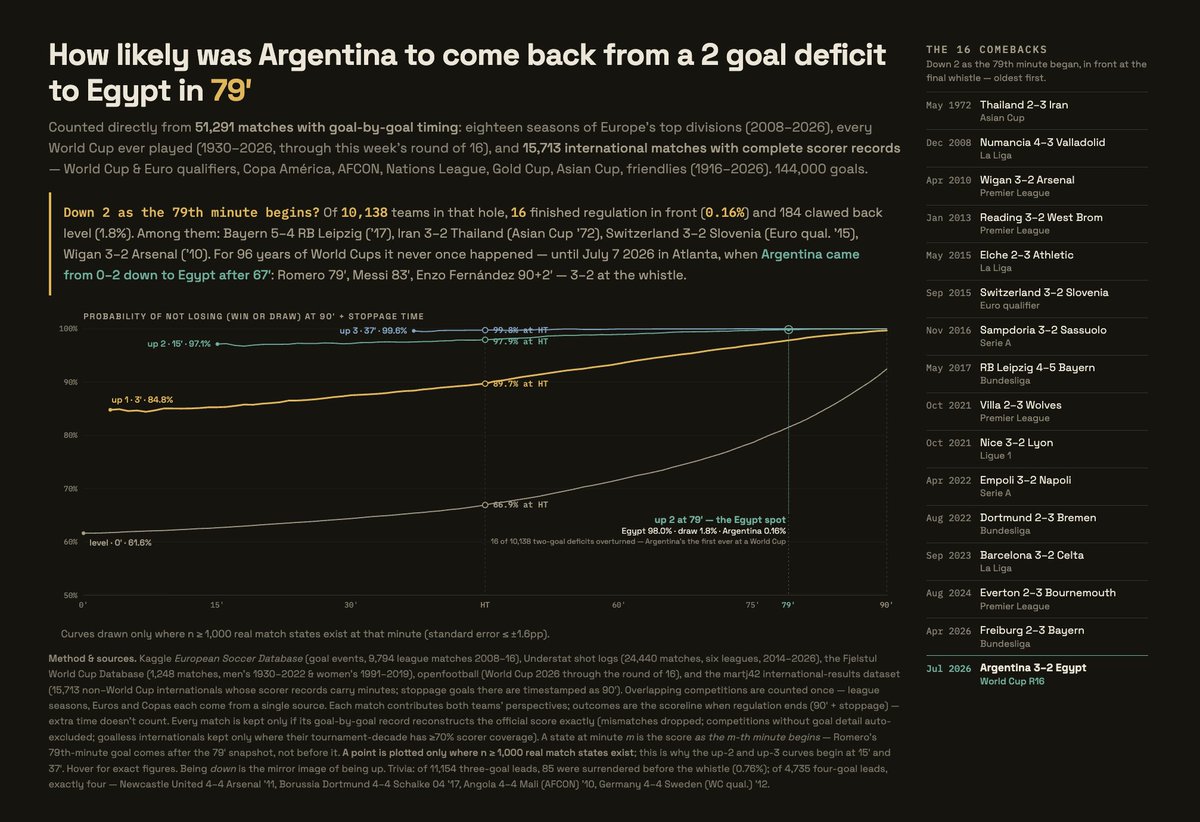
The Argentina come back against Egypt is one of the best matches in football history.
I analyzed ~50,000 games with Fable to show just how crazy it was.
Of the 10,138 times that a team has been up 2-0 at 79', only SIXTEEN times (0.16%) did they ever make a come back at the end of 90 minutes.
This is the first time it's happened in a World Cup.
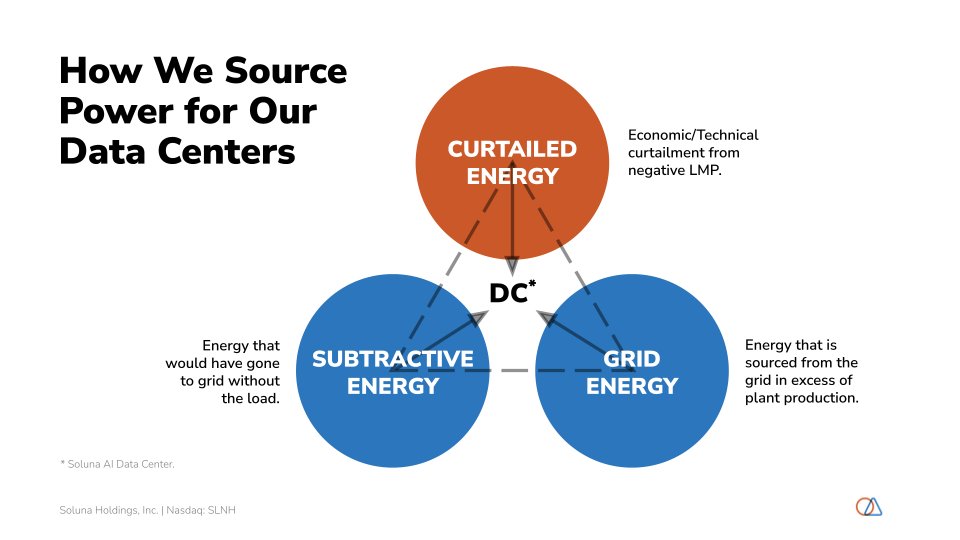
Most data centers connect to the grid and compete for capacity. We build at the source.
Our data centers draw from three power inputs: curtailed energy that would otherwise go unused, direct generation from the plant, and grid supplementation through existing interconnections. MaestroOS manages the mix in real time.
As we expand into AI, we're also evaluating on-site backup generation to deliver the resiliency and continuous uptime AI workloads demand.
This is Renewable Computing.
#RenewableComputing $SLNH
There are moments when a company emerges from becoming something into undeniably being something. DigiPowerX has emerged. I serve as a Director of $DGXX and these are my personal views, not the Company's. Everything here comes from public filings and press releases. This is not investment advice. What follows is my perspective as a Board Member, grounded entirely in publicly disclosed information.
I've been in the rooms. I've sat across from Michel Amar in strategy sessions, attended investor meetings, reviewed the financial models, and watched this executive team: Alec, Jag, Paul, and others, supported by expert legal counsel and senior leaders of the world's largest financial institutions, make decisions under real pressure with real capital on the line. What I'm about to share is my personal view, grounded in publicly disclosed information, because I think the magnitude of what is being built here deserves to be said clearly.
THE FUTURE OF AI IS PHYSICAL
Many talk about AI as if it lives in the cloud. It doesn't. It lives in buildings. Buildings that require hundreds of megawatts of power, purpose-built cooling systems, owned land, Tier III infrastructure, and teams who know how to operate it at scale without blinking.
We are at the beginning of what will be the largest infrastructure buildout in human history. Not the largest tech buildout. The largest infrastructure buildout - period. The demand for AI compute is doubling and doubling again. The models are getting larger. The inference requirements are exploding. OpenAI, Google, Meta, Amazon, and every major enterprise on earth is racing to deploy AI at scale and every single one of them needs power and physical compute infrastructure to do it.
The companies that secured that infrastructure early, before the utilities ran out of capacity, before the land was gone, before the power agreements became impossible to sign - are sitting on assets that cannot be replicated at any price today.
DigiPowerX is one of those companies.
THE PICTURE I'M POSTING
That photo is a Cerebras data center, 10 MW of operational AI compute. Take a look at it. Quiet on the outside. Inside: wafer-scale AI chips, liquid cooling running nonstop, redundant power, and some of the most powerful AI inference hardware ever deployed.
This is what the physical layer of the AI revolution looks like.
DigiPowerX is building four times this, 40 MW. On land we own in Columbiana, Alabama. Powered by a substation we built. Backed by 393 MW of secured power across our portfolio. And anchored by a $1.1 billion, 10-year Master Services Agreement with Cerebras, the company that operates that exact facility in the photo.
Phase 1 - 15 MW - comes online December 15, 2026.
Full 40 MW delivered by Q1 2027.
Substation: complete. Grid interconnection: finalized. All long-lead equipment: secured.
MICHEL AMAR AND WHAT I'VE SEEN FROM THE INSIDE
I've reviewed the financial models. I've been in the investor meetings. I've walked, almost running to keep up, with Michel through back-to-back meetings, building to building across midtown Manhattan. It actually was a very productive and exciting day. I've watched Michel Amar operate, and I want to say publicly what I believe privately: he and Alec saw this coming before many in this space did. We have meetings 24/7, including Saturday's and Sunday's. Many mornings I wake up and there is already a new text or email from Michel on something to be discussed after I grab a large cup of coffee.
They made the call to walk away from Bitcoin mining before it was obvious. They secured the power before it became scarce. We signed Cerebras - one of the most consequential AI compute companies in the world - before breaking ground on the data center. They built NeoCloudz and launched GPU-as-a-Service while the flagship campus was still under construction. And he did all of this with a balance sheet that today carries approximately $150 million in cash and zero long-term debt.
That is not luck. That is vision, executed with discipline.
Cerebras, for context, just completed the largest IPO of 2026 on Nasdaq (CBRS) - opening 68% above offering price, raising $5.55 billion, holding a $20B+ relationship with OpenAI. They looked at every option available to them and chose DigiPowerX to be included. A billion-dollar bet on our team and the assets we've assembled.
I've seen the plan from the inside. What's being communicated publicly reflects exactly what I've seen in execution. There is no gap.
WHERE THIS IS GOING
The AI data center of the future isn't a retrofitted warehouse. It's purpose-built from the ground up - for liquid-cooled, 150kW+ rack density, Tier III uptime, and the kind of power reliability that frontier AI demands. It sits on owned land, connected to grid power that was secured years ago, and operated by people who've never run anything less.
That is exactly what DigiPowerX is building.
And we're not stopping at 40 MW. The pipeline includes a 1.3 GW Letter of Intent in West Virginia - targeted for 2028 through 2030. As AI scales from tens of megawatts to gigawatts, DigiPowerX is already positioned for that next phase.
NeoCloudz, our GPU-as-a-Service platform, is live right now on NVIDIA B200 and B300 bare metal - the fastest, most powerful AI compute available today. First revenues recognized in May 2026. And we've already committed $35 million to NVIDIA's Vera Rubin platform - the successor to Blackwell - for Q1 2027 deployment. We try to be one generation ahead.
Project financing is advancing with one of the world's largest private credit institutions - managing $220B+ in credit assets - structured as non-dilutive 70/30 debt. Firms at this level don't commit to a process without exhaustive underwriting. The fact that this financing is moving forward is itself a validation: of the asset quality, the contracted cash flows, and the professionalism of the DigiPowerX team in every aspect of how this company conducts its business affairs.
THE NUMBERS - PUBLICLY STATED MANAGEMENT TARGETS
2026 → First AI revenues. NeoCloudz live. SubQ AI 24-month bare metal contract (~$19.6M). Revenue engine started.
2027 → ~$300M revenue run rate. Full 40 MW Cerebras campus online. NeoCloudz scaling.
2028 → $450–$500M run rate.
2029 → $800M–$1B run rate.
These are Michel's publicly stated targets. Subject to all the risks in our public filings. But they are grounded in assets that already exist, contracts that are already signed, and a team that is already executing.
I'm proud to serve on this board. I'm proud of Michel Amar, Alec Amar, Paul Ciullo, Jagan Jeyapaul, and every person building this platform. And I'm proud of what this company represents for the future of AI infrastructure in America.
The AI revolution needs a physical layer. DigiPowerX is building it.
That photo shows 10 MW.
- We're delivering 40 MW.
- And we're just getting started.
Full press release (June 3, 2026): https://t.co/toDvZBsnDa
Gerard Rotonda | Director, DigiPowerX Inc.
$DGXX $DGX
#DigiPowerX #AIInfrastructure #DataCenter #GPUaaS #NeoCloudz #NVIDIA #Cerebras #AICompute #FutureOfAI #PowerInfrastructure #NasdaqStocks
$slnh
I’ll start with the financing part, because that is where I see most of the questions around @SolunaHoldings right now.
A lot of investors look at Kati 2 and immediately ask the same thing:
How can Soluna finance a project of that size without massive dilution?
That is a fair question.
But after listening to the interview, I think the better way to look at it is that Kati 2 is not being positioned as a simple parent-level equity-funded project.
John talked much more like this is an infrastructure-finance structure.
The first 100MW phase could easily represent $1B+ of capex if we use the rough $10–12M per MW range discussed for AI/HPC colocation builds. That number sounds huge when compared to Soluna’s current market cap.
But the key is the capital stack.
The discussion was not “raise common equity and build.”
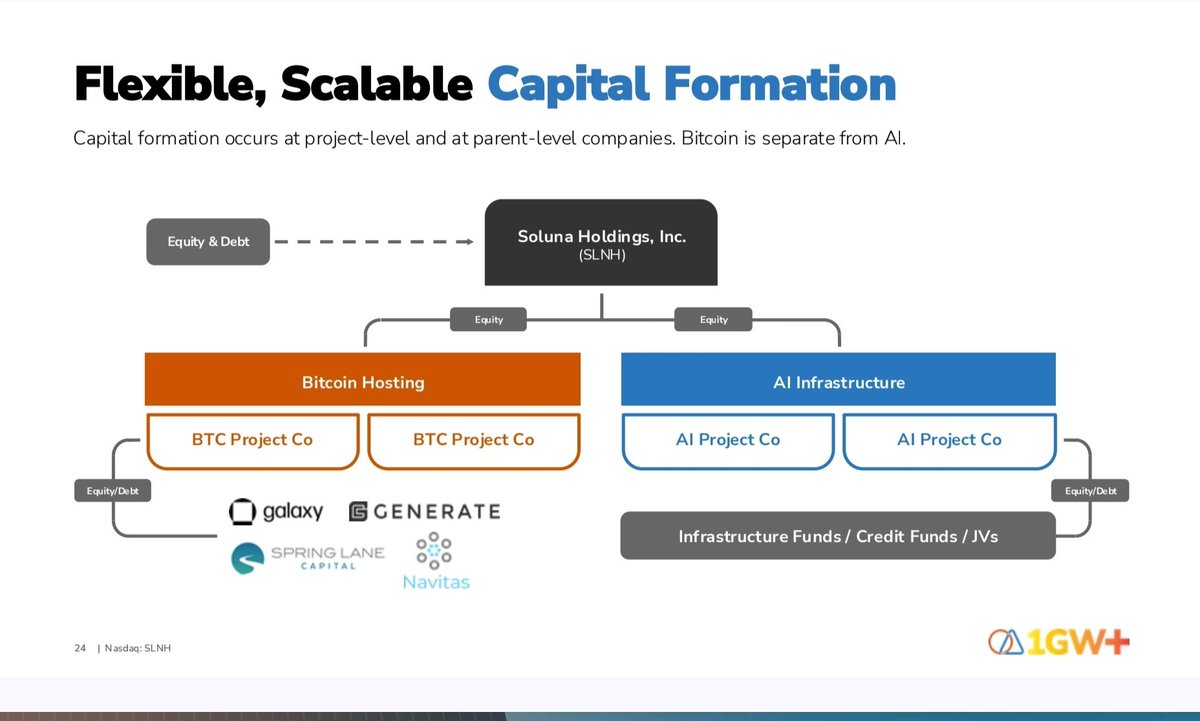
It was about lease-driven financing, debt markets, tenant support, upfront payments, project-level equity, strategic equity partners and optimizing the full capital structure.
This is where CFO Michael Picchi becomes important.
John basically described him as the right CFO for this stage of the company because his background sits at the intersection of energy infrastructure, capital markets and data center leasing. The interview also highlighted that Picchi has prior experience around data center lease structures and has successfully worked with upfront tenant payments in the past to help accelerate buildout timelines.
Soluna is not only trying to finance a building. They are trying to finance large-scale AI/HPC infrastructure around power, lease contracts, tenants, equipment timelines and project-level capital.
A strong AI/HPC lease does not only create future revenue. It can make the project bankable. It can improve lender confidence. It can support debt financing. It can attract infrastructure capital. It can also open the door for tenant prepayments or upfront capital if speed-to-power is critical.
In a market where AI capacity is scarce and power is the bottleneck, that kind of structure could matter a lot.
This is also why Picchi’s hire looks well-timed.
Soluna does not just need a CFO who can manage reporting. They need someone who understands how to structure a large capital stack around data center demand, power economics, infrastructure capital and tenant credit.
That does not mean dilution risk disappears.
Kati 2 is still a huge project, and the final terms will decide how much value Soluna keeps. But I think the market often frames the question too simply.
The question is not:
“Can Soluna fund $1B alone?”
The real question is:
“Can Soluna land a bankable AI/HPC tenant that unlocks debt, tenant support and project-level capital?”
That is the financing inflection point.
And that is why the first Kati 2 lease matters so much.
The S&P 500 soared 16.1% in April and May, the second best ever (only 2020 was better).
Here's the thing, after previous big gains (>10%), June has never been lower and the rest of the year added 18.6% on average.
$SLNH Kati 2’s geography deserves more attention.
Texas is becoming one of the most important data center markets globally. Harvard Belfer has even noted that, at the current pace, Texas could surpass Virginia as the world’s largest data center market by 2030.
But capacity is not spreading evenly.
A lot of activity is already concentrated around DFW, West Texas and Central Texas. Those are strong markets, but concentration brings its own issues: more competition for power, more grid pressure, and more exposure to the same regional risk zones.
Kati 2 sits in Southeast / East Texas, which gives it a different profile.
For AI/HPC customers, location is no longer just about cheap land or being close to a classic cloud region. They care about power access, fiber, grid exposure, redundancy, disaster recovery, regional diversification and how quickly a site can actually be energized.
Metrobloks put it well in the Kati 2 podcast:
“Instead of looking at sites, you’re now chasing power.”
That line explains why Soluna’s setup is interesting.
Kati 2 combines secured renewable power, ERCOT access, site control, wind energy and Soluna’s energy development work with Metrobloks’ AI-ready design and hyperscale customer relationships.
The South Texas angle also has external validation.
Hut 8’s Beacon Point project in Nueces County landed a 15-year AI data center lease for 352MW of first-phase IT capacity, with a base-term contract value of $9.8B.
So large AI customers are clearly willing to look at South Texas when the power, land, scale and delivery profile make sense.
Metrobloks also mentioned Kati 2’s proximity to the Mexican border and the connectivity tissue between the U.S. and Mexico. Cross-border connectivity, regional redundancy and a different corridor for customers thinking beyond the usual clusters.
Transwestern / FrontierGen have also pointed to South Texas as a region for AI-focused data center and advanced infrastructure campuses, driven by energy, land and customized power delivery.
Kati 2 is a site in a region where AI infrastructure demand is already moving, with a power-first setup that could separate it from the crowded Texas clusters.
The geography makes Kati 2 more interesting.
It’s impossible not to be bullish on neo cloud companies $NBIS, $CRWV, $IREN.
The demand environment is absurd.
As the CEO of $NBIS said:
“Demand is so high, coming from so many directions. Whatever is built is consumed.
You can sell everything on bare metal or you can sell by putting software layers on top of that.
One year from now, we will still be capacity constrained.
You can do either 10x more things or 10x cheaper.”
Demand is not the problem.
Supply is.
In a recent AMA, the new $SLNH CFO Michael Picchi (who appears to have just purchased 100,000 shares on the open market a week ago) provided a major update on Project Kati 2 indicating it could potentially expand into a giga-campus (1GW+).
If you've researched Project Kati, you know it's on the southern tip of Texas (close to Starbase) and major natural gas infrastructure.
Additionally, $SLNH also appears to have Projects Ellen and Hedy nearby which could potentially be clustered into the Project Kati mega-campus.
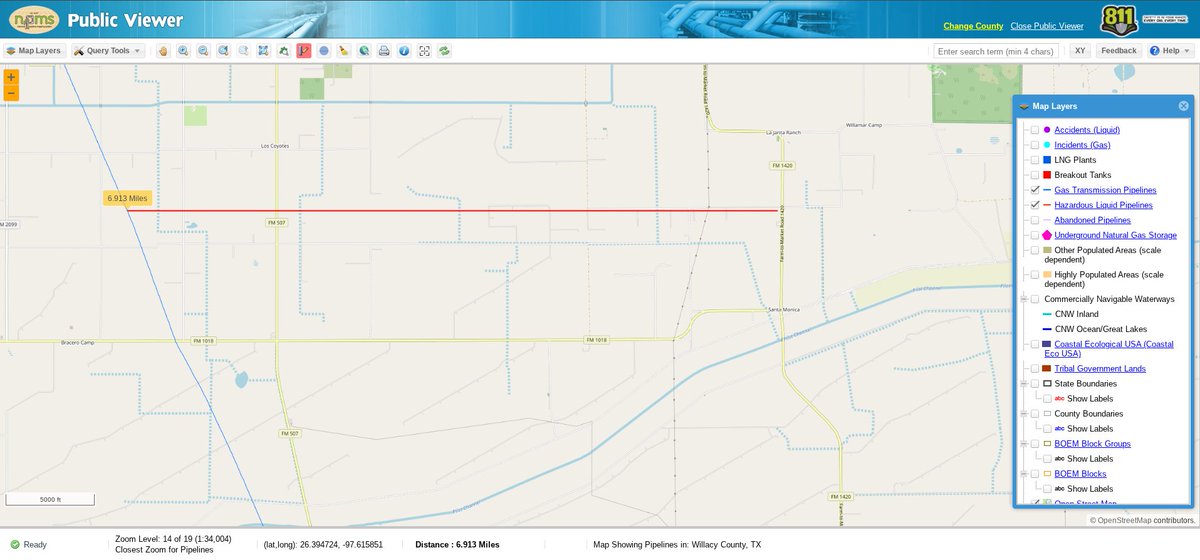
I've included an image showing the distance of Project Kati to the nearest natural gas pipeline and another one with the distance of Project Kati to Projects Ellen and Hedy. I had to pull coordinates and still need to confirm these are accurate locations/distances.
I plan to ask the CEO of $SLNH more detailed questions about this site in our upcoming interview.
There is actually a company building around this idea: $SLNH @SolunaHoldings.
Their model is basically: bring compute to renewable power instead of forcing power to chase data centers.
They focus on stranded/curtailed renewable energy and turn it into compute infrastructure.
BTC hosting today = flexible load
AI/HPC next = higher-value compute
And for AI cooling, it’s not just “basic air cooling.” Soluna has said Kati 2 is being designed with air-cooled systems plus direct liquid closed-loop cooling.
So yes, the idea exists.
Soluna is one of the few public microcaps trying to build exactly around this problem.
$SLNH @SolunaHoldings The U.S. Department of Energy recently published a piece called “Clean Energy Resources to Meet Data Center Electricity Demand.”
https://t.co/WzqZyDDL1a
To me, it reads almost like a macro confirmation of what Soluna has been saying for months.
The DOE’s message is simple:
AI/data center demand is growing fast, and the U.S. power system needs a portfolio approach to handle it.
Not just more power.
But also:
• clean generation
• storage
• grid expansion
• interconnection reform
• energy efficiency
• demand-side flexibility
• better use of existing infrastructure
That is exactly where Soluna’s model becomes interesting.
Soluna is not just trying to build “AI data centers” in the generic sense.
They are trying to solve the power side of the AI buildout.
Kati 2, Dorothy 3, Briscoe Wind Farm, Project Grace, BTC hosting flexibility and the 4.3 GW pipeline all fit into this theme.
The DOE also notes that data centers often need firm power and can stress regional grids because of their large load size.
That is the key challenge.
AI/HPC cannot operate like basic BTC hosting. It needs reliable, bankable power architecture.
But this is also why Soluna’s approach is different:
▪︎ BTC hosting can act as flexible load.
▪︎ AI/HPC can become the higher-value compute load.
▪︎ Owned/controlled renewable power can become the foundation.
▪︎ Grid integration and power controls can make the model more bankable.
This lines up with what @jbelizaireCEO said in the Q1 interview:
“Speed to power.”
And in the Briscoe/Dorothy 3 presentation, Soluna explained that Briscoe gives Dorothy a vertically integrated energy platform with existing ERCOT interconnection – exactly the type of advantage that matters when grid queues and power availability are becoming bottlenecks.
The DOE article also highlights demand flexibility as part of the solution.
That matters because Soluna’s mixed-load model could be valuable:
▪︎ BTC hosting = flexible / curtailable load
▪︎ AI/HPC = higher-value long-term load
That combination may be more grid-friendly than a pure AI data center that only adds permanent load.
So the takeaway is pretty clear:
The government is now openly discussing the same problem Soluna is building around.
AI data centers need power, interconnection, flexibility and clean energy solutions.
That is Soluna’s lane. From a macro perspective, this DOE article supports the direction Soluna is moving in.
$SLNH
Robert L. Bugbee taking a ~9.3% stake in @SolunaHoldings is a strong signal.
Bugbee has spent decades in shipping, energy, commodities and infrastructure. He has led public tanker companies, worked around capital-intensive energy markets, and understands cycles where assets, power access and timing create asymmetric upside.
That background is highly relevant to Soluna.
As some of you al ready know, Soluna is no longer just a Bitcoin mining story. The real thesis is energy infrastructure: monetizing stranded or underutilized renewable power and converting it into AI/HPC data center capacity.
That is exactly the kind of setup an energy-infrastructure investor can understand early: cheap power, hard assets, massive AI demand, and a market still slow to reprice the pivot.
A 13G does not guarantee success, but when someone with Bugbee’s background takes a large position, it suggests the Soluna AI/HPC transformation is starting to attract serious strategic capital.
The market may still be looking at the old mining story.
Smart money may be looking at the power + AI infrastructure story.
$SLNH Some people are rushing to take profits right when the fundamental story is getting stronger.
Look at the roadmap Soluna has already laid out for Q2–Q4 2026:
• Energize Phase 2 of Kati 1
• Kickoff Design & Engineering of Kati 2 AI
• Kati 2 AI announcements
• Dorothy 3 AI announcements
• New AI announcements
• New energy announcements
• New BTC hosting announcements
• PPAs on Rosa, Hedy, Ellen, Annie and new projects
And this comes after the McNallie Money interview where management made the AI/HPC direction very clear:
Speed to power is the product.
Customers are urgently looking for capacity, and Soluna is positioning its power pipeline for AI/HPC.
People forget how these transformations work.
$WULF went through the same disbelief phase. The market doubted the transition, then the first serious AI/HPC validation changed the story. From the 2025 lows to now, WULF became a multi-billion-dollar company.
I believe Soluna can follow a similar re-rating pattern if they execute.
The market is still valuing $SLNH like a small Bitcoin hosting name.
But the company is trying to become an AI power infrastructure platform.
That is why I think sellers taking quick profits here may regret it later.
If Kati 2 lands a bankable AI/HPC lease, this stock could look completely different in 2026.
The upside setup is massive here!
$SLNH One of the most important parts of Soluna’s McNallie Money interview was the financing discussion around Kati 2.
This is where the AI/HPC story starts to move from hype to real infrastructure economics.
CFO Michael Peachey made the scale very clear:
«“Kati 2 just for phase one would be $1.0 billion to $1.2 billion.”»
That is only phase 1.
The reason is simple: AI/HPC data centers are not Bitcoin mining capex.
Anthony framed it perfectly:
«“We’re not talking Bitcoin mining numbers here, we’re talking HPC numbers.”»
AI/HPC buildout costs were discussed around $10–12M per MW.
So Kati 2 phase 1, targeting roughly 100 MW IT, could represent a $1.0–1.2B infrastructure project.
That is the scale many investors still do not understand.
This is not about adding a few more Bitcoin containers.
This is about Soluna trying to move into billion-dollar AI/HPC data center development.
The key question is obvious:
How does a company of Soluna’s current size finance a project this large?
Peachey answered that directly.
«“We do think we’ll be able to get 80% funding on the debt side of it.”»
That matters.
If phase 1 costs $1.0–1.2B, then 80% debt could imply roughly:
• $800–960M debt
• $200–240M equity
Still a large equity requirement, but very different from funding the whole project with common equity.
And importantly, the equity may not all need to come at the Soluna Holdings level.
Peachey also said:
«“Conversely, we might accept an equity investor to partner with us at the Kati 2 level.”»
That is a key point.
A project-level equity partner could reduce parent-level dilution while still allowing Soluna to develop the asset.
This is why the first AI/HPC lease is so important.
Without a lease, Kati 2 is still a development project.
With a lease, Soluna gets:
• A customer
• Contract value
• A clearer construction timeline
• Financing visibility
• Bankability
• A path to capital formation
John said it clearly earlier:
«“Once that lease is signed… we now have to go do capital formation.”»
That is the real unlock.
The market should not look at future capital raises in a simplistic way.
There is bad dilution, and there is growth capital.
Bad dilution = raising equity just to fund losses.
Potentially value-creating capital = raising equity/debt around a signed AI/HPC lease to finance a contracted billion-dollar infrastructure asset.
That is a completely different situation.
Peachey also said Soluna raised $142M in fresh capital in 2025 through multiple sources, including ATM, share equity purchase agreement and project-level debt.
Then he called it:
«“A dry run for 2026.”»
That tells me management sees 2026 as the year where capital formation becomes much larger and more directly tied to AI/HPC.
Another key quote:
«“I do think we would do it in phases.”»
That lowers initial risk.
Soluna is not talking about building all of Kati 2 at once.
The first contract is expected to focus on the first 100 MW.
Then future expansion could follow.
Peachey said the next phase could be another 250 MW, requiring an additional $2.5–3B.
But he also made an important point:
«“At the time we go back to raise money for that next incremental 250 megawatts… the company Soluna will be much, much larger.”»
That is the core of the bull case.
If Soluna lands a major AI/HPC lease, starts construction, and shows a credible financing path, the company may no longer be valued like a small Bitcoin hosting name.
It could begin to be valued as an emerging AI power/data center infrastructure platform.
@perspez Good point on D2 & K1- I think D2 getting operational is huge which gives them D3 (AI/HPC) to focus on fully - getting 100MW to 300MW. CEO had spoken about imp of converting existing sites to AI/HPC (Time to power) about a year ago. I guess we are there now
$SLNH Q1 confirms the transformation is happening.
Soluna is rapidly shifting from a Bitcoin mining story into a power-backed data center infrastructure play.
Revenue grew from $5.9M to $9.4M YoY, but the real signal is the mix shift:
Data hosting revenue jumped from $2.4M to $6.7M and now represents 70%+ of total revenue.
That is a major inflection point.
This is exactly what investors should want to see: Soluna converting its energy-first model into scalable hosting revenue while positioning itself for the AI/HPC boom.
Dorothy 2 and Kati are now contributing revenue, the balance sheet is much stronger, and the company is advancing massive 300+ MW AI/HPC opportunities at Kati 2 and Dorothy 3.
The market still seems to price $SLNH like a small miner.
But the business is evolving into something much more valuable: a power-constrained AI infrastructure platform.
Next major validation: AI/HPC customer, hyperscaler/neocloud deal, JV, or project financing.
https://t.co/FdmEeNvUnK
👀 Brookfield CEO Bruce Flatt: “We will be rewiring the global economy … We’re laying cloud, artificial intelligence factories, and data centers … to basically rewire the world for the new economy that's coming.”