@elusives_@ThomasVanRiet2 Because a lot of are intrigued by the nature so much so that we chose to spend countless hours trying to get a glimpse of answers to some of the biggest mysteries, it would be a dream to have the machine do all the boring mechanical work and give us the answers!
In this age of vibe coding/building everything; why is no one working on open sourcing amp modelers? The fx pedals and amp modeler prices are way too high!
There’s a peculiar helplessness in watching the world race ahead in AI while being unable to participate at the frontier because of constraints completely outside one’s control.
I remember in my early grad school days I was tasked to do a particular computation that would have resolved a somewhat significant discrepancy in the formalism. The details are unimportant, but upon completing the work we presented it in a conference of sorts. I was surprised at
As more and more people write papers using AI, academics are faced with two problems. One is the deluge of papers that clog up the commons (like arxiv), the other is the problem of allocating credit for papers for the purposes of hiring.
My hope is that solving the second problem will help with the first.
Pre-AI, a paper's scientific value and its value as credential were the same. AI has changed this---people can now generate important contributions without even understanding what they have done. You can no longer hire someone based solely on the quality of the work they have produced.
Requiring people to reveal the extent of their AI use is not going to help. As long as there is an advantage to be gained from hiding or minimizing it, people will hide it. It's also not too hard for an expert to learn the contents of their AI-generated paper and present it credibly.
The key question for hiring remains the same: what can this person reliably contribute going forward, using the tools that will be available? What's changed is that past contributions alone no longer provide reliable evidence for this. The challenge is to find other ways to predict this. It doesn't matter if they did large parts of their past work using AI alone, can they keep doing it?
I think extended discussions with the candidate and technical interviews could be the way forward. Someone with a clearer understanding of the field, with a well-thought-out program, with novel insights or ways of thinking is likelier to continue generating interesting work. Extended discussions of their past work, research program, of related areas of research, are usually good ways to test these. There could even be a technical interview, asking PhD viva level questions from areas related to their work (especially for junior postdocs). Of course, we should keep testing and honing these tests for their ability to predict future success.
To a large extent, faculty interviews are already like this. The bigger challenge is going to be in the shortlisting. Perhaps it could focus on 3 best papers, and involve an automated oral exam.
If the hiring process is structured to not reward contribution without understanding, it will remove one of the incentives people have to clog up the commons. Hopefully, fewer people will produce AI slop and hiding AI contribution to papers will become unnecessary.
What do you think? Am I being too optimistic?
@trnka_jaroslav@Renet29304 Why aim for the simpler calculation if the heavy lifting is being done by AI; atleast for N=8 a finite result for the 7/8 loop amplitude would imply some non trivial physics at work
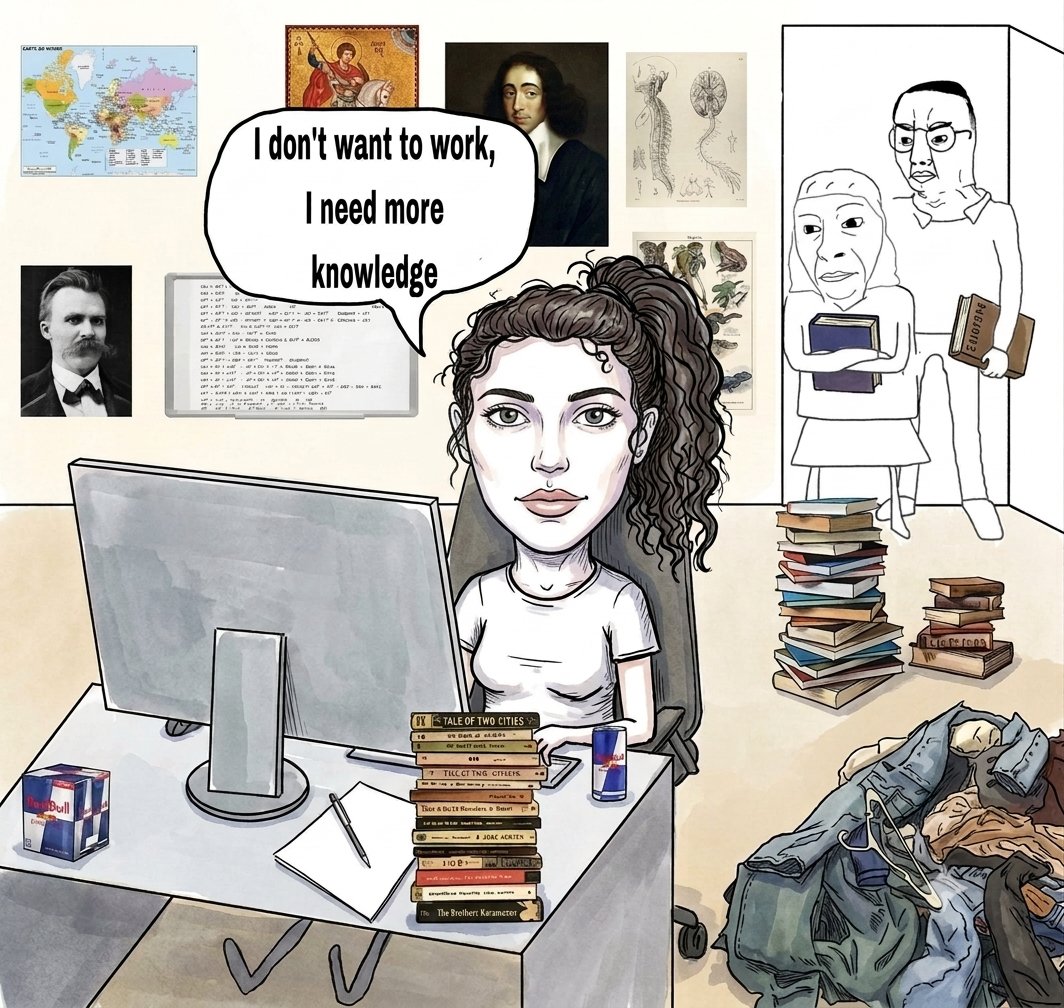
1/ There’s a new archetype dominating the internet: The Expert Spectator.
They consume endless content on philosophy, psychology, and productivity. They know a little about everything, but experience almost nothing.
Good work, but expected tbh. Given the advanced math and coding capabilities of AI, amplitudes is the natural arena; although I would have preferred if they did the 7/8 loop calculation for N=8 SUGRA; because getting a finite result for that would mean some interesting ideas
New on the Science Blog: Yes, Claude can do Nine Loops.
Theoretical physicists predict how particles behave using formulas called scattering amplitudes. These are notoriously hard to compute, so researchers work with layers of increasingly fine corrections called “loops”—each added loop makes the answer more precise but takes exponentially more computation. Most calculations stop at two or three loops. Eight loops was the previous record in a simplified model physicists use as a testing ground (planar N=4 super-Yang-Mills), set by SLAC's Lance Dixon and collaborators.
Last month, physicist and science writer @4gravitons issued a challenge: could an AI push past eight loops in this model, using only the compute budget an academic could reasonably access?
Given a single prompt describing the nine-loop problem, Claude ran largely unsupervised for days in Claude Science and solved it using methods developed by Dixon and his colleagues, at a total cost of a few thousand dollars. Dixon independently verified the result, and von Hippel wrote about the experience for our blog.
Read more: https://t.co/CS2f2qoIhJ
@pilkself Thats true. I worked on "proving the AdS CFT correspondence" a lot during my phd; spent many a years and convinced myself that I had the right framework; ultimately it never panned out :)
I will be very happy if someone could do so with AI now!
@Mi_Arya_@Renet29304 That remains to be seen, but I wont bet on it. Whether one could "discover renormalization" from older techniques by Borel, Abel etc on handling divergent sums; I would assume AI could find the technique although it may require a human to interpret the physical idea
@Mi_Arya_@Renet29304 AI can find connections bw ideas pretty well, and it is plausible that it could uncover some non trivial connections between obscure mathematical ideas and some cool physics. Whether it has an "understanding" of such work is best left to others but can be cool results regardless
@Mi_Arya_@Renet29304 I am not convinced by this; there is a lot of mathematical machinery that has no clear physical analogue. It is plausible that doing so will uncover a lot of somewhat deep insights (similar to witten's work on jones polynomial, morse theory etc)
Actually, come to think about it, academia is populated with wimps & gamma males good at taking tests but crippled with a total absence of imagination.
seems like opus 5.5 is plausibly good enough that solving children’s entertainment is thinkable. there’s room here for some really hyperspecialized stuff like if you only wanted your kids to watch stuff that transmitted the beliefs of your very specific culture / sect / cult
I often thought about it and lamented whether I would be lucky enough see such times; in our lifetime.
I left academia disillusioned by the state of the field; however these days it just feels very similar to the hayday of the string revolution my advisor used to talk about!
My PhD advisor was prolific in the 70s and 80s, and he recounted those years as being in a haze, new results in string theory being published every other day; the tantalizing possibility of finding the "final theory" seemed just round the corner...