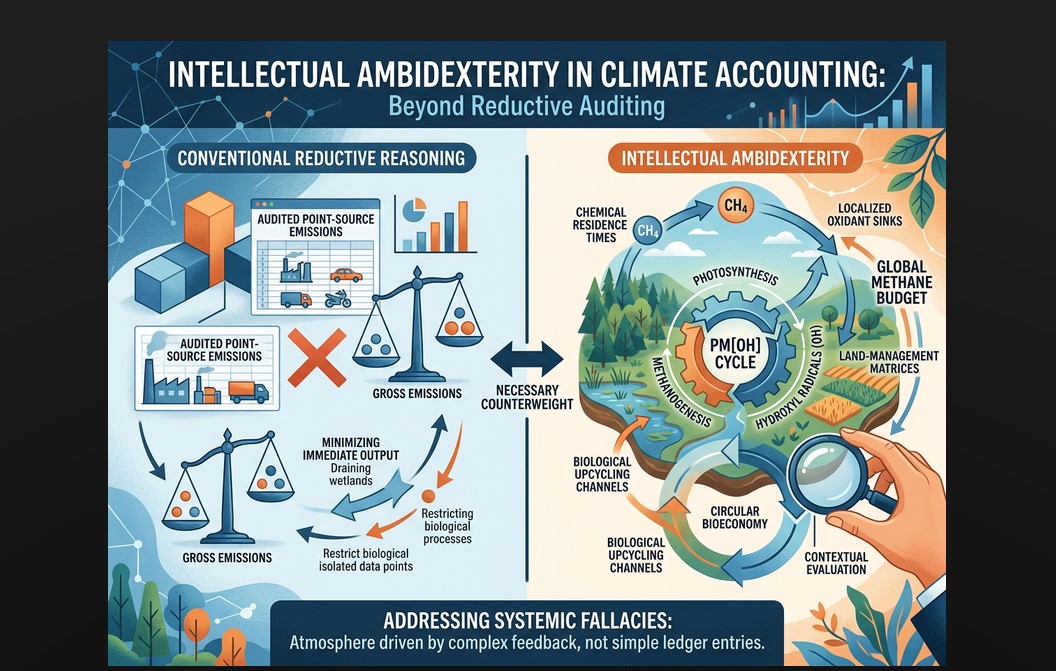
RE: CH4, Intellectual Ambidexterity vs. Reductive Reasoning
Conventional climate accounting relies heavily on reductive reasoning, auditing localized point-source emissions while neglecting the broader ecosystem context. This paper introduces the framework of intellectual ambidexterity as a necessary counterweight to this reductionist approach. By evaluating the global methane (CH4) budget, the behavior of hydroxyl radicals (OH), the photosynthesis–methanogenesis–hydroxyl radical (PM[OH]) cycle, and the mechanics of a circular bioeconomy, this article demonstrates that atmospheric gas accumulation is driven by chemical residence times, land-management matrices, and localized oxidant sinks rather than simple gross emissions. Finally, this article highlights the systemic fallacies of modern point-source ledger auditing, which implicitly suggests draining global aquatic systems or eliminating biological upcycling channels to minimize immediate gaseous output.
Link to full blog: https://t.co/DNuMZWZ9lM
cc. @fleroy1974@GHGGuru@PabloPastos@CSUChicoRegenAg@AcresUSA@UnderstandingAg@cags_grindrod@csmaje
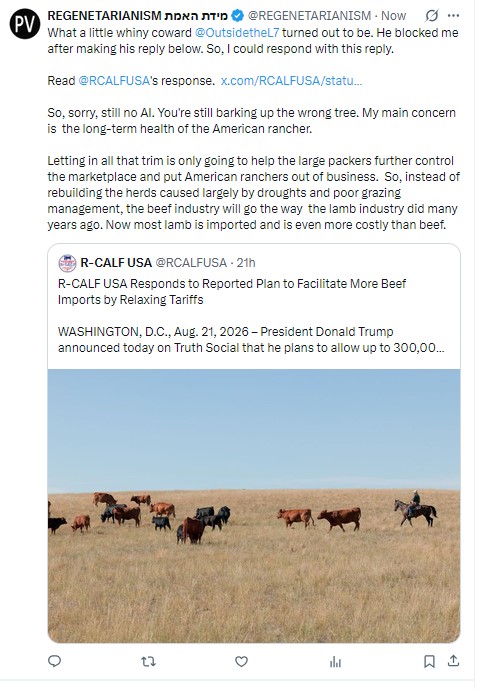
R-CALF USA Responds to Reported Plan to Facilitate More Beef Imports by Relaxing Tariffs
WASHINGTON, D.C., Aug. 21, 2026 – President Donald Trump announced today on Truth Social that he plans to allow up to 300,000 metric tons of beef intended for ground beef production to enter the United States without the out-of-quota tariff for 90 days. The president said the plan is intended to lower beef prices for consumers while providing time for the U.S. cattle herd to rebuild.
In response, R-CALF USA CEO Bill Bullard released the following statement:
“Increasing imports doubles down on a failed strategy that has substituted foreign beef for rebuilding domestic production. Beef imports have already risen to record levels while retail beef prices continued climbing and the U.S. cattle herd continued shrinking. More imports will continue providing multinational beef packers and retailers with cheaper supplies, but they have not resulted in lower beef costs for consumers.
“Most importantly, this policy undermines the producer confidence necessary to rebuild the U.S. cattle herd. Herd expansion takes years. Producers deciding whether to retain heifers today must have confidence that future cattle prices will justify that investment. Responding to cattle prices that finally encourage expansion with more lower-cost imported beef sends exactly the wrong signal.
“We urge the administration to reconsider this approach and instead restore competition in cattle markets, implement import controls that provide producers the confidence and market opportunity to rebuild the domestic herd, and restore mandatory country of origin labeling so consumers can distinguish American beef from imported beef.
“We share the goal of rebuilding America's cattle herd. But we cannot rebuild America's domestic beef supply chain by increasing our dependency on foreign beef.”
Read R-CALF USA's full response explaining how the reported import plan could affect U.S. cattle producers, herd expansion, consumer beef prices and long-term food security here: https://t.co/QM9gt7Mbmv
https://t.co/lmKhDfDuDH
Regenerative ranching is a direct and necessary disruption to conventional ranching. It rejects extractive, industrial models that degrade the land and instead rebuilds what matters most. We are in a fierce battle for living soil, thriving plants, abundant wildlife, resilient livestock—and ultimately, human health itself. By restoring ecosystems, sequestering carbon, and working with nature’s intelligence, regenerative ranching delivers true abundance where depletion once ruled. Support regenerative ranching. The future of our food, our land, and our health depends on it.
https://t.co/YBVMTPVw3t
Nicolette Niman is a cattle rancher, author, and environmental attorney running to represent ground zero of the American urban-rural divide: California's District 2.
https://t.co/yZnUbg4mQl
THRILLED to have the endorsement of Ralph Grossi, long time national and local advocate for agriculture! His letter is in latest edition of The Point Reyes Light. "I am truly heartened by the candidacy of Nicolette Hahn Niman," Ralph writes. I hope you will be, too!
"Nicolette was an environmental lawyer. Then she married a rancher - and everything changed.
https://t.co/rmFBrLhq2w
Now she's the author of Defending Beef, a regenerative rancher in Marin County & she's running for Congress to fight for the rural communities that shaped her."
Nicolette Hahn Niman Brings Food and Farming Issues to the Ballot https://t.co/Wq8SSDYfe8
Rancher/Advocate is Staging an Independent Campaign for U.S. House in California
Donate here: https://t.co/oVwS7vVl0g
cc. @foodtank@CivilEats@AmerGrassfed
https://t.co/g3PMFxpe0d
"Broadly defined, regenerative grazing is a land management approach designed to not only sustainably manage livestock but also restore and improve soil quality, livestock health, biodiversity and local livelihoods."
“At the time of colonization, there was about 170 million acres of tallgrass prairie, and today we have less than 4% of that remaining. Two-thirds of what we have left is in the Flint Hills.”
https://t.co/LkZnoMIhnu
.....