The Defense AI Observatory (DAIO) monitors and analyses the use of artificial intelligence by armed forces | Funded by @dtecbw I Operated by @heikoborchert
📢+++ OUT NOW: THE VERY LONG GAME+++📚
...3...2...1: We are truly excited to inform you that "The Very Long Game: 25 Studies on the Global State of #DefenseAI" has been released today. 🧵 with links to all chapters below
Get your #OpenAccess copy here: https://t.co/ybn3nyzLWc
We are very grateful to @Defense_AIO for making this research into Belarus’s use of AI possible. @konrad_skorupa's work will help us better understand how Belarus is integrating artificial intelligence into its armed forces and wider state security structures.
📣 Between Innovation and Supervision: Defense AI in Belarus📚
The study by @konrad_skorupa looks at the role of AI in improving state efficiency in Belarus and discusses the role of RUS & CHN in advancing the country's AI capabilities. @konrad_muzyka
👉 https://t.co/GcueEKNgGw
📣 Balanced and Pragmatic Steps Toward Defense Self-Reliance: Defense AI in Malaysia 🇲🇾 📚
Prof Adam Wey's study on defense AI in Malaysia insightfully analyzes the interplay btw strategic culture, geostrategic developments and national defense needs.
https://t.co/7jpKkrw3Vd
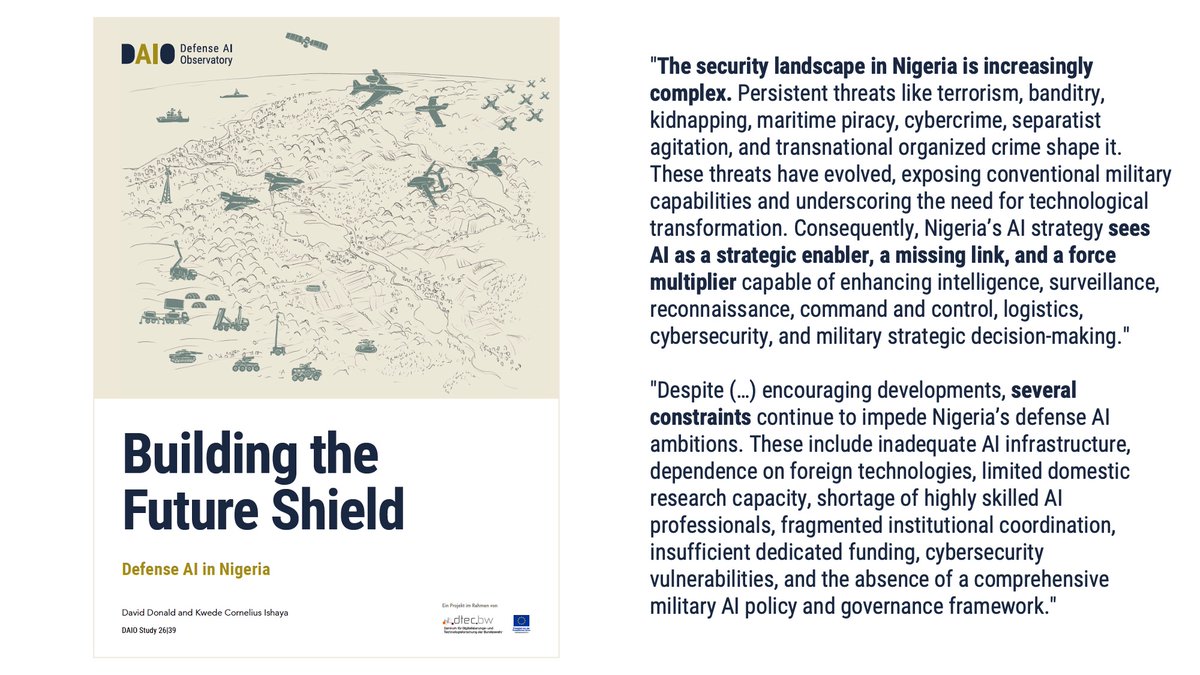
Building the Future Shield: Defense AI in Nigeria🇳🇬
Today we proudly release our first African case study by David Donald and Kwede Cornelius Ishaya on defense AI in Nigeria.
Get your copy here: https://t.co/ZDrc0CaNdv
📣Trusting Allied Machines📚
In our latest paper, LTC Sanghyun Ahn, ROK Army, argues that allied nations in the APAC region can build a regional assurance regime for defense AI "without wating for the hegemon to supply it." For more, see: https://t.co/gSWldcJcE4
📣 Reimagining Horizons: Defense AI in the Philippines🇵🇭The Philippines, writes Keanu Paul Sygaco in our latest study, "must pair reactive measures against immediate threats with proactive efforts" to advance defense AI. For more, see his study: https://t.co/34xhBR1IcU
MOSA: Es geht um viel mehr als offene Schnittstellen
Um anpassungsfähiger zu werden, setzen Streitkräfte verstärkt darauf, monolithische Produkte durch einen modularen und offenen Systemansatz (#MOSA) zu ersetzen. Das Bundesministerium der Verteidigung hat hierzu kürzlich seine eigene Weisung erlassen.
Offene Schnittstellen sind für MOSA zwar wichtig, doch es geht, wie ich im heutigen Standpunkt für den @Tagesspiegel Background Sicherheit & Verteidigung darlege, um deutlich mehr, denn MOSA
1️⃣ greift tiefer und bedeutet, die Eins-zu-Eins Verbindungen in bestehenden Lösungen durch Module zu ersetzen, die in Verbünden kombiniert und durch dynamisch anpassbare Abläufe gesteuert werden;
2️⃣ erfordert die anpassungsfähige Koordination eben dieser Module, die lagespezifisch aufeinander abgestimmt werden können, um den Gegner zu überraschen und ihm eine gewünschte Vorgehensweise (Course of Action, CoA) aufzuzwingen;
3️⃣ bedingt weitreichende rüstungsindustrielle Anpassungen, denn die Idee, militärische Fähigkeiten wie Mosaikbausteine verteilt zu organisieren, ist bislang nur unzureichend abgebildet;
4️⃣ ist als Designprinzip auch für die umfassende Sicherheit von zentraler Bedeutung, um z.B. Aufklärungsinformation für die Drohnenabwehr allen staatlichen und nicht-staatlichen Sicherheitspartnern zur Verfügung zu stellen.
Link zum Beitrag: https://t.co/9zYTQ9zvyi
cc @svenweizenegger@MW42522637@Ce_Moll@_schuetzt@Konflikt_Sicher@Bjoern__M
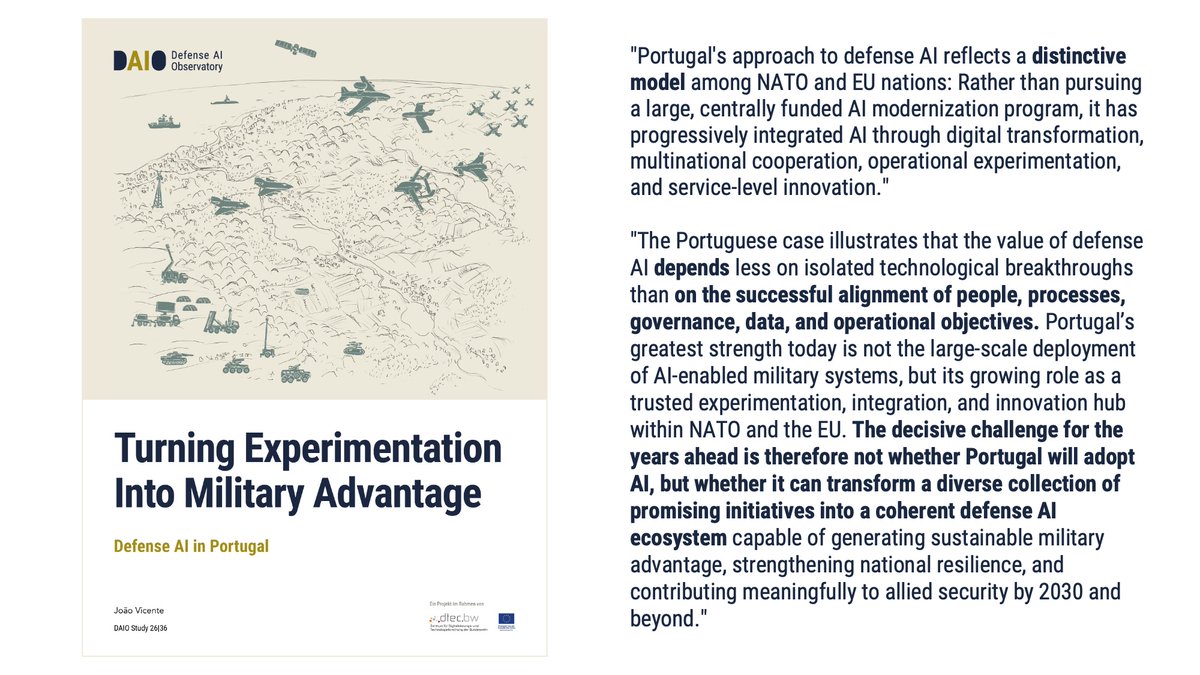
Turning Experimentation Into Military Advantage
Portugal is following a "distinctive model among NATO and EU nations" that emphasizes the role of experimentation in adopting defense AI, writes MajGen Joao Vicente, Portuguese Air Force.
For more, see https://t.co/FvaYeCgmJM
"When AI tools are becoming collaborative partners."
This is the leitmotif of the 2026 #AISummitBudapest, which will take place on 7-8 September. Organized for the fourth time, the conference has turned into Central Europe's premier platform to discuss all things AI....
This year the conference also runs a dedicated workstream on AI in space and defense. Together with Gergely Németh, CEO of KIVI, and MajGen Laszlo Kovacs, HUN MoD, we will explore
🤖 how armed forces are using AI,
🤖 to what extent current use cases describe evolutionary or revolutionary pathways to using AI, and
🤖 what challenges armed forces face when cooperating with non-traditional defense partners.
If you are in Budapest on 7-8 September, please join us on Monday, 7 Sept, 1430 (Quantum Stage). We look forward to welcoming you.
For more on the program and to register, see: https://t.co/3aba6niMrO
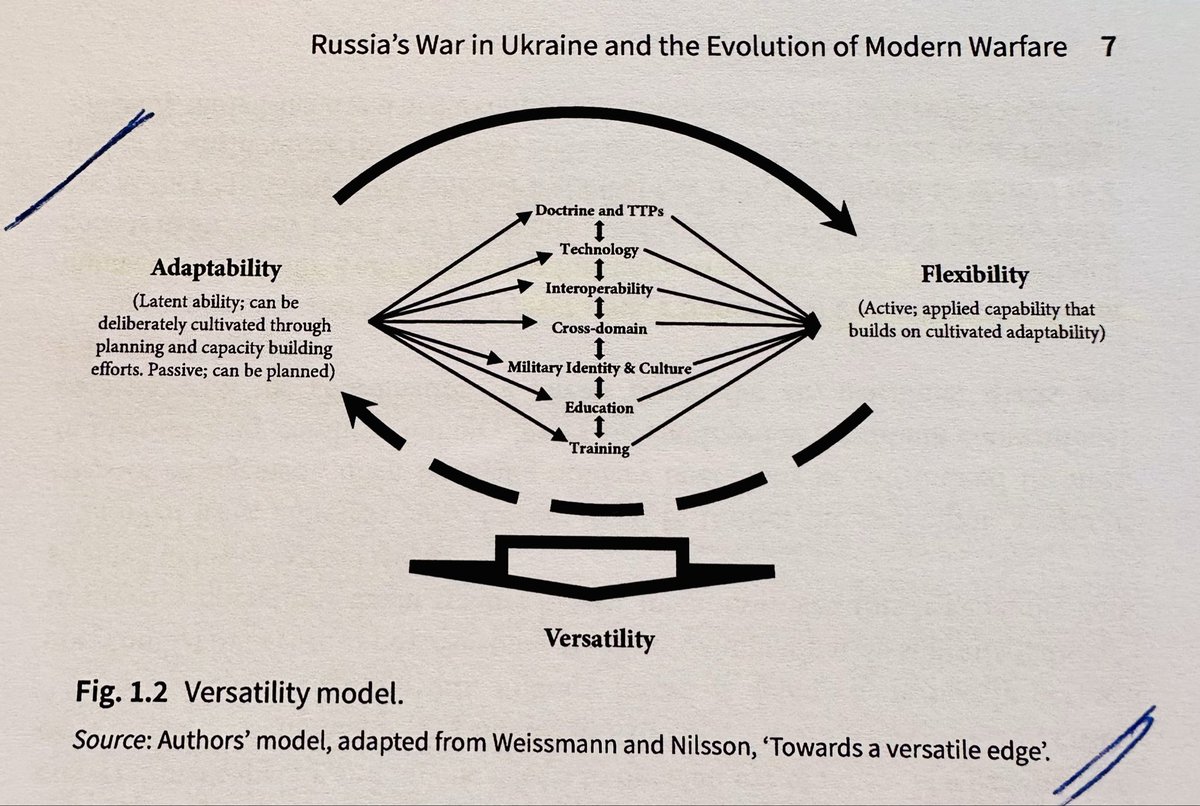
“Russia’s war in Ukraine and modern warfare” is a great companion to “Preparing for war” by @Olivier1Schmitt. I particularly like the versatility model developed by @mikaelweissmann and Niklas Nilsson (see pic)
Use the link in Mikael’s original post below 👇🏻 to get your copy of this open-access volume
cc @Mauro_Gilli@aa_gilli@MichaelRaska@CyberMyri@ZaccagniniIvan
@SIPRIorg For more on "The Very Long Game," our open-access book covering defense AI in the US, CAN, GBR, SWE, FIN, EST, DNK, DEU, FRA, ESP, ITA, GRE, TUR, RUS, UKR, ISR, IRN, IND, CHN, JPN, ROK, TWN, SGP and AUS, see https://t.co/ybn3nyzLWc
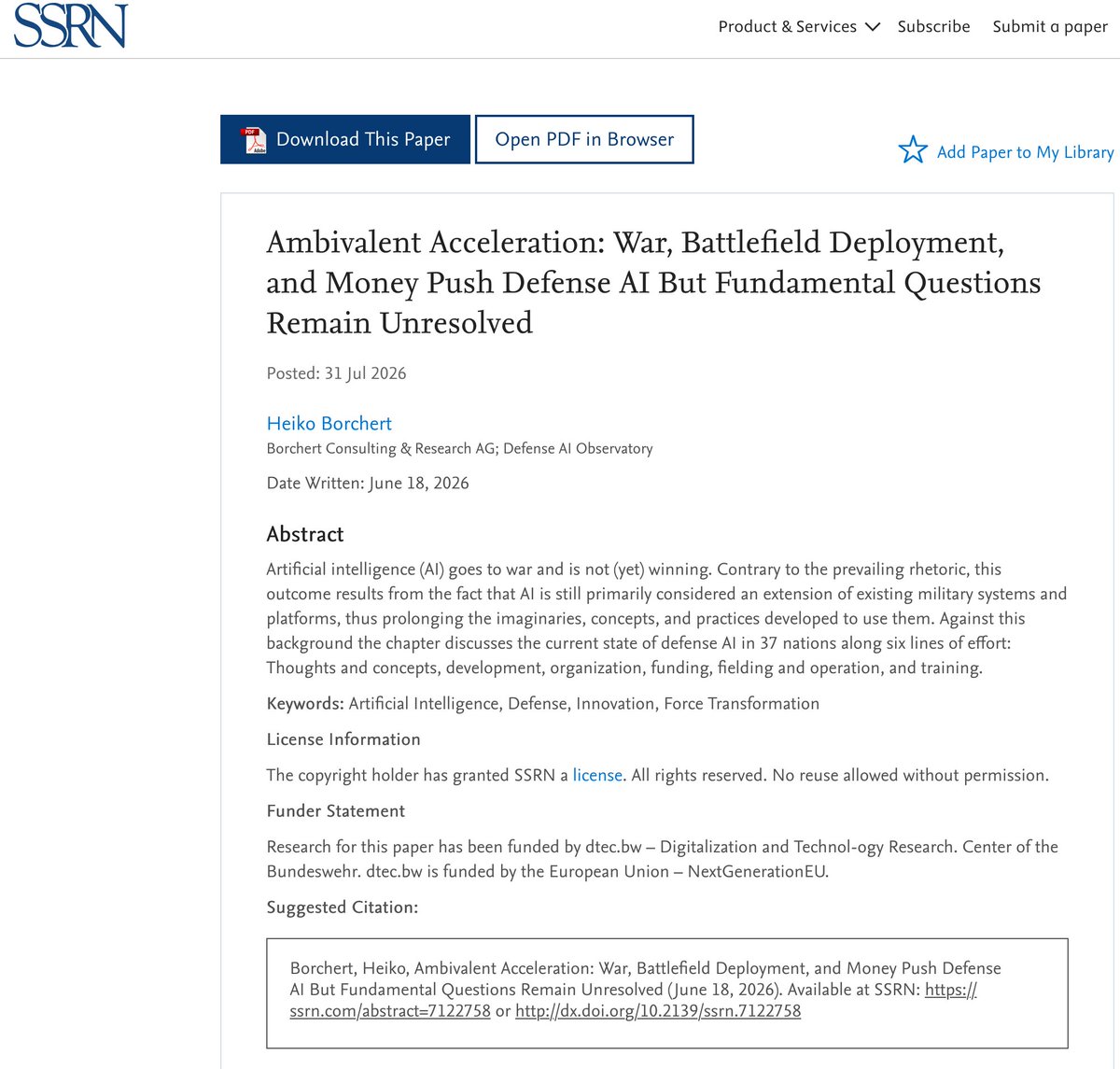
@SIPRIorg Many thanks for this very helpful overview. May we add "Ambivalent Acceleration" our latest assessment of the state of defense AI in 37 nations to your collection? This forthcoming paper updates the findings of "The Very Long Game". See: https://t.co/ympwOy5eSM
Need an #AI refresher?
As an early mover in #AIGovernance, SIPRI has you covered. Explore these recent publications and commentaries to get back up to speed:
🟣 SIPRI Yearbook 2026: Artificial Intelligence and International Peace and Security
🔗https://t.co/LiuX5prAJ9
🟣 Mapping the Military AI Industry
🔗 https://t.co/ykvDGQf5Io
🟣 Responsible Procurement of Military Artificial Intelligence
🔗https://t.co/AfxESEurq2
🟣 Autonomous Weapon Systems and AI-enabled Decision Support Systems in Military Targeting: A Comparison and Recommended Policy Responses
🔗 https://t.co/5j1VkkhPhG
🟣 Towards Multilateral Policy on Autonomous Weapon Systems
🔗 https://t.co/0Ya5QUAPeX
🟣 Addressing the Risks that Civilian AI poses to International Peace and Security: The Role of Responsible Innovation
🔗 https://t.co/DH2vrjoTMJ
🟣 Impact of Military Artificial Intelligence on Nuclear Escalation Risk
🔗 https://t.co/P1GyLPwV9a
🟣 Bias in Military Artificial Intelligence and Compliance with International Humanitarian Law
🔗 https://t.co/Sl8CHsSFbT
🟣 Commentary: Before it’s too late: Why a world of interacting AI agents demands new safeguards
🔗 https://t.co/dy6GrwtMuC
🟣 Commentary: Responsible behaviour in military AI starts with responsible procurement
🔗 https://t.co/SrnKT1rFvy
#ArmamentAndDisarmamentWeek @TMCAsser #ArtificialIntelligence #AIGovernance @GCREAIM@UN_Disarmament@Defense_AIO@BoulaninSIPRI
📢 Small Force, Big Data: Defense AI in New Zealand📚
New Zealand's defense #AI challenge is wheter the country can "build enough competence to remain useful, trusted, and sovereign inside allied systems" writes @ReubenSteff in his latest study
See: https://t.co/ld1aZuK6Zd
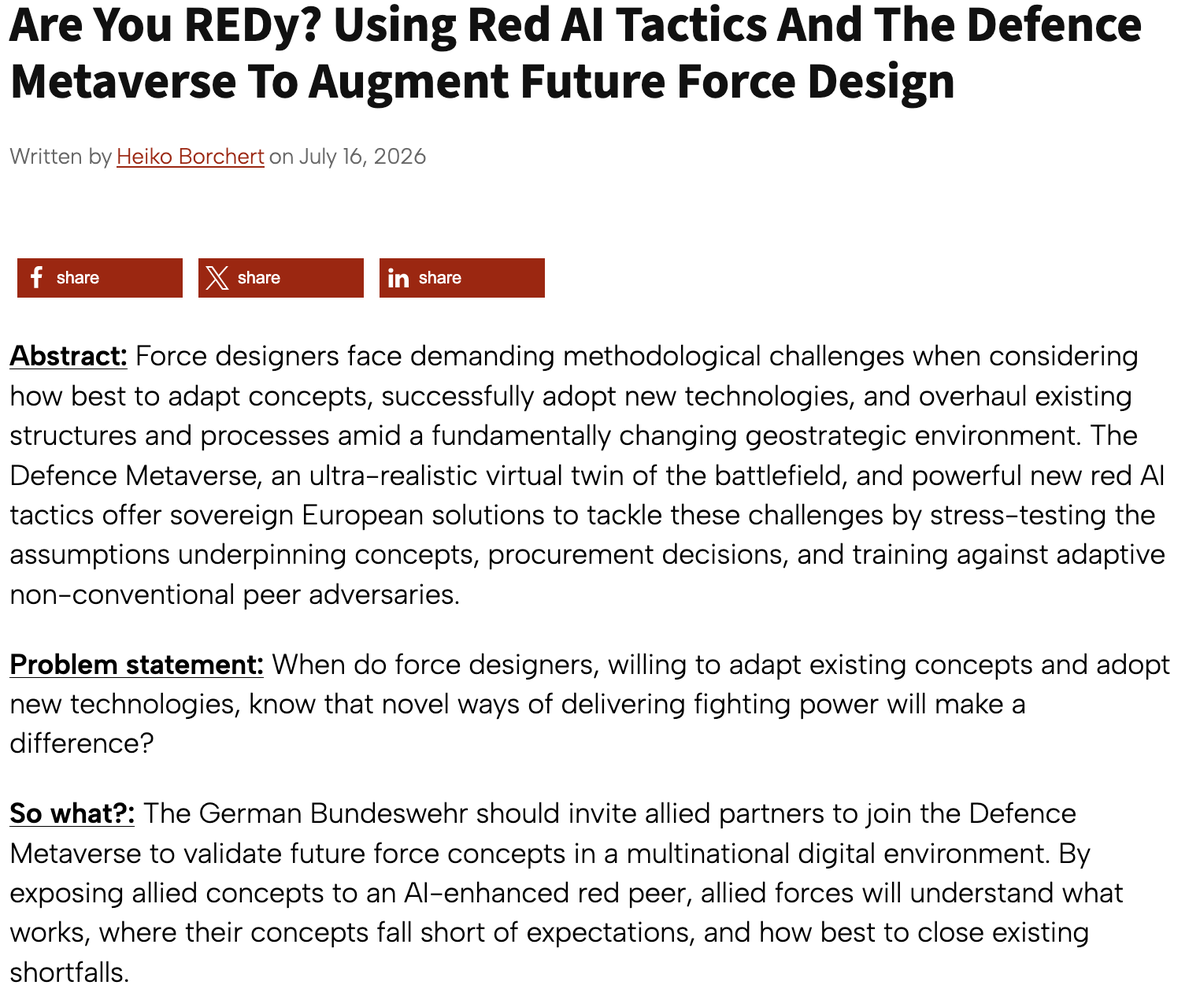
Stress-testing defense assumptions with the defense metaverse and powerful #redAI tactics. We are happy to share the latest piece by @HeikoBorchert for @HorizonDefence
Are You REDy? Using Red AI Tactics and the Defense Metaverse to Augment Force Design
"The European Central Bank is stress-testing the resilience of the European financial system against hypothetical financial and economic shocks. The Defence Metaverse and red AI tactics provide a novel military equivalent to stress-test national and European defence assumptions, to develop concepts and capabilities for the new age of protracted warfare characterised by adversaries deliberately depleting European military capabilities."
This is the key argument of my latest paper for @HorizonDefence.
For more, see https://t.co/cCXCDt4Upb.
Many thanks @MW42522637@Pastey_n and the @HorizonDefence for your help.
@KubiliusA@Mauro_Gilli@MichaelRaska@Konflikt_Sicher@Bjoern__M@VorgBeob