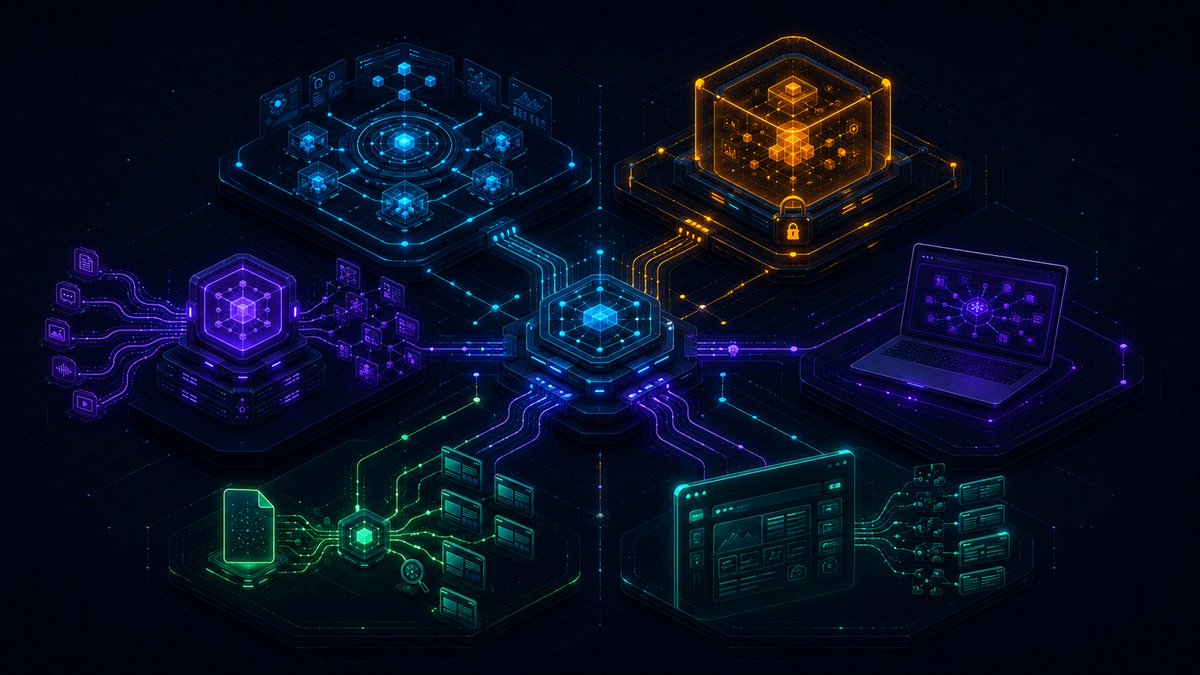
@RokoNetwork is built for exactly this.
Generalized agents plateau once you leave basic messaging, memory, and tools. Real workflows need specialized paths — hard boundaries, clear authority, and a way to see what each agent actually did.
That’s the layer: @AIWGio check gates per workflow, sandboxed execution, and temporal receipts so agent “communities” are monitorable instead of opaque.
Specialize the work. Share the control plane.
Strong framing. Production agents really do fail more on context and control than on raw reasoning.
Once context management is solid, the next gap is usually auditability of actions — knowing what the agent actually did and when. That’s the layer @RokoNetwork building: consensus-grade timing + cryptographic Temporal Receipts, plus governance with explicit check gates.
@jasonlk@RokoNetwork that's what you been looking for,Providing independent, verifiable proof of what a fleet of AI agents actually did — especially when those agents are driving real business outcomes and the human operators are hitting cognitive limits.
@RokoNetwork will sit on top can Prove what the AI agent actually proposed
Temporal Receipts on the agent’s strategy propose
Cryptographic proof of the exact proposal content + precise time
Clear timeline of proposal → review → execution
PoAT / Temporal Receipts
Independent, high-precision timestamps for every stage
Preventing the agent from submitting dangerous proposals in the first place
@AIWGio + Steward
Risk policies and constraints before the proposal even reaches guardians
Audit trail of agent reasoning & past strategies
Fortémí
Persistent, provenance-rich memory of proposals and outcomes
Disputes after a bad execution
Signed receipts + precise timing
Makes post-mortem and liability assignment much better
So how @RokoNetwork would helped to prevent that @AFX_XYZ bridge exploit H
Roko’s core design (Proof of Accurate Time / PoAT, temporal receipts, nanosecond consensus time, and tamper-evident ordering) is aimed precisely at this class of failure:
Temporal receipts + strict inclusion / validity windows
Withdrawal authorizations could be required to carry Roko temporal receipts (ECDSA-signed, bound to consensus time at the moment of creation). Messages older than a very short window (or missing a valid temporal receipt) would be rejected by honest validators/contracts. A compromised key would have a much narrower window to produce a usable authorization.
Physics-grounded consensus time instead of pure cryptographic quorum
Pure multi-sig / hot-validator power can be fully captured if enough keys are stolen. Roko adds an independent dimension: the message must also be consistent with the network’s high-resolution, mesh-synced time. Forging a valid temporal context becomes significantly harder even when keys are compromised.
Tamper-evident ordering and anomaly detection
Unusual signing patterns (rapid, out-of-sequence, or delayed relative to the time mesh) become detectable on-chain. Time-quality and ordering violations are recorded, which can feed monitoring or automatic circuit-breakers.
Complementary layer, not a full replacement
Roko does not magically solve key management or social engineering of validators. What it does is harden the message validity rules so that even compromised signers have tightly constrained ability to produce timely, accepted withdrawal instructions.
I have been talking with the @RokoNetwork team and slowly building a position for over two years now. their white paper just released (link below).
this *cracked* team has created a new category: one that very few even recognize the need for yet. but that will change very soon.
currently sitting at an $1.1mm. $ROKO is finally ready to show the world what they have been up to, and I am *very* excited for the ride.
ca: 0x6f222E04F6c53Cc688FfB0Abe7206aAc66A8FF98 https://t.co/bQ4MaosWNo
white paper: https://t.co/zB1lfsbvgn
excerpts:
"ROKO Network aims to be the neutral clock, notary, and clearing layer for the machine economy — from factory floors and vehicle fleets to the autonomous agent economy."
"Machine work at scale — whether the machine is a robot on a factory floor, a sensor on a pipeline, or an agent in a datacenter — requires three guarantees that no single vendor can credibly selfcertify: independent, nanosecond-resolution time; tamper-evident, replay-protected sign-off that a specific unit of work happened exactly once; and neutral settlement that ties payment to verified completion."
this is *significantly* superior to makeshift blockchain hashing approaches to time verification. it is not just an improvement; it is the advent of an entirely new category: Nanosecond-grade (IEEE 1588 PTP) time-as-a-service (TaaS) via hardware mesh.
top 3 applications imo:
1. verifiable (tamper-proof) settlement and auditing in agent-robot marketplaces: on-chain proofs for machine economy transactions, such as robot-as-a-service, shared intelligence, or fractional ownership. tamper-evident records for work completion, SLAs, and revenue sharing (e.g., via temporal receipts for anchoring and custody).
2. real-time robotics control and swarm synchronization for embodied agents and robotic fleets: nanosecond-precision timing for coordinated actions, safety, and feedback loops (most don't even realize we will need this).
3. synchronized multi-agent coordination in agentic marketplaces: trustless, time-stamped orchestration of autonomous AI agents in decentralized marketplaces (e.g., trading, task allocation, GPU orchestration, service bidding).
When machines work across boundaries, they can disagree about quality, responsibility, and payment. Time should be one less thing to negotiate.
That idea sits at the center of this paper—and of ROKO, the network clock for verifiable machine work.
https://t.co/j9c610qUmd
Every blockchain answers "who owns what." Almost none can answer "who went first — and can you prove it?"
We just did. On Bitcoin. Verifiable by anyone.
Time is the thing crypto quietly fakes. block.timestamp is nudgeable. Order inside a block goes to whoever pays the most gas. Every chain trusts someone's clock. ROKO was built for one thing: make time verifiable instead of trusted.
So here's proof, not a promise.
8 real blocks from the live ROKO testnet — each carrying its timestamp and ordering — sealed into one cryptographic root and anchored into Bitcoin. On-chain. Checkable by anyone on Earth:
https://t.co/v7HKuWsFsP
Look at the OP_RETURN yourself. It says RKO1. That's ROKO's commitment, now witnessed by Bitcoin's proof-of-work. Change one bit of any block and the proof shatters. You don't take our word for the order — you check it.
And there's a war in Bitcoin right now over what belongs on-chain. 42 bytes or unlimited. Core or Knots. $ROKO doesn't ask you to pick a side. Our commitment is 45 bytes — it lands under the old limit, the new one, and Knots' strictest policy alike. We don't bloat the chain. We write one hash.
Here's the part people miss:
Bitcoin is the permanence layer. ROKO is the time layer. Not competitors — complementary. One makes things impossible to erase. The other makes when and in what order impossible to fake.
Where this goes: markets, machines, and AI agents that share a clock they don't have to trust. Where "who went first" is something you verify, not something you're told. Fair ordering. Provable audit trails. Honest provenance. One substrate.
We're not trying to be another L1 in the pile. We're building the way the industry expresses verifiable time — the reference for a category that doesn't have one yet. TLS did it for encryption. Something has to do it for time.
Everything above is checkable. That's the point.
Don't trust. Verify. → https://t.co/VNXoufjd89
The clock is the consensus. Come look.
30+ releases across six tools in June — all open source.
An agent control dashboard,
a secure runtime where agents run code,
self-hosted + in-browser agent memory,
a static-site publisher, and a real browser in your terminal.
The full rundown below.
Did you know, you can run Openclaw/Hermes/Opencode and AIWG 100% locally on computers with video cards as small as 8gb of vram?
That's right, basic gaming PC is an AI powerhouse in disguise. No cloud required.
Have you tried it yet?
I know many developers won't believe this.
You should finish V1, delete it, and start again.
Ship V2 or even V3 after testing V2.
Don't copy code, don't carry libraries forward, again, from 0.
Oh? Are we doing memory systems now? lfg!
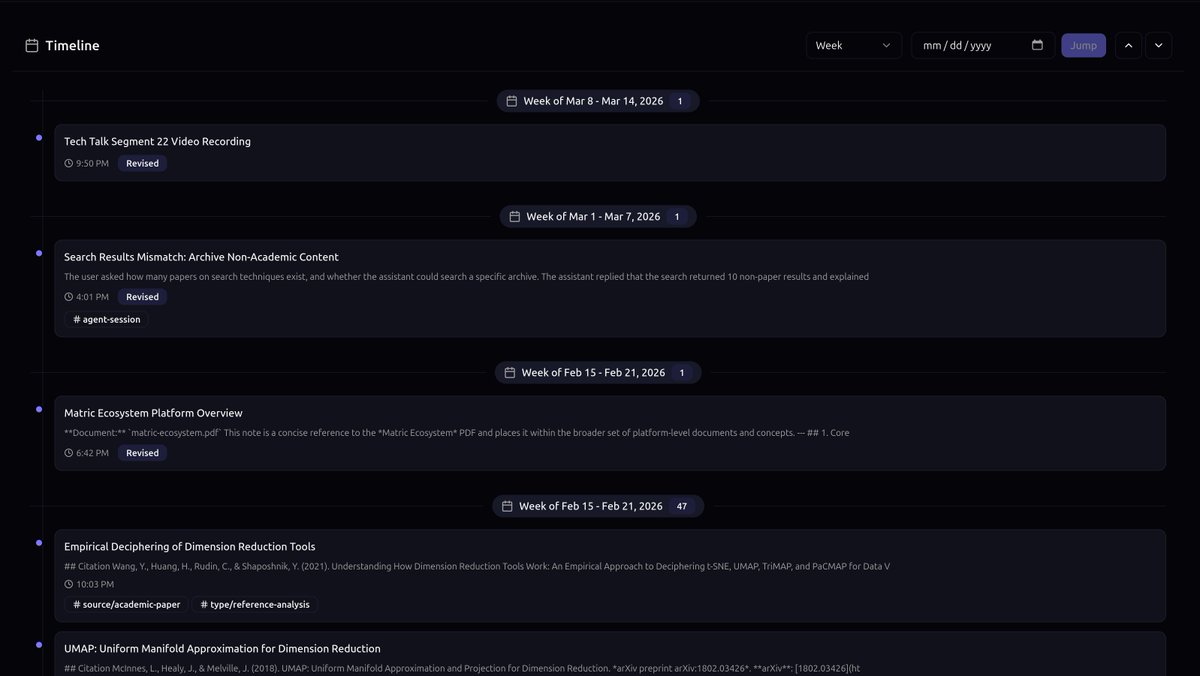
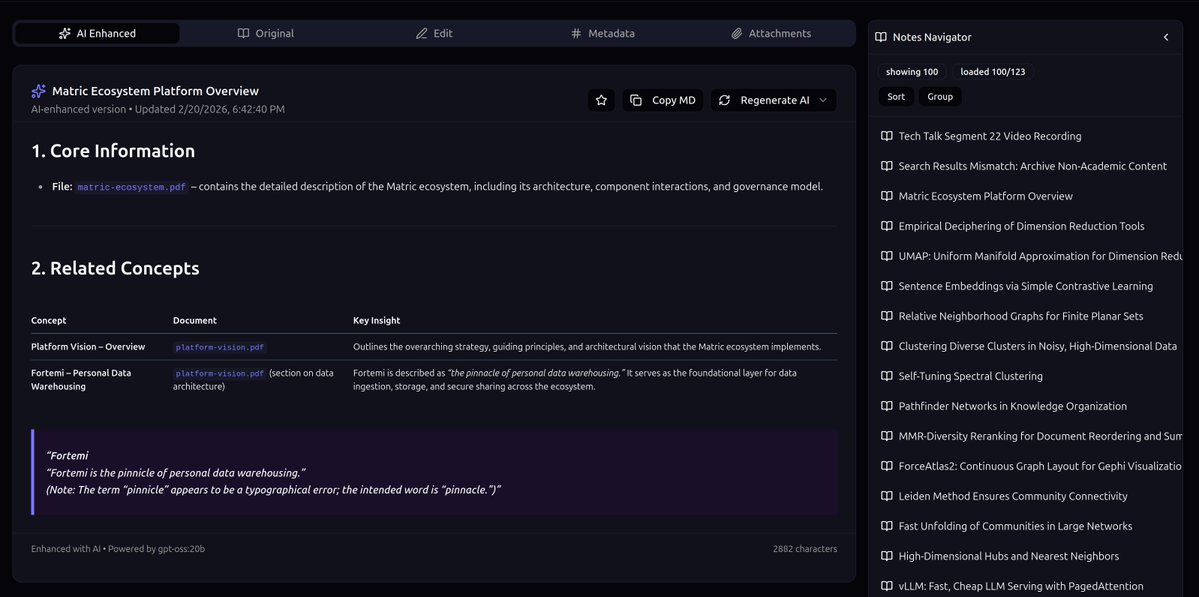
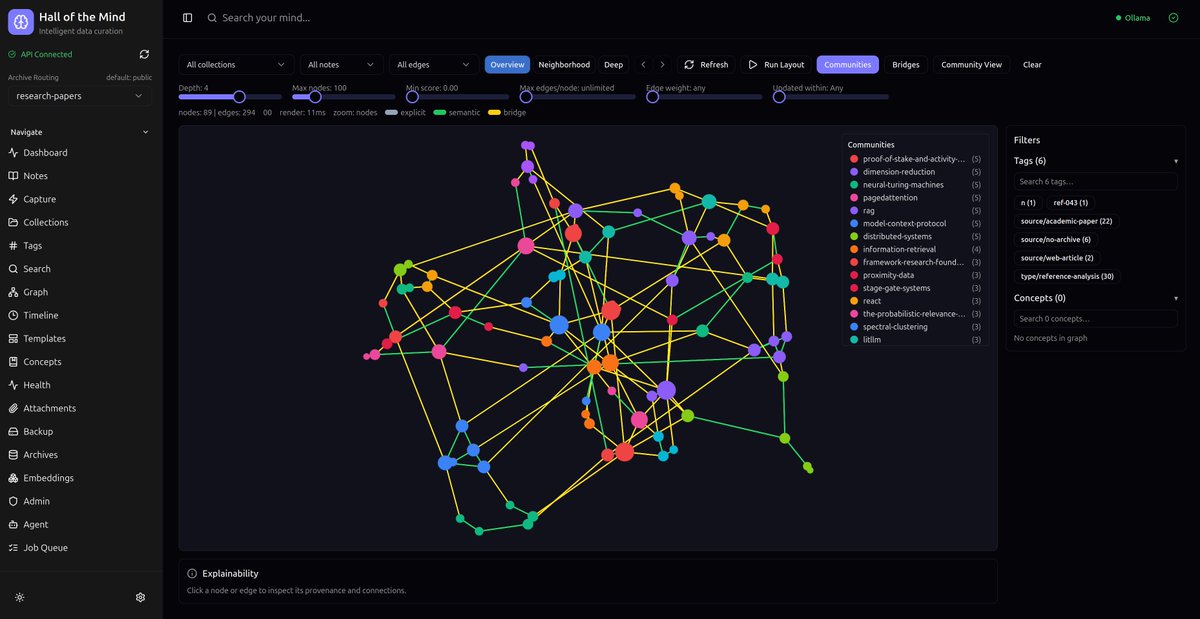
This is Hall of the Mind, an app I started back in March last year to experiment with in-application assistants that you don't directly interact with but are operating within the application with you.
The test case was data curation tooling, over the year the system evolved and the data curation component became such a big part of daily operations for multiple teams we filled it out with a complete feature set from tenancy to resilience and local model empathy.
We called this new server Fortémi and converted Hall of the Mind into a UI app with an embedded agent proxy and job servers for side-by-side user/agent interactions.
Includes the expected graph features you know and love backed by PostgreSQL.
Designed and tested to run local first and scale from there, has been tested on systems with as little as 6gb of VRAM and the server is designed to be usable even without a local GPU (read and many crud ops are CPU only) and fail gracefully when services are unavailable.
Rest API, Server Side Events and MCP are all available for utilization with customizable MCP interface.
All opensource and available today!