@Rainmaker1973 Had to return it twice, after only a week of usage. first the spinning disc caused a clicking noise each rotation - wich was audible in the recordings and with the second one the screws holding the handle on the side went lose and it fell off. Lots of such stories online.
@MaximeRivest haha, nice I have built almost the same. how did you get the pen strokes to be so responsive. my fable claims it is impossible unless I completely sidestep xochitl
@sama it is not a condradiction. ai is currently multiplying the productive output of a human, with the human still beeing the limiting factor (his sleep), so he tries to fix him beeing the bottleneck. he also predicts a future with the human out of the loop, but it is not here yet
@danshuri I am currently iterating on something like geometry nodes for threejs. Do you think that could be helpful in your case? My personal goal is to dynamically create objects matching a real world location scanned by a VR headset.
@sotoalt_@grove_online i have been thinking about something like this for over a decade without finding a solution yet. But I know it needs to be hierarchical. Where you see the highest abstraction first and then can dive into elements as deep as you want.
@IRCSS what happens if you just not apply the x value? I have seen this behaviour before, its moving at twice the distance it should be moving. either try not to apply x here or divide it by 2 which would be a hack
@IRCSS your arrow is moving twice. once because its anchor moves and once because it is moved itself. you should either reparent it or keep it at position zero
@IRCSS That is nice to hear. I had the feeling already that some of my unoptimized geometry with way to many vertices felt quite smooth still. I am experimenting with bringing blender like geometry nodes to threejs using a DSL and wasm backend to bake everything into a few draw calls.
@IRCSS I am targeting meta quest 3 in webxr. From what I have read I cant render more than about 150k vertices in a frame for acceptable performance. I could imagine this to still look quite good in low poly style though, with even lower resolution.
@Nodragem so it must be plateus because my realworld location is flat typically and it must match everywhere you could walk. I need to create contour lines that reflect the macro and micro constraints coming from level design and real world location
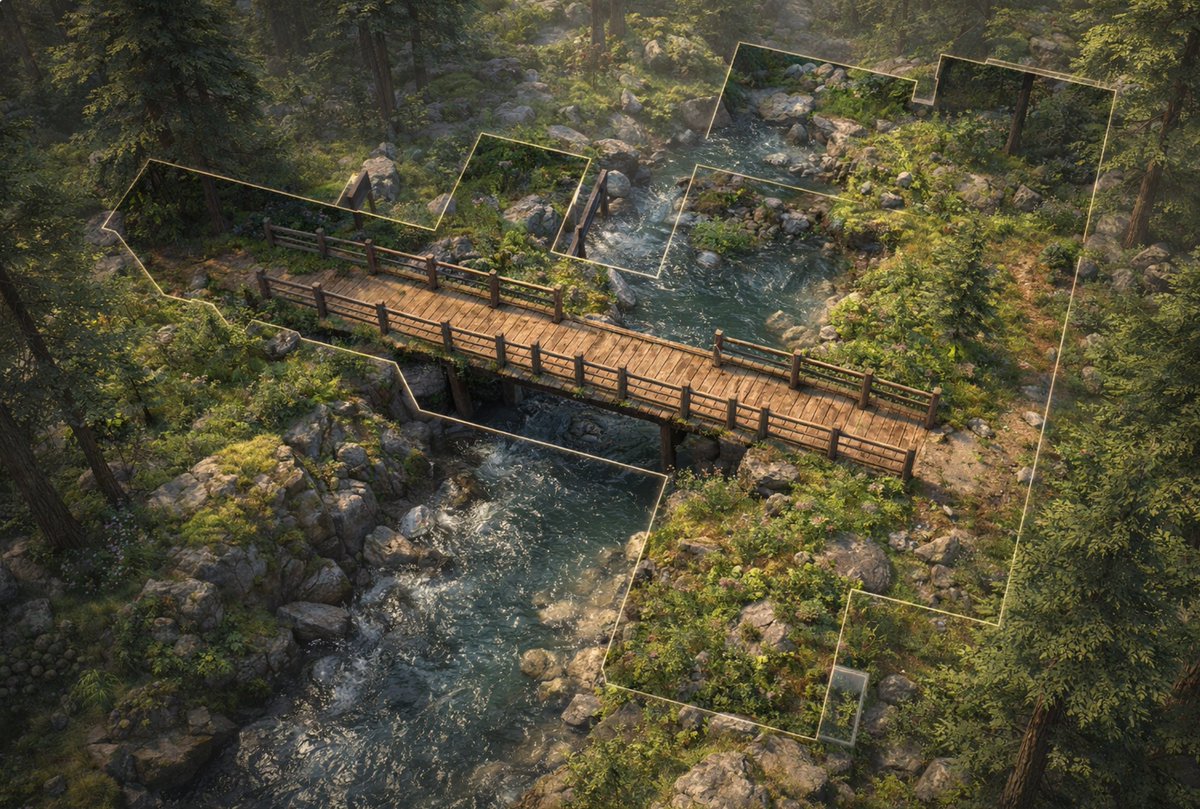
@Nodragem the vision would be to have a world like this built into a local space from a scanned real world location. some kind of redirected walking with discrete steps, where I use a blink animation to switch the camera rotation while you do a rotation in the real world as trigger
@Nodragem i also have a ton of procedural meshes and terrain generators which can take the macro map (which is contour lines and plateus) and the walkable solution from the path solver to generate a world around all of that
@Nodragem i have a solver which can create a variety of walkable netwroks inside a single mapping (red points are portal locations). this is the "forrest trail" preset