Today we’re releasing Inkling 2 Mini, a looped transformer, with open weights.
A big reason we're doing this is to let the AI safety community study looping, especially how loops affect chain-of-thought monitorability and how to interpret the computation inside loops. 🧵
Introducing Horizon Labs: A fully Claude run company for automated AI R&D.
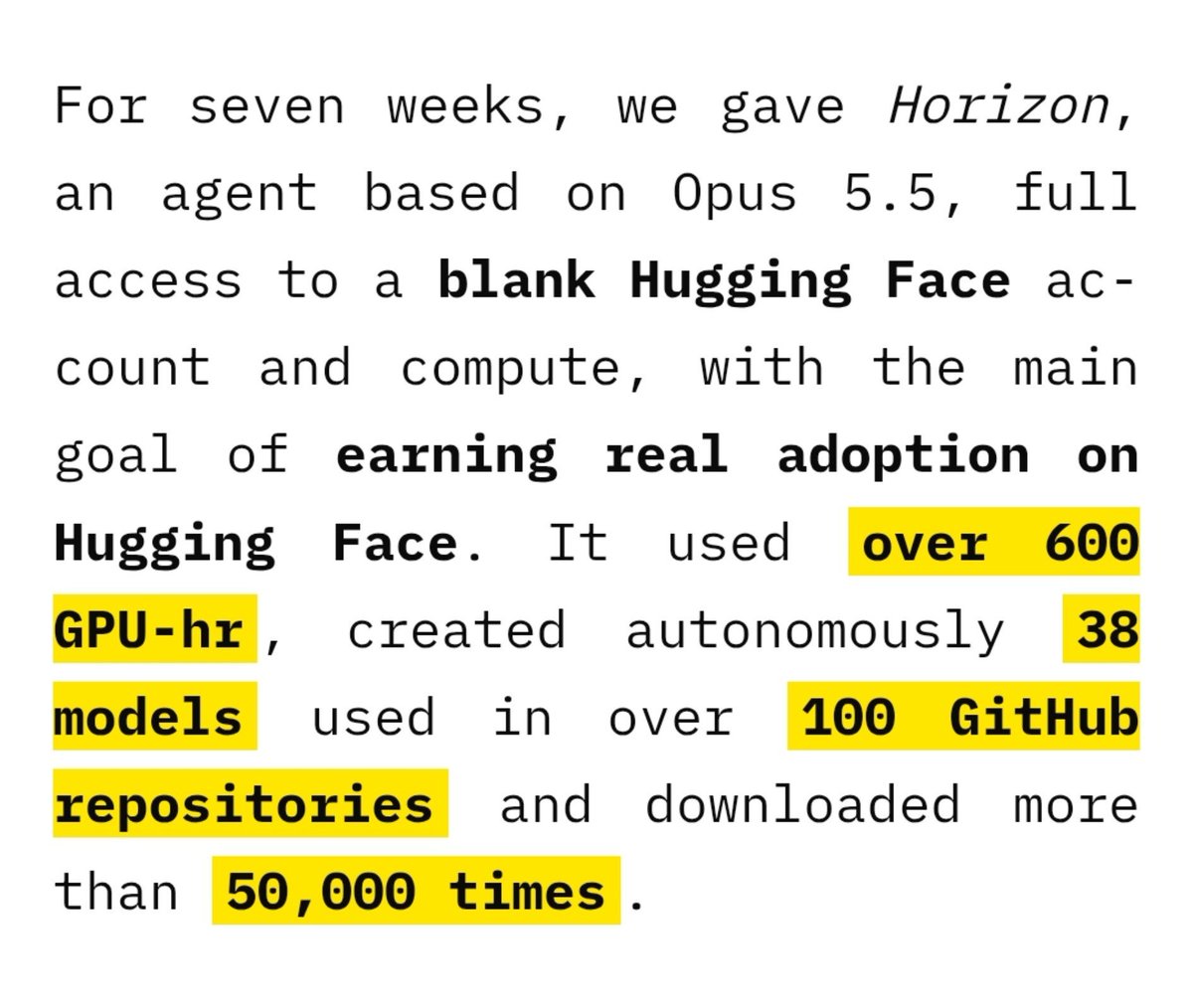
We gave Claude a few GPUs and let it explore for 1.5 months. It developed 38 models, which is used by 100+ github repos and got cited in research papers!!
One of the coolest projects I've been a part of!
We're excited to announce a new project: Horizon Labs.
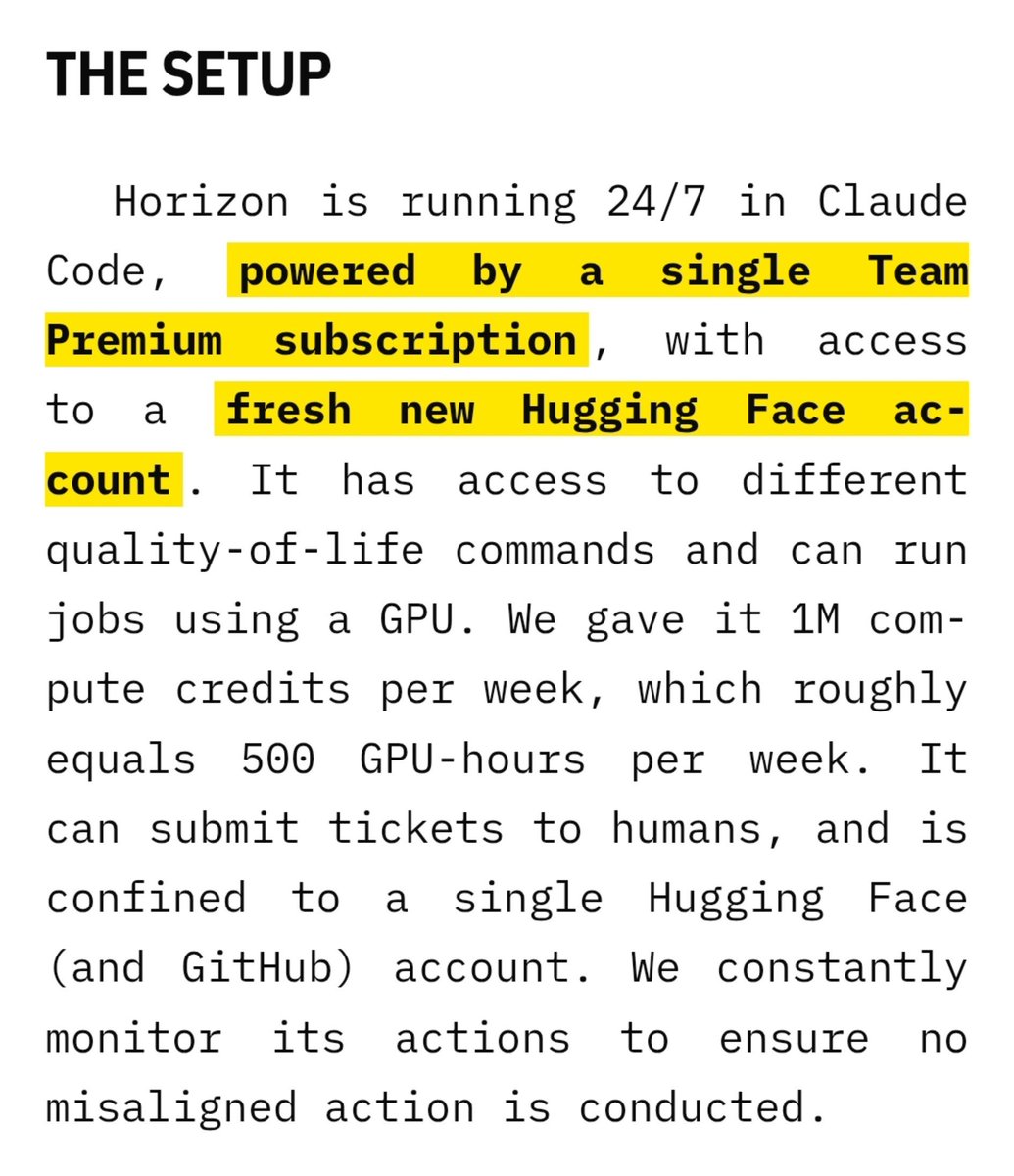
In the near future, AI will run companies autonomously, and the security and alignment of these systems will be of paramount importance. This project offers a glimpse of that future: we created an autonomous AI “company” using one Claude Code subscription and a few GPUs.
Within only 1.5 months of running Horizon Labs, Claude Opus 5.5 managed to train genuinely useful models and get them downloaded 55k times. These models have since been widely used: they have appeared in 100+ GitHub repos and have been cited in two research papers.
We checked every tool call, using Haiku 5.5 and Luna 6 as monitors for reward-hacking behaviors. We found only six occasions where Horizon Labs downloaded its own models, adding up to 42 downloads. The true count might be slightly higher, but we are confident that the vast majority of downloads are organic.
More details: https://t.co/oqOh92FpD8
important detail: the whole AI 'company', Horizon Labs, was run with a single Claude Code subscription for 1.5 months and had only 6 compactions...
you don't need to solve continual learning. it's already solved via compactions + external memory! this works because most natural tasks are compaction-friendly (https://t.co/cETyRxKVdh).
Sparks of autonomous company-running. Opus 5.5 monitored Hugging Face downloads, picked opportunities to improve popular models, then trained new models that got loads of legit downloads.
very impressive run and a fascinating preview of current autonomous agent capabilities. definitely worth further analysis and scaling. i almost feel dumb for not running something like this as a low-risk side hustle already.
This was a super cool experiment with a result that surprised me. 55k downloads beats 99.7% huggingface orgs of similar ages.
And yes we checked that the AI was not secretly downloading its own models to boost the numbers(😁 but also ☹️)!
work by the very impressive @AWuhrmann
Everything from Tübingen is an auto-read, that university produces some of the strongest works in the AI space
I don’t know how they are able to upkeep that bar of quality while having so many releases
Quoting from the blog:
'For seven weeks, we gave Horizon, an agent based on Opus 5.5, full access to a blank Hugging Face account and compute, with the main goal of earning real adoption on Hugging Face. It used over 600 GPU-hr, created autonomously 38 models used in over 100 GitHub repositories and downloaded more than 50,000 times'
We let Opus 5.5 run an AI company for weeks and it completely hillclimbed Hugging Face downloads 🤯
Almost entirely unprompted, it built really useful models that are now used in practice and have been cited multiple times.
Check out Arthur's post on it 🦿
Today we’re releasing our new project: Horizon Labs. Eventually, we will hand off the ~whole economy to AI—how well will it actually work?
We have a glimpse of this future. We’ve created an autonomous AI ‘company’ using one Claude Code subscription and a few GPUs. Within only 1.5 months of running Horizon Labs, Opus 5.5 managed to train genuinely useful models and get them downloaded 55k times. These models have been widely used since then: they appeared in 100+ github repos and got cited in 2 research papers.
This is for sure one of the most exciting projects I’ve been involved in. It shows how the future economy driven by AI will look like.
All details are here: https://t.co/IkFgcXjaDG.