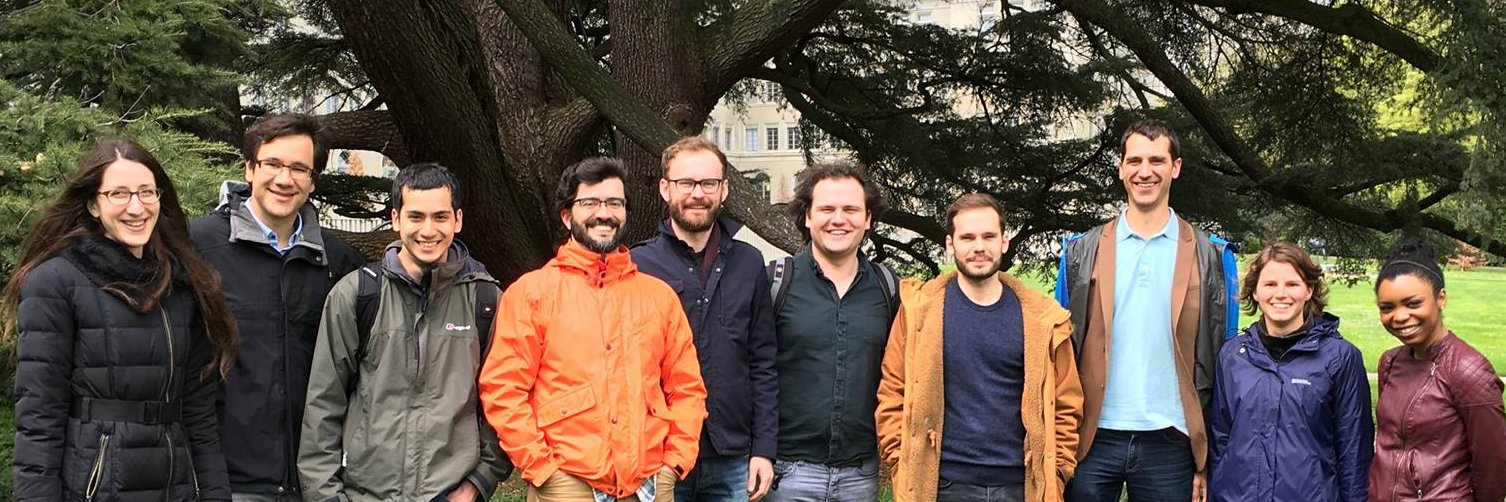
At the interface between biology and computer science, we seek to better understand evolutionary and functional relationships between genes, genomes & species.
FastOMA is out now in Nature Methods 🎉: https://t.co/6nNVfbCVqr A new orthology inference algorithm that scales linearly and is highly accurate. FastOMA can process all >2000 eukaryotic UniProt ref proteomes <24 hours 🚀. Try it out at https://t.co/QUPiRx33J9
From @SinaMajidian, @DessimozLab and colleagues, FastOMA achieves fast and accurate orthology inference, with linear scalability.
https://t.co/dgYgwg8Qpj
OMAnnotator: a novel approach to building an annotated consensus genome sequence
https://t.co/88MhDOkT7a
Automatic identification and annotation of MYB gene family members in plants
https://t.co/C3Xof3G3Lx
In this exciting new preprint, Warwick Vesztrocy et al use Bgee to show that "the most diverged orthologues display the greatest change in gene expression, thus suggesting that they have a greater functional divergence"
https://t.co/pHLCgWQJ8j
Exploring gene duplications! Our study reveals how duplicated genes diverge in function using structural and expression analysis across 36 species. Check out our paper: https://t.co/RxbKnnKFsx
Thanks to @the_alexwv, @Gloveface, Paul Thomas, @cdessimoz#Genomics#Evolution
Session 24: OMA/OMArk is starting now!
To join in the session, jump over to our discord at: https://t.co/FtxlJMZQ5Y
Or you can join in on the YouTube stream at: https://t.co/Y9BRNe01pE
@SinaMajidian@OMABrowser
Learn more in this blog post by Charles Bernard, first author of the work: https://t.co/jOFd1r9zAV
And link to the preprint of course: https://t.co/CLyGOywGJQ
For evolutionary biologists interested in tracing genomes back to their ancient ancestors, we’ve developed EdgeHOG—a tool that reconstructs ancestral gene orders at an unprecedented scale and speed. #Genomics#EvolutionaryBiology#EdgeHOG Thread!
EdgeHOG is now available on GitHub https://t.co/urs2SGX00v. Whether you’re working with a small clade or a large phylogeny, you can now perform ancestral gene order inference with ease. Try it out and let us know how it goes. #OpenScience#GitHub
Many interesting discussions at the #ISMB2024 poster sessions. Thanks to everyone who stopped by our poster and to #ISCB and @DessimozLab for the opportunity!
We made it! The final stop of @BioFAIRUK Roadshow.
Lots of people to thank:
-Those who has took the time to join us in Norwich
-Our amazing speakers @irenepapatheodo @_EllenBell @DipaliD4
-Our fantastic colleagues @EarlhamInst for making the event run smoothly. #FAIR#DataSharing
https://t.co/kWX1askBGy
Have a look at the article I reposted by @BallouxFrancois, @cedriccstan and @LucyvanDorp if you're interested in viruses and their evolutionary signature when jump hosts. I had the pleasure of writing a news and views piece about this work with @cdessimoz
📢 Glad to share our piece 'AI and the democratization of knowledge' @ScientificData. Data is the new oil—ripe for reuse. But what does it take to reuse? it's about making data interpretable by all, including AI, the ultimate non-specialist! #OpenScience https://t.co/dQHEiebreP
📢CALL FOR ABSTRACTS📢
🌟Abstract submission is now open for the Quest for Orthologs meeting #QFO8 which will be held at the University of Quebec in Montreal, Canada on July 17-18!
More info at https://t.co/5mYWGZFqed
Deadline: April 26.
How to evaluate the quality of a genome annotation? Introducing #OMArk, a groundbreaking tool by SIB’s @Why_Nevers & @Dessimozlab and part of the SIB Resource #SwissOrthology, now featured in @NatureBiotech: https://t.co/Xx9a33liIA
Our OMArk paper is finally out at @NatureBiotech! I am excited to share the final results of our work with @Gloveface@cdessimoz@VictorRossier@DessimozLab. OMArk is a one-stop shop for eukaryotic genome annotation assessment. Link : https://t.co/wu11J7sOpN (🧵)