Finance needs a new core ⚪
Today, Dfns enters a new chapter.
We're no longer a wallet company. We're a 𝗰𝗼𝗿𝗲 𝗯𝗮𝗻𝗸𝗶𝗻𝗴 𝗽𝗹𝗮𝘁𝗳𝗼𝗿𝗺 𝙛𝙤𝙧 𝙙𝙞𝙜𝙞𝙩𝙖𝙡 𝙖𝙨𝙨𝙚𝙩𝙨.
Blockchains are now part of how financial institutions move, settle, and control value. 24/7. Globally.
They show up as stablecoins, tokenized funds, tokenized deposits, tokenized stocks, onchain settlement, digital collateral, and programmable treasury.
And as finance moves onchain, the question changes.
It's no longer: "𝘊𝘢𝘯 𝘸𝘦 𝘩𝘰𝘭𝘥 𝘢 𝘬𝘦𝘺? 𝘚𝘪𝘨𝘯 𝘢 𝘵𝘳𝘢𝘯𝘴𝘢𝘤𝘵𝘪𝘰𝘯? 𝘊𝘰𝘯𝘯𝘦𝘤𝘵 𝘵𝘰 𝘢 𝘤𝘩𝘢𝘪𝘯?"
It becomes: "𝘊𝘢𝘯 𝘸𝘦 𝘳𝘶𝘯 𝘰𝘯𝘤𝘩𝘢𝘪𝘯 𝘸𝘪𝘵𝘩 𝘵𝘩𝘦 𝘴𝘢𝘮𝘦 𝘤𝘰𝘯𝘵𝘳𝘰𝘭, 𝘨𝘰𝘷𝘦𝘳𝘯𝘢𝘯𝘤𝘦, 𝘢𝘶𝘥𝘪𝘵𝘢𝘣𝘪𝘭𝘪𝘵𝘺, 𝘳𝘦𝘴𝘪𝘭𝘪𝘦𝘯𝘤𝘦, 𝘢𝘯𝘥 𝘳𝘦𝘨𝘶𝘭𝘢𝘵𝘰𝘳𝘺 𝘥𝘪𝘴𝘤𝘪𝘱𝘭𝘪𝘯𝘦 𝘰𝘶𝘳 𝘣𝘰𝘢𝘳𝘥, 𝘰𝘶𝘳 𝘳𝘦𝘨𝘶𝘭𝘢𝘵𝘰𝘳𝘴, 𝘰𝘶𝘳 𝘢𝘶𝘥𝘪𝘵𝘰𝘳𝘴, 𝘢𝘯𝘥 𝘰𝘶𝘳 𝘤𝘭𝘪𝘦𝘯𝘵𝘴 𝘦𝘹𝘱𝘦𝘤𝘵?"
That's the operating layer we've been building since 2020.
We are the infrastructure layer between a company's existing systems and the blockchains where digital assets now move, settle, and generate value.
Trusted by 400+ fintechs and institutions around the world.
Processing ~1% of global stablecoin volume.
Come build with us today.
🔗 Explore the new website: https://t.co/yAEYHFj0aQ
📺 Watch our brand film: https://t.co/2SeEjLJ1Ae
📑 Read the full announcement: https://t.co/TI3Yv7aULB
"If you want to move USD, you need completely different tokens to be able to cover the network gas fees."
"It's an alien concept to most users who have not been in the blockchain ecosystem."
@dfnsHQ has built a gas sponsorship feature that lets institutions absorb this cost on behalf of their customers, so the end user never has to hold or buy a separate token.
The way it works:
> The institution funds one reserve wallet with native currency, which then covers every customer's network fees automatically.
> It uses EIP-7702 so an externally owned account can act as a smart contract for a single transaction, which removes the need for customers to hold gas tokens entirely.
> That same wallet extends to self-custodial transactions, so customers who later manage their own keys still never see a gas fee on their end
Chris Sutton, Chief Product Officer at Dfns on the DemoDay segment of the live show.
IBM processes an estimated 70% of the world's financial transactions.
@dfnsHQ CPO Chris Sutton explains why that makes @IBM a powerful channel for bringing institutions onchain:
> Every financial institution in the world already has a relationship with IBM in some form.
> A company which is that central to global finance has every incentive to adopt onchain infrastructure early.
> When IBM moves, the institutions that run on its systems gain a ready-made path to follow.
> IBM partnered with DFNS to start building that infrastructure out together.
From the live show last week.
🔴 Only 100 days to go!
In just 100 days, 300 of the world's leading digital assets executives will gather behind closed doors in Geneva.
On November 12-13, @TheBigWhale_ will bring together senior leaders from banks, asset managers, market infrastructure providers and global corporates for two days of high-level discussions, strategic meetings and meaningful connections.
We're incredibly proud of what we're building.
Set in one of Geneva's most iconic lakeside palaces, this won't be another conference. It will be an intimate, high-quality working retreat designed for the people shaping the future of digital assets inside traditional finance.
No expo. No crowded agenda. No endless keynote sessions. Just meaningful conversations, targeted networking, private meetings and interactive workshops with a carefully selected group of partners. The goal is simple: compare strategies, exchange lessons learned, identify the right partners and prepare for the next 18 months.
Attendance is by invitation only, ensuring every discussion is relevant and every connection matters.
We're proud to have the support of some of the industry's most respected players, including @FTI_US, @krakenfx, @dfnsHQ, @Ripple, @trmlabs, @PythNetwork, and @enzymefinance, with more partners to be announced soon.
At TBW, we've spent the past four years working alongside more than 150 leading financial institutions and corporates across Europe. This Summit is a natural extension of that work.
Our ambition is to accelerate the development of Europe's digital assets ecosystem while bringing together the leaders shaping the industry across Europe, North America and Asia.
The conversations will be global, but the mission is clear: help Europe move faster.
Only a handful of invitations remain.
See you in Geneva on November 12-13: https://t.co/pEGO7cEauN
🌍 Africa's cross-border corridors are among the most expensive places on earth to move money.
That gap is the opportunity. @StabylCoin is building the infrastructure to close it, and it chose @dfnsHQ.
Stabyl is a unified liquidity layer for African PSPs, banks, and modern financial systems.
Fragmented global markets consolidated into one deep pool, real-time rate discovery, and settlement that moves institutions from T+3 to instant finality. Stable pricing from boutique transfers to volumes above $50 million, with a full audit trail behind every transaction.
Their CEO Zach Schwartzman says it best: "Liquidity should behave like infrastructure, always available, transparently priced, and callable by API."
We agree. And infrastructure that behaves like infrastructure needs the same thing underneath.
That's DFNS, the core banking platform for digital assets:
✔️ Accounts and wallets provisioned programmatically across stablecoins and networks
✔️ Transaction processing behind every settlement leg, with idempotency, rebroadcasting, and failover.
✔️ Treasury tooling for balances and liquidity across corridors
✔️ Policy and governance enforcing limits, allowlists, and screening before anything moves
We’re proud to support the next generation of financial services built in Africa.
Welcome to DFNS, Stabyl 🤝
📖 Read the announcement: https://t.co/b5z37xWEOY
⌨️ Get started on DFNS today: https://t.co/EaYdvasEGe
"It's been categorized as darknet market. It has a risk score of 0.58."
@dfnsHQ's wallet infrastructure handles flagged deposits through automation, quarantining the asset and routing it to the compliance officer's existing SAR workflow.
"So we have this $1,300 available. But then also what is currently quarantined. So this is that $50 that just received. It hasn't been released because of the KYT policy that is blocking it."
"Do I have the right permissions to go ahead and release this quarantine? The answer is yes."
Payments were the easy part.
Stablecoins move dollars at internet speed. Turning those dollars into reais, euros or won still runs at bank speed, bank cost, and bank hours.
Today we're releasing 𝗦𝘁𝗮𝗯𝗹𝗲𝗰𝗼𝗶𝗻 𝗙𝗫, the new DFNS Downloads report on the hardest and most valuable thing stablecoins will do: 𝘦𝘹𝘤𝘩𝘢𝘯𝘨𝘦 𝘤𝘶𝘳𝘳𝘦𝘯𝘤𝘪𝘦𝘴.
Inside 🔽
→ Why FX is the real prize. $9.6 trillion trades every day. Most of it still settles two days later.
→ Where stablecoins win: emerging market corridors, weekends, prefunding relief.
→ Where stablecoins lose: deep G10 pairs, thin books, premiums.
→ The missing market structure: liquidity, clearing, par redemption, benchmarks, compliance.
→ 99% of stablecoins are dollars. The euro is 20% of global flows yet 0.2% of stablecoins.
→ Brazil declared stablecoin transactions as foreign exchange operations under central bank rules.
→ Three scenarios for how this market forms, and the twelve signals that decide between them.
This report was written on conversations with the people building onchain finance.
Thank you for your valuable contributions: @ubyx_@keyrails@borderlessxyz@tracefinance@withAUSD@walapay_io@qivaliseu@Visa@notabene_id@EuroclearGroup@swiftcommunity@keyrock & Madu.
Every bank will need a wallet. Every wallet will need FX.
📩 Download the full report: https://t.co/dAy3eh4kVG
📼 What the official trailer: https://t.co/UqDlSKw9ye
🎯 Between 2022 and 2024, attackers drained $83.8 million with one trick.
An address that looks like one you've paid before. It's called “address poisoning.”
The mechanics are uncomfortably simple.
1️⃣ Interfaces truncate addresses: first few characters, ellipsis, last few.
2️⃣ Attackers generate a lookalike matching exactly those visible ends
3️⃣ They plant it in your history with a dust transaction
4️⃣ They wait for you to copy the wrong one (the real characters are the ones your screen hides).
🚨 Your payment goes to the wrong address.
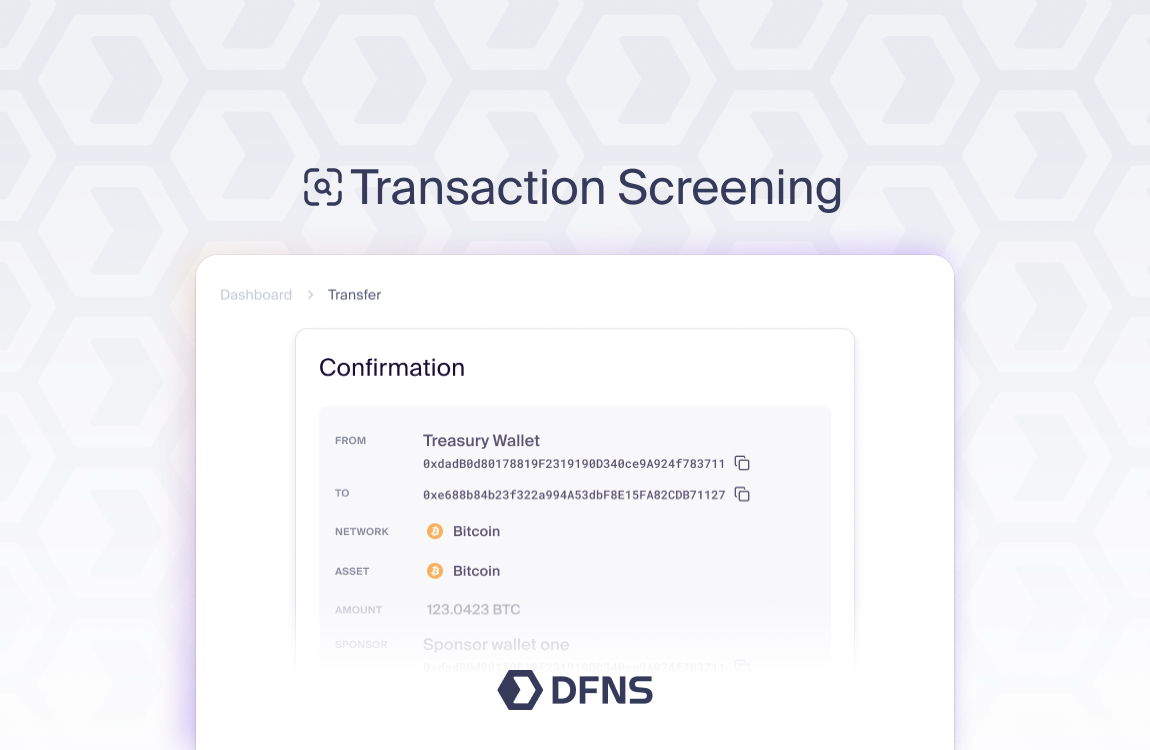
Today, we're introducing 𝗧𝗿𝗮𝗻𝘀𝗮𝗰𝘁𝗶𝗼𝗻 𝗦𝗰𝗿𝗲𝗲𝗻𝗶𝗻𝗴. It’s a new security surface on DFNS that checks every dashboard transfer before it's signed.
The first check, live now: 𝘈𝘥𝘥𝘳𝘦𝘴𝘴 𝘗𝘰𝘪𝘴𝘰𝘯𝘪𝘯𝘨 𝘋𝘦𝘵𝘦𝘤𝘵𝘪𝘰𝘯 🟢
✔️ Adapts the peer-reviewed CMU method: 100% precision and 97.2% recall against 270M real attacks
✔️ Compares the characters users see (the ones attackers must imitate + single-character transpositions)
✔️ Works wallet by wallet, where collisions are true anomalies: the median wallet pays one address, and 99% pay fewer than 25
✔️ Warns, doesn’t block. A false positive costs a click. A missed attack costs funds.
⏭️ Next: detection checks, dusting detection, fake-token scrutiny, cross-chain lookalikes, and integrations with best-in-class threat intelligence from Chainalysis, Blockaid, Hypernative, and others.
Intelligence can come from anywhere. The best feed should win. Enforcement belongs in one place: below the API, at the platform that signs.
A warning is only worth what the layer underneath can do about it. On DFNS, that layer is the product.
📖 Read it: https://t.co/QGXxnhcn1j
⌨️ Start building on DFNS: https://t.co/EaYdvasEGe
🔘 Watch USDC move across chains in about a minute.
Our CPO Chris Sutton just demoed the @circle CCTP integration on @dfnsHQ, and it's the best way to understand what "no third-party bridge" actually means.
In the video:
1️⃣ Select the new Circle CCTP provider in Swaps
2️⃣ Pick a source wallet and a destination wallet on a different chain
3️⃣ Compare Standard vs. Fast quotes
4️⃣ Sign with a passkey. You’re done.
✅ The USDC is burned on the source chain and freshly minted by Circle on the destination chain.
What you don't see is the point:
✔️ No bridge UI, no wrapped assets, no custody intermediary in the middle
✔️ No gas and no signing on the destination chain, Circle's Forwarding Service handles it
✔️ Every cross-chain move passes the Policy Engine before anything signs
A workflow that used to mean leaving your platform, juggling gas on another chain, and trusting a bridge is now one governed transaction.
That's what onchain core banking platform is for.
▶️ Watch the demo: https://t.co/137F0Wd0UM
📖 Read the announcement: https://t.co/JSKAytWzzB
⌨️ Start building: https://t.co/EaYdvasEGe
A semana da @FEBRABANTECH em São Paulo está chegando 🇧🇷
@dfnsHQ, @chainalysis e Capitare estão organizando um encontro exclusivo para convidados, reunindo os líderes que estão construindo as finanças onchain no Brasil.
Bancos e instituições brasileiras estão saindo dos pilotos e entrando em produção: depósitos tokenizados, Drex, FX com stablecoins, trilhos regulados.
E as duas perguntas que toda instituição está fazendo são:
→ como operar ativos digitais com infraestrutura de nível bancário?
→ e como manter todos os fluxos em conformidade ao mesmo tempo?
O feed de dados de compliance da Chainalysis é integrado nativamente à plataforma DFNS, onde as transações são verificadas e controladas antes que qualquer coisa seja assinada.
A Capitare integra sua plataforma de tokenização à DFNS para viabilizar a emissão regulada de ações, títulos, produtos de mercado de capitais e muito mais.
A DFNS impulsiona Rayls, Trace Finance, Caliza, Parfin, Avenia, Transfero e outras empresas que conectam o Brasil ao mundo. O Brasil é um mercado em que estamos construindo há muito tempo.
Se você lidera ativos digitais, pagamentos, tesouraria ou compliance em um banco ou fintech no Brasil, solicite seu lugar aqui:
🍽️ https://t.co/i2rUu4QUxj
A participação é estritamente por convite. As vagas são limitadas e as inscrições são aprovadas individualmente.
Nos vemos em São Paulo 🌄
It's soon @FEBRABANTECH week in São Paulo 🇧🇷
@dfnsHQ, @chainalysis, and Capitare are hosting an invite-only evening for the leaders building onchain finance in Brazil.
Brazilian banks and institutions are moving from pilots to production: tokenized deposits, Drex, stablecoin FX, regulated rails.
And the two questions every institution is asking:
→ how do we operate digital assets with bank-grade infrastructure?
→ and how do we keep every flow compliant while doing it?
Chainalysis' compliance data feed is natively integrated into the DFNS platform, where transactions are screened and controlled before anything is signed.
Capitare integrates with DFNS to enable compliant issuance of equity, bonds, and other capital markets products.
DFNS powers Rayls, Trace Finance, Caliza, Parfin, Avenia, Transfero, and other companies connecting Brazil to the world. Brazil is a market we've been building in for a long time.
If you lead digital assets, payments, treasury, or compliance at a bank or fintech in Brazil, request your seat here:
🍽️ https://t.co/i2rUu4RsmR
Attendance is strictly by invitation. Seats are limited, and registrations are individually approved.
See you in São Paulo 🌄
🏢 In 2019, a villa in Paris became Europe's first property sold through blockchain tokens.
€6.5 million, a notarial deed, shares registered onchain under French law.
The company behind it just chose @dfnsHQ.
While the industry was publishing whitepapers, Equisafe was closing with notaries. Seven years later, it's become the go-to platform to source, issue, distribute, and settle private-market products.
France wrote Europe's earliest framework for blockchain-registered securities. @Equisafe_rwa proved it worked, with real property.
And underneath it all, DFNS has been running the infrastructure:
✔️ A wallet for every issuer and investor, provisioned invisibly, no seed phrases
✔️ Issuance and servicing across the lifecycle, including permissioned token standards
✔️ Transfer restrictions enforced below the API, even with compromised credentials
✔️ DeFi yield and swaps from the same wallets, under the same policy framework
We’re proud to be supporting the pioneers of tokenized finance.
Welcome to DFNS, Equisafe 🤝
📖 Read the announcement: https://t.co/3ljSTRsWC1
⌨️ Get started on DFNS today: https://t.co/ogU5abTrDV
Since Movement seems to have your attention, here’s some of the progress we have made over the last few months:
✅ Secured licensed payment rails to move Money from the US, Europe, and Canada
✅ @HesabPay_ chose to build their Neobank for the global south exclusively on Movement
✅ @near_intents integration live, bringing liquidity across different chains to users
✅ @dfnsHQ integration live, bringing a full stack core banking digital asset platform to our partners
✅ USDCx @circle integrations live on @MEXC , @kucoincom and @BitMartExchange
✅ Movement joined the Circle Alliance Program
✅ @zothdotio integrating to bring yield infrastructure via zVaults and Global Cross Border payments via zPayments
✅ @meshpay integration live to allow seamless flow of stables and other assets from CEX to wallet
✅ Investment announcement in @sortedwallet and @stableyardfi
✅ Launched our own native wallet @motion_wallet
✅ $MOVE token listed on @fasset exchange
✅ Acquisition of @canopyxyz to bring yield infrastructure to Movement users
We are building the rails that bring digital assets in reach of fintechs and banks in emerging markets, and the users they serve.
More news to follow, just make sure you get your news directly from the source.
Gmove.
🔐 Your regulator wants keys in certified HSM.
Your engineering team wants everything inside @awscloud.
@dfnsHQ now supports AWS CloudHSM as a key management backend.
Institutions running on AWS can anchor their DFNS deployment in their own CloudHSM cluster:
→ keys generated, held, and signing inside FIPS 140-3 validated hardware, in their own AWS account.
How it works:
✔️ Keys are generated inside the HSM, marked “non-exportable.” They never exist outside the hardware. AWS operates the box but cannot access your keys.
✔️ The DFNS driver deploys in your environment, connecting through PKCS#11.
✔️ The platform is unchanged: wallets, transaction lifecycle, issuance, treasury, webhooks, audit trails, policies, governance and more.
✔️ And Validation Gate runs inside the driver, with no API to disable it. Even if DFNS were compromised, the last word from your HSM stays with you.
AWS CloudHSM joins IBM, Thales, and Securosys in the DFNS bring-your-own-HSM family, alongside MPC and TEE models. Switching roots of trust never costs a line of code.
That's the point of the model: no dependency on a single provider's hardware, cloud, or enclave. Your architecture, your call.
That's what onchain core banking is for.
📖 Read it: https://t.co/G8CaiKoR2f
⌨️ Get started today: https://t.co/ogU5abTrDV
⚡ A client taps "buy" on their bank's app.
Milliseconds later, an order routes across 65+ venues for best execution. Assets settle into governed wallets. Books reconcile. Nobody touched anything.
That’s what happens when you connect a CBS to an OEMS.
That's what DFNS + Wyden looks like.
And the integration is live 🟢
Wyden is the institutional trading platform banks and brokers run their digital asset trading on. Their OEMS provides smart order routing, netting, and settlement.
@dfnsHQ is the core banking platform providing wallets, accounts, transaction management, treasury, tokenization, workflows, policy, governance, keys, and nodes.
Together, we run straight-through processing from order to settlement:
✔️ Pre-trade checks verified against DFNS wallets before any order is accepted
✔️ Settlement automated end to end, real-time or netted, with omnibus wallets and sub-ledger allocation
✔️ Every movement passing the Policy and Governance Engines before anything signs
DFNS handles account management, transaction lifecycle, treasury, and orchestration. Wyden handles trading, rate quoting, order management, best execution, and netting.
Where one ends and the other begins is configurable.
📖 Learn more about the integration: https://t.co/RrJY38VEwD
⌨️ Get started on DFNS today: https://t.co/ogU5abTrDV
🌍 One of the most consequential fintechs in the world was built in Afghanistan.
And it just chose @dfnsHQ.
When the country's financial system collapsed in 2021, Sanzar Kakar built @HesabPay_, named after the local word for "account", to move money between digital wallets when the banks no longer could.
Then the world's biggest aid organizations noticed:
→ The UN refugee agency supports 86,000+ families through it, nearly $25M across 80,000 wallets
→ The World Food Programme has opened accounts for 49,000 people, including 20,600 women under a World Bank-supported program
→ Mercy Corps extended it to Syria, with Sudan and Haiti in development
→ The New York Times profiled it this January
Now Hesab is building its next chapter: 𝘢 𝘨𝘭𝘰𝘣𝘢𝘭 𝘴𝘦𝘭𝘧-𝘤𝘶𝘴𝘵𝘰𝘥𝘺 𝘣𝘢𝘯𝘬.
$160M a month. 160+ countries. It runs on a $20 handset, and holds dollars as USDC or USDT.
Leave tomorrow, and the money is still yours. That's the whole point.
Hesab serves people whose defining financial experience is accounts that freeze and institutions that can't be trusted with the balance. So it built a bank the user fully owns.
DFNS powers the wallets that make it possible: millions of self-custodial wallets at scale, no seed phrases, with policy and governance underneath. It settles on @movement_xyz through @circle CCTP.
Welcome to DFNS, HesabPay 🤝
📖 Read the announcement: https://t.co/BguDyjXV3k
⌨️ Get started with DFNS: https://t.co/ogU5abTrDV