Researchers at Indian Institute of Technology (BHU) Varanasi have identified a patented compound that selectively targets breast cancer cells while leaving healthy cells unaffected in laboratory studies.
The research, published in Biochemistry, is still in its early stages, but scientists say the discovery could help pave the way for more precise cancer treatments in the future.
Ft Saniya Patel
#CancerResearch #IITBHU #BreastCancer #MedicalResearch #Healthcare
Hi @mybmcwardKW
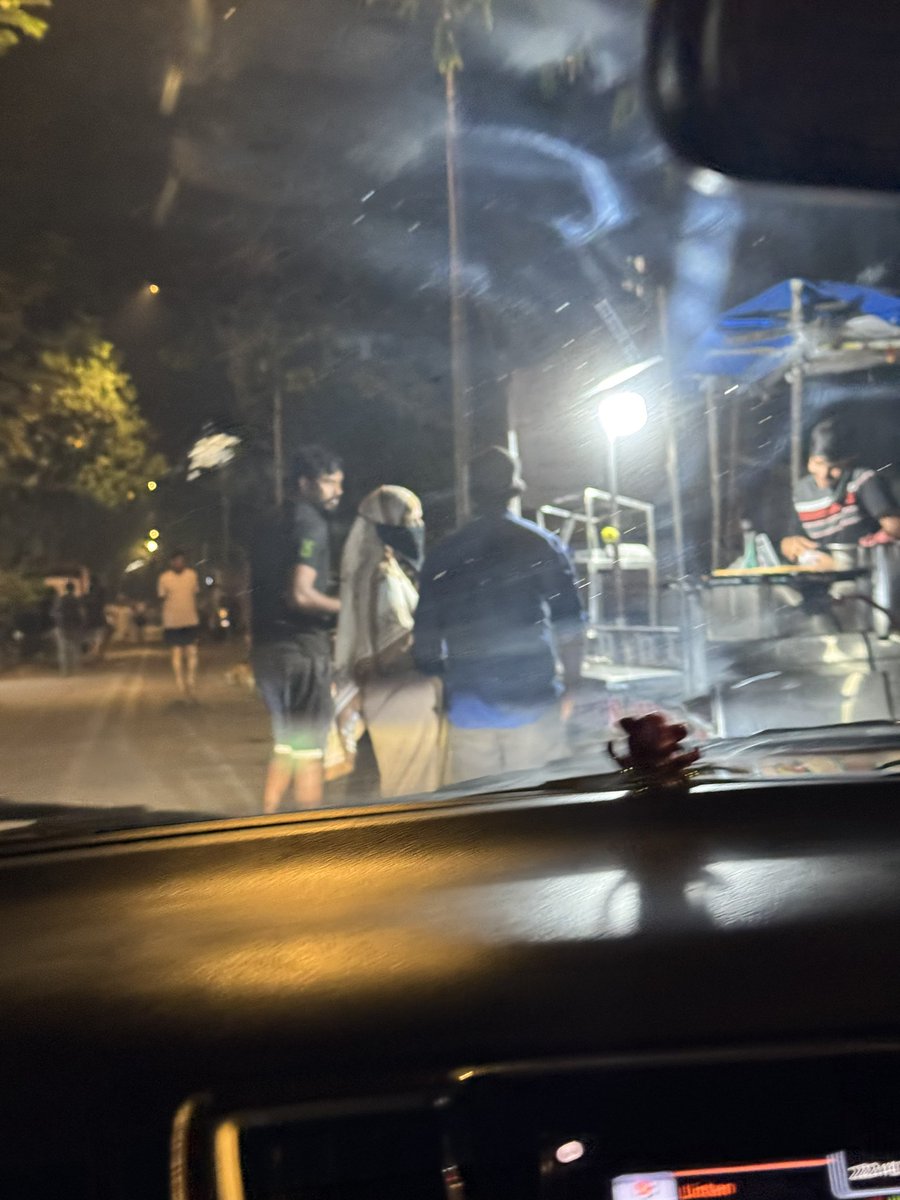
While you are driving hawkers away from the main road on Veera Desai they have entered our small lane which has only one entry point. This is opposite axis bank on Veera Desai Road. There are open flames outside the society gate thanks to the chai stall. @mybmc
At an age when most people slow down, Inderjit Singh Sidhu only sped up his service to society. At 88, the retired Deputy Inspector General of Police didn’t fade into quiet retirement — he took to the streets, broom in hand, to clean Chandigarh’s roads and public spaces with unmatched dedication.
What began over a decade ago as a simple response to garbage piling up in his Sector 49 neighbourhood soon became a remarkable symbol of civic responsibility. Sidhu rose before dawn almost every day, sweeping, gathering litter and hauling trash in a humble handcart — not for applause, not for attention, but out of conscience. “There is no shame in cleaning. Cleanliness is next to godliness,” he once said, embodying the simple yet powerful philosophy that has now captured the nation’s heart.
Initially, neighbours were puzzled — some even called him “crazy.” But his consistency transformed curiosity into respect and eventually inspiration. Residents began helping, and what started as a solitary mission evolved into a small community movement rooted in shared pride for the “City Beautiful.” His efforts also sparked a broader conversation about civic duty and the role of citizens in shaping their surroundings.
Sidhu’s unwavering commitment caught national attention after videos of him at work went viral, drawing admiration from across the country. Industrialist Anand Mahindra described him as a “quiet warrior of the streets” — a living testament to the truth that purpose doesn’t retire and service doesn’t age.
In recognition of his extraordinary civic contribution, the Union government honoured him with the Padma Shri in the ‘Unsung Heroes’ category in Republic Day 2026. Yet even this highest civilian accolade didn’t change his routine — he learned of the award and simply continued his morning clean-ups, driven not by praise but by principle.
Inderjit Singh Sidhu’s story isn’t just about cleaning streets — it’s about leading by example, inspiring change, and reminding every citizen that true service begins with action, not applause.
Mumbaikars!
Every Tuesday at 3:30 PM, you can meet me at the @MumbaiPolice Headquarters to share your doubts, problems, and complaints.
No prior appointment is required. Addressing your concerns and issues is our priority.
#MeetCPOnTuesday#MumbaiPolice4All
Is this really the alternate route to Bengaluru Airport? 🚧
The Hennur–Bagalur stretch, from Sparsh Hospital to Bagalur Colony, is broken & filled with potholes. If improved, it can ease pressure on Hebbal and save citizens in East #Bengaluru & nearby areas time, cost & ORR jams
Residents & @rajeevupadhyay have shared videos across the stretch, yet MLA & #BBMP remain silent. 🤫
Why is this not being attended to? It was the same last year too — how many more visits, inspections or “reality checks” are needed to act @thekjgeorge@BABasavaraja@BBMPCOMM?
Pakistan’s growing arsenal of armed drones is no longer a symbol of indigenous innovation, but the result of a deepening trilateral axis involving Turkey, China, and covert Western indulgence.
Among the most dangerous assets to emerge from this nexus is the Yiha III a Turkish-origin kamikaze drone designed for swarm operations, which Pakistan has rapidly inducted into its hybrid warfare strategy against India.
Developed by Turkish drone firms with battlefield learnings from Libya, Syria, and Nagorno-Karabakh, the Yiha III is equipped with autonomous targeting, GPS navigation, and the ability to carry small payloads allowing Pakistan to launch multi-directional saturation attacks in contested zones.
These loitering munitions are not only difficult to intercept due to their size and flight patterns, but they are also economically devastating for a country forced to maintain 24/7 radar and missile defense readiness across wide geographies.
Indian air defense units have reportedly intercepted drone swarms over Punjab, Jammu & Kashmir, Rajasthan. This drone warfare is not designed for spectacular damage but rather to cause attritional costs, force radar fatigue, and trigger false alarms classic hallmarks of hybrid warfare.
Add to this the periodic closure of Indian airspace near borders, disruption of civil aviation schedules, and targeted information campaigns on social media amplified by proxy actors in Turkey, the Gulf, and Western capitals, and the broader hybrid warfare ecosystem becomes evident.
It is no longer just Pakistan’s war
it is a war being enabled, funded, and supported by a coterie of actors who fear the rise of a confident, assertive India. That fear peaked with Operation Sindoor a daring, coordinated Indian operation that struck Pakistani airbases, disabling major radars, drone depots, and air defense grids in a matter of hours.
This was not just a tactical military success; it was a psychological rupture. India openly declared strategic and air superiority over Pakistan, a statement that unsettled not just Islamabad but policy planners in Washington, Beijing, and Ankara.
The Modi government’s swift and calibrated response stunned the global order, especially those who had banked on India’s restraint as a permanent fixture in South Asian geopolitics.
India has technically stamped its authority in the regional announcing its arrival as a power on global stage by crippling air defences & bases of another nuclear power. This has not gone unnoticed in world capitals specially Washington, Beijing, Ankara, London and many more alike.
The G2 narrative where the United States and China assume the right to define global equilibrium has now been upended. Neither anticipated that India would respond so decisively, nor that it would publicly position itself as a sovereign military power capable of unilateral trans-border action against a Nuclear armed state.
The unspoken panic in Western and Chinese corridors is evident. There is now a renewed urgency to stunt India’s rise through economic pressure, strategic distractions, and by reactivating Pakistan as a manageable chaos agent.
Hi @abhirajbhal & @urbanclap,
In bangalore, Kiadb Residencial space have 4000 flats are ready to movein out of which 2500 are occupied. Still we struggle for day to day services from UrbanClap, Please have a look and enable services for pincode 562149.
#revenue#newmarket
@Arushi8395 @AmeetSatam@MTPHereToHelp I had booked a cab for my parents. The cab took 40 minutes from Stadium gate in JP road till my place. Normally it takes two minutes.
The driver was completely frustrated and so were my parents. Very sad state...
@MTPHereToHelp This is happening everyday, then why do you wait for people to complain on twitter to take action? Why do we have to spend hours in traffic to get some attention?
Moreover now yall have dug up the RTO signal and road as well. All main roads leading from Juhu to Andheri have been dug up with 0 traffic management. No one cares about the public here. @AmeetSatam@MTPHereToHelp@mybmc@mid_day@mashrujeet
@AmeetSatam can you please do something about the horrendous situation that Veera Desai Road is in?? Residents have been complaining for over a month now and no action is being taken. More and more things are being dug up and there is rarely @MTPHereToHelp to manage the traffic.
The entry to our lane is completely blocked on Veera Desai Road because they have dug up the roads & hawkers which used to be there have taken up the entry to the lane. Atleast get the hawkers moved if you’re going to dig up the road @mybmc@MTPHereToHelp@AndheriLOCA
It just took one bad rainy season for Bengaluru to face a massive water shortage crisis. Given that extreme weather conditions will only become more common, this probably won't be the last time we face this crisis.
I learned recently that wastewater could be part of the solution. Bengaluru's total freshwater demand is ~2632 (million litres a day) MLD, and it generates ~2000 MLD of wastewater. Of this, centralized sewage treatment plants treat ~1,300 MLD, and this water is used for agricultural purposes.
About 3,500 apartments and commercial establishments have decentralized sewage treatment plants (STPs) and waste ~80% of their excess STP water. This STP water is low quality and mostly unusable beyond flushing and gardening.
If this excess STP water can be converted to high-quality water, about 450–500 MLD of water demand could be met by decentralized treatment plans.
@BosonWhitewater is one startup we met that is trying to solve the problem of converting STP water to potable water.
@mybmc@AmeetSatam Veera Desi road citizens left to fend for themselves. Roads dug up, footpath non existent/blocked, no respite from those in power. Chaotic. Can't imagine senior citizens coping with this.Hope someone visits and turns this entire bad experience/ living around.