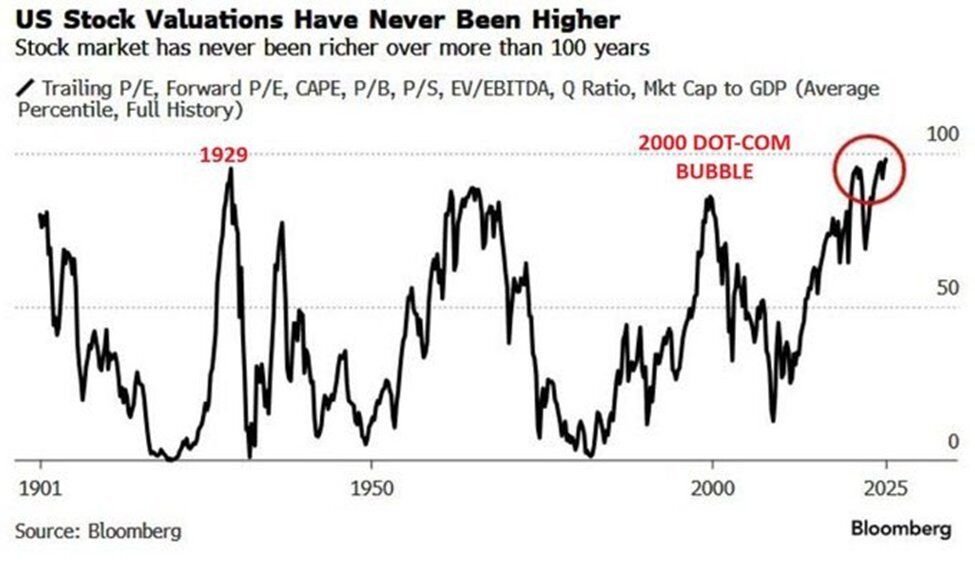
🔥 BIG: US stock market valuations have hit their most expensive level in over 100 years, exceeding even the Dot-Com Bubble and pre-Great Depression peaks.
Pay attention to volume. Price follows volume.
In the top 100 CMC ranked tokens, there are many zombie tokens that are ranked quiet high #10-#50 but with a few millions of artificial liquidity. When the bearmarket comes, these tokens will be absolutely rekted.
Below is a snapshot the real top 30 CMC tokens (with >$100m daily volume)
We’re pleased to announce the listing of Polygon (POL) on OSL Global. @Polygon
POL is now available for trading via Flash Trade, offering streamlined execution within a regulated environment.
Trading Pair (Flash Trade): POL / USD
Listing Time: Dec 29th, 2025, 20:00 (UTC+8)
Deposits and Withdrawals Network: Polygon Network
This listing expands access to Polygon’s ecosystem, a leading Ethereum scaling infrastructure supporting a wide range of on-chain applications and real-world use cases.
More Details 🔗 https://t.co/HCtAvSnk7n
Thank you for sharing @mewwts, it's very much appreciated. Polygon is gaining momentum in the payments sector, and the first $1B is just the beginning.
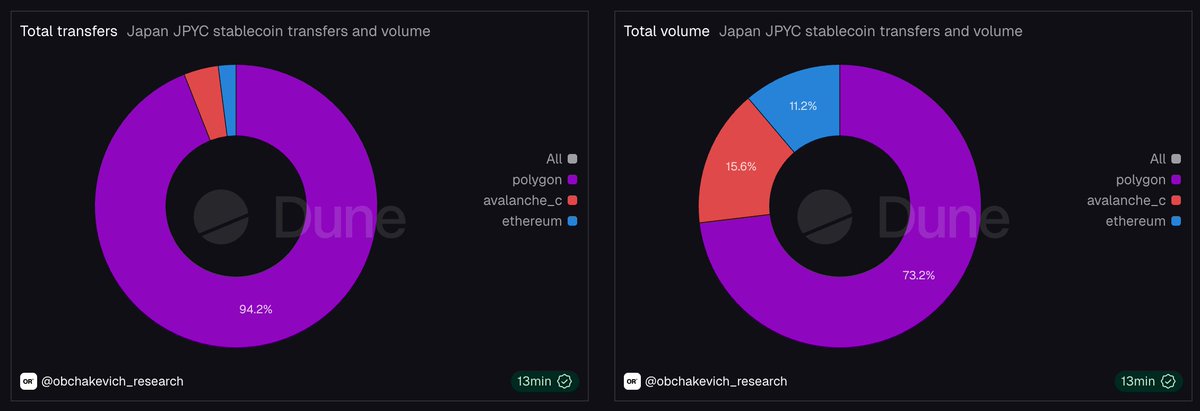
@0xPolygon is increasingly being used for real-world retail payments: local stablecoins ( $XSGD, $BRZ, $JPYC) exceeded $10B in total volume, and payment apps processed over $1B in November.
Particularly noteworthy are over 500k small transactions worth $10–100, which indicates growth in everyday consumer use, not just DeFi or large B2B transfers.
Linkedin post: https://t.co/px56xRWBlE
Dashboard: https://t.co/vcpuQui4yn
Payment projects on Polygon generated $1,000,000,000 in November 2025.
This is a new ATH in terms of volume for @aveniaio, @CoinflowLabs, @moonpay, @zerohashx, @raincards.
The largest number of transfers were made by @Revolut, @moonpay, @raincard, and @NOWPayments_io.
This analysis takes into account all types of payment transfers, from card payments and deposits to B2B transfers, off/on ramp.
"A lot of the time we're not even pitching them. We're just simply educating them."
Polygon Labs Head of Payments Jamal breaks down the art of enterprise crypto sales and why education beats pitching.
𝗧𝗵𝗲 𝗔𝗣𝗔𝗖 𝗦𝘁𝗮𝗯𝗹𝗲𝗰𝗼𝗶𝗻 𝗣𝗮𝘆𝗺𝗲𝗻𝘁𝘀 𝗟𝗮𝗻𝗱𝘀𝗰𝗮𝗽𝗲 ⬇️
APAC is the 𝗳𝗮𝘀𝘁𝗲𝘀𝘁-𝗴𝗿𝗼𝘄𝗶𝗻𝗴 𝗿𝗲𝗴𝗶𝗼𝗻 in the world for onchain activity, up 69% year-over-year to $2.36T (Chainalysis).
The region is varied and diverse, and the use cases reflect that.
Adoption starts with remittances and cross-border trade, but is quickly expanding into micro-payments, gaming, social commerce, and SME finance.
Banks are getting involved — from Japan’s megabanks co-issuing yen stablecoins to Singaporean banks testing tokenized settlements.
APAC may be a regulatory patchwork, but it’s also the clearest glimpse of where stablecoin payments are headed next.
As Singapore Fintech Festival kicks off, we're releasing this map to showcase the broad and rapidly growing adoption of stablecoins across the region.
𝗪𝗵𝘆?
Because behind every headline is a network of teams doing the hard work — and this map helps surface new partners, vendors, and opportunities.
This is just v1. We're sure to have missed folks. Let us know in the comments and we'll add to a V2
Special thanks to @0xPeejay who played a key role driving this initiative and the teams from @utila_io (Ron Hasglal), @Kun_sight (Robert Feng), and @trondao (Sam Elfarra) for their support and collaboration.
The world’s largest funds network, processing £250B+ monthly, chooses Polygon to launch tokenized fund share classes to 4,500 financial institutions in 58 markets.
Calastone is bringing institutional finance onchain, on Polygon rails.
The Aave vs Morpho debate that resurfaces every time a vault blows up is honestly misplaced. Fundamentally, both operate on the same lending-borrowing model — the difference lies in who curates risk.
Aave acts as both the vault curator and the risk manager. When you deposit into Aave, you don’t choose which asset your funds are lent against — Aave does. It decides which assets to onboard, how to isolate markets, and what parameters govern them. This “our way or the highway” model works beautifully in bull markets, but often breaks on the way down. Time will tell if this cycle is any different.
Morpho takes a different path. It decentralizes risk curation. Instead of Aave deciding for everyone, Morpho lets third-party curators — like Gauntlet or Steakhouse — create vaults tailored to specific risk appetites. These curators design parameters around collateral quality, liquidity depth, and liquidation logic, allowing lenders and borrowers to self-select into the kind of risk they want to take.
Take Vault Bridge, which runs on Morpho. Same curators, same ecosystem — yet its vaults didn’t blow up. Why? Because the collateral was properly curated, liquidity was deep, and exposure was balanced. It’s not magic; it’s design.
What we’re seeing isn’t a fight between two protocols. It’s a reflection of risk philosophy. Aave centralizes risk management; Morpho decentralizes it. And just like in 2008, when banks failed not because “banking” was broken but because asset quality and greed were, DeFi failures will almost always trace back to risk design, not protocol design.
As yields rise, so does risk. That’s why one USDC vault earns 5% while another offers 12%. Institutions — and serious capital — will increasingly demand the ability to choose what they lend against, not just where they lend.
In that world, the winners won’t just be the platforms that lend and borrow — but the ones that let markets curate risk, transparently.
Why Polygon’s Value Comes From Utility — Not Just Payments
Every time a new partnership is announced, someone asks — “But how does this add value to Polygon?”
They look at gas fees and think that’s the measure of success.
But Polygon’s value isn’t just in the number of transactions — it’s in how useful those transactions make money once it’s on the network.
Payments Are the Starting Line, Not the Finish Line:
- Payment-only chains like Tron, Stellar etc. — are good at moving money. But they stop there. Money moves, then leaves. There’s no retention, no composability, no value capture.
- Even legacy giants like MoneyGram and Western Union made their profits on on/off-ramps and FX spreads not because they innovated, but because users had no alternative.
Now, with blockchains commoditising transfer costs, that moat is gone. So gas fees is not going to bring revenue.
They’re coming on-chain simply to reduce cost, not because they add new value. That’s a race to the bottom.
Polygon Builds a Global “Revolut-at-Scale”
Now imagine the opposite: You hold money on Polygon and can:
- Spend it or pay friends in Europe via Revolut using stablecoins on Polygon,
- Use it in LATAM through Mercado Libre, Nubank, and so many other applications.
- Receive it in Africa via Flutterwave, Yellow Card
- Lend or borrow it on Morpho — instantly.
- Seamlessly invest in tokenized financial products like BUIDL with Blackrock..
- Receive payroll via Deel, sent using ZK privacy with Railgun.
Polygon turns every balance into programmable capital — usable, portable, and composable across markets.
The same stablecoin that powers a remittance in Nigeria can fund DeFi in Singapore or buy an NFT in Paris.
That’s not just “moving” money — that’s activating it.
The Valuation Layer — Why Utility Wins
Here’s the hard truth: Chains that only process payments will never justify high valuations.
They’re modern plumbing — necessary but replaceable.
Look at the fintech world for proof: Those fintechs that own the use case and the user are the most valuable. You realise that the chains with just plumbing have much less value as compared to fintech’s.
The pattern is clear: Platforms that add layers of utility on top of payments — lending, investing, commerce, identity — command 5–10× higher valuations.
Because they capture not just movement of value, but participation in value.
Polygon’s architecture mirrors that same pattern — except it’s global from day one.
The Polygon Flywheel
Utility → Liquidity → Retention → Network Value
When money can:
Earn yield,
Settle RWAs,
Power on-chain credit,
Move globally across users and apps,
Pay for their bills.
Spend their money via cards
…it creates economic density, not just throughput.
The more useful each Rupee or Dollar becomes on @0xPolygon, the higher the network’s intrinsic valuation — because it isn’t just processing value, it’s hosting it and very soon it will start to participate in the economics of it as well.
Why This Matters
- Payment-only chains will always be valued like infrastructure — finite upside, commodity economics.
- Polygon, on the other hand, behaves like a global fintech super-stack —
where money earns, trades, settles, and powers digital economies across continents.
That’s why partnerships like @theflutterwave , @Mercadolibre, @stripe , @reliancejio, @Grab, and all the major financial institutions across the world etc along with institutions like JP Morgan, @BlackRock, Apollo Credit matter. Each one expands where money can work, not just where it can move.
The Endgame: If Revolut and PayPal created value within regions, Polygon is creating that value globally, across markets and applications. And just like @Visa and @Mastercard dominate because they underpin every network, Polygon will command value because it underpins every use case — from payments to programmable finance.
So next time someone asks: “But how does this add value to Polygon?”
Tell them: “Because Polygon isn’t counting transactions — it’s compounding utility.”
Did you know that @0xPolygon PoS did 131M Txs with Stablecoins during October'25? To put that into perspective, that means:
🟣 +63% vs Sept'25 (MoM) // +204% vs Oct'24 (YoY)
🟣 1.6Bn stablecoin Txs annualized - that is already 1% of what mastercard processed in 2024
🟣 #1 in EVM world (+30% Base // 3x Arbitrum // 5x Ethereum // 6x OP)
Data from @artemis stablecoin terminal
@0xPolygon is for payments
Closing out a massive Uptober for @0xpolygon payments as app transfer volume jumps another 20% to an all-time high alongside on/offramp volume up 35%, card volume up 30%, and infra project volume up 19%.
Source: https://t.co/MOHI2jasYi via @obchakevich_