'Research Watch' from @CD_AACR highlights @Gerta_Hoxhaj's recent discovery that both de novo sythesis & salvage pathways contribute to tumor purine pools, including nucelotides from our diet. Impact: potentially more effective, targeted cancer treatments. https://t.co/IOBA1W7AQR #relentlessdiscovery
Finally, I am extremely proud of our team for their dedication, effort, and teamwork in bringing this project to completion! With that, I’ll END with our latest Texan adventures. 14/14
Moreover, we also found that inhibiting the purine salvage pathway slows down tumor progression, highlighting the crucial role of the SALVAGE pathway in cancer and suggesting that purine salvage could provide a route of resistance to de novo inhibitors.13/14
Remarkably, we found that supplementing mice with a high nucleotide dose (~the mouse equivalent of ~2 steaks/day), accelerated tumor growth, suggesting that nucleotide availability may be limiting for tumor growth. 12/14
Since the Salvage pathway can recycle dietary nucleotides, we were curious whether the nucleotide content in the diet could influence tumor growth. We don’t often think about nucleotides as nutrient sources in our diet, but food, especially meat products are rich in nucleotides. 11/14
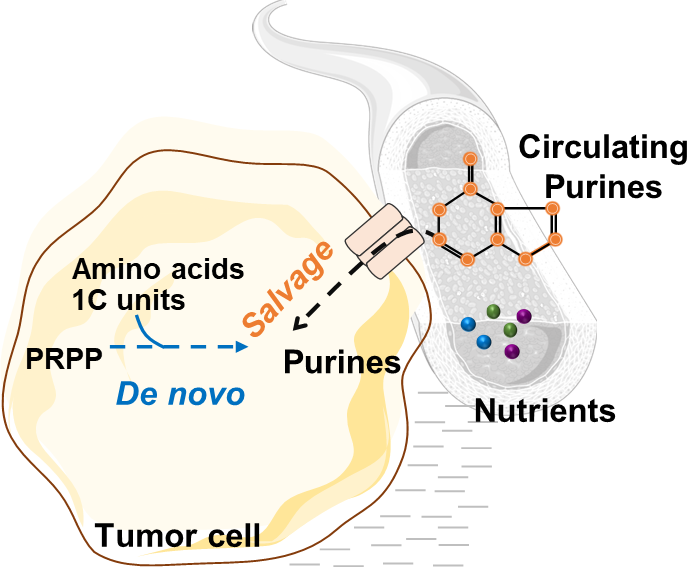
What about Tumors? Despite the prevailing notion that tumors predominantly rely on the De Novo pathway, we found that the De Novo synthesis and Salvage pathways contribute similarly to maintaining nucleotide pools in tumors. 10/14
We observed unique preferences for purine salvage precursors in tissues. Adenine and inosine were the most effective circulating precursors for supplying purines, while surprisingly, hypoxanthine, one of the most abundant bases in cells, was rapidly degraded and poorly salvaged.9/14
What did we learn from these infusions in Tissues? Surprisingly, the Kidney turns out to be the Superstar organ for SALVAGing most of the purine bases! Tracing with 15N-glutamine (De novo), showed that the Small Intestine has the highest De Novo synthesis rate, matching its high turnover rate. 8/14
While seemingly easy, this proved to be a formidable task! To trace the Salvage pathway, we established in vivo infusion schemes for the 6 most common purine precursors, including bases like adenine, hypoxanthine, guanine, and their nucleoside forms—adenosine, inosine, guanosine.7/14
Historically, it is believed that proliferating cells predominantly rely on de novo synthesis, while tissues favor the salvage pathway. We wanted to put this notion to the test, so we embarked on assessing the contribution of the De novo or Salvage pathways in vivo.6/14
Purines are synthesized via two routes: De Novo synthesis- which builds the purine ring from scratch but is metabolically costly, or by the energy-efficient Salvage pathway, which recycles nucleobases from the diet or from nucleotide catabolism.5/14
Now the science: Cells need a steady supply of purine nucleotides, to function, grow, and thrive. For more than seven decades, purine synthesis has been a prime target for cancer. Yet, we don't know how tumors or normal tissues acquire their purine pools in vivo. 4/14
We are looking for a scientist to lead the CRI transgenic core. This is an opportunity to run a core AND to create a cutting-edge research program on in vivo gene editing. We've made > 200 new GEMMs since 2018, now we want to innovate! Please retweet https://t.co/4jIAkBWQXp
Embracing Texas! A fun day out with the lab and rotation students celebrating Trishna's birthday and our ACS Scholar Award! Thank you @ACS_Research for supporting our research!