Proud to be the first high school student in the world to ever be sanctioned by an authoritarian regime for uncovering corruption. It just proves that the work I’ve done to expose Russias sanctions evasion stablecoin, A7A5, has touched a raw nerve.
https://t.co/b0voHBkqG7
INSIGHT: $ADA falls below $0.20 for the first time in five years as @IOHK_Charles says he is "taking a break" and warns of a coming "wave of failures" in Cardano's ecosystem after the community cancelled its flagship 2026 Summit and rejected key treasury proposals.
INSIGHT: $ADA falls below $0.20 for the first time in five years as @IOHK_Charles says he is "taking a break" and warns of a coming "wave of failures" in Cardano's ecosystem after the community cancelled its flagship 2026 Summit and rejected key treasury proposals.
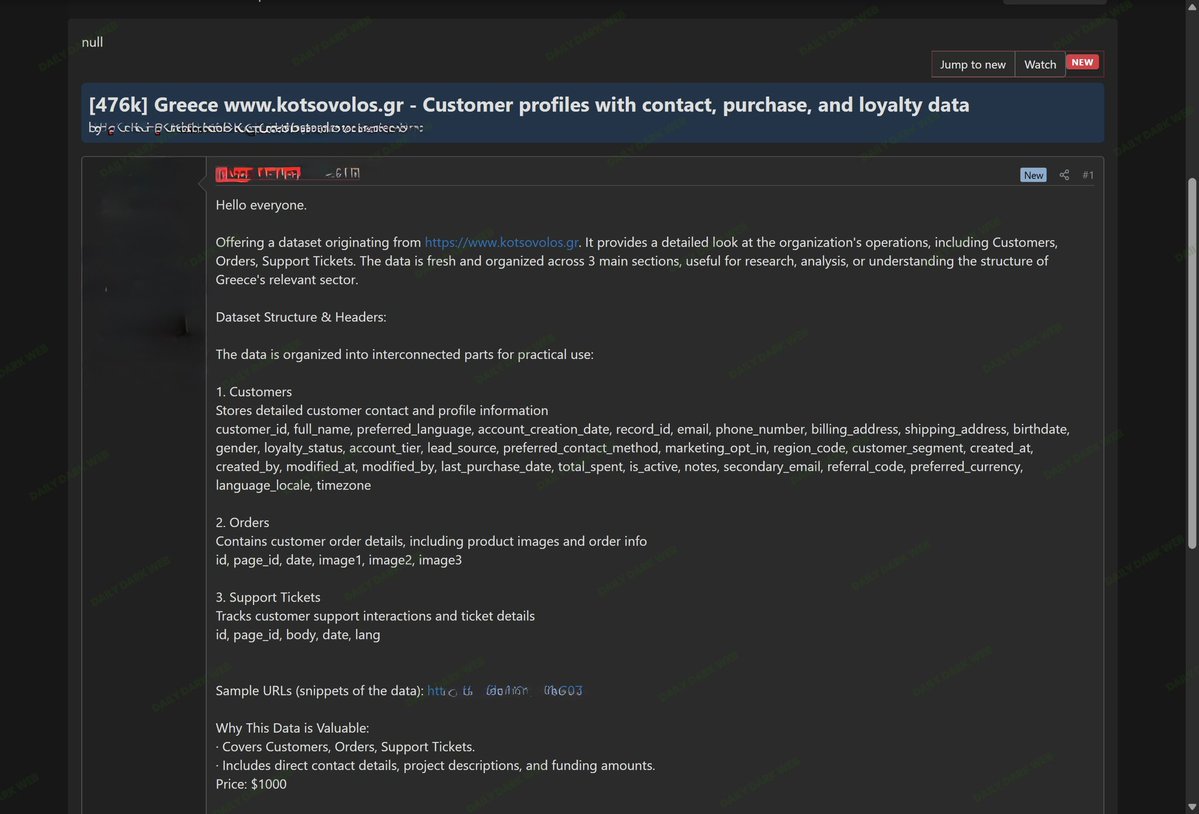
🇬🇷 Alleged customer and loyalty-program dataset linked to Greek retailer “https://t.co/uVJTR0M6et” has surfaced on underground forums.
According to the threat actor’s claims, the dataset allegedly contains approximately 476,000 records associated with:
• Customer profiles
• Orders and purchase activity
• Loyalty program information
• Support ticket interactions
The post advertises access to structured datasets containing:
• Full names
• Email addresses
• Phone numbers
• Billing/shipping addresses
• Birth dates
• Marketing preferences
• Loyalty status
• Total spending history
• Preferred currencies/languages
• Customer segmentation metadata
• Support ticket content
If authentic, this type of dataset is significantly more valuable than simple credential leaks because it enables:
• Advanced social engineering
• Targeted phishing
• Fraud profiling
• Identity correlation
• Behavioral analysis
• Loyalty/rewards abuse
• Financial scam personalization
Retail and e-commerce ecosystems remain among the most consistently targeted sectors globally because they centralize:
• Payment-related metadata
• Consumer identity information
• Purchase behavior analytics
• Marketing datasets
• Support systems
• Third-party logistics integrations
One important detail in this alleged leak is the inclusion of:
• Customer support tickets
• Purchase history
• Marketing preference data
These fields dramatically increase the operational value of stolen datasets for threat actors because they allow attackers to craft highly convincing impersonation campaigns.
For example:
• Fake delivery notifications
• Loyalty reward scams
• Refund fraud
• Invoice impersonation
• Customer support phishing
• Warranty-extension scams
become substantially more effective when attackers possess historical transaction context.
Another increasingly important trend is the monetization of “consumer intelligence datasets.”
Modern underground markets no longer value only:
• Passwords
or
• Credit cards.
Instead, attackers increasingly seek:
• Behavioral profiles
• Spending patterns
• Customer segmentation data
• Marketing metadata
• Loyalty ecosystems
• CRM exports
because these datasets support:
• Fraud operations
• AI-assisted phishing
• Synthetic identity creation
• Large-scale social engineering campaigns
European organizations face additional pressure because GDPR exposure from these incidents can become severe when:
• Purchase behavior
• Consumer profiling
• Support communications
• Contact metadata
• Marketing consent records
are involved.
Retail organizations should continuously review:
• CRM security posture
• Third-party SaaS integrations
• Loyalty platform exposure
• Customer support tooling
• API security
• Cloud storage exposure
• Data retention policies
• Marketing platform access controls
• Privileged account monitoring
because attackers increasingly target:
• Misconfigured APIs
• SaaS integrations
• Support systems
• Marketing automation tools
• Third-party plugins
rather than the primary storefront infrastructure itself.
The broader European retail sector continues to experience increasing pressure from:
• Credential theft groups
• Initial access brokers
• Infostealer malware campaigns
• Supply-chain compromises
• Cloud misconfigurations
• Ransomware operators
especially where customer ecosystems contain high-quality behavioral and transactional data.
At this stage, the underground forum claims remain unverified and should be treated cautiously until independently validated.
#DDW #Greece #CyberSecurity #DarkWeb #DataLeak #RetailSecurity #EcommerceSecurity #ThreatIntelligence #GDPR #ConsumerData #LoyaltyProgram #FraudPrevention
🥷@craigraw just shipped Silent Payments receiving in Sparrow Wallet!
One Bitcoin address. Reuse it forever. Zero privacy loss.
This is one of the biggest privacy upgrades Bitcoin has had in years. Here's why it matters and what Silent Payments actually are. 🧵
Today, we share a breakthrough on the planar unit distance problem, a famous open question first posed by Paul Erdős in 1946.
For nearly 80 years, mathematicians believed the best possible solutions looked roughly like square grids.
An OpenAI model has now disproved that belief, discovering an entirely new family of constructions that performs better.
This marks the first time AI has autonomously solved a prominent open problem central to a field of mathematics.
A side project I've been working on is a time-lock encryption oracle that can be easily used by humans and agents. Use it for delayed data access, embargoes, sending messages/files to the future, or anything else you can come up with.
1. Timelock a file in the browser by choosing the unlock time, drag and drop the file, and click encrypt. Easy. You then have the encrypted file to share with others.
2. When a key's time arrives, anyone with the encrypted file can decrypt it in their browser.
All of the above can also be done by developers and agents in the terminal using only curl and openssl, which all machines should have installed already. Get your agent to experiment with it!
It works by publishing an RSA key for each minute for the next 30 days. The system then releases the corresponding private key at the top of each new minute. It was designed to be maximally simple and compatible with all systems.
This is not a commercial project and is not related to @River. I just wanted something like this exist on the internet to see how people use it. Have fun!
Join tomorrow's meetup in Athens where @deanmachine will talk about DAOs and Sowellian Governance (https://t.co/SeoeZejAzH) and DZ will talk about @getpubky and Nostr: https://t.co/DiLXOn2WNh
Honoured to present Sowellian Governance and discuss decentralized communities with the Bitcoin Community in Athens
Come join us on May 14th
https://t.co/GhGCrl7Dne
@marcmynome Well, most stablecoins either allow for your wallet to be frozen or they have confiscatable collateral or both. So the peer-to-peer part on its own is only partly valuable.
@LeonWaidmann Given ETH/BTC is down over -60% since then, it shows that with fewer coins coming into circulation, there is still considerably less demand.
Perhaps NOT fiddling with the knobs and dials was the entire point, not the inflation rate magnitude.
Thanks for coming to my TED talk.
Privacy isn't just for customers; it's for merchants too. Why should your payment processor know your turnover, your products, or your customer's identity?
CashuPayServer uses Cashu mints for settlement of Lightning payments. This creates a "privacy buffer" between your shop and the network. The mint sees the Lightning payment; you see the credit. Nobody sees the link between the two except you.
Why Cashu mint? The easiest way to accept Lightning and not run a Lightning node. And yes, it can immediately withdraw to a real non-custodial Lightning wallet.
Accept Lightning with "Stealth Mode" enabled.
https://t.co/NnryACHcnr
@jurbed > Each usdc held on Base or elsewhere is financing American government.
That is an interesting observation because each $ or € at the bank is mostly financing retail and corporate loans. Tether and GENIUS-Act stablecoins mostly finance the US government.