I resigned from Anthropic today. I spent the last three years doing pretraining research at both OpenAI and Anthropic. Neither company is acting responsibly. They are racing straight to self-improving superintelligence and gambling with our lives. More thoughts below.
The shingles vaccine in use today has been linked to a reduced risk of heart disease and heart failure, according to a study of more than 70,000 people
https://t.co/jhG8LcPyIc
1/ I'm a cardiologist. I've practiced for twenty-five years, through a lot of "breakthroughs" that turned out to be press releases. So understand the weight of what I'm about to say: I have never seen a single week in medicine like the one we just lived through.
In the span of a few days, four separate scientific breakthroughs landed. The stock market treated them as four unrelated stories and sent a handful of biotech companies soaring. But that's the shallow read. Look closer and they are not four stories at all. They are four faces of the same story — the biggest shift in medicine since the discovery of antibiotics.
Medicine is becoming programmable. Individualized. Written for one human being instead of the average of millions.
Let me walk you through exactly what happened, in plain language, and show you where this is actually headed. Because the future arrived quietly this week, and most people scrolled right past it.
A study with almost 74,000 subjects ages 50-85.
Conclusion:
-The wealthiest Americans had approximately the same survival rates as the poorest people in Europe.
Wealth helps enormously within the United States, but even high wealth does not completely overcome the US–European mortality disadvantage.
Wealthy Americans presumably have much greater ability to buy excellent medical care, better housing, healthier food, gyms, preventive testing and so forth. Yet their survival remained roughly comparable to the poorest group in Northern/Western Europe.
The study doesn’t provide direct answers to why this happens. However, maybe wealth cannot outperform lifestyle, strong social safety net, great food around friends and family, lower stress, walking significantly more everyday to your bakery (yes, believe it or not, Europeans are big on bread), local food stores, coffee shops, affording to retire when it is time without worrying about paying bills especially when you get sick…
As both an American and European citizen, I believe it may be time for Americans to recalibrate how we think about longevity.
We are increasingly chasing the latest intervention such as rapamycin, peptides, cold plunges, red-light therapy…hoping that targeting a single enzyme or metabolic pathway will move the needle.
As a systems physiologist, I struggle with that view. Human physiology is not a collection of isolated pathways. Trillions of cells communicate across metabolic, vascular, endocrine, immune and neurological systems. Health emerges from their integration.
Perhaps longevity is less about hacking individual pathways and more about creating the environment in which the whole organism can thrive.
1/2 Thanks Gavin for an especially thoughtful exchange. I don't usually spend much time on social media but I wanted to engage here because it really brings out the heart of an important conversation.
First, on regulation, I think that “either concentrate it in the hands of a chosen few companies and politicians via regulation or distribute it widely” is a false choice. I know that there’s a sort of Silicon Valley shorthand where regulation = regulatory capture = concentration of power, but I’ve always found this to be an overly simplified picture of the world. Many people outside this bubble think of regulation as something that constrains corporate power and benefits ordinary people. I don’t necessarily agree with that perspective either, rather I think it’s complicated and really depends on what the “regulation” consists of. But in particular I think that those in the “regulation = regulatory capture = concentration of power” frame often underrate the decentralizing power of objective and fair institutional processes. A crude analogy is that the formal court system can sometimes feel stuffy and elitist, but it does a much better job of defending the rights of vulnerable individuals than the alternative, mob justice. At their best, institutions can vest power in ideas rather than people, and thereby decentralize that power.
This is why Anthropic has always made its policy proposals very carefully. We try very hard to make proposals that disadvantage (slow down) frontier AI companies while *advantaging* smaller competitors. California’s SB53 (which we supported), and even the much-maligned SB 1047 (which we were ambivalent on), completely exempt any company below a certain amount of revenue or model training costs from being covered at all (it was $500M for SB 53, lower for 1047 but we objected to that). More recently the testing process we’ve advocated for at CAISI and the White House involves more rigorous tests for frontier models than off-frontier models — something that differentially advantages challengers. Similarly, the “Pacing the Frontier” letter envisions (or at least Anthropic’s preferred implementation of it envisions) modulating the pace of the very best models while not constraining those who are catching up. This hurts the business interests of the frontier labs and helps challengers, including open-weights!
Overall my view is that AI is *structurally* a technology that tends to concentrate power, for reasons that have nothing to do with regulation (more to do with the extreme implications of the scaling laws). Open-weights do help some with this but are nowhere near a sufficient solution because they simply shift the concentration somewhat to those with the most compute and chips (which are roughly the frontier labs plus maybe hardware providers). By contrast I think the right “rules of the road” can simultaneously (a) address AI’s cyber/bio/alignment risks, (b) institutionally constrain the power of the frontier AI companies, and (c) leave room for open-weights models while also addressing the specific risks that they bring.
BTW I do not think that the events of the last few months have “failed to result in [my] preferred regulatory path”. The approach that the Trump administration is reported to be taking — pre-deployment testing for frontier models, and also testing of open-weights models when they get closer to the frontier — is one that I am very supportive of, though of course I have to see the details to be sure. I am also supportive of Demis Hassabis’ ideas around a FINRA-like entity. This contrasts with six months ago when most of the industry was still pushing for preemption of all state regulation and no apparent federal approach either.
📢 Excited to share PaddleOCR team's latest work: HPD-Parsing! Huge shoutout to my colleague @XieQunyi , who led the development of this amazing model! 🚀
We've rethought how VLM-based document parsing works—and the results are game-changing.
💡 The key insight? Document parsing = global coordination + local parallel execution. Like great teamwork!
1/ The bottleneck: Existing unified document parsers treat a whole page as ONE autoregressive sequence. Every token waits for the one before it. As documents get longer, inference gets painfully slow.
2/ Our solution: HPD-Parsing breaks the single-thread paradigm into a Hierarchical Parallel Decoding architecture: ·
1️⃣ Main Layout Branch — organizes document structure & reading order globally ·
2️⃣ Dynamic Content Branches — each layout region gets its own decoding branch running IN PARALLEL ·
3️⃣ Progressive Multi-Token Prediction (P-MTP) — 6.6 tokens/step accepted within each branch
The design elegantly mirrors how documents naturally work: structure is global, content is local.
3/ The numbers speak for themselves:
⚡ 4,752 tokens/sec — 3.06× throughput vs vanilla autoregressive
⚡ 2.62× faster than the fastest existing document parser
🏆 94.91 overall score on OmniDocBench v1.6 — new SOTA among end-to-end unified parsers 🔥
⚖️ Only 1B parameters (lightweight!)
Best part: the longer the document, the BIGGER the speedup. Because the critical decoding path = longest block, not total length.
Plus: error isolation. When one region goes wrong, it stays local — no cascading failures across the page.
HPD-Parsing opens a new direction: globally coordinated, locally parallel — the future of efficient document understanding.
Paper: https://t.co/vHSfkY3pN2
Model: https://t.co/1PFb4n8je3
#DocumentParsing #OCR #AI #PaddleOCR #NLP #VLMs
NEWS 🚨: Astronomers have evidence of an atmosphere on a potentially habitable world 49 light-years away
"This is an extraordinary result if confirmed. The signal is definitely there"
"[If it holds greenhouse gases] it could possess a liquid water ocean warm enough to swim in"
Today I published The China Tech Field Guide, and it is free.
Over the past year, Hello China Tech has covered China's AI, semiconductor, robotics, and EV sectors essay by essay. The Field Guide consolidates that year into six principles. A sample of the argument: in 2025, 764 Chinese AI companies raised a combined Rmb 83bn, and the top 20 captured 30 per cent of it. Capital structure, not technology, decides which firms survive. The state does not referee these markets. It designs them.
If your work touches China tech, the Guide is designed to be the document you send to a colleague who asks where to start. Web and PDF, both free. https://t.co/AQlldvD7aE
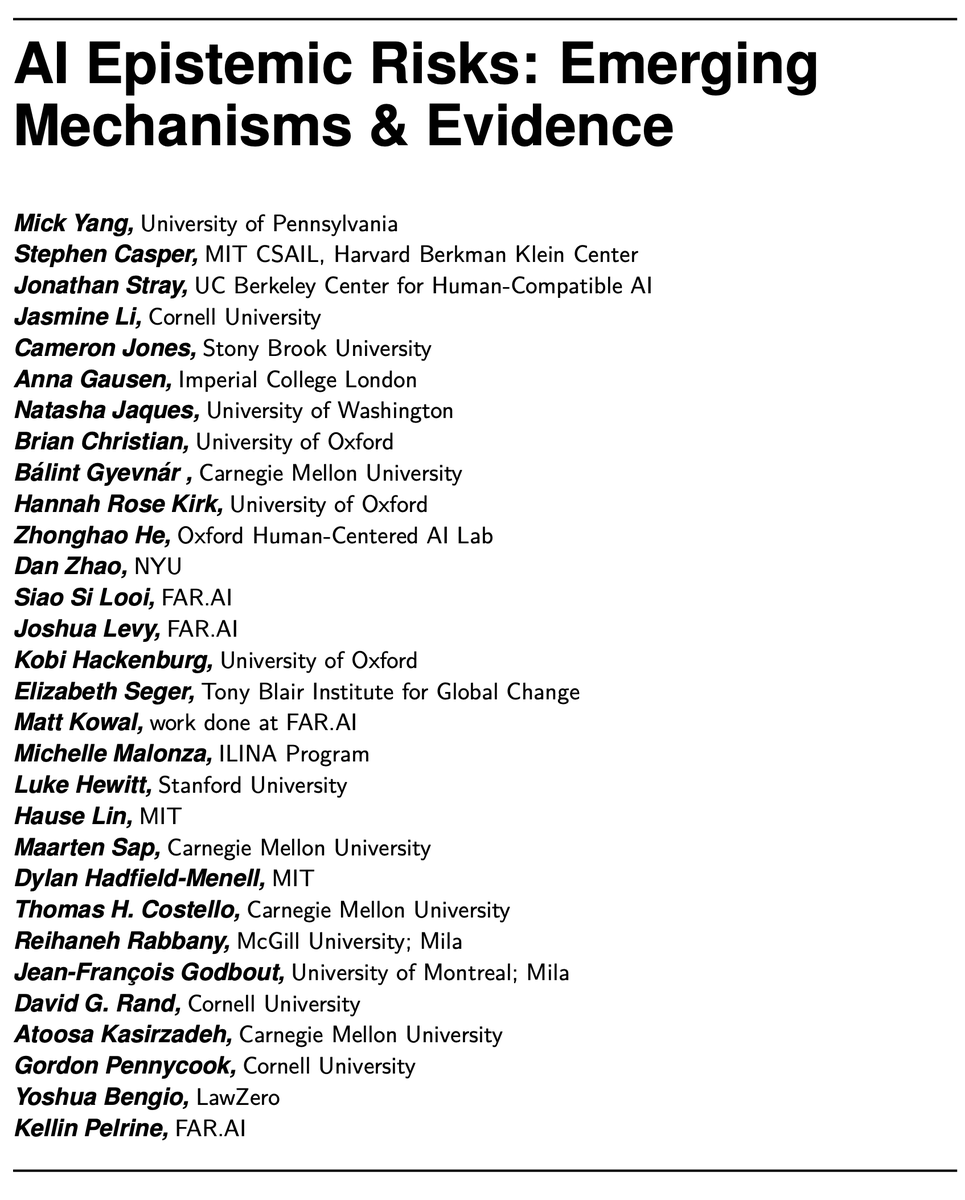
Humanity's ability to know, reason, judge, and act well is the foundation of science, democracy, crisis response, & management of AI itself.
AI poses serious risks to that foundation.
New paper on epistemic risks by 30 experts calls for attention to this. Link in thread.
A new Nature paper makes a powerful point.
Current evaluations treat LLMs like students sitting an exam in which “I don’t know” is marked as wrong. Under these conditions, guessing becomes strategically optimal.
Hallucinations are not only a technical failure of LLMs. They are also, in part, an incentive problem created by the way we evaluate them.
The authors propose an elegant solution: make wrong answers costly, so that the model abstains unless sufficiently confident.
This is a very welcome contribution, which I hope can help develop a new generation of models, one that we can trust more, especially at the frontier of knowledge, where current models are notoriously bad.
*
Full paper in the first reply
"How far can you go and still be human?"
How does a small state like Israel afford the immense R&D costs to develop cutting-edge #nanotechnology capable of entering and controlling the human brain?
Could @Netanyahu ’s time at MIT with nanotech evangelist Ray Kurzweil have anything to do with it?
@MindNexusLive ’s Jesse Beltran warns it leads to “complete control of the human species.”
the pope and anthropic's co-founder just stood together at the vatican to release "magnifica humanitas," the first ever catholic teaching on AI
yes, you read that right. the full ceremony was 2 hours.
here's the most interesting things for you to know:
1. this is the biggest religious response to AI in history. popes only put out a handful of these huge official letters in their entire time as pope. the fact that one of them is about AI tells you how seriously the church is taking what's coming.
2. small detail with massive meaning: this pope picked the name "leo XIV" on purpose. the last pope named leo was leo XIII back in 1891, and his most famous act was writing the church's response to the industrial revolution. picking the same name is a deliberate signal. this pope sees AI as the new industrial revolution.
3. the catholic church does this every time a major technology reshapes humanity. they wrote "rerum novarum" in 1891 to respond to the industrial revolution. when nuclear weapons threatened the world in the 1960s, they wrote "pacem in terris." climate change and runaway tech got "laudato si" in 2015. now AI gets "magnifica humanitas." they don't issue these often.
4. the pope's main line: "AI needs to be disarmed." he literally compared AI to nuclear weapons. he said the church spent decades pushing for nuclear disarmament because the technology was too dangerous to leave in the hands of a few. he says AI is now in that same category.
5. anthropic co-founder christopher olah told the pope, on stage at the vatican, that anthropic's own research team keeps finding things inside their AI models that "mirror joy, satisfaction, fear, grief, and unease."
6. olah's reframe of what AI actually is: these things are grown. they're trained on a structure roughly modeled after the human brain and fed everything humans have ever written. in his own words: "they are made from us, from our words." he said even the people building them don't fully understand what's happening inside.
7. olah publicly admitted that every AI lab, including his own, faces pressure that can conflict with doing the right thing. commercial pressure to keep shipping, competitive pressure from other labs, plus the older pressures of pride and ambition. his solution: we desperately need outside critics with no skin in the game who will tell the labs when they're failing.
8. olah says there are 3 giant questions the AI labs cannot answer alone and the world needs religion and philosophy to step in on:
> how do we make sure poor countries actually benefit from AI?
> what does human flourishing even look like in this new world?
> and what are these things we're actually building?
9. one of the sharpest lines in the whole encyclical: "the promise of automatic general prosperity often proves illusory." translation: the idea that AI will just make everyone rich on its own is a fantasy. someone has to actually design the system so the benefits get shared.
10. the pope also pulled out a 100-year-old quote: "contemporary man has not been trained to use power well." said by a theologian back in the 1920s. the whole encyclical is basically a long argument that we need to learn how to use this kind of power before it uses us.
11. the pope kept stressing that he doesn't have the technical answers. but he says the church has thousands of years of wisdom on what it means to be human, and that wisdom is exactly what's missing from how we're building AI right now. his closing line: this technology should serve "human flourishing and human dignity, not control consciences."
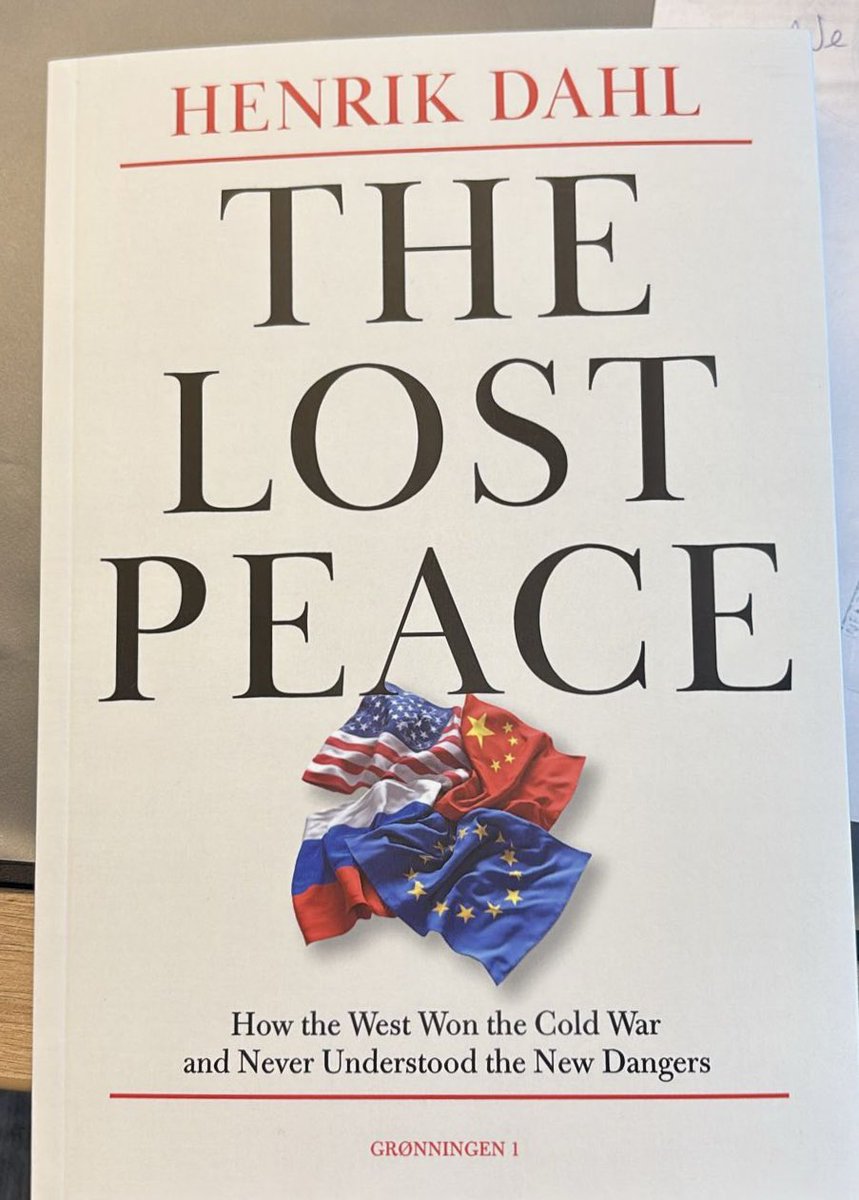
Now you can get my book about the lost peace after the Cold War in English.
The political West won the Cold War in the years between 1989 and 1991.
But in the decades that followed, peace was lost. The political elites failed to understand that Russia’s imperialist ambitions remained intact - even after Putin’s speech in Munich in 2007. They failed to understand what China’s strategic project was really about - even after Xi Jinping came to power in 2012. They failed to understand the Middle East - even after the Muslim Brotherhood won the election in Egypt in 2012. And they failed to understand that energy policy is geostrategy - even after two energy crises in the 1970s and repeated warnings against Europe’s growing dependence on Russia.
That is why the West, and Europe in particular, has ended up in the dangerous and fragile situation we find ourselves in today.
The mistakes were not made because warnings were lacking. They were made because the belief in the map was so strong that no one believed the messengers who said the map did not reflect reality at all.
The book is therefore first and foremost a critique of the way political elites think and make decisions.
The book was published in Danish in October 2025. It received a long series of positive reviews — first in Denmark, and later also in Norway and Sweden.
In April 2026, the newspaper Jyllands-Posten nominated it for the paper’s award for the best non-fiction book of the year.
EXCLUSIVE: A Fox News Digital investigation reveals how a multimillionaire tech tycoon is deploying Mao Zedong’s playbook against Western culture.
Neville Roy Singham has funneled $278 million into a massive web of shell entities and nonprofits to coordinate Marxist messaging designed to promote China as the global heavyweight while systematically stripping away American influence.
Part 2 of the exclusive investigation by @AsraNomani 👉 https://t.co/T8otWYZEaZ
In 2002, the US conducted Millennium Challenge, the largest war games in its history. They split soldiers into two teams: 🔵Blue, which was America, and 🔴Red, an unnamed generic Middle Eastern country.
The 🔴Red team was led by retired Marine Corps Lieutenant General Paul K. Van Riper.
The idea behind the games was to see how, not if, the 🔵Blue team would win. In other words, the 🔴Red team was supposed to lose, but General Van Riper didn’t want to lose. So he played to win. He used asymmetric tactics by doing things like using civilian boats instead of military ones, motorcycle couriers and coded messages in mosque towers because their cell phone networks had been hacked.
He launched a massive preemptive strike using a swarm of small boats and cruise missiles, which overwhelmed the 🔵Blue Team’s Aegis defense system. In the simulation, this resulted in the “sinking” of 16 American warships, including an aircraft carrier.
The exercise was supposed to take 14 days. Vin Riper and his team won after day one.
Understandably, the US military was embarrassed because this was supposed to show off all its superior tactics and cutting edge technologies. So, they restarted the exercise and changed the rules to force everyone to follow a script so that the 🔴red team could not win.
The exercise controllers brought the sunken ships back to life, and forced Van Riper to follow a scripted path that ensured a 🔵Blue Team victory.
🔴Red was ordered to turn off certain air defense systems and use regular cellular communications to allow 🔵Blue to destroy them.
🔴Red was also told exactly where to move certain units so 🔵Blue could pretend to find them and neutralise them according to a pre-planned timeline.
Most crucially, Van Riper was forbidden from using the swarming tactics that had been so effective in the opening hours.
The controllers argued that the reset was necessary because the goal of Millennium Challenge 2002 wasn’t just to see who would win, but to test new Network-Centric Warfare concepts. They felt that if the game ended on Day 2, they wouldn’t get to test the rest of their expensive toys. Van Riper, however, argued that testing those toys in a rigged environment provided a false sense of security.
General Van Riper was so angry, he quit the exercise midway and wrote a 21-page recommendation on changes the military had to make to, get around his asymmetric tactics. They ignored the report and said the exercises were a huge success that proved the military doctrine was good.
“It was no longer a free-play exercise... it was a scripted exercise. They had a desired outcome, and they were going to get it.”
— Lt. Gen. Paul Van Riper
24 years later, maybe Von Riper was onto something.


![latestinspace's tweet photo. NEWS 🚨: Astronomers have evidence of an atmosphere on a potentially habitable world 49 light-years away
"This is an extraordinary result if confirmed. The signal is definitely there"
"[If it holds greenhouse gases] it could possess a liquid water ocean warm enough to swim in" https://t.co/U3RRR9JVVS](https://pbs.twimg.com/media/HNb_zZBXEAATr6P.jpg)