Innovation only creates value when it is translated into practical solutions.
Following Reserve Bank of Zimbabwe approval, we are launching CyberRemit—a card-based inbound remittance platform that enables anyone, anywhere in the world, to send money directly into a TN CyberTech Bank USD account or Visa card using any Visa or Mastercard.
Why it matters:
• No cash collection points • No lengthy correspondent banking chains • No complex remittance networks • Direct credit into customer accounts or cards • Real-time or near real-time settlement • Fully digital, secure and convenient experience
CyberRemit leverages the global Visa and Mastercard infrastructure, eliminating reliance on costly remittance partnerships while providing global reach, transparent pricing and faster access to funds. It also supports deposit mobilisation by directing remittances straight into customer accounts.
Pricing is simple and highly competitive: a sender fee of just 1% of the transaction value, subject to a minimum of US$0.20 per transaction.
Phase 2 will expand access further by enabling remittances into EcoCash wallets, bank ATMs, agents and selected third-party partners.
We are also exploring Exchange Control frameworks that could allow diaspora remittances used for productive investments—such as housing, farming and other projects—to qualify for foreign investment status, with full rights of repatriation of capital, capital gains, dividends and interest.
At TN CyberTech Bank, our focus is clear: use technology to solve real-world problems, deepen financial inclusion and unlock capital for development.
If you have family, friends or business partners abroad, introduce them to CyberRemit. and then open TN CyberTech Bank accounts and obtain Visa or Mastercard cards for seamless, secure and affordable remittance services.
That is the future of banking—and we are helping build it.
Role-specific plugins in Codex are built around the work teams actually do.
Plugins for Data Analytics, Creative Production, and Product Design give Codex the tools and context to create reports, creative directions, and prototypes.
Built and used by OpenAI teams.
Building apps has never been easier.
With Sites, Codex can turn your work, ideas, and plans into an interactive website or app your team can explore, use, and share with a URL.
Rolling out to Business and Enterprise plans, before expanding more broadly.
Data platform costs drift when ownership is unclear and consumption lacks accountability.
Tagging and dashboards work only with clear decision rights, turning spend into action and reinvestment.
@kearney Link https://t.co/V62Z5JofXs via @antgrasso
Increasingly, HTML Artifacts are becoming a core part of how I work with AI agents.
Long-horizon agent sessions need a better way to surface insights about what work it has done.
This may not be obvious right now, but as you start to let your agent work on dynamic workflows, large codebases, long-running loops (e.g., using /goal), and deep research tasks, you need a good way to present results. Chat window is not it.
You also don't want to just trust everything the agents do. Artifacts help provide an important verification layer, which in turn enables important decision-making.
I like HTML artifacts because I can just ask the agent to produce as many of them (and in whatever form) as I need to verify the work and make sense out of everything. I even built a nice tab system for my artifacts. They are great for continual learning and research.
I use HTML artifacts for logging, tracking experiments, brainstorming, managing my inbox, code reviews, agent session management, deep research, writing, reading, and so much more.
I believe @karpathy wrote about this somewhere: As we move on to more advanced applications of AI agents and outputs get more complex, we will start to find the need for even more advanced forms of interactions with AI, including interactive neural videos/simulations.
Codex Dynamic workflows are great. Try it out.
1. Go to GitHub link below
2. Copy install instruction
3. Type /dynamic to invoke the skill
Recreates the same orchestration logic as Claude Dynamic Workflows.
> Generates orchestration script.
> Spins up a swarm of subagents.
> Enters /goal mode to complete the task.
Free and open source.
Self-supervised learning reduces annotation costs by generating labels from raw data, limiting manual effort. As models scale across business units, pretraining on unlabeled datasets shortens fine-tuning cycles and frees skilled teams for higher-value work.
Microblog @antgrasso
OpenJarvis: a local-first personal AI is now available to run with Ollama
Built by Stanford’s @HazyResearch and Scaling Intelligence labs, as part of their “Intelligence Per Watt” research into efficient local AI. @Stanford
Learn more in the blog post 👇👇👇
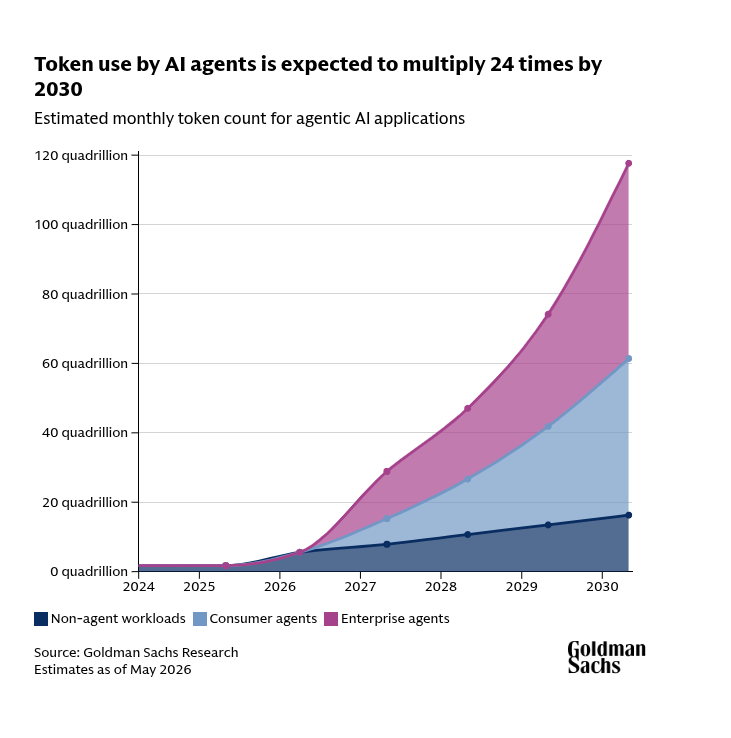
Goldman Sachs: "Token use by AI agents is expected to multiply 24 times by 2030"
AI agents are now creating the first serious cost test for the AI boom. As was reported this week, Uber and Microsoft are already rethinking expensive agent usage.
A chatbot may answer once, but an agent plans, calls tools, checks results, edits mistakes, and repeats the loop.
That loop can make one user request consume 10x, 50x, or even far more tokens than a normal answer.
Goldman’s bullish case is that monthly token use could reach 120 quadrillion by 2030, while inference cost per token keeps falling 60%-70% per year.
The fight is now between agent productivity and token waste.
Earlier this month, Microsoft began revoking developer access to Claude Code, with plans to move them to its in-house Copilot Command Line Interface tool by June 30. The company has framed this as consolidating teams around its own tools, but the timing at the fiscal year’s end hints it may also be about lowering costs.
2 quality-of-life improvements for developers working with Codex today:
Codex background agents now have stable pixel identicons.
When the same agent shows up across tabs, mentions, transcripts, and the thread panel, it’s easier to recognize at a glance.
For every ChatGPT conversation that started as “one quick thing” and became a full on saga: table of contents is here.
Available now for chats with 5+ responses.
After 3 years of using Claude, I can say that it is the technology that has revolutionized my life the most, along with the Internet.
So here are 10 prompts that have transformed my day-to-day life and that could do the same for you:
This survey suggests over 80% of companies have seen no productivity gains from AI so far, despite billions in spending.
Among 6,000 executives, 1/3 of leaders said they use AI, but only for 90 minutes a week.
This is even though most respondents believe AI will increase productivity by 1.4%, cut staff by 0.7%, and boost output by 0.8% in the next 3 years.
Of the executives, a third said they use AI at work, but only around 1.5 hours per week on average. Meanwhile, 25% of those surveyed have not used AI yet.
---
nber .org/papers/w34836
Microsoft is making moves again.
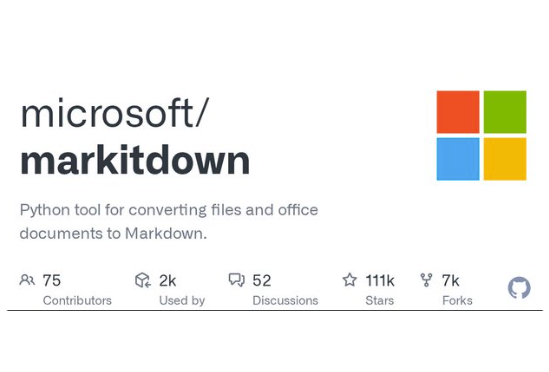
A quiet little Python tool just shot to the top of GitHub’s trending charts.
100,000+ stars.
It’s called MarkItDown.
And it does something deceptively simple:
It turns almost any file into clean Markdown.
PDFs. Word docs. PowerPoints. Excel files. Images.
Drop a file in. Get structured Markdown out.
Sounds small.
It’s not.
Because one of the biggest bottlenecks in AI workflows — especially RAG systems — is getting messy, real-world documents into a format models can actually use.
And real-world documents are brutal.
PDFs are chaotic.
Word docs are full of hidden formatting junk.
PowerPoints are messy and often image-heavy.
Spreadsheets can be a nightmare to parse cleanly.
That’s where this gets interesting.
MarkItDown strips away the friction and gives you something LLM pipelines can actually work with.
In other words: less preprocessing, less pain, faster AI implementation.
Even better, this isn’t some random side project.
It’s an official Microsoft open-source tool.
Free. Commercially usable. Practical.
I tested it on a 200-page PDF.
A few seconds later, I had Markdown that was shockingly clean.
And that’s what big tech does at its best:
They take an annoying, universal problem that everyone has been duct-taping together…
and turn it into a simple standard.
That’s why this matters.
It’s not just a file conversion tool.
It’s infrastructure for the next wave of AI applications.
Get it here: https://t.co/UDzes0sbDs
===
🚨 Want to learn how to build + ship AI and Data Science projects (that businesses actually want in 2026)?
On June 24th, I am hosting a free workshop to help you get started with AI + DS projects in Python.
Register here (500 seats): https://t.co/onpLpRwkzH
Two economists just published a mathematical proof that AI will destroy the economy.
Not might. Not could. Will — if nothing changes.
The paper is called "The AI Layoff Trap." Published March 2, 2026. Wharton School, University of Pennsylvania. Boston University. Peer reviewed. Mathematically modeled.
The conclusion is one sentence.
"At the limit, firms automate their way to boundless productivity and zero demand."
An economy that produces everything. And sells it to nobody.
Here is how you get there.
A company fires 500 workers and replaces them with AI. A competitor fires 700 to keep up. Another fires 1,000. Every company is behaving rationally. Every company is following the incentives correctly. And every company is building a trap for itself.
Because the workers who were fired were also customers.
When they lose their jobs faster than the economy can absorb them, they stop spending. Consumer demand falls. Companies respond by cutting costs — which means automating more workers — which means less spending — which means more falling demand — which means more automation.
The loop has no natural exit.
The researchers tested every proposed solution. Universal basic income. Capital income taxes. Worker equity participation. Upskilling programs. Corporate coordination agreements.
Every single one failed in the model.
The only intervention that worked: a Pigouvian automation tax — a per-task levy charged every time a company replaces a human with AI, forcing them to price in the demand they are destroying before they pull the trigger.
No government has implemented this. No major economy is seriously discussing it.
Meanwhile the numbers are already tracking the curve. 100,000 tech workers laid off in 2025. 92,000 more in the first months of 2026. Jack Dorsey fired half of Block's workforce and said publicly: "Within the next year, the majority of companies will reach the same conclusion."
Nobody is doing anything wrong. Companies are following their incentives perfectly. That is exactly the problem.
Rational behavior. At scale. Simultaneously. With no mechanism to stop it.
Two economists built the math. The math leads to one place.
Source: Falk & Tsoukalas · Wharton School + Boston University ·
BREAKING: 🇨🇳 China's court just ruled companies can't fire workers only to replace them with AI.
Beijing is warning firms that putting profit over jobs could carry penalties, especially when it comes to young people.
Read that again. The country racing hardest to win the AI race just told its own companies to slow down.
You can't automate a human out of a job purely to cut costs.
China has high youth unemployment and a slowing economy. A wave of AI layoffs would devastating.
So Beijing is doing what it always does.
Stability first. Efficiency second.
The "AI replaces everyone" trade assumes nothing stands in the way. Beijing just stood in the way. By decree.
What could be the next trillion-dollar industries?
Building on our research into the 12 arenas of future growth, we’ve identified 18 emerging industries showing early signs of outsized potential. https://t.co/H4mRUnXfaH