NEAR is pumping. Here's why:
> Arthur Hayes essay. Hayes groups NEAR + ZEC + HYPE as his top basket. Calls NEAR his favorite shitcoin. The single biggest retail trigger.
> NEAR is the privacy execution layer. ZEC is pumping. The actual trading flows through NEAR Intents + confidential shard + confidential swaps. Best privacy stack on market. Confidential transactions already 42% of volume.
> Bitwise NEAR ETP. Bitwise announced significant inflows into their NEAR Staking ETP (per Bitwise CIO Hunter Horsley). Institutional money is buying.
> NEAR Intents buybacks. $19B+ cumulative swap volume generates real fees that buy back NEAR. Hyperliquid-style revenue model with verifiable cash flow.
> AI pedigree. Co-founder Illia is one of 8 authors of "Attention Is All You Need" - the original Transformer paper. When AI narrative hits crypto, NEAR has the cleanest founder story.
> AI products shipping. Automatic PII anonymization for LLM prompts. Confidential inference APIs. Only crypto featured at NVIDIA's dev conference.
> Dynamic Resharding + PQ signing in upgrade 2.13. Automatic horizontal scaling and post-quantum security in one June release.
> Cross-ecosystem endorsements. Both David Hoffman (Bankless, ETH-aligned) and Mert (Helius, SOL-aligned) publicly calling NEAR underrated. Rare to see voices from rival ecosystems agreeing.
> Bermuda government pilot. On-chain car registration and installment payments. Real government adoption.
> Clean tokenomics. Inflation cut from 5% to 2.5% in February. Full supply unlocked. No vesting overhang.
> Chart breakout. Multi-year descending trendline broken. Open interest at fresh highs.
Multi-vector pump. Each catalyst validates the next.
The key question is going to be how many L1's are optimal and what configuration of L1 capabilities will prevail. My guess is 5 or 6 with clear leaders and core challengers. The L1 trade is the cleanest as you can use Metcalfes Law approximation models to value them vs DCF models. Network adoption models tend to outperform. Some of the applications later will outperform but it's harder to bet on.
My proxy for Metcalfes Law that gives the best correlation is total value transacted per active user. This can be normalized to give like for like comps and then weighted for where they are on the adoption curve. It works well.
Using ETH as the base smart contract L1, SOL is still cheap, SUI is super cheap vs SOL, as is NEAR ( no position).
An easier way to estimate it, with still high correlation, is stable coin value transacted per active user. Active user are those that transact in stables, DeFi, dex's etc not just buy or sell
When you reach a stage in life where you have no bank interest to pay, no VC demanding returns, no public company expecting strong quarterly reports, no income that requires your labour and nothing left to buy, your focus naturally shifts from wealth creation to lower risk wealth preservation.
But for me, wealth preservation is only one bucket.
I live in service: all wealth must carry spiritual energy, because not all wealth is equal.
If our Creator blesses us with abundance, then our money should also boycott systems that violate our creators guidance.
For me, Bitcoin in self-custody is the ultimate boycott.
Bitcoiners like me dislike the phase where Bitcoin becomes a Wall Street tool through their custody, shares and collateralised lending services.
We fight back with self-custody.
I choose to stay, fight, educate others from my lessons and avoid the financial weapons of mass destruction that come from the Proof-of-Weapons Network.
Rotation is healthy—a higher cost basis means more people committed to holding through the storm.
Once you reach the billions, more billions have diminishing returns if you are truly free.
Many billionaires are not free—their wealth is tied to Wall Street, and once you enter that mafia, they never let you go.
Some of the wealthiest people in the world are slaves to Wall Street.
It’s a personal choice.
I choose to continue to boycott the Proof-of-Weapons Network with Proof of Work.
I understand why others choose to exit.
In my opinion. wealth can be taken by our creator if we don’t do good with the wealth our creator gives us.
Good is often not easy.
There has been a huge spike in the volume of BLACKDRAGONFOREVER NFTs over the last 24hrs and we have reason to believe the activity is coming from other chains…
What do they know???
Probably that $NEAR has 40m daily users but only 5000 BDFNFTs exist and will find added benefits throughout the ecosystem… 🔜
Did you grab yours yet?
NEAR Intents = The Universal Liquidity Layer
0 to $1B in volume — 305 days
$1B to $2B in volume — 35 days
$2B to $3B in volume — 20 days
$3B to $4B in volume — 8 days
$NEAR is a massive opportunity in the markets at these levels.
Crypto <> AI is the biggest opportunity that there exists.
Now, what are we going to release soon? Yes, an episode with the founder of $NEAR: Illia on our New Era Finance channel.
Hit that like button if you're looking forward to that one.
Aside from that, $TAO is having the halving in nearly 6 weeks from now, which implies that there's going to be a ton of interest going into the AI vertical.
Given that $NEAR is currently resting at the cycle low and holding up higher timeframe support, it's a great level to be accumulating the position.
Breaking through the 20-Week MA is the key, once that happens, we're in for a run which could provide a 3-6x against Bitcoin.
One of the most promising ecosystems.
I can see all of Fintwit back to hurling insults at each other again, so I figured I’d share my view and try to be a voice of reason, even if I end up being wrong.
It’s my job to stick my neck out. I’ve been doing it for years, and I’m still here.
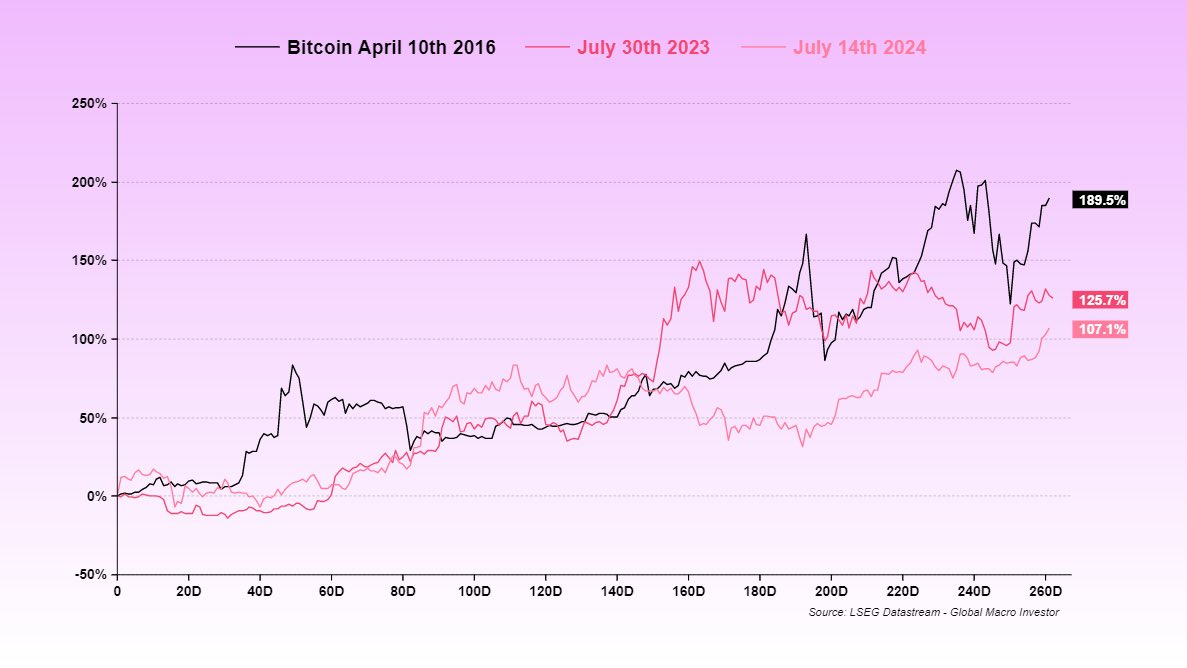
For what it’s worth, I think Bitcoin is forming another broadening wedge pattern, which is typically a bullish setup (chart 1).
We’ve seen plenty of these in the past, and right now we’re testing the lower boundary of support.
Another thing to note is that this bull market is officially 2 standard deviations oversold on the log regression channel (chart 2).
Unless the bull market is over, which is not our view, these levels are about as good an opportunity as you’re going to get to add to this market.
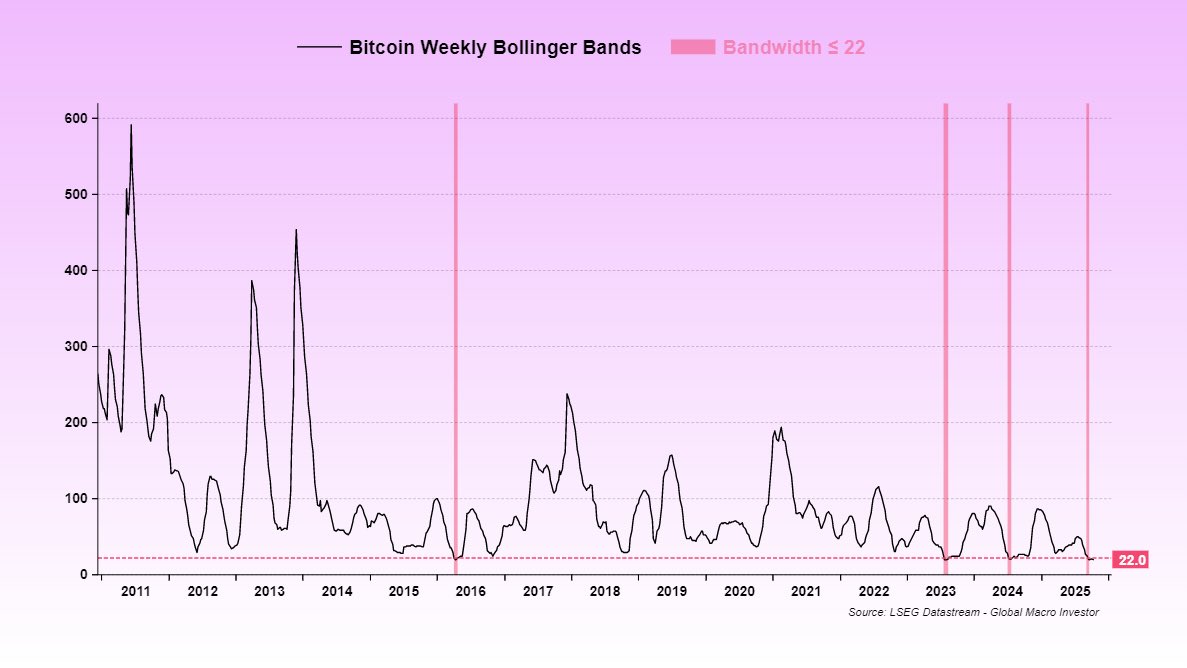
Also worth pointing out, Bitcoin’s Bollinger Bands have only been this tight three other times in its entire history (chart 3)…
What does that mean?
We’re in a mega low-vol environment…
Right now, the bands are as tight as they were in September 2023, just before a 200% rally.
That move lasted from September through March 2024, with a 20% correction in January before prices rallied another 90%.
The next chart shows the last three times Bitcoin’s Bollinger Bandwidth was less than or equal to 22, along with the forward twelve-month returns (chart 4).
The sample size is small, but the results have been extremely positive…
It’s the classic beach-ball-underwater dynamic. The harder you push it down, the more explosive the move when it finally breaks free.
All in all, we need to do better when times are tough. It’s not just your hopes and dreams caught up in this trade, it’s ours too. Fintwit can be powerful when you follow the right people who are genuinely trying to help. We’re not gurus, but we’ve been doing this a long time, built comprehensive frameworks, and we’re doing our best to share what we’ve learned.
At the same time, there’s a ton of poison and hate out there. Avoid it. When times get rough, we should rally around each other and stay focused on the big picture.
This is a 70-vol asset. If you can’t handle that level of volatility, this asset class might not be for you. If you don’t believe in crypto and the life-changing tech it brings, it’s hard to stomach the swings.
The only way to survive this kind of volatility is to extend your time horizon. When you think in days or weeks, every move feels like life or death. When you think in months or years, it all fades into noise.
Once you stop fighting volatility and start embracing it as a feature of this space, everything changes. Volatility turns into opportunity. It’s a gift that lets you add to your conviction.
Our view remains that Q4, once the dust settles, will be bullish, and we’ve done a ton of work to support that view.
That’s the best I can leave you with on days like this.
Good luck out there…
Bitcoin at all time high
Gold at all time high
Liberate yourself from the dollar and all its fiat currency derivatives
Boycott the federal reserve with Bitcoin
Boycott Blackrock by holding it in self-custody
Boycott the banks by not borrowing against it
Serve humanity
Fight oppression
Repost if you agree
2 big reasons this is awesome for @moonbirds
1) This kind of traction helps us land deals and distribution with web 2 partners.
2) This is the first expansion of the brand onto @solana and it went really well.
Let's cut through the BS with hard facts: 🧵
BTC= 7 TPS with 82 nodes
ETH= 179 TPS with 8.1k nodes
SOL= 20k+ TPS with 1.1k nodes
ADA= 18 TPS with 3k nodes
SUI= 20k+ TPS with 121 nodes
APT= 20k+ TPS with 150 nodes
NEAR= 100k+ TPS with 296 nodes
ALGO= 10k+ TPS with 3.7k nodes
(TPS = Capacity) (Nodes = Decentralization)
Capacity + Decentralization = Scalability!
This is all, a gross oversimplification, as there are far more metrics to take into account & many more devils in the details. However, these are still incredibly important metrics on their own & should not be underestimated!
Node Count Methodology:
When it comes to the number of "nodes", I was specifically referring to native-delegated & solo validators (block producers).
Based on this definition, we can only count "pool nodes" in the case of BTC, as they serve the equivalent function of a "validator" in PoS. Considering that miners do not even run a node & full nodes are not involved in block production!
In the case of ETH, we count the physical number of consensus clients. That has to be the upper bound for the number of "validators" on ETH, due to it being a requirement for block production.
TPS Measure Methodology:
When it comes to TPS, we are specifically referring to the maximum Theoretical Transactions Per Second for basic 1 to 1 value transfers. This gives us a fair & comparable scalability metric across all chains!
The TPS figures were also rounded down in the case of the most advanced scaling technologies. In SOL's case, for example, the raw cu/gass figures give it a TPS exceeding 200k!
However, in reality, bottlenecks are hit much sooner, in part because smart contract chains TX are far more complex. This leads to different bottlenecks getting hit much sooner in the real world. However, in the hypothetical scenario of running as many simple TXs as possible (for the purpose of comparison). We hit an EDDSA verification bottleneck at around 30k TPS & there are also other significant bottlenecks further up. This means we have to account for this with specific knowledge of these blockchains:
That is how, while being aware of these specific bottlenecks for purely parallelized chains, we can safely estimate a TPS of 20k+ for SOL, SUI & APT.
Chains utilizing sharding get around this bottleneck & are in the 100K+ TPS range (this is assuming more shards can be deployed to meet demand).
For any chain that does not deploy advanced on-chain scaling techniques, we can give an exact TPS figure, as there are hard limits that can be easily calculated. Like in ETH (gas limit) & ADA & BTC (block size limit), respectively
Need For Speed:
Speed is distinct from capacity in the case of blockchain design; it is also one of the most important metrics, alongside more decentralization metrics. It did not fit in the opening, & I wanted to keep it more simple, so we are including it here instead:
BTC= 7 TPS at 10min on 82 nodes
ETH= 179 TPS at 12sec on 8.1k nodes
SOL= 20k+ TPS at 0.4sec on 1.1k nodes
ADA= 18 TPS at 20sec on 3k nodes
SUI= 20k+ TPS at 0.5sec on 121 nodes
APT= 20k+ TPS at 0.2sec on 150 nodes
NEAR= 100k+ TPS at 0.6sec on 296 nodes
ALGO= 10k+ TPS at 2.8sec on 3.7k nodes
Speed, in this case, is simply measuring block time, not finality, which is another equally valuable metric.
The real trade-off space is not between capacity & decentralization, but rather between capacity & speed. Another reason why the classical blockchain trilemma is so incredibly outdated today.
My Selection, Deal With It:
Instead of strictly following market capitalization as I usually do for such lists & other specific rules for inclusion, in order to avoid accusations of bias. I just included whatever I wanted to this time instead...
I will be accused of being a paid shill, no matter what I do at this point, while also facing extreme toxicity for telling everyone about these basic truths...
That is why I only included what I thought was interesting to compare & whatever happened to fit within the X-character limit, as most people do not read the body of the text, only the start anyway.
It is likely that some of you will still think it is a grand conspiracy against your obscure chain because the tech is just so good... The tribalism, cope & delusion have become so ridiculous for some in this world...
Honorable Exception:
I usually exclude ALGO from such lists due to its centralized relay nodes, which make it technically permissioned (centralized). However, considering they are very close to fixing that issue, I thought I could make an exception here... So, this can be considered a shoutout for their positive efforts!
Conclusion:
There is little correlation between the number of nodes & TPS. That is because many aspects of the blockchain trilemma have been effectively solved & the trade-offs in the design space are now more focused on other levers such as capacity vs speed.
Economic & consensus design also ends up having a far greater impact on node counts, at least when compared to the total capacity of these chains.
Shoutout to ETH for having the most nodes & NEAR for having the highest capacity! 🏆
We should all strive to increase these figures & praise those who push the boundaries of innovation. The goal is to maximize freedom (decentralization) for as many people as possible (scalability).
As cryptocurrency is useless without capacity & pointless without decentralization! 🔥
⚡ INSIGHT: The former NFT blue chip project @moonbirds is surging again under new leader Spencer — an NFT trader with a builder's mindset.
Via Cointelegraph Magazine
🔥 @rhea_finance on @NEARProtocol is dominating 🚀
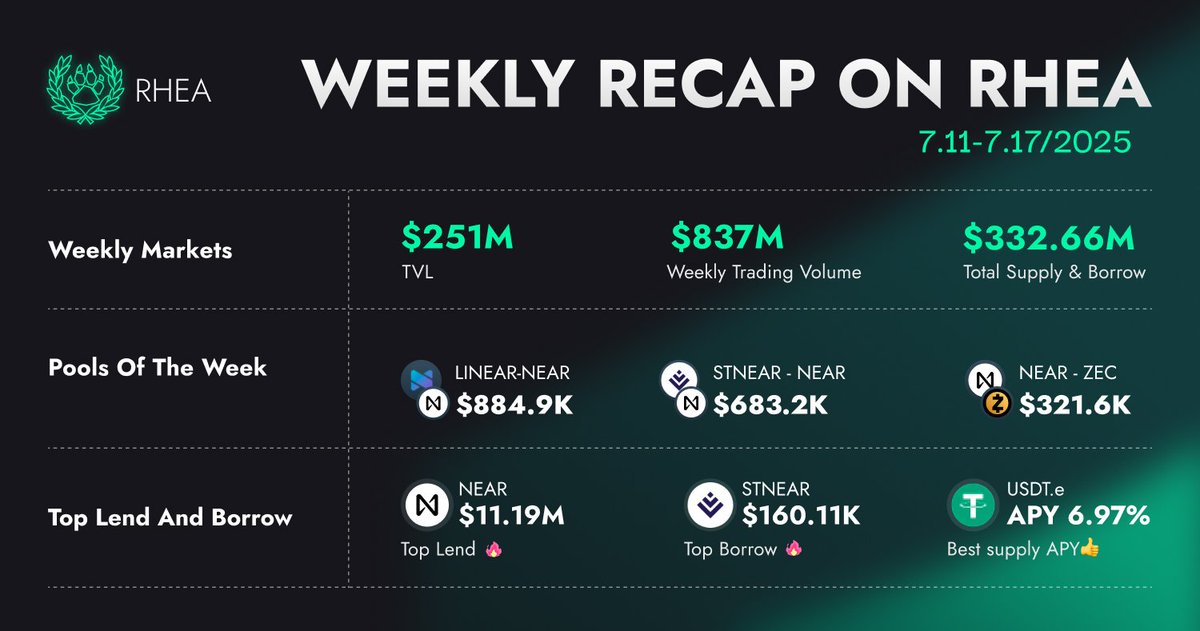
The July 11–17 recap reveals $837M in trading volume and booming lending activity Rhea is setting the pace on NEAR!
📊 Weekly Highlights (July 11–17):
• Trading Volume: $837M USD (~$119.6M/day) 📈
• Supplied & Borrowed: $332.66M USD 💰
• TVL: $251M holding strong 🔒
🏆 Top Assets:
Most Lent: $NEAR at $11.19M 🥇
Most Borrowed: $stNEAR (@meta_pool) at $160.11K 🥇
NEAR’s native asset and Meta Pool’s liquid staking token are powering the momentum.
Rhea is becoming a DeFi force to watch. 🔥