Should the taxpayer still bear the burden of proof in instances where a tax dispute with the Revenue Authority is based in pre-populated & third party data?
In my submission before the National Assembly's Finance & Planning Committee on behalf of the Tax Research Centre at @StrathU, I argue that Finance Bill 2026's proposals seeking to anchor Incomes & Expenses Validation in law will be incomplete if they do not include a proposal for the the Revenue Authority being saddled with the burden of proof in such instances.
Here's why:
· Finance Bill 2026 proposes to amend Sec75 of the Tax Procedures Act to provide that the Revenue Authority may use technology to pre-populate tax returns on behalf of a person required to submit or lodge a tax return
· Finance Bill 2026 further proposes that a person required to submit or lodge a tax return may rely on pre-populated return generated by the Revenue Authority to file their return
· Finance Bill 2026 proposes to amend Sec112 to provide that the Cabinet Secretary of the National Treasury may make Regulations for the procedure for the submission or lodging of returns based on pre-populated tax returns generated by the Revenue Authority
Here's where the problem is:
· In all this, Sec56(1) which provides that "In any proceedings, the burden shall be on the taxpayer to prove that a tax decision is incorrect" remains unchanged
· Sec56(1) is predicated on the fact that Kenya has been running on a self-assessment based regime & the data upon which tax disputes emerges was held by the taxpayer
· With Incomes & Expenses Validation & the onset of a Dual Assessment regime in Kenya, taxpayers are now exposed not just to errors of judgement & data on their part, but also errors of technology & transmission which are out of their control
· Can we really still have the burden of proof lying exclusively with the taxpayer in an environment where tax compliance has shifted from a function of record keeping to one where system integration reliability is now a key factor?
@K2grind Due to geopolitics, that's back in 2023.
Would like to see if they are offering the same package.Rosatom was offering desalination plant plus connecting the nuclear reactor to the cost.
We don't own the ship, only getting the power.
Good question.
Companies use retained earnings to reinvest and expand because it is often their cheapest source of capital.
If retained earnings are also being taxed, how exactly are businesses expected to grow, create jobs and build long-term capacity.
Increasing Fuliza limits is monetary policy transmission.
All of a sudden, the whole country had a credit line that expands purchasing power.
What's baffling is that a private company is the one doing this, at its own volition.. as a commercial product..
Changes in Fuliza limits directly impact purchasing power, aggregate demand, retail sales, and inflation.
That my friends, is how corporations will end up running countries!
@kinjeketile@K2grind@mucheke@SeweS_ Not really...Rosatom was here with a floating power plant proposal powering the coast and a desalination plant.
The proposal was sent to west Africa and north Africa instead.
@DavidNdii https://t.co/ah46CNbQYq
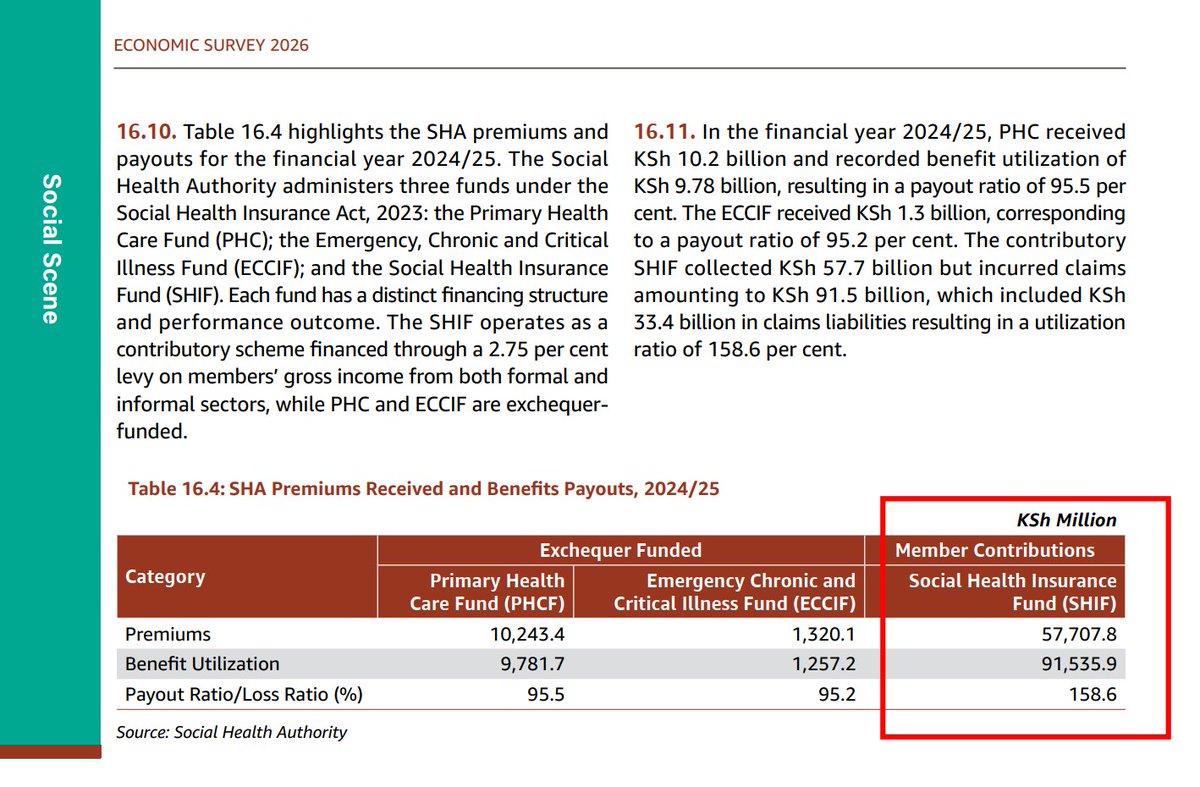
Cool story bro. On SHA , citibank and stanchart had already warned the state on the unfunded liabilities, you wont be there when it implodes and that's all that matters for you.
Cant hate the player.
@RufasKe@DavidNdii@nderi_j I am exhausted, this guy will claim every project as his brainchild and shut up when it implodes- you never hear him talk about hustler fund like he used to, SHA too even though he claimed he had been thinking about it for 4 years.
What happened to the industry? It was the perfect storm: an unsustainable fiscal policy colliding with a collapsing business climate. Let me explain with one product as an example.
When we opened Tribeka in August 2011, we sourced beer from distributors at KES 82–89 per bottle. We retailed it at KES 200 Monday to Wednesday, then KES 250 from Reggae Thursday all the way through Sunday. That delivered a 200% gross margin. It was incredibly lucrative. We paid down debt fast, took on new debt for expansion, and opened Natives in November 2012.
Then everything started unravelling. The new administration chose to fuel growth with massive debt-financed infrastructure. They pointed to the low tax-to-GDP ratio (distorted by counting these non-cash-generating assets toward GDP) and declared taxation too low. The lowest-hanging fruit? Sin taxes on alcohol. Annual hikes followed, and by 2018 wholesale prices had climbed to KES 180. To protect our old margin we would have needed to sell at KES 540 — but the street price stayed stuck at KES 250. Our gross margin collapsed to just 38% before salaries, rent, taxes or anything else.
The tax burden had by then spread across the entire economy. Real incomes stagnated, so people cut household spending to the bone. The era of dropping KES 100k on a table was over.
By 2015 we had scaled to 8 venues, 380 permanent staff (550 on weekends counting temps), and $11 million in annual revenue. The cracks were already visible. I hoped the crazy 8%+ deficits were just a pre-election anomaly and that we’d see budget discipline after the vote. Instead, they doubled down. They even indexed alcohol tax hikes to CPI — which was madness, because the inflation was being caused by the very taxes and money printing they were doing.
By 2018 we were injecting fresh millions just to cover salaries and rent in some outlets. We were actually relieved when leases expired, even as some landlords tried to muscle us for “goodwill” payments. Minimum wage had jumped from KES 8k to 14k, Tribeka rent had soared from KES 500k to 1.2 million, and we faced an endless parade of extortionate “bureaucracy taxes” and compliance costs.
Today purchasing power hasn’t recovered much. The liquor business is nothing like it was. I walked away with heavy losses, but the lessons I learned are worth their weight in gold. No regrets.
If I were starting again today, I’d open a Michelin-starred restaurant serving a cozy 50 pax and cater strictly to the 1% — the ones who’ve used the Cantillon effect to suck the country dry through rent-seeking, plus the rich foreigners riding the same wave.