Personal update: I've joined Anthropic. I think the next few years at the frontier of LLMs will be especially formative. I am very excited to join the team here and get back to R&D. I remain deeply passionate about education and plan to resume my work on it in time.
In 2022, OpenAI researchers found something that broke every rule of machine learning.
Their tiny model trained for 10,000 epochs. It learned absolutely nothing. Validation accuracy was dead stuck at 50%.
Then at epoch 12,000, without warning, it jumped to 99%.
This phenomenon is called "Grokking".
And in 2026, it might be the most important discovery in AI nobody talks about.
Neural networks can train for thousands of cycles without seeming to learn anything useful. Then, in a single epoch, they suddenly achieve near-perfect generalization.
What started as a weird training glitch has become a foundational insight into how models truly learn.
We’ve always been told: “If validation loss stops improving for a few hundred epochs, stop training.” Early stopping was the golden rule.
Grokking says the exact opposite: Keep going.
The model might look completely stuck, but real understanding is quietly forming under the hood.
During that long, dead plateau, the machine isn't idle. It's doing deep internal work:
- Circuits form, dissolve, and reform.
- Spurious correlations get pruned away.
- Weight patterns crystallize around true underlying rules.
- The model shifts from brute-force memorization to genuine comprehension.
It’s the machine version of a human “aha!” moment—a long, agonizing buildup followed by sudden clarity.
Take modular addition as a real-world example. Researchers fed a small model just 30% of all possible examples.
At epoch 500, it hit 100% training accuracy but stayed at 50% validation. It had memorized the test answers, but couldn't solve a new problem.
At epoch 10,000, it still sat at 50% validation. It looked utterly hopeless.
Then at epoch 12,000, it instantly shot to 99%. It didn't just guess right; it had grokked the actual mathematical rule.
This explains the hidden mechanics behind the massive reasoning models we use today.
When you see modern reinforcement learning or long-context reasoning models suddenly "click" after looking stuck, you are witnessing grokking at scale.
Massive training runs aren’t wasteful, they are deliberately forcing the AI to stop memorizing and start thinking.
And we are learning to induce this at inference time.
Extended Chain-of-Thought prompts that force a model to think for thousands of tokens, self-consistency loops, and verification passes are all designed to do one thing: teach the model to grok your problem on the fly.
The big philosophical takeaway is brutal for our short attention spans.
Learning isn’t smooth. It isn’t gradual. It is discontinuous.
Models, and humans, can stay “dumb” for ages, right up until they suddenly understand everything.
People talk, listen, watch, think, and collaborate at the same time, in real time. We've designed an AI that works with people the same way.
We share our approach, early results, and a quick look at our model in action.
https://t.co/AFJZ5kH7Ku
Harvard Business Review just published a super interesting piece.
AI’s biggest shock may be that nobody can price the future cleanly anymore i.e. we all are staring at a "AI Fog"
i.e. the range of outcomes is now so wide that people cannot tell whether today’s prized skill, product, or business model will still pay off a few years from now.
AI’s first big economic effect is not automation itself, but the collapse of foresight.
The hidden cost of AI may be a collapse in conviction, as its erasing the visibility that modern finance depends on.
Modern capitalism runs on the assumption that tomorrow will rhyme with today closely enough to justify big, slow bets. On long bets like degrees, hiring plans, factories, software valuations, and infrastructure, and those bets work only when the future is readable.
All these depend on one quiet belief: the future is legible.
AI attacks that legibility before it fully rewires any one industry.
That hits workers first, because a medical degree, MBA, or coding career looks weaker when AI agents may absorb diagnosis, analysis, drafting, research, and junior software work.
That hits companies next, because stock prices depend on durable future cash flow, and terminal value breaks down when AI can erode moats in software, services, and even specialized manufacturing.
That changes behavior fast.
Students hesitate to buy expensive human capital when the job at the end may be redefined halfway through training, and companies hesitate to hire when junior work, software work, and coordination work are all moving targets.
Financial markets feel the same pressure, because once AI casts doubt on a company’s durability, the terminal value carrying much of its valuation starts to look less like math and more like faith.
So the immediate economic consequence of AI may be shorter horizons.
Less skyscraper, more tent.
Less irreversible commitment, more staged investment, modular teams, and organizations built to learn before they lock in.
It points to something subtler and probably more important: when institutions cannot see clearly, they stop making the kinds of commitments that built the old economy.
---
hbr .org/2026/04/the-future-is-shrouded-in-an-ai-fog
A tech consultant in Sydney spent $3,000 and two months to do what Moderna has spent billions trying to scale.
Paul Conyngham adopted Rosie, a staffy-Shar Pei cross, from a shelter in 2019. In 2024, tumors started growing on her back leg. Mast cell cancer, the most common skin cancer in dogs. He tried surgery, chemo, immunotherapy. Nothing shrank the tumors. Just slowed them down while the bills stacked into the tens of thousands.
So he opened ChatGPT and asked it how to cure his dog’s cancer.
The AI didn’t cure anything. What it did was compress months of literature review into hours. It suggested genomic sequencing, walked him through neoantigen identification, helped him build a research pipeline that would normally require a postdoc and a lab budget. He paid $3,000 to sequence Rosie’s tumor DNA at UNSW’s Ramaciotti Centre, then ran the mutations through AlphaFold to model the protein structures. A computational biology professor at UNSW saw his analysis and was, in his own words, gobsmacked that someone with zero biology training had assembled the whole thing.
Then came the part nobody expects. The science was the easy half. Australian ethics approval to run a drug trial on your own pet took three months. Two hours every night after work, filling out a 100-page application. The red tape was harder than designing the vaccine.
Once he cleared that, Páll Thordarson at the UNSW RNA Institute built a custom mRNA vaccine from Conyngham’s data. Sequencing to finished vaccine: less than two months. Conyngham drove 10 hours to deliver Rosie for her first injection in December. One month later, the tennis-ball-sized tumor on her leg had shrunk 75%.
Here’s where the numbers get interesting. Moderna and Merck just reported five-year data on their personalized mRNA cancer vaccine for melanoma. It encodes up to 34 neoantigens per patient. The Phase III trial is fully enrolled. Projected cost per patient: $100,000 to $300,000. Their pipeline is worth an estimated $2.3 billion in annual sales by 2031.
Conyngham did a version of the same workflow for his dog. Sequenced the tumor. Identified the neoantigens. Built a custom mRNA construct. Total cost: $3,000 for sequencing plus university lab time. The gap between those two numbers is where AI is about to rearrange the entire cost structure of precision medicine.
The regulatory moat is real. Conyngham could do this because veterinary experimental treatments face lighter scrutiny than human medicine. There’s no FDA Phase I-III gauntlet for a one-off compassionate use case on a dog. But the technical workflow, tumor sequencing to neoantigen prediction to mRNA synthesis, is converging toward something a motivated person with the right AI tools can orchestrate in weeks instead of years.
One guy, a rescue dog, and a $20/month ChatGPT subscription just produced a proof of concept that the pharmaceutical industry has spent a decade and billions of dollars building toward. The vaccine worked. The tumor shrank. And the only reason it happened is because a dog owner loved his dog enough to spend three months fighting paperwork.
Let me explain what just happened, because I don’t think people realize how INSANE this is.
> Cortical Labs put 200,000 real human brain cells onto a silicon chip and trained them to play Doom in just one week.
> Each CL1 system costs $35,000.
> A rack of 30 units consumes only 850–1,000 watts combined.
> The human brain operates on 20 watts.
> Large AI training clusters burn through megawatts.
>Backed by In-Q-Tel.
115 units began shipping in 2025.
> Cortical Labs is selling “Wetware as a Service” through Cortical Cloud, letting developers deploy code remotely to living human neurons with no lab required,
> priced like a software subscription but powered by real brain cells grown from adult skin and blood samples.
> it isn’t about gaming, it’s about biological computing that could eventually outperform traditional silicon in energy efficiency and adaptability.
This is getting really scary and we’re still at the very beginning.
It is hard to communicate how much programming has changed due to AI in the last 2 months: not gradually and over time in the "progress as usual" way, but specifically this last December. There are a number of asterisks but imo coding agents basically didn’t work before December and basically work since - the models have significantly higher quality, long-term coherence and tenacity and they can power through large and long tasks, well past enough that it is extremely disruptive to the default programming workflow.
Just to give an example, over the weekend I was building a local video analysis dashboard for the cameras of my home so I wrote: “Here is the local IP and username/password of my DGX Spark. Log in, set up ssh keys, set up vLLM, download and bench Qwen3-VL, set up a server endpoint to inference videos, a basic web ui dashboard, test everything, set it up with systemd, record memory notes for yourself and write up a markdown report for me”. The agent went off for ~30 minutes, ran into multiple issues, researched solutions online, resolved them one by one, wrote the code, tested it, debugged it, set up the services, and came back with the report and it was just done. I didn’t touch anything. All of this could easily have been a weekend project just 3 months ago but today it’s something you kick off and forget about for 30 minutes.
As a result, programming is becoming unrecognizable. You’re not typing computer code into an editor like the way things were since computers were invented, that era is over. You're spinning up AI agents, giving them tasks *in English* and managing and reviewing their work in parallel. The biggest prize is in figuring out how you can keep ascending the layers of abstraction to set up long-running orchestrator Claws with all of the right tools, memory and instructions that productively manage multiple parallel Code instances for you. The leverage achievable via top tier "agentic engineering" feels very high right now.
It’s not perfect, it needs high-level direction, judgement, taste, oversight, iteration and hints and ideas. It works a lot better in some scenarios than others (e.g. especially for tasks that are well-specified and where you can verify/test functionality). The key is to build intuition to decompose the task just right to hand off the parts that work and help out around the edges. But imo, this is nowhere near "business as usual" time in software.
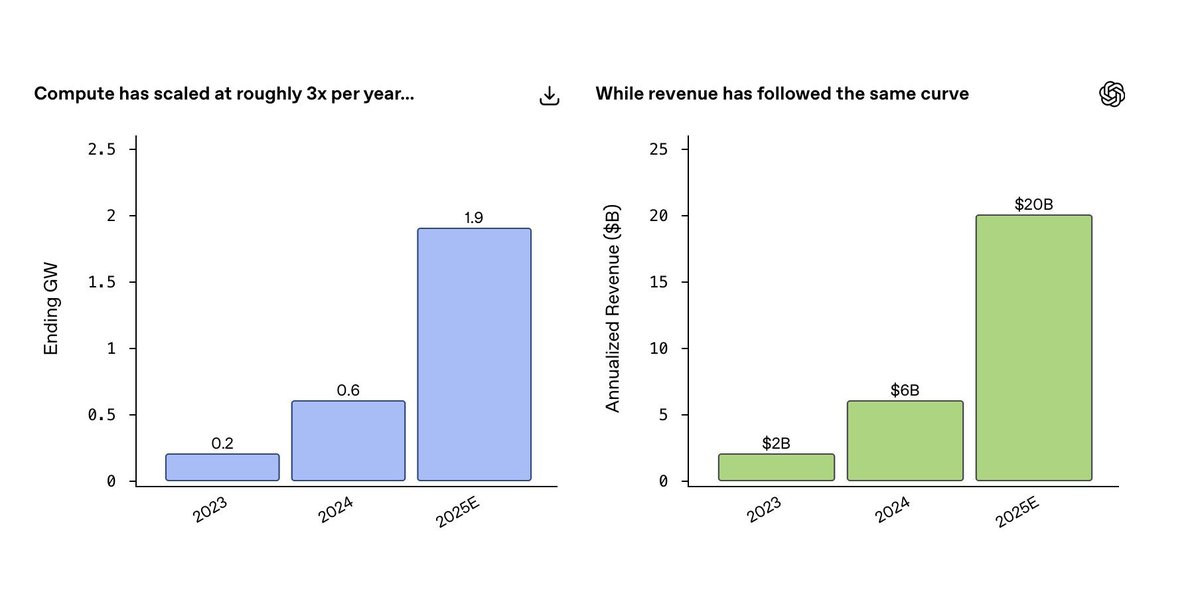
OpenAI ha llegado a los 20,000$ millones de ARR 🤯
Ojo al dato, porque esto es algo que llevo diciendo en esta cuenta desde hace mucho: ESCALA como una empresa de energía. Como un commodity.
• Cómputo: 0.2 GW (2023) → 0.6 GW (2024) → ~1.9 GW (2025)
• Ingresos: $2B ARR → $6B → $20B+
• Ambos básicamente 3X año tras año
O sea… ¿quieres el siguiente salto de 3X en ingresos?
Enhorabuena → ahora necesitas el siguiente 3X de GPUs, electricidad, refrigeración, supply chain, contratos… todo.
Este es el nuevo juego:
- Los modelos importan.
- La distribución importa.
- Pero el boss final de verdad es quién asegura el próximo gigavatio antes.
Las empresas de IA están hambrientas de capacidad de cómputo. Y NVIDIA no para de fabricar galletas.
In June 2017, eight Google researchers publish “Attention Is All You Need.” The paper invents the transformer architecture.
Google’s response to inventing the foundation of modern AI?
They assigned chatbot development to a “20% project.”
Daniel De Freitas had to recruit an “army of helpers who were ignoring their day jobs” to build Meena in 2020. When Meena actually worked, executives killed it because it might “say dumb things.”
Noam Shazeer, one of the eight transformer authors, built LaMDA on top of Meena. He wrote an internal memo called “Meena Eats the World” predicting it could replace Google Search and generate trillions in revenue. Google’s leadership response: we can’t release this, too risky.
Shazeer and De Freitas quit in 2021. Google paid $2.7 billion to bring Shazeer back in 2024.
Meanwhile, Ilya Sutskever left Google for OpenAI in 2015. Elon Musk personally recruited him. At the time, Google offered Sutskever $2 million to stay. He took a pay cut to join a nonprofit. OpenAI built GPT on the transformer architecture Google published. ChatGPT launched November 30, 2022, hit 100 million users in two months, and broke the record for fastest-growing consumer app ever.
Google’s internal response? “Code red.” Sundar Pichai pulled engineers off other projects. Larry Page and Sergey Brin came out of semi-retirement. Bard launched in February 2023 and immediately told people to eat glue.
Here’s what Brin’s admission actually reveals: Google’s culture became structurally incapable of taking asymmetric bets.
The eight authors of “Attention Is All You Need” all left Google. They founded Cohere, https://t.co/7uyF0lGgl2, Adept, Inceptive, Essential AI, and Sakana AI. They went to OpenAI. They scattered across the industry, taking the knowledge Google paid for and building competitors.
This is what happens when a company optimizes for avoiding embarrassment over capturing upside. Google’s executives looked at chatbots and saw reputation risk. OpenAI looked at the same technology and saw the future of computing.
Brin’s “we were too scared” framing actually understates the problem. This wasn’t fear of chatbots saying wrong things. This was fear of any product that couldn’t be perfectly controlled at launch. The same mindset that killed Google Glass, Google Plus, and a graveyard of internal projects that might have worked if they’d shipped them and iterated.
The transformer paper has been cited 173,000 times. The irony is excruciating. Google invented the thing and then became a case study in how not to deploy it.
And now the roles have reversed. Google just released Gemini 3, topped the benchmarks, grew to 650 million users. Sam Altman declared his own “code red” last week. OpenAI is delaying advertising and agent projects to focus on making ChatGPT better.
The AI race is a leapfrog game where first-mover advantage lasted about eighteen months.
sat next to a guy on a flight who smelled like old money
rolex. tailored suit. reading a physical newspaper like it was 1987.
figured he was some finance executive or inherited wealth.
we got talking. I mentioned I sell stuff online.
he put down his newspaper.
"what kind of stuff?"
digital products. courses. ebooks. that kind of thing.
he smiled weird.
"I made $4 million last year selling a PDF about aquariums."
I thought he was messing with me.
he wasn't.
this guy is 61 years old. spent 30 years as an accountant. hated every second of it. retired at 55 with decent savings but nothing crazy.
his hobby was aquariums. had been keeping fish tanks since he was 12.
"my wife told me to start a blog so I'd stop boring her with fish facts."
so he did. wrote about aquarium stuff 3 times a week. water chemistry. tank setups. fish compatibility.
for 2 years nobody read it.
"I had maybe 50 visitors a month. all probably bots."
but he kept going because he had nothing else to do.
year 3, one article ranked on google. then another. then another.
suddenly he was getting 100K visitors a month. all people searching for aquarium help.
"I realized these people would probably pay for a complete guide. so I wrote one."
147 pages. everything about setting up and maintaining an aquarium.
priced it at $47.
first month: $6K
first year: $340K
last year: $4.2 million
from a PDF about fish tanks.
I asked about his marketing strategy.
"I don't have one. google sends people to my blog. blog mentions the guide. people buy it. I go play golf."
no email sequence?
"I have a newsletter. I send fish tips once a week. sometimes I mention the guide at the bottom. that's it."
no upsells?
"I made a second guide about saltwater tanks specifically. $67. people who bought the first one usually buy the second. that's my whole business."
no team?
"my wife helps with customer service. we get maybe 10 emails a day. most are just people showing us their tanks."
this 61 year old retiree built a bigger business than most "entrepreneurs" I know.
no ads. no funnel hacks. no growth strategies. no personal brand.
just mass expertise in one weird niche and patience to let it compound.
before we landed he gave me advice I didn't ask for:
"everyone your age wants to get rich fast. that's why most of you stay broke. I wrote about fish for 2 years before making a dollar. now I make more than I did in 30 years of accounting. speed is overrated. patience pays."
the plane landed. he grabbed his newspaper and walked off.
probably went home to feed his fish.
“From 2012 to 2020, it was the age of research. From 2020 to 2025, it was the age of scaling.
Is the belief that if you just 100x the scale, everything would be transformed?
I don't think that's true. It's back to the age of research again, just with big computers.”
@ilyasut
Elon Musk: “I am not working on a phone. I can tell you where I think things will go, which is that we’re not going to have a phone in the traditional sense. What we’ll call a phone will really be an edge node for AI inference with some radios to connect. Essentially, you’ll have AI on the server side communicating with AI on your device—formerly known as a phone—and generating real-time video of anything you could possibly want. There won’t be operating systems or apps in the future; it’ll just be a device that’s there for the screen and audio, and to put as much AI on the device as possible.”
(via Joe Rogan Experience Podcast)
If this Karpathy interview doesn't pop the ai bubble,
nothing will.
10 brutal quotes:
1. LLMs don’t work yet
They don’t have enough intelligence, they’re not multimodal enough, they can’t use computers, and they don’t remember what you tell them.
They’re cognitively lacking. It’ll take about a decade to work through all of that.
2. When you boot them up, they always start from zero
They have no distillation phase, no process like sleep where what happened gets analyzed and written back into the weights.
3. What’s stored in their weights is only a hazy recollection of the internet
It's just a compressed blur of 15 trillion tokens squeezed into a few billion parameters. Their context window is just short-term working memory.
4. They’re good at imitation, terrible at going off the data manifold
Too much memory, not enough reasoning.
We need to strip away the memorized knowledge and keep the cognitive core: the algorithms, the magic of intelligence, problem-solving, strategy.
5. We’ve probably recreated a cortical tissue, pattern-learning and general, but we’re still missing the rest of the brain
No hippocampus for memory.
No amygdala for instincts.
No emotions or motivations.
6. They memorize perfectly but generalize poorly
If you give them random numbers, they can recite them back. No human can do that.
That’s the problem: humans forget just enough to be forced to find patterns.
7. Anything truly new, code that’s never been written before, ideas that have no template; they stumble
They’re still autocomplete engines with perfect recall and no understanding. Until we find that cognitive core, intelligence stripped of memory but full of reasoning, they’ll stay brilliant mimics, not minds.