When I was a kid, many leaders leaders railed against sin, but rarely addressed the debilitating shame that results from it.
Today, many leaders rail against shame, but rarely address the fatal sins that cause it.
Why can't we have "the fence on the cliff AND the ambulance in the valley?"
NEW investigation for @WSJ:
- Polymarket is paying scores of offshore clippers to quietly promote its international exchange in the U.S. (though it’s banned from letting Americans trade on the platform)
- Polymarket made dummy websites mirroring its real site, then paid creators to use the fake site and pretend to win thousands.
- Creators altered headlines and used outdated footage to imply they won bets—even when they often lost
- Polymarket paid Adin Ross multiple millions to promote the site
All that and more in my latest story with @ByKLong@ceostroff@brenna__smith
The best part about the LDS Church is the lived experience.
Community
Purpose
Opportunities to serve
Communion with the divine
Holy Ghost as a constant companion
A life free from devastating vices
Temple worship
Staying is the greatest choice I ever made.
how you can give constructive feedback to anyone without directly:
1. identify the best (or least bad) element in the work
2. identify something improvable and say “I’d be curious to see what happens if you… (started with X / left out Y/etc)
3. lookin forward to the next one!
@Pinboard Because humans have ancient anti-friction technology (butthole hair) that machines can't replicate yet. So they must do the awkward "legs apart" walk to prevent legs from rubbing against each other.
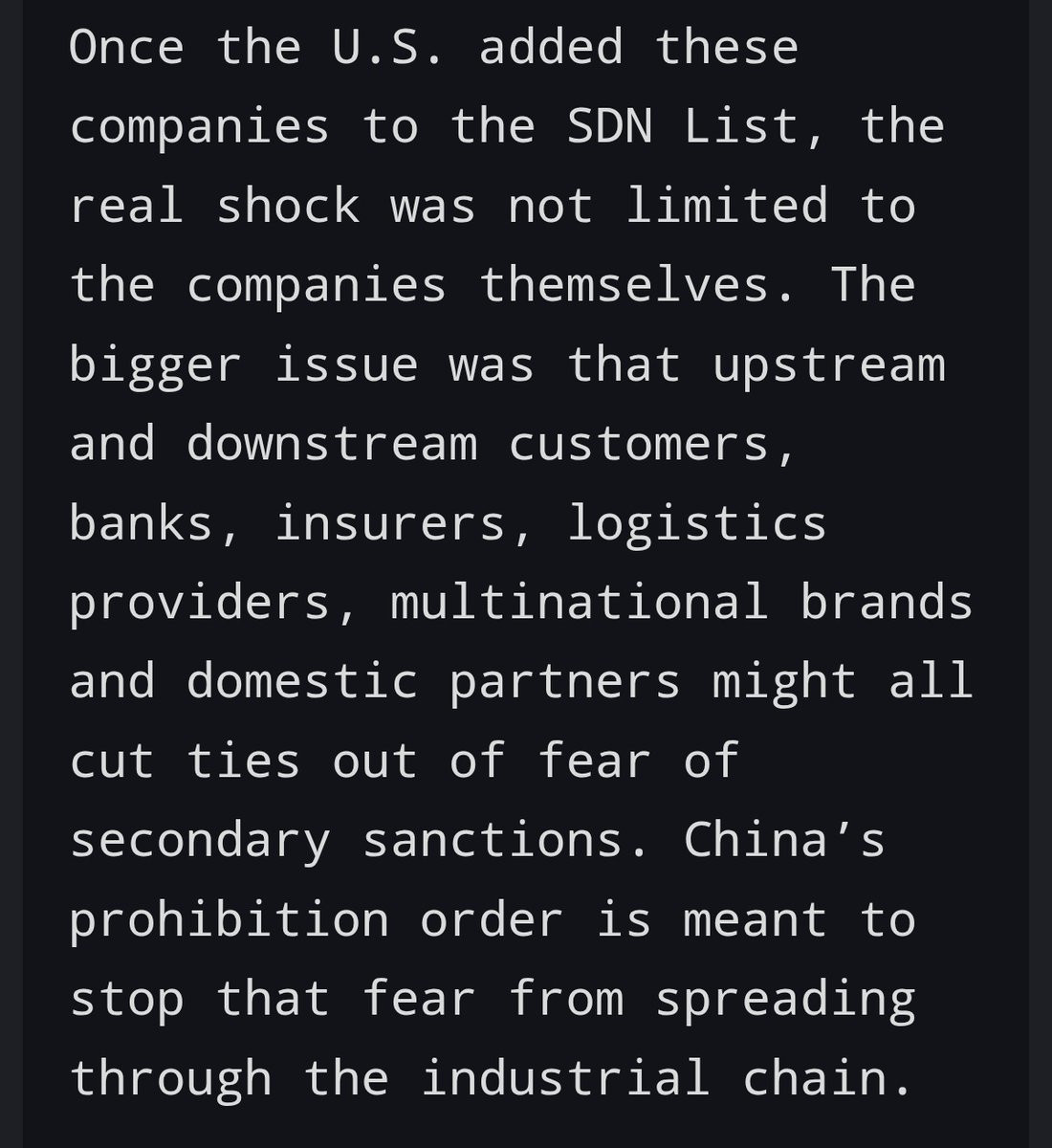
This new China regulation on sanctions is going to make CEOs and in-house counsels of companies with activity in both US and China sweat, a lot.
The complaint from China here is jurisdiction. Historically the US is the only country to effectively impose secondary sanctions (other countries inc EU and China complain about this, probably part of it is envy 😂 as only the US is powerful enough to do it).
What are secondary sanctions? A country can sanction their own companies of course, they have jurisdiction. When they sanction an international company/country, what they are doing really is to prevent their own national companies (under their jurisdiction) from trading with them.
For example, Chinese company X is sanctioned, means no US company can deal with them, the company is also effectively shut down from business in the US too. See Huawei sanctioned, google cannot do business with them, so no android no app store in Huawei phones.
But secondary sanctions extend one level further. It sanctions any international company (over which you don't have jurisdiction) from dealing with a sanctioned company/country.
For example, if Chinese Company X is sanctioned by the US, then European bank Y doing business with the Chinese company in Europe or in China or wherever, also needs to shut down all the accounts and loans to that company, because otherwise they can get sanctioned by the US, and the European bank cannot afford to lose access to US banks and USD.
What this effectively means is that a US sanction makes a company immediately a global pariah, because no other third party country/company will dare to do local business with them, even if the transactions dont touch the US.
With this new Chinese regulation, that becomes a problem. If European bank Y shuts down loans and accounts for the Chinese company, just to be safe from potential US secondary sanctions, the Chinese company can sue them for damages in China, and if the European bank has business in China, thats a problem (effectively, up until now the default option was to shut down business with the Chinese company to protect US business, now China is saying there are consequences to your China business from doing that).
Legal experts (I am not one) can opine if I got this more or less right
No other country is so effective at secondary sanctions. Imagine the EU daring to sanction a US company for doing business in a third country that is under EU sanctions. The US would be like "ayo? says who? under what rules? Nah".
I read a fantastic book on all this called "Backfire" by Agathe Demarais. Sanctions have become a go-to foreign policy tool because they are super efficient, much better than embargoes. Policy makers see sanctions as a low-cost tactic: only a handful of civil servants are needed to draft sanctions, the burden of implementing sanctions falls on
multinationals and banks, which have to hire an army of compliance officers and create systems and paperwork.
They make it so painful to comply, that just the mere scent of a possible sanction to a company or a country down road precludes global companies from investing there or establishing a relationship. Not worth it.
The book also analyses instances when sanctions fail to achieve their intended goals and have large side effects (I have a summary of the book from my kindle highlights if interested).
It really is a book about 1980s-2020s economic history, geopolitics, and financial warfare. Super interesting, and recommended it at the time for anyone sitting at the board of an MNC.
Also two screenshots here from Geopolitechs article on the subject, which is also very good.
Bob Dylan wrote an entire song commanding listeners to “like” a particular music publication, and in exchange, said publication ranked the song as the #1 best song of all time, and no one wants to call this what it is: plain bribery.
This is horrifying to read, but shout out to the police detective who listened to a homeless convicted criminal who'd been declared insane, investigated his story thoroughly, ran DNA tests, and proved the truth - that he'd been wrongfully convicted of claiming his own identity.
This may sound like a sponsored post but I promise it's not (I just hate TurboTax and their rent-seeking lobbyists with the passion of a thousand suns):
Use FreeTaxUSA instead. It's >90% cheaper than TurboTax and easier to use/higher quality software.
@RichfieldRich@EyringHB My father died from bone cancer. It was a slow and excruciating death. To try to distract him, I rang every day at the time when my sisters would change the dressings on his open wounds. I asked, 'How do you endure it'. He replied, 'My Saviour descended below all things'.
Here's how a conversation between a thoughtful Trinitarian and a thoughtful Latter-day Saint always goes:
The Trinitarian brings up the Creeds. The Latter-day Saint says "I don't accept the Creeds as authoritative because they are unscriptural and unauthorized."
The Trinitarian insists they are simply restatements of truths taught in scripture. This starts the back and forth from the Bible, mainly from the New Testament.
The Trinitarian brings a verse saying, "I and my Father are one."
The Latter-day Saint explains that "oneness" of the Godhead members doesn't necessarily imply a full Trinitarian consubstantiation. After all, Jesus also said husband and wife ought to be "one." And He prayed for His disciples to be one even as He and the Father are one. Surely that doesn't mean we all become consubstantial entities in the Trinity?
Then the Trinitarian side talks about "Hear, O Israel: The Lord our God is one."
Then the Latter-day Saint responds with "Let us create man in our own image."
Then the Trinitarian brings up "Philip, if you've seen me, you've seen the Father" and other verses.
The Latter-day Saint then brings up verses about the express likeness: "this is life eternal, that they might know thee the only true God, and Jesus Christ," the Gethsemane prayer—"not my will, but thine, be done," the baptism of Jesus, "why callest thou me good? there is none good but one, that is, God," "the Father is greater than I," and the idea that the Father knows the timing of the Second Coming but not the Son, etc.
Then the Trinitarian responds with, "Well, He's carefully crafting His words for the people and it's the Person of the Son speaking, so in a sense it's true," and brings up "Before Abraham was, I AM," indicating Jesus is the Jehovah of the Old Testament.
And the Latter-day Saint says, "Yes, we believe that, too. But that doesn't mean He is the same as the Father." Also, what of the first, second, and third-century disciples—some of whom walked with Jesus Himself—who didn't hold a Trinitarian formulation? Were they not Christian?
And they go round and round, pulling up the Greek and the Aramaic, and both come away at the end more sure of their own positions than that the other's is the correct understanding.
At the end of the day, an honest neutral observer of this discussion knows one thing: the Trinitarian theory is not self-evident from the Bible alone. As the Harper Bible Dictionary itself states, "the formal doctrine of the Trinity as it was defined by the great church councils of the fourth and fifth centuries is not to be found in the [New Testament]." There is ample room for an intelligent person to interpret the text either way, and neither is proven correct.
The best a Trinitarian or Latter-day Saint can say about the Bible is "my position is evident to me."
But through all this back and forth, the Latter-day Saint has been debating with one hand tied behind his back. Because although we love the Bible and accept it as the word of God, we are not reliant only on the Bible. We believe God has given additional clarification on the ambiguity of His inspired but imperfectly translated earlier words in the Holy Bible.
God the Father and Jesus Christ appeared to Joseph Smith. And just as they appeared to the martyr Stephen, they appeared as two distinct Personages, with Jesus standing on the right hand of God. Then in the Book of Mormon and subsequent revelations, Jesus explicitly and directly set forth His nature, removing all ambiguity. And these truths are confirmed to us by personal revelation from God Himself.
This is not a contradiction of the Bible, just a contradiction of the Creedalist understanding of the Bible. We respect our Catholic and Protestant brothers and sisters who read the Bible through a different lens and understand the verses differently than us. Even though their understanding is opposed to what we believe is substantiated in Holy Scripture, we recognize their efforts to follow the Savior to the best of their ability and wouldn't dare call them un-Christian for what we see as a mistaken view.
And we respectfully ask others recognize the Bible is not self-evident on these matters and grant us the same grace we extend to them.
This is sad. I know as a politician these companies are going to spend a billion dollars against me for saying it but 🤷🏽♀️
Pervasive gambling is not good for society. It turns life into a casino, traps people in addiction & debt, surges domestic violence, and fosters manipulation.
This is wild.
143 million people thought they were catching Pokémon. They were actually building one of the largest real-world visual datasets in AI history.
Niantic just disclosed that photos and AR scans collected through Pokémon Go have produced a dataset of over 30 billion real-world images. The company is now using that data to power visual navigation AI for delivery robots.
Players didn't just walk around with their phones. They scanned landmarks, storefronts, parks, and sidewalks from every angle, at every time of day, in lighting and weather conditions that staged photography would never capture. They documented the physical world at a scale no mapping company with a fleet of vehicles could have replicated on the same timeline or budget.
Niantic collected this systematically, data point by data point, across eight years, while users thought the only thing at stake was catching a rare Charizard.
The most valuable AI training datasets in the world aren't being assembled in data centers. They're being built by people who have no idea they're building them.
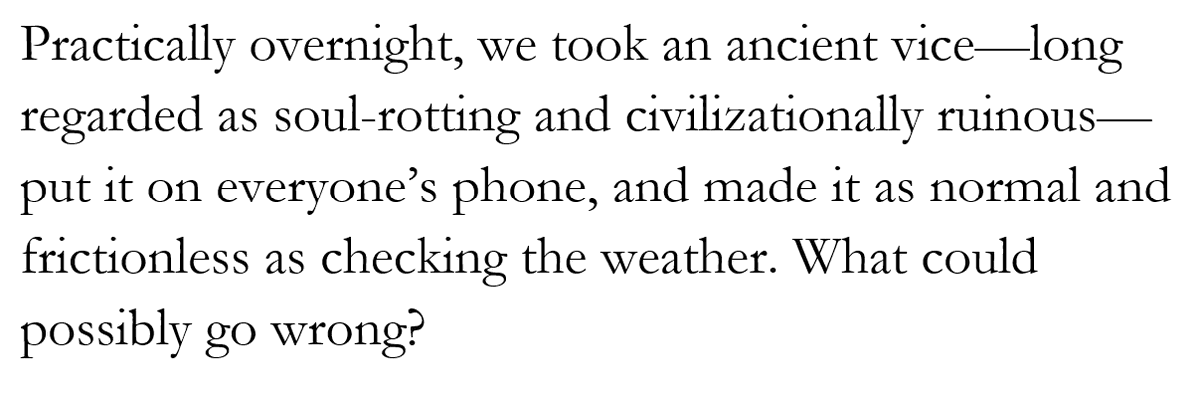
The Atlantic has a sobering, first-person look at the ramifications of legalized online sports betting. Here are a few of the more telling passages.
1/5




![ITalkOfChrist's tweet photo. Here's how a conversation between a thoughtful Trinitarian and a thoughtful Latter-day Saint always goes:
The Trinitarian brings up the Creeds. The Latter-day Saint says "I don't accept the Creeds as authoritative because they are unscriptural and unauthorized."
The Trinitarian insists they are simply restatements of truths taught in scripture. This starts the back and forth from the Bible, mainly from the New Testament.
The Trinitarian brings a verse saying, "I and my Father are one."
The Latter-day Saint explains that "oneness" of the Godhead members doesn't necessarily imply a full Trinitarian consubstantiation. After all, Jesus also said husband and wife ought to be "one." And He prayed for His disciples to be one even as He and the Father are one. Surely that doesn't mean we all become consubstantial entities in the Trinity?
Then the Trinitarian side talks about "Hear, O Israel: The Lord our God is one."
Then the Latter-day Saint responds with "Let us create man in our own image."
Then the Trinitarian brings up "Philip, if you've seen me, you've seen the Father" and other verses.
The Latter-day Saint then brings up verses about the express likeness: "this is life eternal, that they might know thee the only true God, and Jesus Christ," the Gethsemane prayer—"not my will, but thine, be done," the baptism of Jesus, "why callest thou me good? there is none good but one, that is, God," "the Father is greater than I," and the idea that the Father knows the timing of the Second Coming but not the Son, etc.
Then the Trinitarian responds with, "Well, He's carefully crafting His words for the people and it's the Person of the Son speaking, so in a sense it's true," and brings up "Before Abraham was, I AM," indicating Jesus is the Jehovah of the Old Testament.
And the Latter-day Saint says, "Yes, we believe that, too. But that doesn't mean He is the same as the Father." Also, what of the first, second, and third-century disciples—some of whom walked with Jesus Himself—who didn't hold a Trinitarian formulation? Were they not Christian?
And they go round and round, pulling up the Greek and the Aramaic, and both come away at the end more sure of their own positions than that the other's is the correct understanding.
At the end of the day, an honest neutral observer of this discussion knows one thing: the Trinitarian theory is not self-evident from the Bible alone. As the Harper Bible Dictionary itself states, "the formal doctrine of the Trinity as it was defined by the great church councils of the fourth and fifth centuries is not to be found in the [New Testament]." There is ample room for an intelligent person to interpret the text either way, and neither is proven correct.
The best a Trinitarian or Latter-day Saint can say about the Bible is "my position is evident to me."
But through all this back and forth, the Latter-day Saint has been debating with one hand tied behind his back. Because although we love the Bible and accept it as the word of God, we are not reliant only on the Bible. We believe God has given additional clarification on the ambiguity of His inspired but imperfectly translated earlier words in the Holy Bible.
God the Father and Jesus Christ appeared to Joseph Smith. And just as they appeared to the martyr Stephen, they appeared as two distinct Personages, with Jesus standing on the right hand of God. Then in the Book of Mormon and subsequent revelations, Jesus explicitly and directly set forth His nature, removing all ambiguity. And these truths are confirmed to us by personal revelation from God Himself.
This is not a contradiction of the Bible, just a contradiction of the Creedalist understanding of the Bible. We respect our Catholic and Protestant brothers and sisters who read the Bible through a different lens and understand the verses differently than us. Even though their understanding is opposed to what we believe is substantiated in Holy Scripture, we recognize their efforts to follow the Savior to the best of their ability and wouldn't dare call them un-Christian for what we see as a mistaken view.
And we respectfully ask others recognize the Bible is not self-evident on these matters and grant us the same grace we extend to them.](https://pbs.twimg.com/media/HEoK0ViaUAATTF_.jpg)