@ABridgen Manchester airport has about 200,000 aircraft movements annually, so ballpark 550 flights per 24hrs, roughly 23 an hour. Big engines, and the non-CO2 effects (water vapour/ice crystals, soot etc) are greater than the CO2 in terms of climate change.
It’s probably worth saying at this point something I’ve said before, lest it gets lost in the sands of time and political rhetoric about immigration and illegal entry, and how we got to this point.
I was an immigration officer in the 1970s and 1980s. The power to grant or refuse leave to enter was vested to me in law under the authority of a Chief Immigration Officer. Anyone arriving without a valid passport (and a visa if required) was refused entry at the border, detained, and removed on the next available ship or aircraft whence they came. This was under the Immigration Act 1971 (still
In force although amended massively by successive governments ever since). It was some 20 - 30 years after the 1951 ECHR and the 1951 Refugee Convention was signed.
Nobody claimed asylum. Nobody claimed human rights. No country refused to take people back. Those who had destroyed their passports were removed on a letter, signed by me.
Fast forward 50 years and now anyone who arrives at the border without a passport or a visa automatically claims asylum or human rights. Immigration Officers of today (or Border Force Officers) are thereby disempowered to send them back before their asylum claims or human rights claims are considered. And their appeals are dismissed. They cannot be detained in the meantime because under the Hardial Singh principles immigration detention is only lawful if there is a realistic prospect of removal within a reasonable period of time. Which there isn’t of course. So the only option available to the officer is to grant temporary permission whilst these applications are considered. And if the applicant claims to be destitute they must be given support and accommodation at public expense. Because failure to do so would put the government in breach of A3 of the ECHR (inhuman and degrading treatment). And even if the applicant is eventually refused protection - and loses their appeal - we need to get a passport to remove them on. And they often refuse to comply with the documentation process. Even if they do many countries still refuse to issue them with a passport and refuse to take them back. And even after all this they can abscond and if ever caught start the whole process again.
This is where we are and so far no government has been able to break the Gordian knot that ties the hands of our officers. In order to do that they would have to reverse decades of laws and judgements - and demur from long held well intentioned international conventions. And probably look at the British Constitution itself to curtail the opportunity of political opponents to use the courts to thwart the will of Parliament.
This is not to criticise or favour any political party or policy. It is simply a matter of record to inform the next generation of politicians and the civil servants charged with the duty of implementing any new laws or policies they may introduce.
And to ask why - if we did it back in my day - why can’t we do it now?
I even wrote a book about it. I hope someone keeps a copy for posterity - or even history - when thinking about how to fix this seemingly intractable problem.
https://t.co/EJ4WPWXCzK
🇬🇧 The UK Ministry of Defence has launched an emergency security response after discovering that Chinese-made cameras on the Royal Navy’s K3 Scout drones were secretly transmitting data to an IP address in China.
The 27-foot, £12 million uncrewed vessels are used by Royal Marines and special forces. Cyber assessments found the cameras sending unauthorized “heartbeat” signals.
The MoD has cut all internet connectivity from the cameras and says there is no evidence sensitive data was compromised.
After years of austerity and real wage cuts UK child poverty rate is higher than in most European countries.
Poverty, poor food, housing, healthcare, insecurity, anxiety triggers irreversible premature ageing.
What future?
https://t.co/k3iaLRYz7a
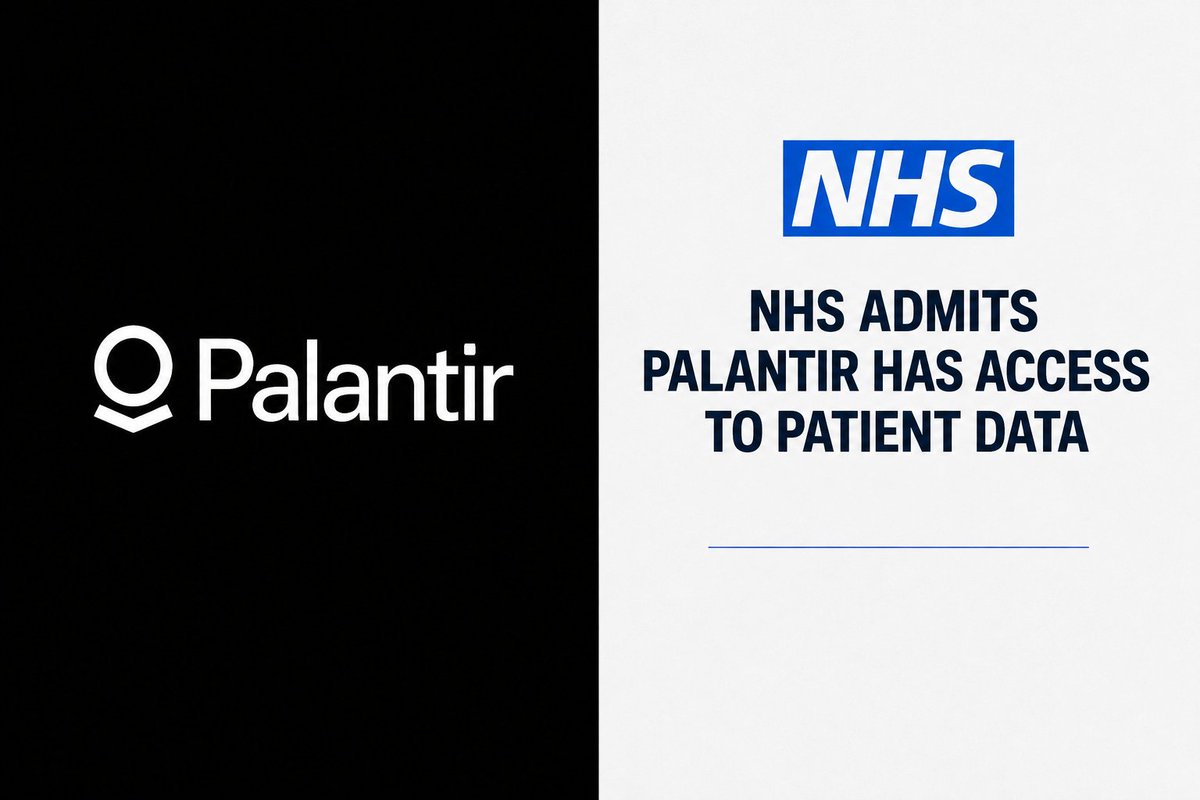
NHS England didn’t tell the truth about who can see patients’ medical records, and it has now admitted that Palantir engineers have had full admin access to identifiable patient data all this time.
NHS’ legal document said only NHS staff could see them. When I called them out for not telling the truth, a few senior people who work for NHS and Palantir told me I was wrong.
3 Palantir engineers hold admin access to the National Data Integration Tenant, the system holding those records before names are stripped out. 33 more engineers from other suppliers have narrower access.
I called this out because Palantir's software requires full access to customer data. No organization can work with Palantir while keeping its data private. Data sovereignty doesn't exist when a supplier runs the core systems storing and interpreting that data. A system can't interpret data without full access to it.
NHS now says supplier access to identifiable data is technically necessary. That would have been decided when the system is designed, not afterwards, so it was necessary from the first day. NHS designed the system and then published a document saying the access doesn’t happen.
Tom Bartlett built the NHS tenant. He published a defence of the access, and I replied straight away.
He compared admin access to holding the keys to a warehouse of sealed boxes. But his own diagram shows a part of the system where the records sit with the names still on them. The boxes are already open where Palantir engineers work.
He also said the data is pseudonymised. Pseudonymisation swaps names for codes. Anyone holding the list that matches the codes to the names swaps them back. And the tenant holds the data before the codes are applied.
He said the access is audited, but audit logs show misuse after it has happened and the people who run the logs hold the admin access. He relied on a diagram from a design document that nobody outside NHS and its suppliers has checked against the running system, and neither he nor NHS has said what the admin role permits. He then wrote that you can’t build a national data integration platform “without seeing the data that flows through it”, which is the thing he was arguing against.
Dr Nicola Byrne, the National Data Guardian, had to write and ask before NHS admitted all of this. Her office says it can’t independently check NHS claim that the access is necessary.
NHS England lied about who could see your medical records.
The document was there to tell you exactly that. It left out the 3 Palantir engineers who held admin access to the records of tens of millions of people. NHS England calls it an error and apologises for the confusion. I don’t believe them. They knew.
Everything else NHS has said about this rests on the word of people who didn’t tell the truth from the start. We should take anything they save from this point forward with a pinch of salt because they haven’t been truthful with the most important information. You could possibly imagine when it comes to the personal identify information attached to the most sensitive information that people could have exposed.
Norman Jackson climbed out of a Lancaster bomber onto the wing, in the freezing slipstream, four miles above Germany, to put out an engine fire with a hand extinguisher while the aircraft flew on through the night. It is one of the most physically unbelievable acts of courage in the history of the air war, and the fact that he survived it at all is a miracle.
Jackson was a flight engineer, and by April 1944 he had already finished his tour of 30 missions. He did not have to fly again. But his crew still had sorties to complete, and he would not let them go without him, so he volunteered for one more, a raid on Schweinfurt. On the way home a German night fighter tore into them, ripped open the wing, and set the fuel tank ablaze. A wing fire on a bomber full of fuel meant the aircraft would explode within minutes. Everyone aboard knew it.
Jackson, already wounded by shell splinters, did the only thing that might save them. He got a fire extinguisher, strapped on his parachute, and had his crewmates feed the rip cord out slowly so his canopy would billow behind him as an anchor. Then he pushed himself out through the hatch into a 200 mile an hour wind and hauled himself out onto the wing of the flying bomber, in the dark, at 20,000 feet, and started fighting the fire by hand.
He nearly did it. He got the extinguisher onto the flames and had the fire coming under control. Then the night fighter swung back for another pass and raked the aircraft again. Jackson was hit in the legs, the fire flared back up and burned his hands and face, and he was swept off the wing into the night. His parachute, already burned by the fire, streamed out only partly open and smouldering.
And he lived. He fell four miles with a half-burned parachute and hit the ground with a broken ankle, a shattered leg, and terrible burns, but alive. The Germans found him and he spent ten months in hospital before a POW camp, from which he later escaped. His own crew, who bailed out and assumed he was dead, survived to tell what he had done, and that is the only reason the story is known.
They gave Norman Jackson the Victoria Cross. He climbed onto the wing of a burning aircraft in flight to save his friends, and then fell out of the sky on fire, and got up and walked away from it.
Peter Sharples, chief executive of the Veterans Institute, says he has been contacted by hundreds of affected veterans, with some chased for £20,000 to £30,000.
A group is now preparing a legal challenge against Pat McFadden as Work and Pensions Secretary, arguing the policy breaches the Armed Forces Covenant.
This bastard Pat McFadden has committed an egregious act.
He has docked veterans’ benefits in a stealth raid on military pensions.
Former serviceman are being ordered to repay thousands of pounds because the Department for Work and Pensions classifies their military pension as “unearned income.”
It’s absolutely disgusting that migrants receive so many freebies when we can’t even see to the security of our own servicemen.
Why does Labour hate our armed forces?
Strip away the theatre and Reform UK is a billionaire-backed project to dismantle the public realm, shred regulatory protections and hand what remains of state power to capital.
It’s plain to see – just follow the money.
Farage accepted a £5 million “gift” from a Thailand-based crypto billionaire, then went on to champion a light-touch approach to cryptocurrency regulation.
It’s clear we need a stronger firewall around our democracy.
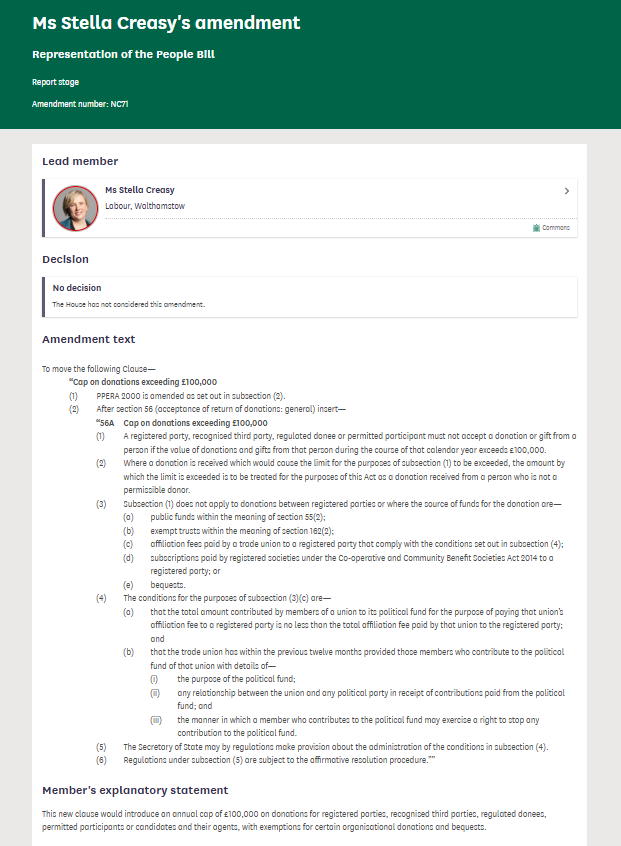
That’s why I’ve backed @stellacreasy's amendment to the Representation of the People Bill to cap political donations at £100,000.
This would be a vital safeguard against billionaire capture of our politics and a important step towards rebuilding trust in our democracy.
MEET THE BARRISTER THE POST OFFICE FEARS
Here's a name that deserves to trend more than half the people who actually do. Sam Stein KC.
While the @PostOffice was busy ruining ordinary people's lives over money that was never actually missing, Stein was in a courtroom taking it apart piece by piece.
He represents most of the subpostmasters at the Post Office Horizon Inquiry @PostOffInquiry, instructed by Howe and Co @HoweAndCo, on behalf of the people the Post Office tried to bury.
In 2021 he stood in the Court of Appeal representing a group of subpostmasters, instructed by Howe and Co @HoweAndCo, in the same case that finally cleared Jo Hamilton @JoHamil73963257 and dozens of others after years of wrongful convictions.
He told the judges the Post Office's refusal to investigate its own broken Horizon system, built by Fujitsu @fujitsu_uk, was the longest running affront to British justice in living memory. The judges agreed and quashed the convictions.
Then the public inquiry started and Stein really got going.
He told the inquiry the Post Office had turned itself into "the nation's most untrustworthy brand." A blunt summary, backed by 2.2 million pages of evidence.
He described former Post Office lawyer Mandy Talbot as "the Post Office's very own evil robot" after she was asked repeatedly who had directed a legal strategy built to silence a subpostmaster and kept saying she couldn't remember. Convenient amnesia. Goes around a lot in this organisation.
He summed up a whole phase of hearings by calling the parade of witnesses "a rogues' gallery." Executives who forgot everything except how to protect themselves.
Questioning executive Angela van den Bogerd about the Post Office's own helpline, he told her she had been "intimidating and bullying" toward subpostmistress Jennifer O'Dell, who kept calling to say she hadn't stolen a penny. She was telling the truth. Nobody listened for years.
In his closing submission for phase 2, he told the inquiry to work out whether the entire scandal was a "cock-up or cook-up." By phase 3 he had his answer. Cook-up, no doubt about it. He said the Post Office spent that entire phase dodging its own failures and instead "turned its tank turret gun on Fujitsu."
Subpostmasters called the organisation that prosecuted them "the abuser." Questioning former minister Pat McFadden about it, Stein got that word onto the official record, permanently.
In his final closing statement, Stein made the point that mattered most. This was never really a problem with a computer. It was a problem with people, and people paid the price. He said what actually drove the scandal was "cruelty, callousness and connivance," and that people are still living with the consequences.
He also named former CEO Paula Vennells, executive Angela van den Bogerd and in-house lawyer Jarnail Singh as part of a rogues' gallery remembered for lies and incompetence, and pointed out £37 million received by the Post Office is still unaccounted for. Nobody's chasing it.
Urgency always disappears when it's the institution's own money at stake.
He also said the external law firm Cartwright King failed subpostmasters, because by the time its lawyers were brought in, they had become company men.
Stein also pushed the inquiry to recommend actual restorative justice. Counselling for postmasters and their families. Bursaries for children whose education was wrecked. A permanent memorial. Reputations rebuilt in the small communities where they were destroyed.
Volume 1 of the final report landed in July 2025. The rest keeps slipping. Current estimate is September 2026, and even that looks optimistic. A criminal investigation into the Post Office is on hold waiting for it.
People keep dying while they wait to be believed.
The Post Office spent two decades hoping this would quietly disappear. Sam Stein KC made sure it never got the chance.
SOURCES @ComputerWeekly@lawsocgazette@BBCNews and many others.
All humans could disappear, in fact will eventually disappear, and the planet will still get 10C hotter because of the existing GHGs in the air. Most warming materialises on a century timescale and then warming is very slow over centuries and millennia. The temperature will finally plateau for around 10,000 years before, extremely slowly, starting to cool. The last time this planet was that hot, it took 55 million years to cool down.
POST OFFICE BANKRUPTED A MAN FOR ASKING FOR HELP 91 TIMES
Lee Castleton spent 9 years in the RAF, then worked as a stockbroker in the City. In 2003 he and his wife decided they wanted a slower life for their two young kids. They sold their home and bought a small Post Office branch in Bridlington, on the seafront.
Within a year the dream job turned into a nightmare. His accounts started showing losses that made no sense. So he did the responsible thing and called the Horizon helpline. Then he called it again. And again. 91 times in 12 weeks, begging someone to explain where the money was going.
Nobody could tell him. The Post Office's answer to being told 91 times that their own system was broken was to audit him, suspend him, and demand he pay back 25,000 pounds he never touched.
Castleton had no money left for a lawyer so he represented himself in the High Court, alone, against an organisation with a government sized legal budget. He lost. The Post Office then chased him for 321,000 pounds in legal costs and bankrupted him.
That is the reward for reporting a fault 91 times. Bankruptcy.
The fallout went well beyond the shop. His kids were bullied at school. His daughter was spat at because people in town assumed her dad was a thief. His wife's health suffered under the strain. All because a computer system got the maths wrong and nobody at the top wanted to admit it.
In 2019 Castleton was one of over 550 former postmasters who won a group settlement of 58 million pounds. He personally received 20,000 pounds, a rounding error next to what the case cost him. He was even locked out of a mediation scheme the Post Office ran for people who believed they had been wrongly pursued.
Years later former Post Office chief executive Paula Vennells told the Horizon IT Inquiry under oath that Castleton's treatment was unforgivable. She also said she had likely signed off on the 300,000 pound bill that ruined him. Unforgivable is one word for it. There are others.
Castleton is now suing the @PostOffice and @fujitsu_uk for up to 8 million pounds, arguing the original 2007 judgment against him was obtained by fraud. In May 2026 the Court of Appeal ruled his case should be heard as one trial instead of being split into pieces designed to bury it in cost and delay. A small win. Nearly two decades late.
He wanted a quieter life running a post office by the sea. Instead he became one of the clearest examples of what happens when an institution would rather bankrupt an innocent man than admit its software was broken.
Sources @BBCNews@lawsocgazette@ComputerWeekly and others
It's astonishing how many climate scientists believe the IPCC/fossil fuel propaganda that greenhouse gas emissions increase global warming pretty much in real time. This is absolutely, categorically absurd. It's the staggering amounts of GHGs already in the atmosphere that drive climate change. There are massive delays in the responses of climate feedbacks to the direct warming effect of GHGs. Eventually the GHGs in today's atmosphere will produce a 10C hotter planet after fast and slow feedbacks have operated and the planet has restored its energy equilibrium (as much energy radiated as absorbed) as required by physics. That's right, this planet is at 1.5C of a journey to 10C, predetermined by the GHGs in the air we're breathing. Regularly quoted climate sensitivity of 3C to 5C is a red herring as this doesn't include slow feedbacks, a fact which always seems to be omitted. And slow feedbacks are not slow in the Anthropocene. GHGs added to the atmosphere today won't begin to have an effect until the second half of the century. In stark contrast, cuts in particulate air pollution, which acts as a sunshade, have immediate, powerful and persistent effects.
Bordeaux, France, has now recorded more days above 40°C in 2026 alone than during the entire 105-year period from 1920 (when observations began) to 2025. This is deeply shocking.
Privatisation dividend.
Royal Mail to hike price of bulk service by a third.
Big blow to the NHS and large organisations.
Other customers ripped off. 1st class postage price £1.80, 2nd class 91p. When privatized in 2013: 1st class 60p; 2nd class 50p.
https://t.co/npYem7tjSZ
Alarm at NHS England as patient records put under control of US private equity firm TPG via a takeover.
Business model is profiteering, not care for patients.
Regulatory/Govt silence on expansion of private equity.
Public money fuelling PE growth.
https://t.co/ot8TYs5jxd