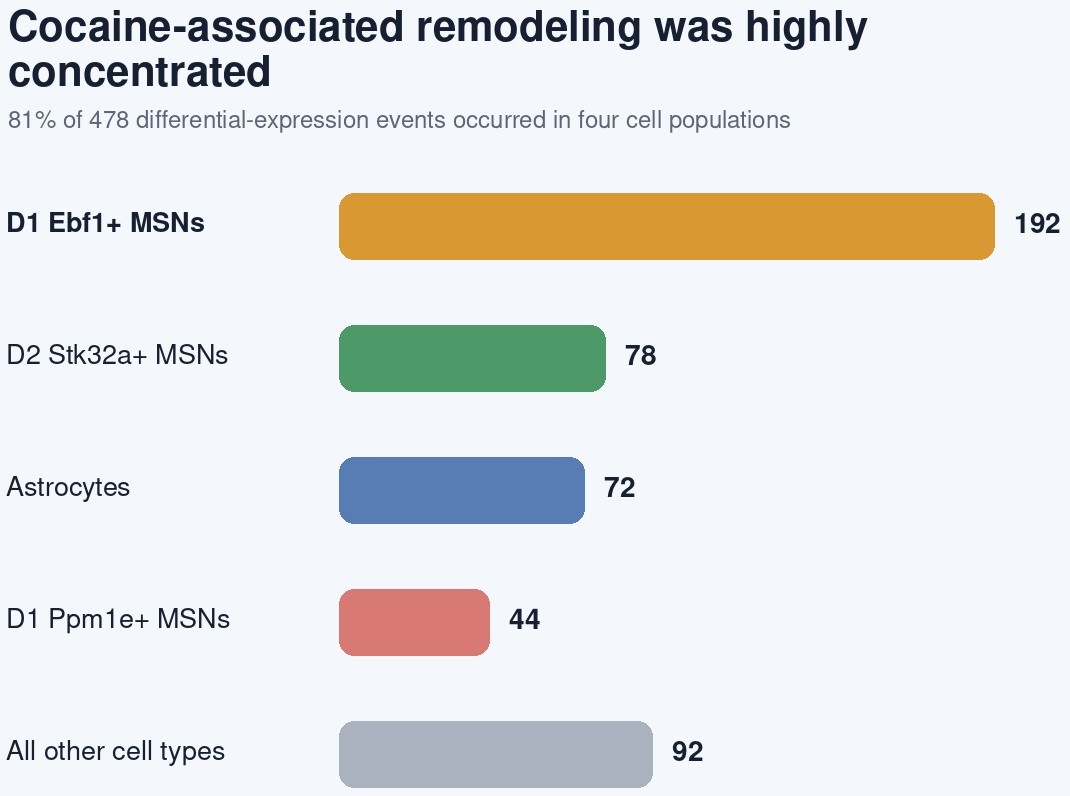
TLDR, cocaine self-administration was associated with parallel, cell type-specific NAc programs that prioritize MSN subtypes and astrocytes for mechanistic and manipulation studies.
Team effort with Heath Schmidt, @RickCrist6, @snchehimi, Riley Merkel, et al.
The response extended beyond D1 Ebf1+ cells. D2 Stk32a+ and D1 Ppm1e+ MSNs carried substantial, largely distinct DEG programs. This moves us beyond a simple D1-vs-D2 framework and points to both matrix- and striosome-associated populations.
Importantly, "activated" and "transcriptionally active" were not equivalent. D1 Ebf1+ MSNs and astrocytes showed both, oligodendrocytes showed an IEG increase without large DEG burden, while D2 Stk32a+ and D1 Ppm1e+ MSNs showed the opposite.
D1 Ebf1+ MSN stood out with ~40% of all differential-expression events, higher immediate-early gene scores, and the strongest transcription-factor and microRNA-target enrichment.
New preprint from our team! What happens across the nucleus accumbens (NAc) when rats voluntarily take cocaine?
Using snRNA-seq, we find that the response is not uniform and it concentrates in discrete medium spiny neuron subtypes and astrocytes.
https://t.co/ZopVdB4nKq
Here, male and female rats self-administered IV cocaine for 10 days, with yoked controls receiving matched infusions of saline. Animals were sacrificed immediately after the final session, allowing us to examine immediate early gene and broader transcriptional programs.
Why this matters: cocaine use disorder still has no FDA-approved medication. The NAc is central to reinforcement and drug seeking and prior transcriptomics efforts used bulk sequencing that averaged effects across neuronal and non-neuronal populations.
I'm really proud to be a part of such an outstanding scientific achievement by four amazing scientific teams, and greatful to @FlyBottleEscape for spearheading this effort.
🧠⚡️💊New @Nature publication !
Mimicking opioid analgesia in cortical pain circuits
We built a brain-behavior framework to decode spontaneous chronic pain in mice—and to biologically mimic morphine with a synthetic opioid gene therapy
https://t.co/YqvBzdEqEL
@PennMedicine
🧠⚡️💊New @Nature publication !
Mimicking opioid analgesia in cortical pain circuits
We built a brain-behavior framework to decode spontaneous chronic pain in mice—and to biologically mimic morphine with a synthetic opioid gene therapy
https://t.co/YqvBzdEqEL
@PennMedicine
Hot off the @Nature press! A-SOiD behavior library developed specifically for pain studies quantifies a new chemogenetic gene therapy that targets opioid circuit in ACC without addictive properties
@FlyBottleEscape@CmuScience@cmuneurosci
https://t.co/81jphkV5dk
I'm at @nanopore London Calling 2025. Tune into the Epitranscriptomics session and Single Cell workflow session to see two talks about our exciting use of #PromethION sequencing for psychiatric disease and substance abuse research.
An outstanding discussion of potential term economic outcomes through the lense dollar valuation, debt financing, and fiscal expenditure. Really worth the hour.
What Must Be Done To Prevent @DOGE From Failing
@42Macro founder and CEO joined FFTT founder and president @LukeGromen to discuss their latest thoughts on the US’ fiscal crisis, what must be done to fix it, and how the various scenarios are likely to impact investor portfolios.
People close to @elonmusk and @VivekGRamaswamy will be doing a great service to America if they get them to watch this video.
We have had our @nanopore P2solo instruments for one year and have been able to generate volumes of exciting data. Tomorrow, I'll be describing our long read single cell work looking at preclinical depression treatment models.
Today we are attending the @10xGenomics Philly user group meeting. The new/upcoming assays offer exciting advances in #singlecell, especially in the isoform resolved space.