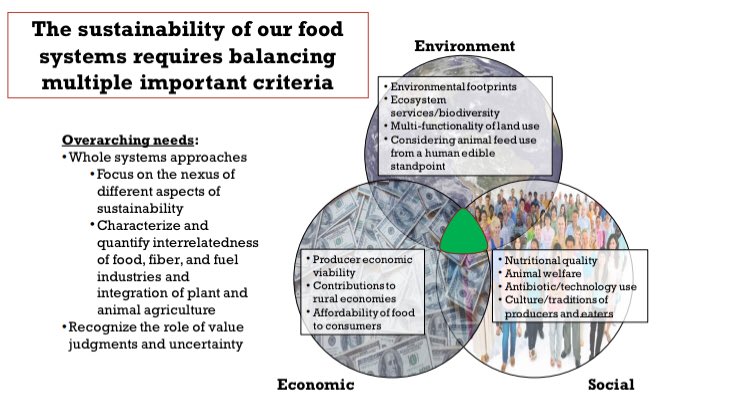
“Sustainable food” discussions nearly always get boiled down to environmental footprints, which is just one piece of environmental sustainability. When will we move beyond comparing footprints (e.g. #GHG/kcal) as a proxy for sustainability?
Welcome home Reid, Victor, Christina, and Jeremy! 🫶
The Artemis II astronauts have splashed down at 8:07pm ET (0007 UTC April 11), bringing their historic 10-day mission around the Moon to an end.
Brazil surpassed the US as the world's leading beef producer last year, driven by higher-than-expected output and strong export demand, which helped ease global supply shortages and limit a surge in meat prices https://t.co/jenFOLB99A
Sunrise on the research feedyard. Collecting individual cattle feed intake, growth performance, & gas flux on 250 head investigating if different doses of supplemental fat in the diet affect cattle growth performance and methane emissions.
Are we sure that level of socioeconomic impact & potential ecological impact (what happens to the grazinglands?) is worth “saving” 92 Mt of CO2e or 1% of US GHG emissions? We need better metrics & assessments of the food system to avoid simplistic solutions that ignore tradeoffs
Paper examining the “carbon footprint” of meat consumption in US cities. Total estimated footprint is 329 Mt of CO2e, which is around 5.2% of US gross GHG emissions in 2022.
https://t.co/Yp6BBHR9U3
One of the “demand side” measures is cutting beef consumption in half and switch that consumption to chicken. The only way this cuts emissions is if there are are fewer cattle & likely farms, ranches, feedlots, & people who have livelihoods supported by cattle
New episode! 🚨
We sat down with @drsplace, a leading voice in beef sustainability, to talk about progress happening across industry. From innovation on the ground to science guiding real climate solutions, this is a CLEAR Conversation you can't miss. 👇
https://t.co/HmA8ye3pkz
Interesting new pre-print: "Overall, our findings do not support the hypothesis that expanding plant-based meat analogues offerings alone can meaningfully shift consumer choices away from meat"
https://t.co/oEqRZNDEPR
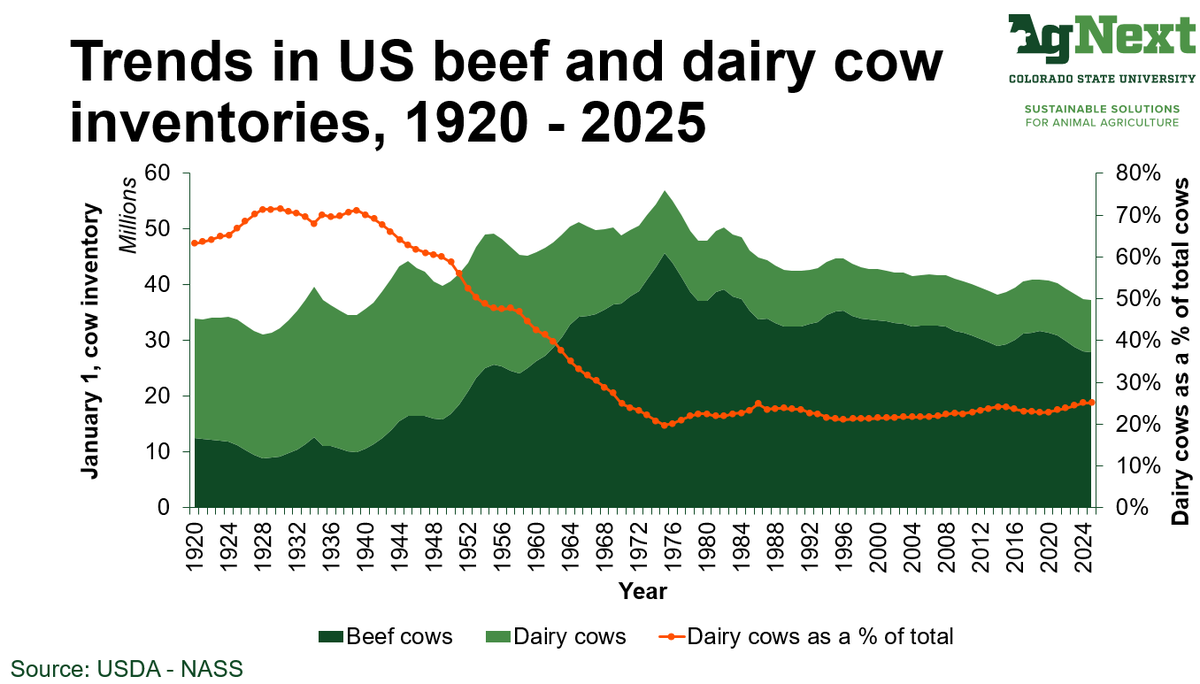
Number of beef & dairy cows in the US since 1920. Since the peak in 1975, the US has 19.7 million fewer cows in 2025. As dairy cows as a % of total have grown in the past two decades, their contribution to the beef supply has become more important
Register today for the next Dairy Publication Roundtable Series session! Join Dr. Manriquez for a discussion on “Preventing Farmworker Heat Stress and Related Health Risks in Dairy Operations.”
🗓️ Thursday, July 24 | 12:00 p.m. MST
🔗 Register: https://t.co/raYik7fFDf
New on the AgNext Podcast: @DrSPlace joins @DrKimStackhouse and @PedroCattle to talk about methane fact sheets developed with @coagriculture1. These tools help stakeholders better understand methane in livestock production.
🎧 Listen now: https://t.co/PLS3fkOyVJ
🎙️ Episode 1 is LIVE!
Why is eating well so hard – even when we want to?
Neuroscientist @sguyenet breaks down:
🏪 Why our food environment outpaced our biology
🧠 How certain foods hijack our brains
💊 What the data shows about Ozempic & GLP-1 drugs
Apple: https://t.co/uiovMPl6N7
Spotify: https://t.co/728D3lhmlO
On July 8th my colleagues and I discussed “The Essential Societal Role of Livestock, Today and Tomorrow” for the Livestock Symposium at the 2025 Meeting of the American & Canadian Societies of Animal Science in Hollywood, FL.
The presentations were recorded and videos are now available.