We welcome the Constitutional Court for striking down several provisions of the Computer Misuse (Amendment) Act, 2022, upholding fundamental constitutional freedoms.
As the internet remains central to participation, journalism, and public discourse, this decision reinforces the need for clear and constitutionally sound laws on online expression.
A win for Uganda!
Here is our detailed statement: https://t.co/8HTiJCAWYx
A High Court custody ruling issued on 4 February 2026 reproduced the full names and full NINs of a 12-year-old child, the full names and full NINs of both parents, and detailed birth-registration information, including certificate and registration details, place and date of issuance, and the issuing registration officer. All in a public judgment. Deeply troubling for child privacy and data protection. ⚖️
This case shows why pseudonymity is no longer optional. Justice does not require permanent digital exposure of a child’s identity. Protect children. Use initials or pseudonyms. 🔐⚖️
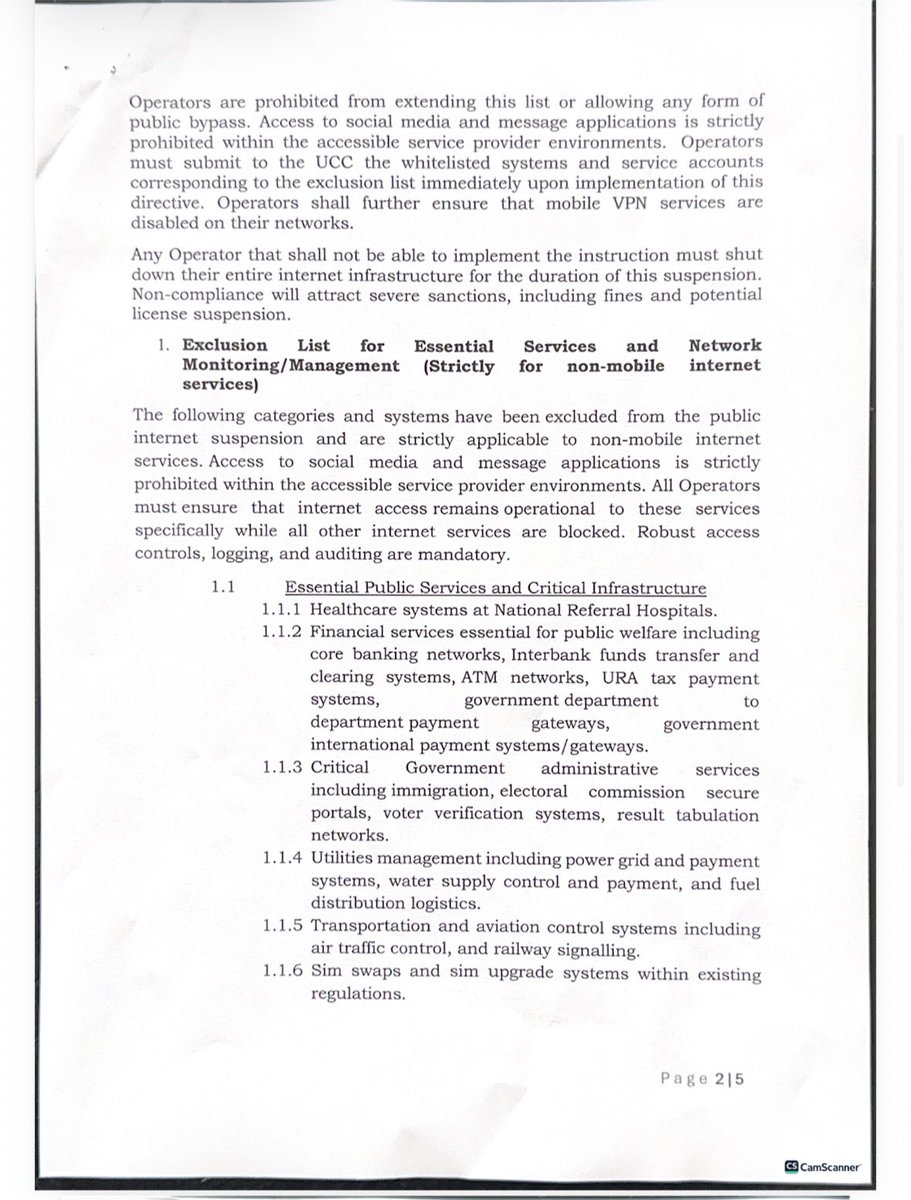
Under the prevailing circumstances, using ordinary consumer VPNs on the MTN network is unlikely to work. The reason is straightforward: within its network, MTN is enforcing regulatory compliance measures that actively block VPN traffic.
How is this done?
If I were a network engineer tasked with implementing such controls, I would consider three primary approaches:
1. Deep Packet Inspection (DPI)
This is the most common and effective method. Ordinarily, routers only examine packet headers, mainly the destination address. DPI, however, allows core-network equipment to inspect packet metadata and traffic patterns. Even when payloads are encrypted, VPN protocols often have identifiable signatures that DPI systems can detect and block.
2. Port Blocking
VPNs typically communicate over well-known ports. By blocking or throttling traffic on these ports, an operator can disable many VPN connections with minimal effort.
3. IP Blacklisting
ISPs can block traffic to IP addresses associated with known VPN servers. Popular providers such as NordVPN or ExpressVPN operate from a finite pool of server IPs. These lists are commercially available and can be integrated into network firewalls to block all outbound traffic to those destinations.
Verdict
Conventional VPN applications such as Thunder VPN, SuperVPN, and similar services are unlikely to function reliably under these conditions.
What would I suggest if I were engineering around such a network?
If one were experimenting with network logic rather than consumer VPNs, the following options are more resilient:
1. V2Ray / v2rayNG (the “gold standard” for hard blocks)
V2Ray is not a VPN service but a highly flexible proxy framework designed to evade sophisticated censorship systems, including the Great Firewall of China. It supports traffic obfuscation and protocol camouflage, making it difficult for DPI systems to reliably detect. MTN’s core network, which is heavily influenced by Chinese vendor technology, likely employs similar inspection techniques.
2. Shadowsocks / ShadowsocksR (SSR)
Originally developed to bypass censorship, Shadowsocks is a lightweight SOCKS5 proxy that focuses on remaining inconspicuous to DPI systems. It avoids many of the telltale signatures that standard VPNs expose. On Android, the official Shadowsocks app is available via the Play Store.
3. Psiphon (the “old reliable”)
Psiphon is purpose-built for censored environments. Rather than relying on a single protocol, it dynamically cycles through multiple methods such as SSH tunneling and HTTP proxies until it finds a viable path through the ISP’s firewall.
4. Proton VPN (Stealth Protocol)
Proton VPN is one of the few mainstream VPN providers offering a dedicated “Stealth” protocol. This mode disguises VPN traffic as ordinary HTTPS traffic, making it significantly harder for DPI systems to identify and block.
5. Surfshark (NoBorders Mode)
Surfshark includes a NoBorders mode that automatically activates when network restrictions are detected. It directs users to servers optimized for operation in restricted or censored environments.
6. Avoid default mobile DNS resolvers
Sometimes blocking occurs at the DNS level through redirects or poisoned responses. Avoid relying on the DNS servers automatically assigned by the 4G/5G network. Instead, configure a private DNS provider such as:
https://t.co/n3vpvcl8NO or https://t.co/BXGW4FeShk
This can bypass basic DNS-based blocking mechanisms.
Conclusion
Empirical evidence spreads quickly. Over time, it becomes clear which techniques are effective and which are not. Broad traffic blocking, in particular, is counterproductive. It consumes disproportionate network resources, increases rule complexity, degrades efficiency, and ultimately harms overall network performance. In large-scale, complex networks, restraint is a virtue. The fewer blunt interventions imposed through blocking, the more resilient, scalable, and efficient the system becomes.
📢 Statement: CIPESA Condemns Ongoing Internet Disruption in #Uganda 🇺🇬
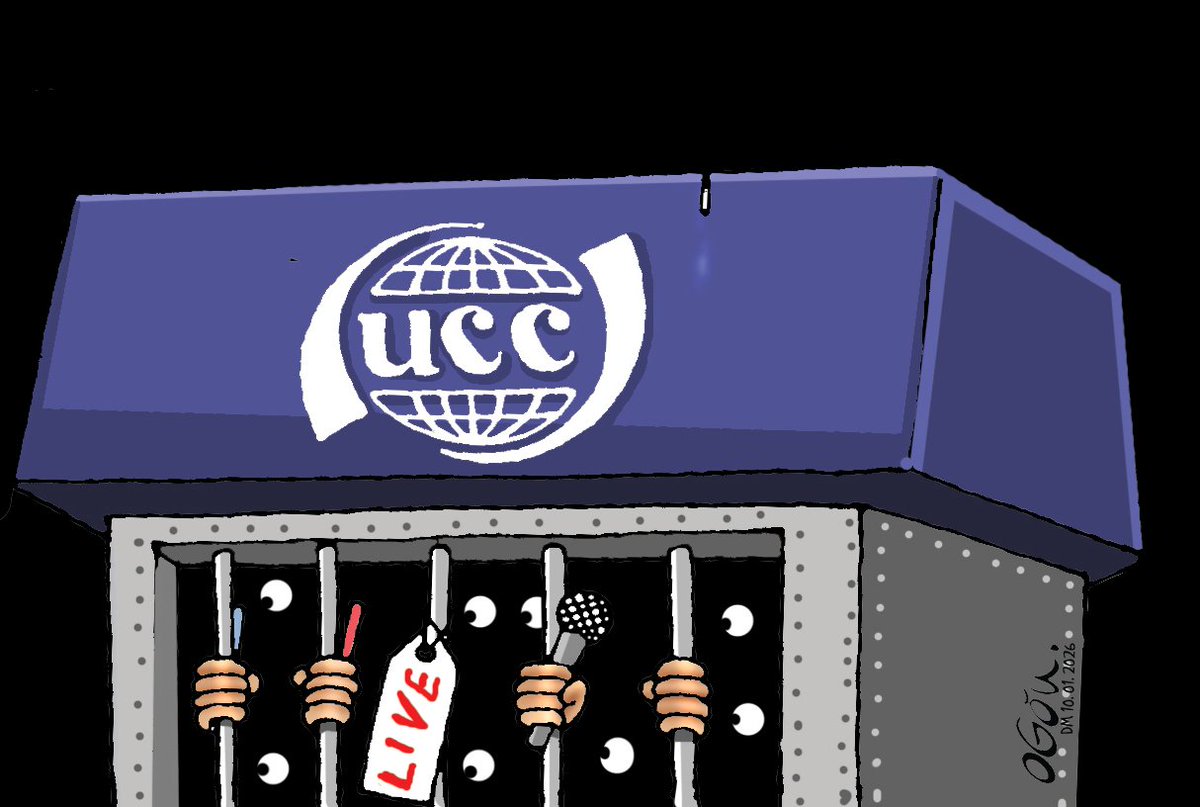
We urge the Government of Uganda to immediately restore full access to social media platforms, blocked websites, and mobile money services. We further call upon the Government of Uganda to cease and desist from ordering internet throttling and blockages, which unjustifiably deny citizens the right to express themselves and to access, share, and disseminate information.
Internet disruptions further limit the public’s ability to conduct business, access public services, participate in community and civic affairs, socialise, and maintain contact with friends, family, and associates.
CIPESA also urges the Government of Uganda to immediately cease attacks against journalists and media workers, particularly those from independent media houses and journalists who are critical of government actions. These violations, which have been widely documented by national and international actors, including the United Nations, undermine media freedom and the public’s right to access information, especially during electoral periods.
#KeepItOn
#InternetFreedomAfrica
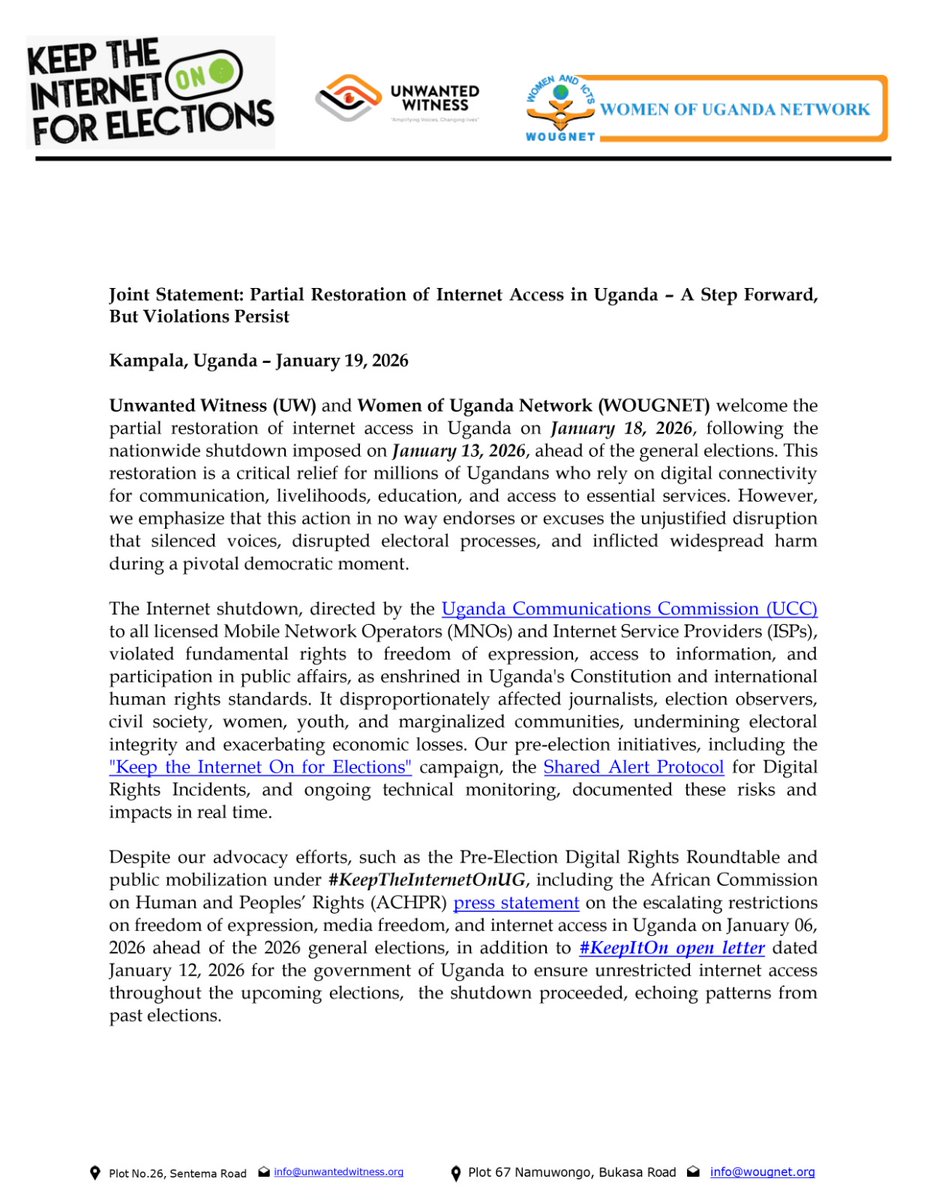
𝐏𝐚𝐫𝐭𝐢𝐚𝐥 𝐫𝐞𝐬𝐭𝐨𝐫𝐚𝐭𝐢𝐨𝐧 𝐢𝐬 𝐧𝐨𝐭 𝐚𝐜𝐜𝐨𝐮𝐧𝐭𝐚𝐛𝐢𝐥𝐢𝐭𝐲.
Our Joint Statement with @wougnet sets the record straight: internet shutdowns violate rights, undermine elections, and demand reform.
Read more here: https://t.co/OHzLfZE868
As expected, the Uganda Communications Commission (UCC) has confirmed that access to internet and mobile services will be shutdown starting from 13/01/2026
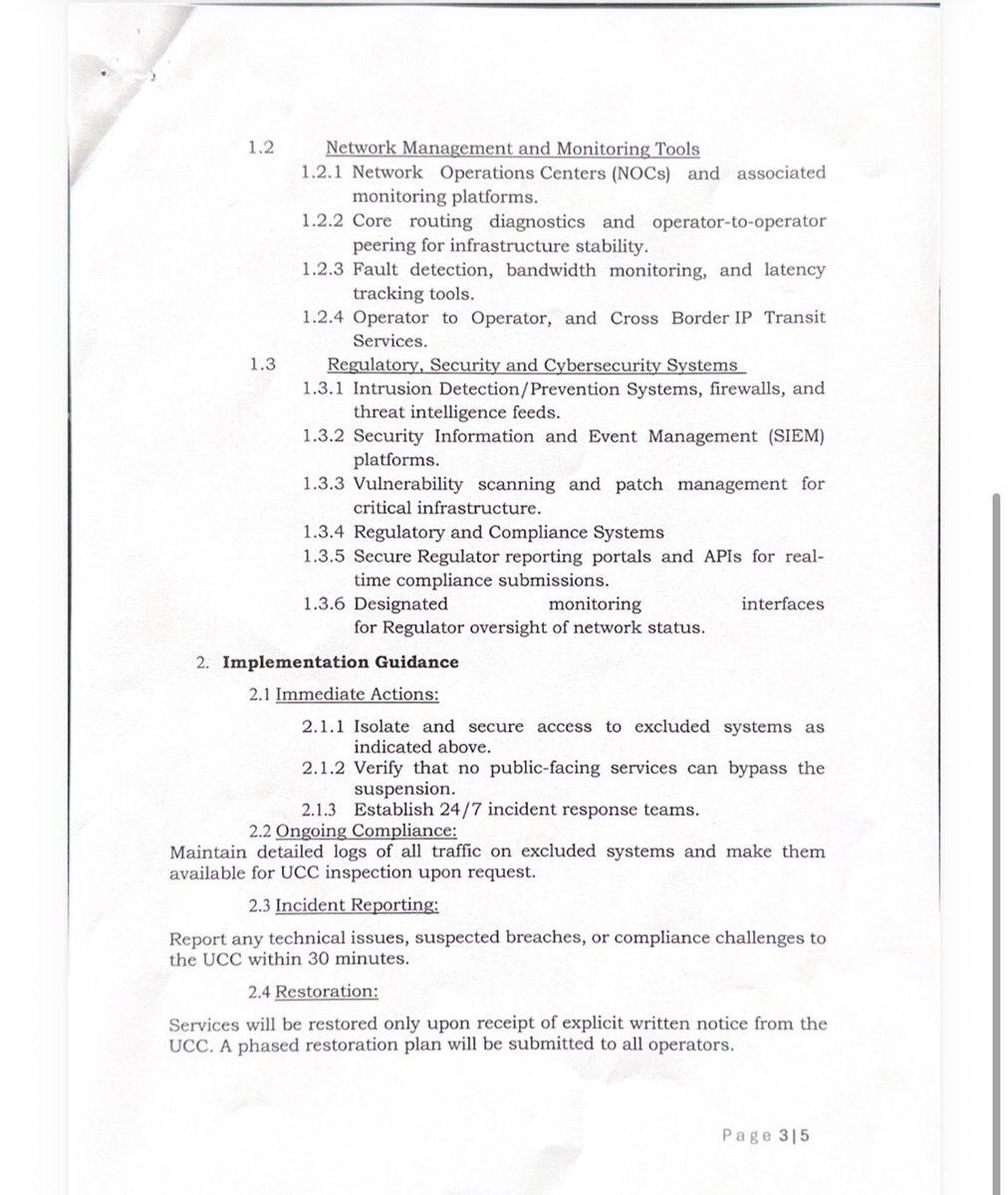
JUST IN: The Uganda Communications Commission has ordered a temporary shutdown of public internet access and selected mobile services from 6:00pm on January 13, 2026, during the election period.
The directive affects public internet access, SIM card sales and registration, and outbound data roaming, with exemptions granted to essential services such as healthcare, banking, and government systems.
Details 👇
#NBSUpdates
Following a formal request from @UgandaEC, @UCC_Official directed telecom operators & ISPs to restrict access in Uganda to an unauthorised online platform that was providing voter-related information without requisite approval.
@UCC_ED@ConsumerUCC
Why UCC has banned livestreaming election results
Nyombi said unofficial tally centres, premature announcements, or broadcasting unverified results are unlawful. The Commission is closely monitoring broadcast and online activities, and violations will attract appropriate penalties, including suspension or revocation of licences, and prosecution where applicable
DETAILS👉 https://t.co/bPzdHCXIgE
#VisionUpdates
🟦SPECIAL REPORT
🟥License to Watch: How Uganda’s digital number plates became spy tools
✳️A Russian Company, a Chinese Network, and Uganda's Surveillance State
*⃣ Via @GenKatusiime In partnership with @pulitzercenter
https://t.co/7TwcNvZ1IN🟥 License
Govt may block Internet during 2026 elections – minister
“We will not allow anyone to disrupt peace. Do you know that Uganda is the most stable country in East and Central Africa?”
https://t.co/Q62nOsM9Pc
#MonitorUpdates
📣 Visa applicants, take note!
Starting now, if you’re applying for a student visa (F, M, or J category visa), make sure your social media accounts are set to public. This helps with the identity and admissibility checks required by U.S. law.
🚫 Not including this info could result in a visa denial or make you ineligible for future visas.
📝 Be honest, double check your application, and make sure everything is accurate before submitting!
More info here: https://t.co/eyxCMHC6eG
A new report reveals that the State security agencies are constantly prying into the private lives of Ugandans ahead of the 2026 General Elections.
#MonitorUpdates https://t.co/BBJub8z03p