1. Open models are not “inherently” decelerationist. They don’t impact capex because ultimately someone needs to provide exact same compute. Growth of compute and therefore capex remains unchanged, if not increased even more.
2. Open models are not AI communism. You can imagine many open model providers compete for hyperscaler compute and hosting just like closed models do.
3. It is not true that open models cannot make money. In fact they can make more money than closed models by offloading capex risks to hyperscalers and take 20-30% cut in revenues. Hyperscalers can value add customizations and become resellers of models targeting specific customers. It’s same model as Windows and OEMs.
If anything, open models makes market more fairer, accelerates competition even more by building on each other and allows people to run deeper benchmarks to understand true behaviors and performance.
Oh look someone who works for OpenAI telling you that
- AI is so dangerous! How can you let anyone but us handle it!
- Anyone who lets other people use it basically just doesn’t understand tech. They dumb boomers. We smart tho. Never mind their regulations actually show a highly specific and nuanced understanding of tech.
- open models will just mean communist dystopia where no one makes any money! Because you know, there is nothing else besides weights in the AI ecosystem. You open that and it’s GG humanity. No sir, if you are going to go broke, it should only be by using our models
- manipulatively use metaphors like “Chinese lab let an infinitely dangerous AI escape” to link back to COVID and stuff oh yeah we see what you’re doing, that’s a good one, be careful what fears you stoke and don’t be surprised when the public asks to slow down development
Oh wait you’ll just blame that on Chinese misinformation anyways, perfect plan, well done
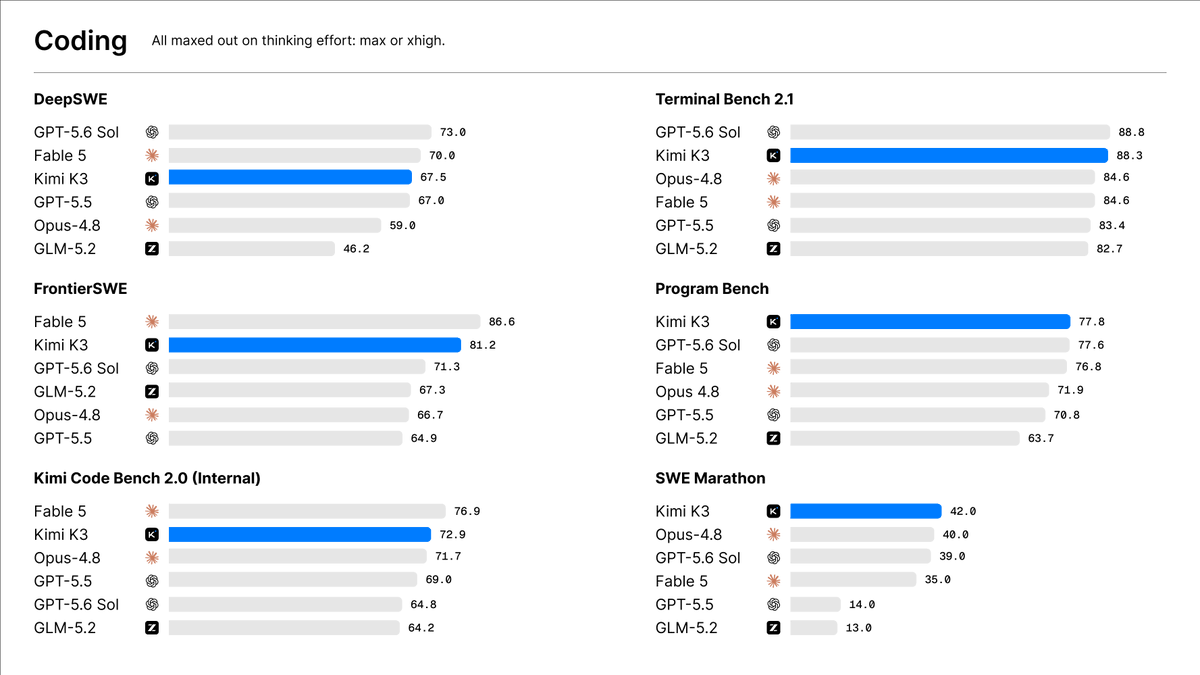
Introducing Kimi K3: Open Frontier Intelligence
🔹 2.8 Trillion Parameters, 1 Million Context, Native Multimodal
🔹 Kimi Delta Attention enables up to 6.3x faster decoding in million-token contexts
🔹 Attention Residuals deliver ~25% higher training efficiency at <2% additional cost
🔹 Built for long-horizon agentic coding and self-evolving workflows
Kimi K3 is now live on on https://t.co/zrk6zZxZUo, Kimi Work, Kimi Code, and the Kimi API.
Open Weights by July 27, 2026.
🔗 API: https://t.co/XCrgjXAqMw
🔗 Tech blog: https://t.co/YTfiMSNM1f
Foreign Anthropic employees were supposed to lose access to Mythos 5 while export controls were levied. But it’s widely believed that these employees could still access “Mythos 5.1”: an even better model only available to employees.
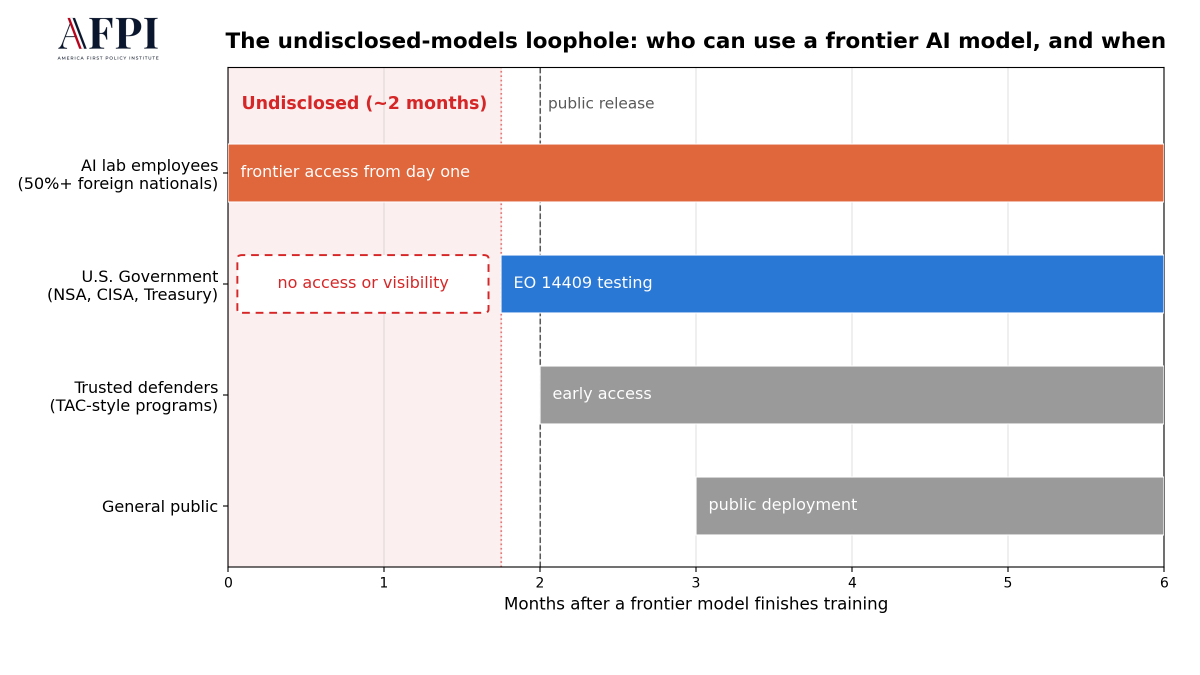
There’s an undisclosed-models loophole. Our new piece for @A1Policy shows how the government might not gain access or knowledge of new capabilities quickly enough. Existing frameworks do not cover models unless they are soon-to-be-deployed. But keeping the best models internal-only for months is standard practice in the industry. There are four problems with this:
1) Lack of visibility. Cyber capabilities at the level of Mythos are already “must-haves” for agencies like NSA. It’s insane to believe that companies could be allowed to keep Mythos++ capabilities secret from USG.
2) Theft risk. Our adversaries want to steal top AI models and secrets. If the best models are secret from USG, an adversary could steal that model and instantly gain cyber, bio, and other capabilities MORE advanced than the best available to USG.
3) Use by insider threats. Our prior research has shown that probably over half of top AI company employees are unvetted foreign nationals. They could misuse highly capable internal models or distribute their secrets to our adversaries.
4) They’re hard to define. Company-only models change every day as they are trained and updated. This makes it hard for our policy tools, like export controls and the testing framework, to cover them.
Ilya Sutskever’s company Safe Superintelligence, for example, is widely believed to have near-frontier capabilities but completely skirts policies intended to manage cyber proliferation because it doesn’t publicly deploy models.
We offer policy options to close the loophole. The key update we need is for reporting, export controls, and USG access to start not when models are planned for deployment, but when models cross the capability thresholds outlined in the AI-cyber EO’s classified benchmarking process.
it’s so funny that “evil oppressive china” is just releasing open source frontier models
while the “land of the free” is single-handedly dictating one by one exactly who gets to use our frontier models