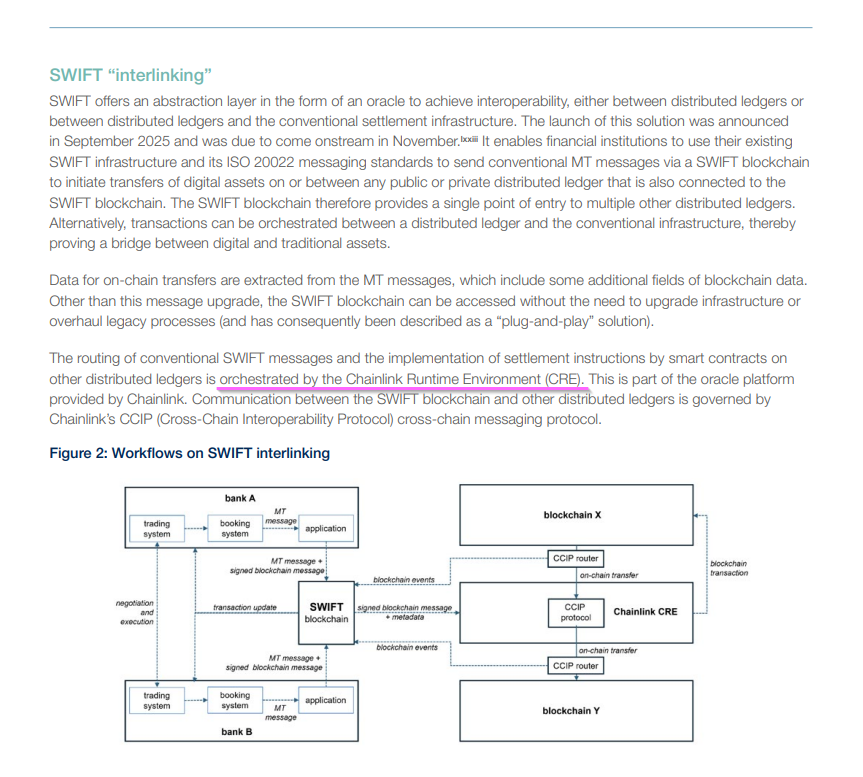
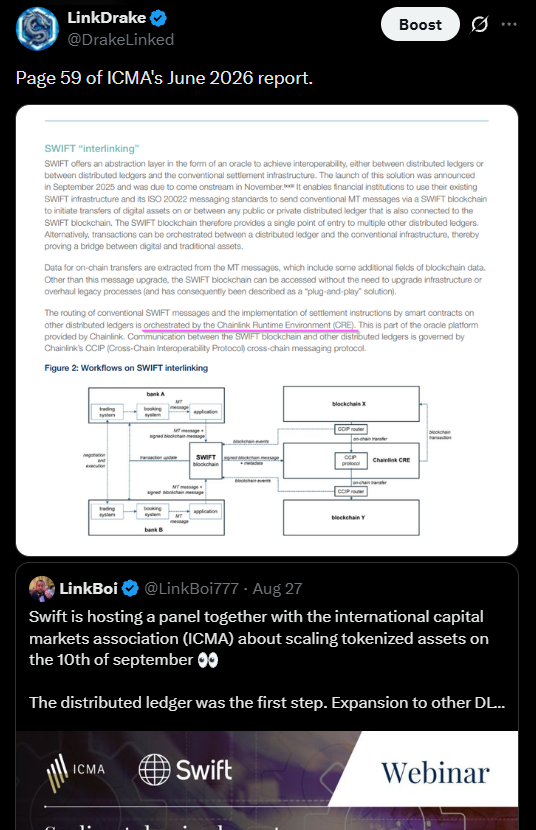
Swift is hosting a panel together with the international capital markets association (ICMA) about scaling tokenized assets on the 10th of september 👀
The distributed ledger was the first step. Expansion to other DLT usecases is the next one and @chainlink will be the one powering this!
🚨🚨🚨 Chainlink CRE fees may be much higher than we initially estimated 🚨🚨🚨
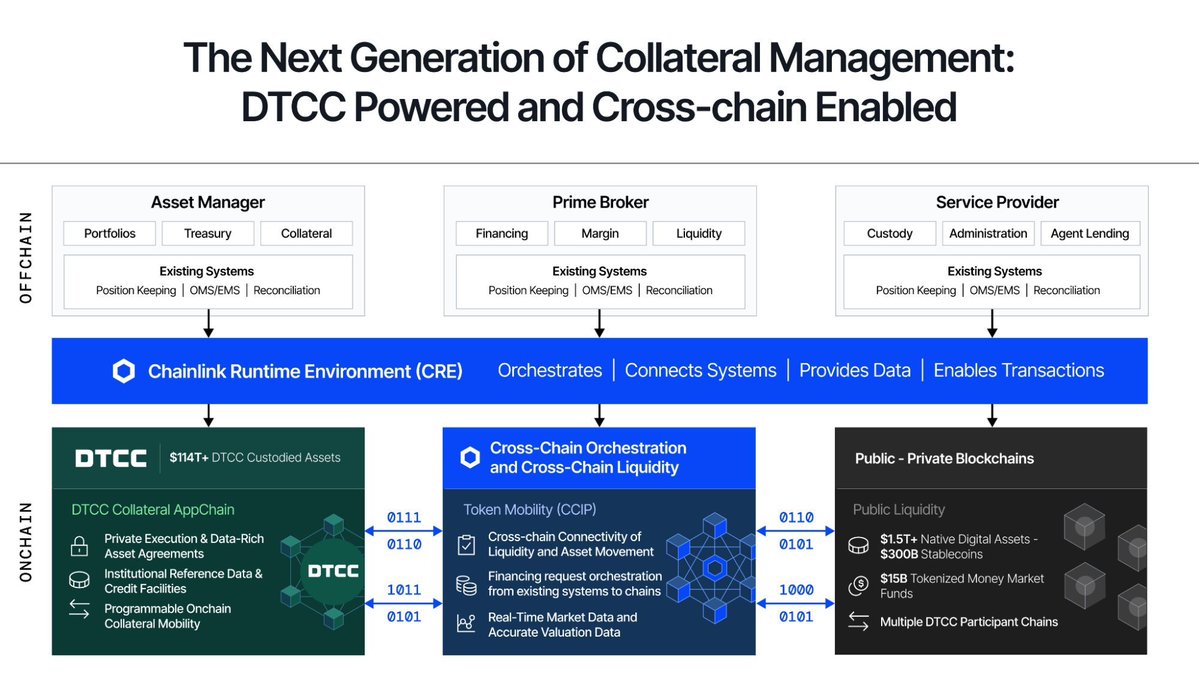
👀 We were assuming that there's only 1 orchestration fee in this DTCC transaction, but it looks like there's actually 4 separate orchestration fees, plus a CCIP fee too 👀
𝐓𝐡𝐚𝐭'𝐬 𝟓 𝐬𝐞𝐩𝐚𝐫𝐚𝐭𝐞 𝐟𝐞𝐞𝐬 𝐩𝐚𝐢𝐝 𝐢𝐧 𝐋𝐈𝐍𝐊 𝐢𝐧 𝐭𝐡𝐢𝐬 𝐨𝐧𝐞 𝐭𝐫𝐚𝐧𝐬𝐚𝐜𝐭𝐢𝐨𝐧. 🔥🔥🔥
The CRE orchestration fee isn't charged once per transaction. It's charged on every workflow step a user signs (see attached images - blurry because they're screenshots from the live demo).
In the DTCC demo at Sibos, every wallet signature shows "Orchestration fee 0.01 LINK":
13:30 Create financing contract
14:48 Deposit $10m tUSD
17:22 Request $5m loan against MSFT
29:44 Repay loan
That's 4 separate Orchestration fees, paid in LINK.
On top of that there's a separate CCIP fee (20:15) for bridging the collateral to the DTCC AppChain.
Repo + securities lending is $20T+ a day.
Even a tiny share, with multiple LINK fees per transaction, adds up fast.
The scaling is clear: more steps in a workflow means more fees.
$LINK
𝗧𝗵𝗶𝘀 𝗶𝘀 𝘄𝗵𝗮𝘁 𝘁𝘂𝗿𝗻𝗶𝗻𝗴 𝗖𝗵𝗮𝗶𝗻𝗹𝗶𝗻𝗸 𝗖𝗥𝗘 𝗶𝗻𝘁𝗼 𝗮 𝗿𝗲𝘃𝗲𝗻𝘂𝗲 𝗲𝗻𝗴𝗶𝗻𝗲 𝗹𝗼𝗼𝗸𝘀 𝗹𝗶𝗸𝗲.
Chainlink's CRE billing code has taken a big step toward production.
PR #23858 meters every CRE workflow run by compute time, in milliseconds. It's moved out of draft and is now marked "Verified on Staging."
Staging is the final dress rehearsal where the real thing gets tested before it ships. Nodes are already producing these usage receipts and Chainlink's billing pipeline is receiving them.
And alongside it, the team is building tools to audit the bill itself, deliberately feeding in bad usage data to prove the system catches it.
You don't build audit tooling for something you never plan to send to production.
The funniest part: every node records your usage independently and the bill is the median. Even your invoice is decentralized. Chainlink are even putting the bill through consensus. 😂
And as we saw from the Fulcrum x DTCC demo at Sibos, these CRE workflow fees (orchestration fees) are paid in LINK.
ethereum:0x514910771af9ca656af840dff83e8264ecf986ca
@nullpackets The FOMO is going to be insane, because once the green candles make the news real for people, they are going to panic and wonder if the Link Marines are right about everything (we are).
the launch of the DTCC Tokenization Service before the Collateral Management system has to do with distribution. got to get the assets to be traded tradable first.
its like when the dealer shuffles the deck and deals to all the players. And then If you need more money at the casino once trading starts - the House (The DTCC Collateral Management System) will be there to hook you up with a Chainlink Fusion powered loan.
Payable in $LINK
The asymmetric opportunity is closing. At least you wont be able to say you didnt know.👍
𝗧𝗵𝗶𝘀 𝗶𝘀 𝘄𝗵𝗮𝘁 𝘁𝘂𝗿𝗻𝗶𝗻𝗴 𝗖𝗵𝗮𝗶𝗻𝗹𝗶𝗻𝗸 𝗖𝗥𝗘 𝗶𝗻𝘁𝗼 𝗮 𝗿𝗲𝘃𝗲𝗻𝘂𝗲 𝗲𝗻𝗴𝗶𝗻𝗲 𝗹𝗼𝗼𝗸𝘀 𝗹𝗶𝗸𝗲.
Chainlink's CRE billing code has taken a big step toward production.
PR #23858 meters every CRE workflow run by compute time, in milliseconds. It's moved out of draft and is now marked "Verified on Staging."
Staging is the final dress rehearsal where the real thing gets tested before it ships. Nodes are already producing these usage receipts and Chainlink's billing pipeline is receiving them.
And alongside it, the team is building tools to audit the bill itself, deliberately feeding in bad usage data to prove the system catches it.
You don't build audit tooling for something you never plan to send to production.
The funniest part: every node records your usage independently and the bill is the median. Even your invoice is decentralized. Chainlink are even putting the bill through consensus. 😂
And as we saw from the Fulcrum x DTCC demo at Sibos, these CRE workflow fees (orchestration fees) are paid in LINK.
ethereum:0x514910771af9ca656af840dff83e8264ecf986ca
🚨🚨🚨 Chainlink CRE fees may be much higher than we initially estimated 🚨🚨🚨
👀 We were assuming that there's only 1 orchestration fee in this DTCC transaction, but it looks like there's actually 4 separate orchestration fees, plus a CCIP fee too 👀
𝐓𝐡𝐚𝐭'𝐬 𝟓 𝐬𝐞𝐩𝐚𝐫𝐚𝐭𝐞 𝐟𝐞𝐞𝐬 𝐩𝐚𝐢𝐝 𝐢𝐧 𝐋𝐈𝐍𝐊 𝐢𝐧 𝐭𝐡𝐢𝐬 𝐨𝐧𝐞 𝐭𝐫𝐚𝐧𝐬𝐚𝐜𝐭𝐢𝐨𝐧. 🔥🔥🔥
The CRE orchestration fee isn't charged once per transaction. It's charged on every workflow step a user signs (see attached images - blurry because they're screenshots from the live demo).
In the DTCC demo at Sibos, every wallet signature shows "Orchestration fee 0.01 LINK":
13:30 Create financing contract
14:48 Deposit $10m tUSD
17:22 Request $5m loan against MSFT
29:44 Repay loan
That's 4 separate Orchestration fees, paid in LINK.
On top of that there's a separate CCIP fee (20:15) for bridging the collateral to the DTCC AppChain.
Repo + securities lending is $20T+ a day.
Even a tiny share, with multiple LINK fees per transaction, adds up fast.
The scaling is clear: more steps in a workflow means more fees.
$LINK
This stuff shows that Chainlink's revenue will be directly proportional to the amount of CRE usage, because it's embedded into the code, and it strongly looks like it's billed in LINK.
So not only is the token built into CRE, but there's a clear path to more and more revenue over time as institutions adopt CRE, as workflows grow in number, and as workflows contain more steps and contain more complex computations.
Because it looks certain that there'll be massive usage of CRE, we can also assume that revenue will grow significantly.
If revenue grows significantly, we can probably assume that the weekly buyback amounts will also grow.
As the total value secured by node operators increases, the need for more and more LINK to be staked too over time, to keep cryptoeconomic incentives aligned over time.
Then you've got the ETFs which are accumulating more and more LINK over time (e.g. Grayscale).
From the speculative point of view alone, LINK will likely reprice. Most people are still clueless what Chainlink even is, nevermind that it'll be acting as the central abstraction and orchestration layer for countless institutions and protocols, not a specific L1.
Now couple that with demonstrable revenue numbers. They're hiring an "Institutional Relations Lead" whose job it will be to talk about protocol revenue, revenue models, staking mechanics, etc.. (see attached post).
There's multiple reasons that point towards Chainlink reaching critical mass, not only in terms of the protocol development and the wave of adoption that we're on the verge of, but in terms of how that is reflected in the token price too
just my opinion, but in terms of what's most likely, it points towards the token going a lot higher
https://t.co/JLqew4lKew
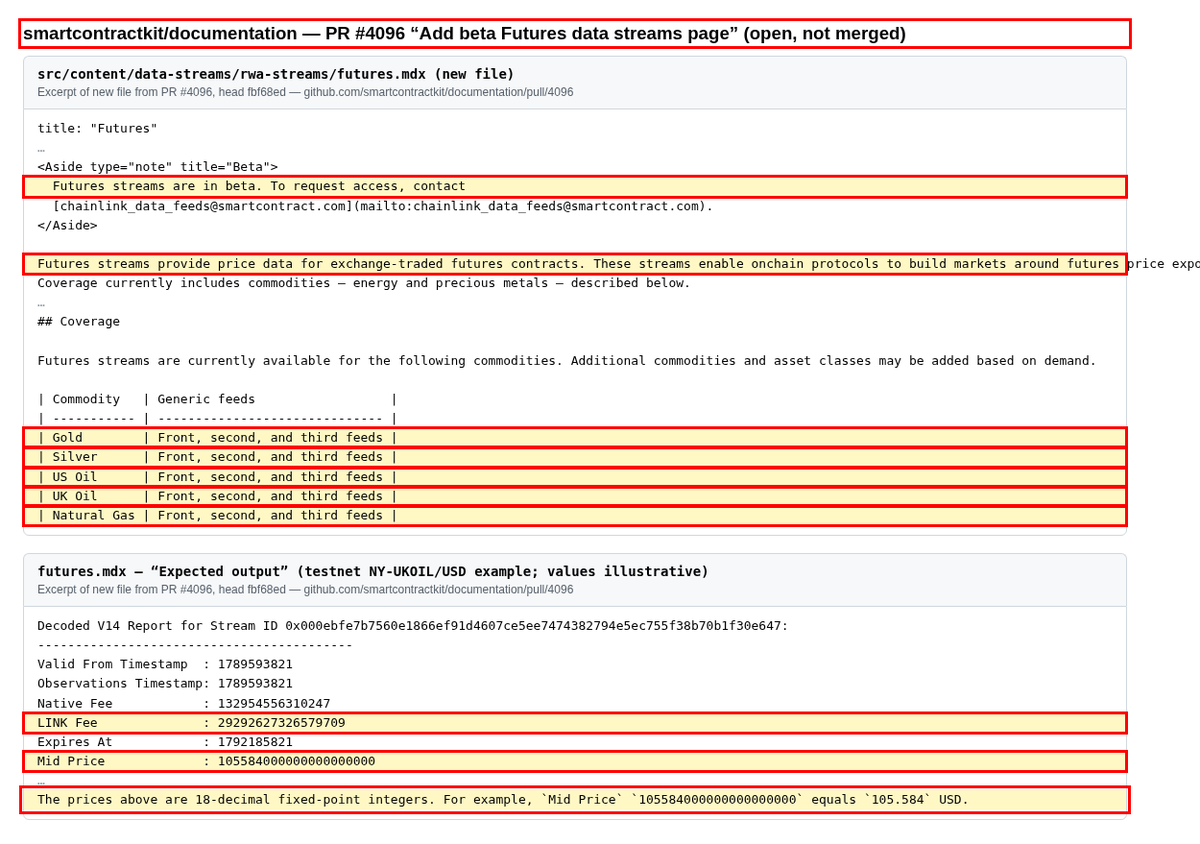
Chainlink Data Streams looks like it's going to add commodity futures 🪙🛢️
A new beta "Futures" documentation page says:
"Futures streams provide price data for exchange-traded futures contracts. These streams enable onchain protocols to build markets around futures price exposure."
Coverage listed: Gold, Silver, US Oil, UK Oil, and Natural Gas, each with front, second, and third-month feeds that roll over automatically when a contract expires, so builders "never need to re-point feed endpoints".
How this impacts revenue:
Chainlink's Q3 review says Data Streams "opened self-serve paid access for market makers and algorithmic traders, with subscriptions to individual streams and market bundles."
This is another Data Streams product to sell.
https://t.co/SoYFMreRL0
ethereum:0x514910771af9ca656af840dff83e8264ecf986ca
you must like pounding sand. because none of what you and the thot class are saying changes whats already been built and going into production.
You keep talking about trust. But you stll havent done the work to see how their chains work to solve trust using the Chainlink abstraction and orchestration layer.
https://t.co/b7VWjKWpVf
you must like pounding sand. because none of what you and the thot class are saying changes whats already been built and going into production.
You keep talking about trust. But you stll havent done the work to see how their chains work to solve trust using the Chainlink abstraction and orchestration layer.
https://t.co/b7VWjKWpVf