This parallels the early Marx, where a human relationship becomes alienated in a thing, then the human becomes alienated from even activity with the thing--a kind of negation of the negation where a subject object relationship becomes an object object relationship.
Got a donut too while I was out at the salty donut, which were too salty for me, thought it was just a name thing but no, you can put a lot of salt in donuts apparently
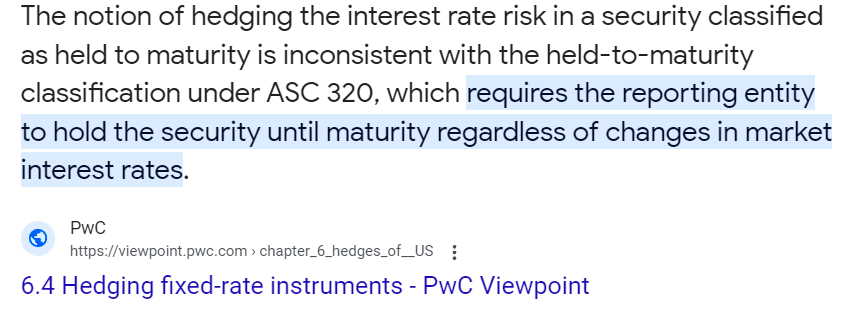
On the AFS portion, but, as was pointed out, this would only work for the AFS portion, whereas, in 2022 or whatever, it was the HTM portion that was at stake, but given this context, I wonder why you would ever even hold HTM ? Why not just put them as AFS? Why take the risk? 2/2
Ok, if I'm reading this thread right, then cash flow hedges (which go through OCI if I'm not mistaken) would mitigate liquidity issues for banks during periods of rising rates, since they would provide daily cash flow equivalent? To the losses 1/2
In the same way that zizek defined postmodernism (I think) as trying to find ways to enjoy without limits, which necessitated capitalism to invest things like beer without alcohol and coke without calories. 2/2
The thing that's fascinating to me about VIEs is that (and they are similar in this way to tokenized equity, a la OpenAI shares through Robinhood) is that they try to create the alchemical trick of passing on economic benefits (gains) without ownership, 1/2
Most equity tokenization today is analogous to the Variable Interest Entity (VIE) structure used by Alibaba ($BABA) on US exchanges, where American investors don’t directly own native BABA shares but instead own a Cayman company with contractual rights to Alibaba’s economics.
This does open up the market to new investors who otherwise wouldn’t be able to buy, but also creates a net new entity, new shares, and new counterparty risk that dramatically increase complexity around these assets.
Exposure will be somewhat indirect (though better than nothing for people who normally can’t access these assets) until onchain native issuance is the standard
Seems like equity method is beneficial here since you can recognize 100% of azure revenue while only having to recognize 27% of OpenAI losses, as opposed to a full consolidation...
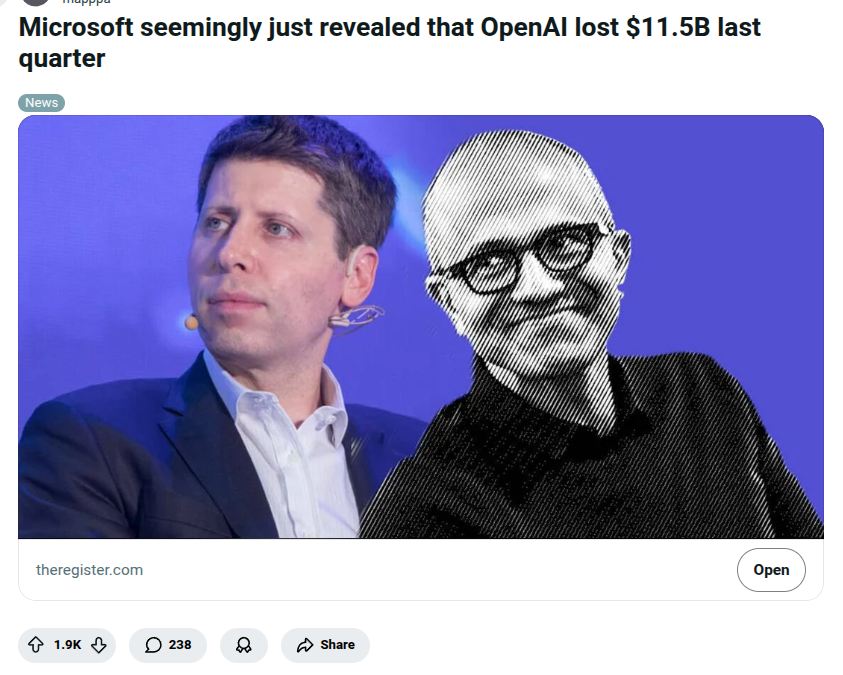
🧾 Microsoft’s latest official SEC earnings filing quietly revealed that OpenAI lost about $11.5B in a single quarter, based on how Microsoft accounts for its 27% ownership stake.
For its OpenAI investment, Microsoft uses what’s called equity method accounting, which means it directly reports its share of OpenAI’s profit or loss on its own books.
So when Microsoft said it took a $3.1B hit due to its OpenAI investment, that means OpenAI itself lost about $11.5B, because Microsoft’s share (27%) of that total loss is $3.1B.
The filings also disclosed that Microsoft has now funded $11.6B of its $13B total commitment to OpenAI, confirming nearly all of the promised money has been delivered.
Now, $3.1B is not a big amount for Microsoft, as it can absorb that hit easily since it made $27.7B in net income last quarter.
---
theregister .com/2025/10/29/microsoft_earnings_q1_26_openai_loss/
Hot take maybe, but i feel like the point of cfo advisory, when done right, maybe tax planning in general, is to create a minor use of a single (dominant) language (GAAP, IRC, etc)
We must be bilingual even in a single language, we must have a minor language inside our own language, we must create a minor use of our own language… Proust says: ‘Great literature is written in a sort of foreign language…’ That is the definition of style.
—Deleuze, Dialogues
@Vinny_Daniel0 If I try to solve for it: put in 50 years (so by age 90), current net worth and savings rate in $, and future value $1B then the I/% is 13.99%. High to do on average over so long a time frame. And after tax.
The math on irr is super fascinating to me, you can't solve for "r" directly, you have it back into it, then at some point you just have to start guessing, the answer is a plug
Hard to adjudicate this one, Amazon had consent rights because of their preferred stake, tho the DIP lender is the one taking the risk and is thus in a better position to restructure the deal to their advantage
A twist in the Saks story: Amazon, a preferred equity investor in Saks, filed an objection to the proposed DIP financing.
Amazon is arguing that the proposed financing violates their consent rights under the $475 million preferred equity investment, contending that the DIP financing serves "no legitimate business objective" and would cause immediate and irreparable harm.
Wow.
Be a investing cash flow (capex proper) into a financing one
I wonder if this was by design in the ASC or if people just figured out they could do this
Never thought about it like this, using a finance lease is beneficial for FCF, since capex would otherwise be an investing outflow, so, since a financing lease splits cash flow into operating (interest payments) and financing (principal), but also since 1/3
Microsoft’s purchases of property and equipment remaining in accounts payable have seen a very unusual increase of $11.7 billion QoQ, equal to a 170% QoQ increase.
Microsoft is the spine and the compass of this AI revolution. It was early to invest in OpenAI and is the biggest purchaser of Nvidia GPUs and Nvidia’s number one customer. Microsoft is responsible for over 20% of Nvidia’s total revenue, which is attributed solely to Datacenter and Networking. When Microsoft talks about spending, the entire industry listens. When Microsoft is about to announce its capex, it is a bigger event than CPI or jobs data.
Therefore, Satya is on Jensen’s “favorites” contacts list, and likewise Jensen is on Satya’s phone. Microsoft gets the best conditions when it comes to pricing, delivery, support, and service from Nvidia. Jensen has every reason to make sure Satya is satisfied, and likewise. Jensen knows he can ask for favors from Satya, and Satya can ask for favors from Jensen. This brings me to the following.
On the last earnings call, Microsoft revealed that "capital expenditures were $34.9 billion, driven by growing demand for its cloud and AI offerings. This quarter, roughly half of the spend was on short-lived assets, primarily GPUs and CPUs, to support increasing Azure platform demand, growing first-party apps and AI solutions, accelerating R&D by product teams, as well as continued replacement of end-of-life server and networking equipment."
Microsoft impressed the AI industry with the largest quarterly capital expenditure in its history, totaling $34.9 billion, while roughly half of it went to GPUs and CPUs. To put the scale of this spending in perspective, this $34.9 billion represents a 74% increase compared to the same quarter in the previous year.
All of this happened while Microsoft reported that its free cash flow increased 33% to $25.7 billion, with minimal impact from the sequential increase in capex.
Nvidia is very much enjoying Microsoft’s capex. Nvidia reported revenue of $51.2 billion for its Datacenter segment, where Microsoft contributed a total of 22%, equal to $11.3 billion.
But let’s look behind the scenes of these impressive balance sheets.
Microsoft, which is very conservative about revealing details of its commitments and accounts payable, detailed for the first time in its last 10-K how much of its property and equipment purchases remained in accounts payable during the last year and the previous two years. As of June 30, 2025, 2024, and 2023, purchases of property and equipment remaining in accounts payable were $6.9 billion, $4.3 billion, and $3.8 billion, respectively. Nothing that raises eyebrows so far.
Last earnings, Microsoft somehow detailed this again, and this time reported that purchases of property and equipment remaining in accounts payable increased by 170% QoQ, or $11.7 billion (!!!). That is basically one-third of its last capex, or all the spending on short-lived assets, primarily GPUs and CPUs (!!!).
Now let’s look at Nvidia’s balance sheet. Nvidia said that one of its largest direct customers had $7.34 billion, or 22%, in outstanding accounts payable to Nvidia as of October 26, 2025.
If we take a ratio of 40% of this $18.6 billion in property and equipment remaining in accounts payable and attribute it to GPUs, we get, coincidentally, the same number of $7.34 billion that Nvidia reported. It therefore seems highly likely that the largest direct customer that owes Nvidia 22% of its accounts receivable is Microsoft, and that most of this amount was added QoQ.
This means that Microsoft, in order to present impressive capex while keeping a “healthy” balance sheet and strong free cash flow, used the bill-and-hold arrangement it has with Nvidia to purchase a large amount of Blackwell GPUs that are probably waiting in warehouses. Nvidia, which is happy to receive such orders, records them as revenue in order to continue the Beat and Raise tradition.
So Satya got his impressive balance sheet and capex, and Jensen got his Beat and Raise to keep going.
Otherwise, the whole world would have fallen apart.
The lions shares of that flows through financing, you have the situation where, if you're just looking at FCF (as operating - capex), that is going to be, say, artificially high, since capex is artificially low, since a finance leases displaces what would otherwise 2/3