The latest Link lab paper is out @BiochemistryACS!: https://t.co/YtwobeGIjF This work, led by Angela Zhu, focuses on the cysimiditides, a new subfamily of #RiPPs. The cysimiditides include a tetracysteine motif that coordinates a zinc ion and a single aspartimide moiety.
Today we report that an engineered skin bacterium, swabbed gently on the head of a mouse, can unleash a potent antibody response against a pathogen. Could lead to topical vaccines that are applied in a cream. @DjenetBousbaine led the charge... @Nature 1/55
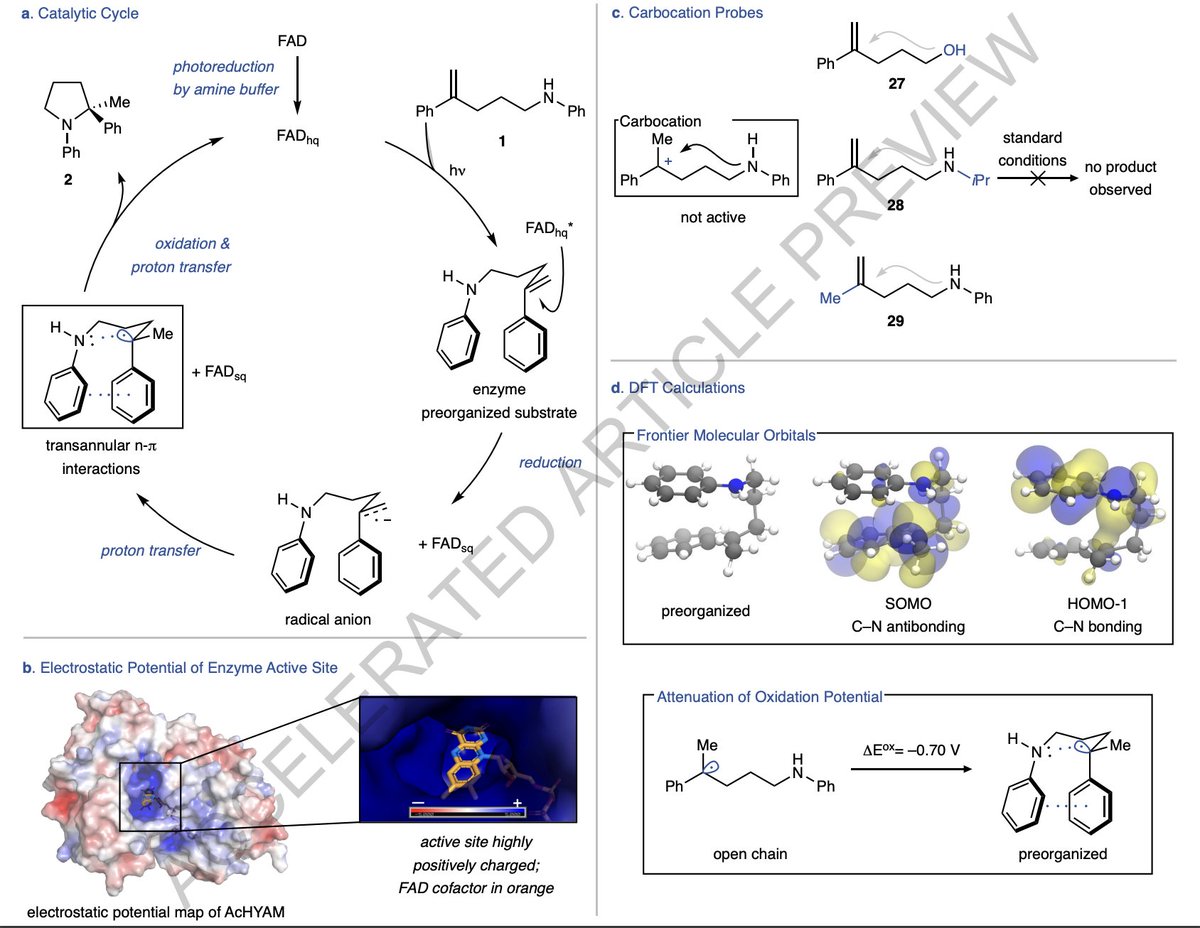
Emergence of a distinct mechanism of C–N bond formation in #photoenzymes by Felix C. Raps @felix_raps, Ariadna Rivas-Souchet, Chey M. Jones @CheyMJones, and Todd K. Hyster @HysterLab at @PrincetonChem https://t.co/z5lOfovJrF
Excited to be at @BostonBacteria at Boston Univ! Looking forward to some great science #BBM2024 🧫 I’m presenting poster number 104 tomorrow, come say hi!
Psst. Hey.
Yeah you.
Want to build 100s to 1000s of plasmids (*any sequence* up to ~6000 bp) for about $10 to $40 each?
https://t.co/lpHx3pkzrG
Try it out ... feedback is welcomed & encouraged :)
Our chemoenzymatic synthesis of the lasso peptide Microcin J25 is out now in @J_A_C_S! We used flow-SPPS to synthesize several sidechain- and backbone-modified precursor peptides and demonstrated their in vitro transformation. https://t.co/w00YCwtBDj @UZH_Chemistry@Hartrampf_Lab
Our chemical synthesis of PTM-modified MYC peptides and their interactions with the tumor suppressor Bin1 is online @ChemicalScience.
Congratulations @elysetwilliams, @rebeccabev5, @ZerbeOliver, and everyone else involved! 🎉
https://t.co/g53XAsR0wJ
#MyFirstChemSci
Excited to release our latest work, led by Sebastian Gonzalez La Corte (@sesgonzalez) with Ned Wingreen: https://t.co/BO5DJXTbjp!
Here, we show that polymers unexpectedly sculpt proliferating bacterial colonies into spaghetti-like "cables".🦠🍝
Tweetorial follows! [1/10]
The latest Link lab paper is out @J_A_C_S today led by @bsmchoi: https://t.co/GdNotwDE3w. In this work we show that ATP grasp enzymes that usually make esters can also make thioesters.
Identification of a 2-Aminobenzimidazole Scaffold that Potentiates Gram-Positive Selective Antibiotics Against Gram-Negative Bacteria (C. Melander et al.) @MelanderLab https://t.co/fELlzkI9hR
Excited to share the latest Link lab paper on the uptake of lasso peptide antibiotic cloacaenodin into susceptible bacteria. The work was led by @DrewCarson712 in the Link lab and another collab with @ZhongyueY. https://t.co/xzMhReT9Xl
Our new paper is just out now in ACS Chemical Biology! Here we uncover the transport pathway that the antimicrobial lasso peptide cloacaenodin uses to be able to kill susceptible bacteria. This helps explain the narrow-spectrum activity we observe.
https://t.co/rQ8zo2wfWL
Our lab's work highly suggests that narrow-spectrum antimicrobial lasso peptides (MccJ25, cloacaenodin, ubonodin) evolved their specificities as a result of their hijacking unique, outer membrane proteins (using active transport) to cross the formidable Gram-neg outer membrane.