@mernit Similar to your requirements above, it "just handles" the experience you expect to have when managing lots of projects along with personal context. It is designed to run on a VPS, so it has a dedicated full persistent computer, which gives it a lot of flexibility and power.
Anthropic's managed agents hold a similar view: no replayable/rewindable sandbox is needed, the execution environment can be ephemeral, and agents are able to use its historical session records for reconstruct the environment
https://t.co/Sl5PLoEqdE
Nearly every day I learn a new way that computers today are a shadow of what was imagined in the 80s
This week's pill is datalog
Our entire world runs on SQL and arcane 25-30 year old C++ databases—many of them needlessly running as servers with bespoke configuration that only experts understand
And yet, we've worked out much more elegant and powerful ways to work with data and build databases
Array languages (APL/K/Q), datalog—separate worlds, divided by academic departments and industries, quietly building vastly more beautiful systems than a database ORM in Python, or wiring together three separate database products developed by startups
Why, in the last 15 years, did it feet like a *revolution* to write software as glue code between dozens of managed services based on 60s and 70s ideas?
I think it's entirely possible to reject all of this and build new systems that bring all the best ideas together, in ways that make most problems in software magically disappear
When you start thinking this way, you start to see a world where computers become an artistic medium—a means of directly shaping information, relationships, and media—a true "tool for thought"
Murail is one existence proof
Another near-existence proof is how the GPU became a general computing platform. It took us so long to discover deep learning in part because GPUs were "for graphics." Hacks and unintuitive ways of thinking were required for general workloads.
Real-time computing is one of the most difficult and arcane areas of software. Sure, it keeps people employed, but it requires rare insane individuals or well-capitalized teams over decades to realize a new idea. Power consolidates in corporations that become entrenched and too big to fail, like Unreal Engine, Ableton Live, Touch Designer, Pro Tools, NVIDIA Isaac, SuperCollider.
This is not a law of the universe. You can build systems that just solve the entire problem domain.
q/kdb+ did this for time series in hedge funds. Mathematica did this for mathematics and physics. Erlang/BEAM did this for communications. But much has been learned since those systems were conceived.
The challenge of our time is to build systems like this and make them predictable, composable, and growable like the Python and JavaScript ecosystems demonstrated is possible
Rust is a great example—already more than a decade old—and quickly becoming a new foundation. But it's already being contested.
I want to see systems that work for all levels—for business and of creative expression—and leverage the intuitions people learn in school, but have no skill ceiling, no expression ceiling, and no make-work
I think we can do it
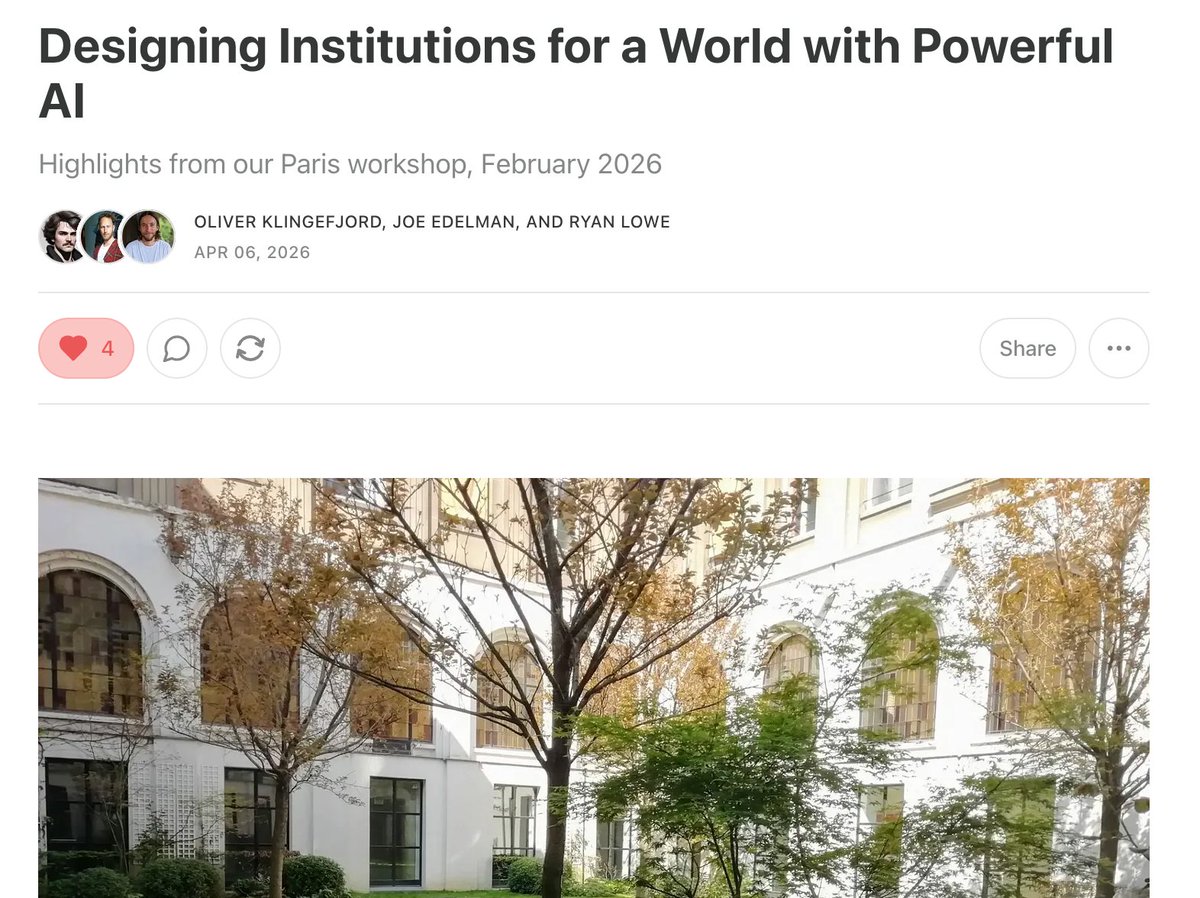
a small update on what we've been up to with @meaningaligned: we're convening researchers to think about what we're calling "AGI Institutions".
we believe roughly that: (1) good futures with powerful AI systems will require an entirely new institutional landscape, a shift of a similar magnitude to the founding of the US; (2) this will require a process of deliberate invention, drawing folk from social choice theory, mechanism design, AI, philosophy, etc; (3) things are moving pretty fast so we better, ya know, get the ball rolling.
we hosted a one-day workshop on this in Paris (co-located with IASEAI), and it was a huge success!! we wrote up a little bit about it in a blog post (link below).
we'll be running more of these, and also have some other cool projects that we'll talk more about soon :). if you’re working on institution design for a world with powerful AI and want to be involved, reach out to us at [email protected]
@krispuckett I'm not sure you read the essay. Player-coaches are mentioned (unbundling the mentorship and development duties of management). In fact quite a lot about craft, relationship, and the human touch is mentioned.
Four things your brain does that your agent doesn't:
• Encrypts memory at rest (your skull)
• Keeps reasoning private (no one watches you think)
• Discloses selectively (prove claims without showing data)
• Carries reputation everywhere (your track record is yours)
Open standard to fix this: https://t.co/1qfStqIFBr
I've spent the past 3 months working on an insanely ambitious project with coding agents. My intention with this project was to ask: "what if I went all the way?"
It started with seeing if I could build a successor to SuperCollider (SC4), but it grew into something more fundamental.
It's hard to describe exactly, but I think it's best understood as "LLVM for real-time tensor processing." What is "tensor processing?" It's a superset of, among other things, all of DSP, neural networks, and control theory. Graphics and physics simulations as well to a limited extent.
In simple English, it allows you to write code that makes sound (or controls robots) on a computer much more easily than has been possible before. That includes everything from a DAW to a livecoding environment, a game audio engine, something like Max/MSP, a simple music CLI, text-to-speech—just about anything.
Today it made sound for the first time (🎉). It could have made sound a long time ago, but I approached this project in a radically insane way. I spent my entire time generating—now hundreds—of research spikes, reference collections, and specifications of various kinds, which all continuously fed back into a higher-order mathematical model.
By working from a mathematical model in this way, I was able to do some insane things, like invent a new kind of type system that guarantees performance by construction. The type system is also isomorphic to an algebra and to a novel form of matrix computation. This isomorphism (really, functor) is mechanically proven in Agda. That probably sounds like nonsense to most, but it means we can formally verify the compiler, provide performance-related feedback to programmers, reason about optimizations in new ways, and many more surprising and weird things that may or may not be useful.
The IR/bytecode layer is based on @sol_plunder's PLAN, which gives us some nice properties and means layers above that could have a backend in the PLAN OS eventually (with a fairly tractable jet story).
I'm really amazed and surprised this was even possible. In the process, I learned all about performance optimization, Rust, compilers, parsers, tropical semirings, category theory, abstract algebra, type theory, and much more.
This whole time, I've been unable to tell if I was completely crazy or not, but today we validated the core performance characteristics of the system with benchmarks and implemented fm synthesis, additive synthesis, and granular synthesis.
Assuming everything falls into place, this will allow people to write performant DSP, run real-time neural networks, and much more with automatic performance guarantees within 2-3x of what's possible with hand-tuned C++ code. And, it should ship an embeddable, portable runtime for ordinary machines, embedded devices, WASM, VST plugins, or wherever you need it.
Some of this is, however, conditional on there not being unforeseen surprises in the actual writing of the compiler.
Next up: (1) actually write the compiler and (2) design a programming language for it ... or chicken out and ship a Python library.